
This is what playing it safe looks like. Nothing egregiously wrong, but nothing extraordinary. It’s solid.
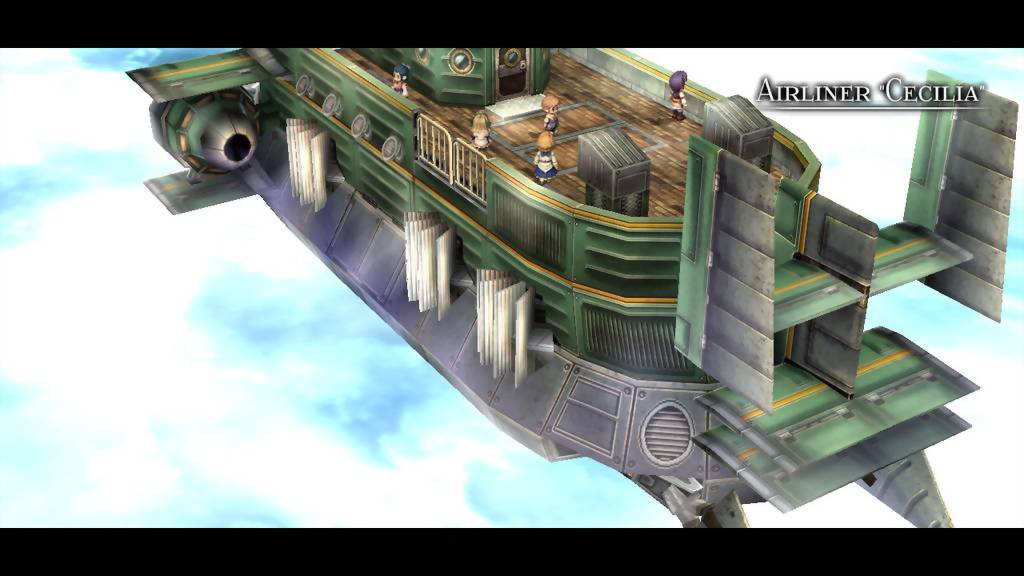 Please note, this is based on the 2007 PSP version of the game.
I almost stopped playing the first Trails in the Sky before powering my way through and beating it. I spent two years sporadically playing the second chapter during downtime at work, but interest waned over time. I finally dedicated a solid amount of time during a few recent plane trips and a rainy day during vacation. This has been a tough series for me to get into; the pacing is slow, but with patience, there is some merit to the series.
However, that merit seems too elusive and can be hard to spot due to the many reused assets from the first game, which is a glaring flaw, at least in my eyes, although other gamers might enjoy the continuity. This game takes place immediately after the first and in most of the same locations. It heavily relies on knowledge from the first game, with numerous references to its story and character interactions, so be aware of that.
The story centers around Estelle trying to find Joshua amidst a country-threatening plot by the overpowered secret organization, Ouroboros. Having spent two years on and off with it, that’s the gist of it, but admittedly lost some of the subtle nuances over such a long period of time. There is some witty banter lost in a sea of dialogue reminiscent of Xenogears' tedious Disc 2 moments. I don’t like conversing with people who have a penchant for restating the same thing in several different ways, and that is what the game feels like too often, what amounts to constant blabbering.
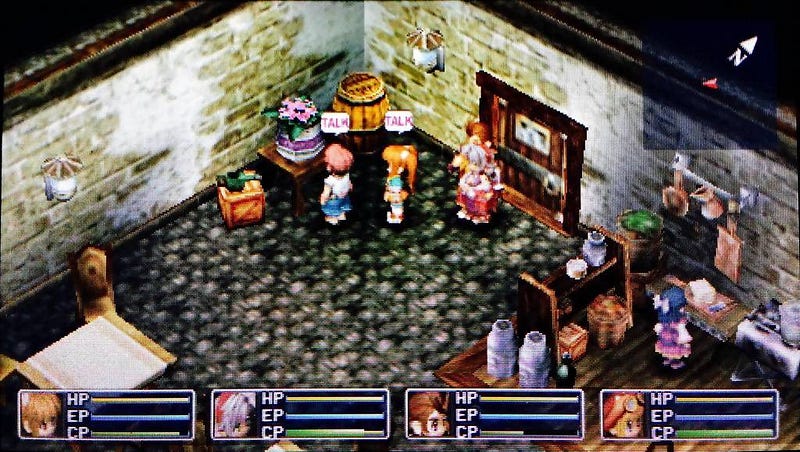 The Bracer Guild, once again, serves as the central hub for missions and side quests. It is important to check the board often in each town, as updates happen frequently. However, depending on this, several other side quests could be missed, so talk to townspeople if you want to get the highest possible Guild Rank, as there are several hidden quests. Guild rank increases after a certain number of completed missions and comes with increasingly useful rewards.
Nothing has changed between this game and its predecessor graphically. They are both cute games, and every enemy sprite is bursting with color. If gamers are keen to find everything in this game, close attention to the little things in every nook and cranny of each town, house, castle, and dungeon is exceptionally important, as there are several missable side missions. There are plenty of maps which help to maintain your bearings and find even the most well-hidden stuff but, as is the case with the first game, the camera could use work.
Much of the music is taken directly from the first game. This isn’t the worst thing in the world, as many of the tracks, especially some of the more tranquil town themes, are a pleasure to listen to. There are a few new tracks, but overall, the scope and variety of the soundtrack is limited due to certain songs playing so often. There is limited voice acting in battles, which does not add to the experience in any meaningful way.
Battles function the same as the first game. They are fun, partially because gamers are empowered so much by the fact that there are visible enemies on the fields and dungeons, plus they are slow and easy to avoid or sneak up on. The surprise of random encounters can get annoying, after all.
Combat is on a grid and is a unique combination of turn-based and strategy, and perhaps most reminiscent of a little-known Sting/Square SNES game called Treasure Hunter G. Characters have a few options in battle: Normal attacks are sufficient early game. Later, and for foes that have weaknesses to exploit, arts, which function as magic, can do massive damage.
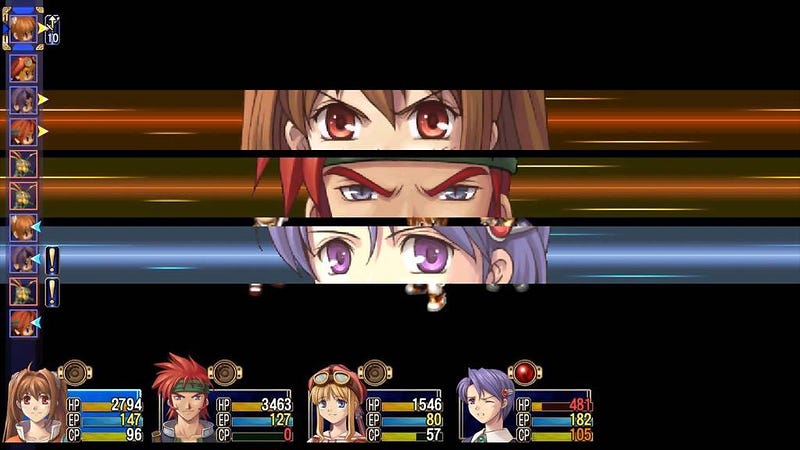 Still, it is best to use physical attacks as much as possible because every time one is used, or every time a character is hit, a craft meter (Craft Points) is slowly filled up. Crafts usually cost 20–40 points, and the meter can reach as high as 200, but once it hits 100, a devastating S-Craft can be unleashed, which does heavy damage, even to bosses. However, it completely depletes the CP meter, meaning up to 100 could, technically, be “wasted,” so it is best to use an S-Craft closest to 100 and just use basic crafts to get right around (but over) 100; at least that was my understanding of the S-Craft mechanic.
There is a visible turn order which helps in determining strategy, and it’s likely most who try this will need to think out a few turns in advance. Some turns also allow for special bonuses like HP, magic recovery, or increased strength. Sometimes taking out an enemy at just the right time will switch the bonus they would have gotten to a player-controlled character. There is no penalty for losing battles, from what I could see, and they can simply be restarted and attempted as many times as desired. Battles aren’t that tough, and simply knowing how to progress the plot was, at times, harder. Or finding little, well-hidden items throughout the world. I would even say that this game was easier than the first and, compared to other RPGs, is about mid-level or average, challenge-wise.
Outside of battles, there are a few opportunities for customization. Aside from the standard weapon, armor, boots, and accessory (x2), there are quartz and orbals. Quartz comes in 7 different colors and is dropped by enemies. Once enough quartz of a certain color is dropped, statistic-increasing orbals can be created, some of which also increase the number of spells that can be cast in battle. The best orbals require many different types of quartz, rather than just one. However, it is not enough to just create orbals. Orbal slots must also be open, and opening them also uses quartz. Is it better to open up slots right away to place more orbals or wait a long time to create an especially strong orbal even if not all the slots are open?
Some recipes can be found in various cafes, but recipes aren’t nearly as involved as some of the Star Ocean or Tales games. They were just slightly more powerful versions of healing items. Fishing is also possible, but other than a few side missions, I didn’t bother, though it was easy but not as fleshed out as other games with fishing.
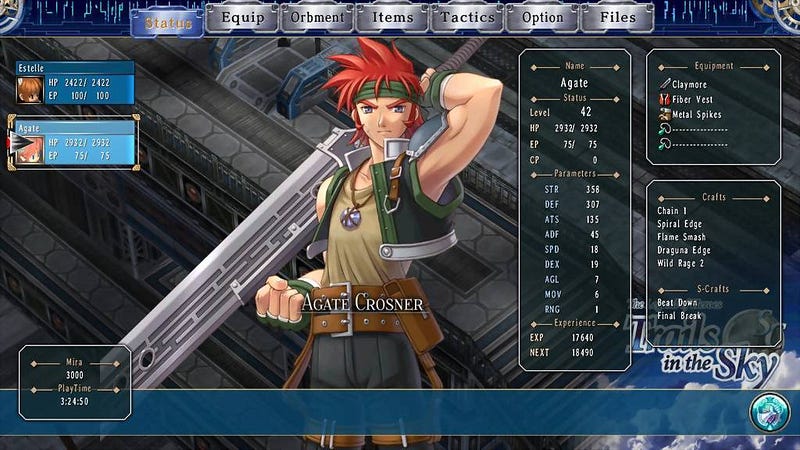 One of the most glaring issues in Trails, one I cannot stand in any RPG, is the constant coming and going of various characters. Just as you are getting used to a new character and start building them up and investing in them, they leave, and another character comes in, sometimes an exceptionally weak one. It left me wondering if I should even bother making an effort for the newcomer, or if I should just focus on Estelle. Granted, this isn’t as egregious as the first game, but I was still stressed at times, thinking: Is this other person joining me just going to leave a few hours later too? I don’t like this revolving cast of characters, and it is more unpleasant without using a walkthrough. I felt a little better outfitting characters here because the cast was less fluid, and for most portions of the game you even had a choice of who to bring, though sometimes, be aware, an underpowered character could be forced into the party for story purposes.
Finishing side quests rewards plenty of money, which alleviates the annoyance of having to outfit a new character or an underpowered one for the party side quests are completed. There are a lot of side quests found on job boards at Bracer guilds located in any large town. Most of them amount to going back a few screens to a place you’ve already been to defeat a fairly strong enemy, or enemies, that aren’t as tough as a boss but far more powerful than average enemies. Others are fetch quests, which can get boring but at least offer decent or even great rewards.
One last issue is that, when you get right down to it, the world is small, and there are not a lot of opportunities to really spread your wings and truly explore. Narrow paths lead from one town to the next, to the next dungeon, and so on, with a few branching paths including either a future destination or a small side tower to explore. Minimal replay value comes from trying to find more obscure hidden quests missed on a first run or checking out any towers that might have been bypassed after playing for the first time.
For newcomers to the series, I wouldn’t recommend this. If you enjoyed the first game in the trilogy, you’ll find the same quality here: “if it’s not broken, don’t fix it.” However, keep that quote in mind if you disliked or found the first game to be a slog, and consider avoiding this, as no new gameplay mechanics are introduced and nothing was fixed or changed.
Wayback Wednesday Volume 1: Final Fantasy 7 and Chrono Trigger.
Wayback Wednesday Volume 2: Super Metroid and Castlevania: Symphony of the Night.
Wayback Wednesday Volume 3: The Legend of Zelda: A Link to the Past and Lunar: Silver Star Story Complete
Wayback Wednesday Volume 4: Secret of Mana and Wild Arms
Wayback Wednesday Volume 5: Illusion of Gaia and Grandia
Wayback Wednesday Volume 6: Breath of Fire 3 and X-Men Legends
Wayback Wednesday Volume 7: Star Ocean: The Second Story and Super Mario RPG
Wayback Wednesday Volume 8: Demon's Crest and Dragon Quest VI
Wayback Wednesday Volume 9: Suikoden I and Jeanne d'Arc
Wayback Wednesday Volume 10: Ranking the first 6 Final Fantasy games
Wayback Wednesday Volume 11: Earthbound and Valkyrie Profile
Wayback Wednesday Volume 12: Legend of Legaia and Secret of Evermore
Wayback Wednesday Volume 13: Threads of Fate and Soulblazer
Wayback Wednesday Volume 14: Radiata Stories and Robotrek
Wayback Wednesday Volume 15: Rogue Galaxy and Vandal Hearts
Wayback Wednesday Volume 16: Chrono Cross and Muramasa: The Demon Blade
Wayback Wednesday Volume 17: Okami and Legend of Mana
Wayback Wednesday Volume 18: Paper Mario and Terranigma
Wayback Wednesday Volume 19: Dragon Quest VIII and Atelier Iris 2: The Azoth of Destiny
Wayback Wednesday Volume 20: Ranking the 6 console Final Fantasy games from the PS1 and 2
Wayback Wednesday Volume 21: Eternal Sonata and Actraiser
Wayback Wednesday Volume 22: Persona: Revelations and Tales of Destiny
Wayback Wednesday Volume 23: Shadow Hearts: Covenant and Dragon View
Wayback Wednesday Volume 24: Ken Griffey Jr. Presents Major League Baseball and Lunar: Eternal Blue
Wayback Wednesday Volume 25: Suikoden II and Xenogears
Wayback Wednesday Volume 26: Azure Dreams and Wild Arms 2
Wayback Wednesday Volume 27: Ar Tonelico and Sword of Mana
Wayback Wednesday Volume 28: Albert Odyssey and Super Paper Mario
Wayback Wednesday Volume 29: Arcana and X-Men Legends II
Wayback Wednesday Volume 30: 10 over-rated classics that haven’t aged well
Wayback Wednesday Volume 31: Dragon Quest IX and E.V.O.: Search for Eden
Wayback Wednesday Volume 32: Tales of Symphonia and Elemental Gimmick Gear
Wayback Wednesday Volume 33: Ys Seven and Brain Lord
Wayback Wednesday Volume 34: Lufia and The Legend of Oasis
Wayback Wednesday Volume 35: Kingdom Hearts: Birth by Sleep and Magic Knight Rayearth
Wayback Wednesday Volume 36: Tales of the Abyss and Crisis Core: Final Fantasy VII
Wayback Wednesday Volume 37: Rhapsody: A Musical Adventure and Legaia 2
Wayback Wednesday Volume 38: Star Ocean 3: Till the End of Time and The Twisted Tales of Spike McFang
Wayback Wednesday Volume 39: The Granstream Saga and Wild Arms 3