

Check out Part 1, The Legend of Zelda: A Link to the Past, here.
Lunar: Silver Star Story was developed by Game Arts and published by the oft-maligned Working Designs, though they don’t deserve the reputation they get in some corners. This is an incredible game that, despite some dated humor, has aged surprisingly well and serves as a blueprint for modern game developers looking to capture the hearts of retro-RPG fans around the world.
Even before the story takes off, the first thing players are likely to notice is the offbeat humor. While some of the jokes are indeed corny, many more add a unique flavor to the game. At a time when most translators were content to stick with the literal, sometimes dry translations, Working Designs took a risk and tried to spice up the commentary and story, and, in many respects, they passed with flying colors! Some of the dialogue felt meandering and lame, but more often than not, Working Designs hit the nail on the head with its witty banter.
The story begins with a small town, country kid named Alex who soon finds himself in the midst of matters way beyond his grasp, or so it seems at first! His goal is to shake the small-time life and become a legendary Dragon Master. Several difficult trials ensure this will not be easy, as well as an evil sorcerer who gets in the way and threatens the very livelihood of Lunar. Eventually, Alex is tasked with saving the world, yes, that cliche RPG story trope makes a return.
Along the way, he interacts and travels with several friends, including the lovely Luna and the masculine, sometimes annoying and vulgar, Kyle, who seems to be a distant relative of Ronfar in Eternal Blue. Nash was often too arrogant, though it was interesting to see both Nash and Kyle grow as the game progressed. Ramus was a little too money-focused for my tastes, but in the end, he had a good heart. Mia seemed to lack a strong personality and often remained in the background; I would have loved to see more development from her. Jessica felt like a perfect archetype of the modern strong woman and was an intriguing character to get to know. Nall was a baffling character for me, and I did not enjoy his input the majority of the time. Too many games try to capitalize on the mascot trend, hoping it will bring in more money regardless of the quality of the character or whether they add anything truly meaningful. Intended or not, that is the feeling I got from Nall, and the only reason I could see for Chu-chu existing in Xenogears, for example.
The cut scenes in Lunar are numerous and add a lot of personality to the game. They are not just eye-candy but function as important, useful additions to the written dialogue and plot. These animations rival the heavy hitters of the era, such as Final Fantasy 7, and surpass other well-known games such as Xenogears. On the other hand, in-game sprites are minuscule and disappointing. Thankfully, towns, dungeons, and the world map at least look clean and crisp (without a hint of pixelation) and are vibrant, somewhat making up for their (lack of) stature. Enemies are unique but tend to be small. On the other hand, bosses look threatening, are gigantic, and appear as very impressive, disgusting beasts.
The music is exceptional, especially the town music, providing a well-needed retreat from the plethora of enemies that populate caves, mountains, and other dungeons. The regular battle music leaves a little to be desired and is unlikely to top anyone’s list of top battle themes from the 32-bit era. On the opposite end of the spectrum, the boss theme created a sense of urgency and underlying danger. The dungeon tracks do a perfect job of creating an air of mystery, and they were a pleasure to listen to, especially the Crystal Tower. Voice acting is acceptable, but upon repeated listens, it quickly gets old and loses its luster, especially within battles when casting spells or when characters make victory quotes. Nall’s voice was also grating after just a few seconds.
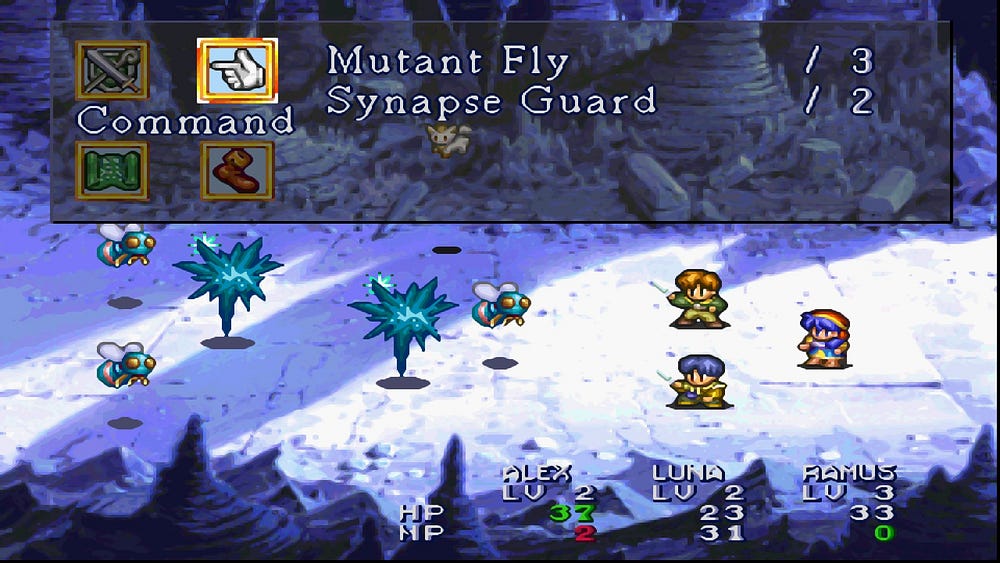 The battle system is basic, and the learning curve is not steep, allowing players to feel like they’ve mastered the game very quickly. This is a very accessible game. When moving around the battlefield, you have to account for “range” when picking an enemy for a particular character to attack, so a small amount of strategy is required, but most of the time, “range” will be a very distant afterthought. “Auto battle” was also added to this version of Silver Star Story, something the Saturn version lacked. There are special moves that do more damage, but nothing spectacular, and the arsenal of these stronger moves is somewhat constrained. The game is of average difficulty; however, the bosses can provide a decent challenge, especially towards the end game, if you have not reached around level 50. It is imperative to remain fully stocked with MP healing items as soon as possible, as this makes wandering the dungeons much easier.
Although a great game, once you beat it, the replay value is extremely limited. Regardless, this is still a memorable gem from the PSX era. There are some flaws, but despite its graphics that have not aged well and cultural references firmly placed in the early 2000s, the story is interesting, character development for many of the key characters is superb, and the music is top-notch. Give Lunar: Silver Star Story a try if you haven’t tried it yet!
Lunar: Eternal Blue featured here!
Wayback Wednesday Volume 1: Final Fantasy 7 and Chrono Trigger.
Wayback Wednesday Volume 2: Super Metroid and Castlevania: Symphony of the Night.