

You don’t need 108 reasons to play this game, just one: It’s a classic!
Looking at a PlayStation classic through the lens of the remaster.
(Check out Part 2, Jeanne D'Arc, here.)
Suikoden 1, along with Lunar: SSSC, Star Ocean 2, Grandia 1, Wild Arms 1, and Breath of Fire 3, were my favorite PSX RPGs growing up. I’ve had replays of five of those in the past five or six years, but my replay of Suikoden has been a long time coming, more than 25 years! A thought always pops into my head when I start another classic: is it nostalgia overload, or will the games live up to my fond memories? Some games, such as Chrono Cross, Final Fantasy 8, or Wild Arms 2, actually struck me as better than I remembered, while others were more of a letdown. So, where does the Suikoden remaster fall?
The protagonist, officially known as Tir, is the son of Teo McDohl, one of the Scarlet Moon Empire’s prestigious Great Generals. When Teo is dispatched to lead a military campaign in the northern territories, Tir remains behind, cared for by a close-knit group of family allies: his lifelong friend Ted and loyal household servants Cleo, Pahn, and Gremio, the last of whom is devoted to a fault! They support Tir as he begins his service in the Imperial Army. However, it doesn’t take long to uncover the rot at the heart of the Empire. Tir soon comes to realize that the very institution he serves is responsible for oppressing and impoverishing its people and is riddled with corruption. While not relentlessly bleak, Suikoden explores heavier themes than most of its PSX peers, with perhaps only Vandal Hearts pushing into darker narrative territory.
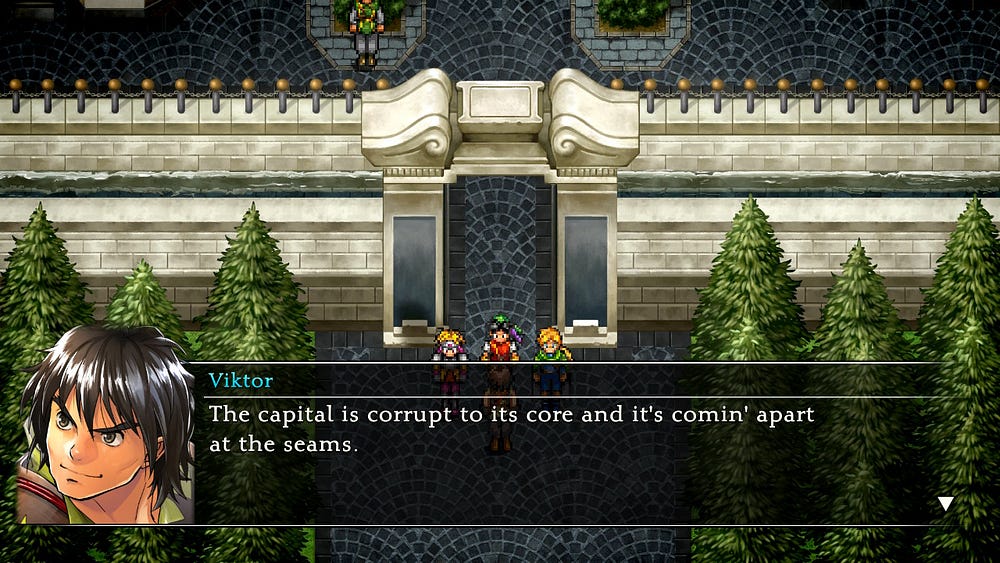 Looking at the bigger picture: Suikoden is an example of a piece of media that is just as relevant now as when it was created because its key themes are timeless, for better or worse: Politics, war, corruption, and rebellion. But also gathering together a group of like-minded people fighting for change, 108 stars. There is a rudimentary castle-building mechanic that serves as a base for these bastions of truth, honor, justice, and a better world. You gain a castle within a few hours of the game that grows through four levels depending on how many recruits you have.
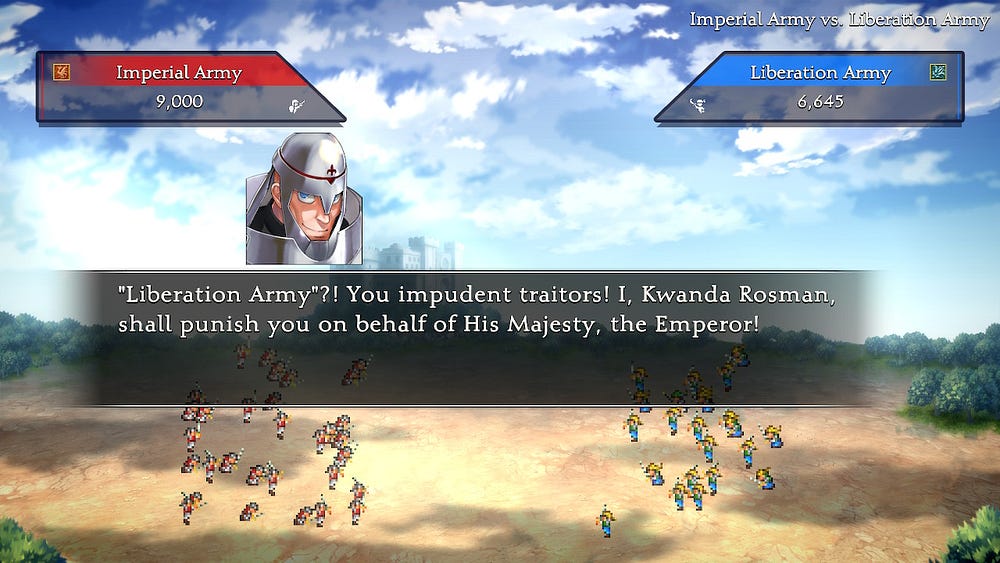
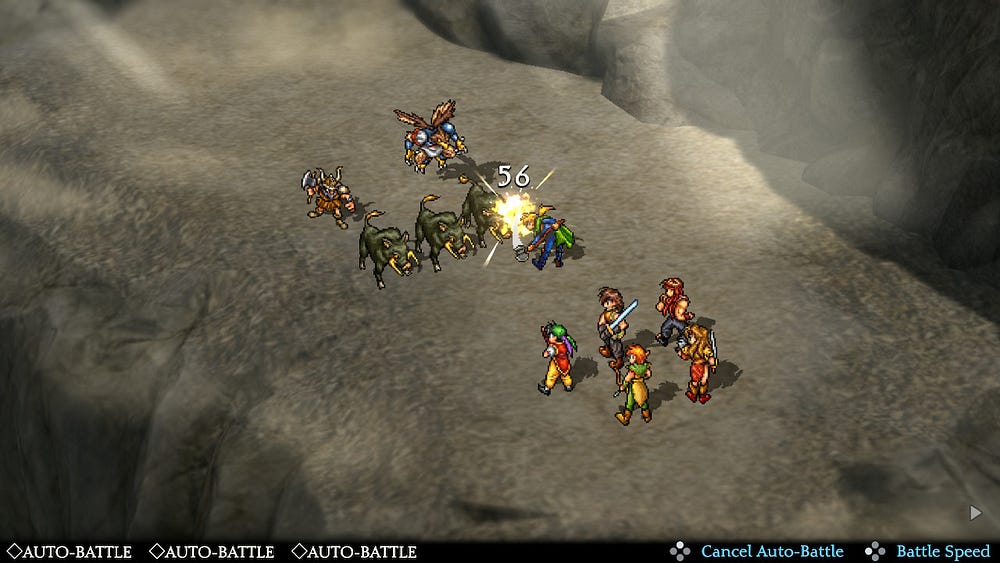
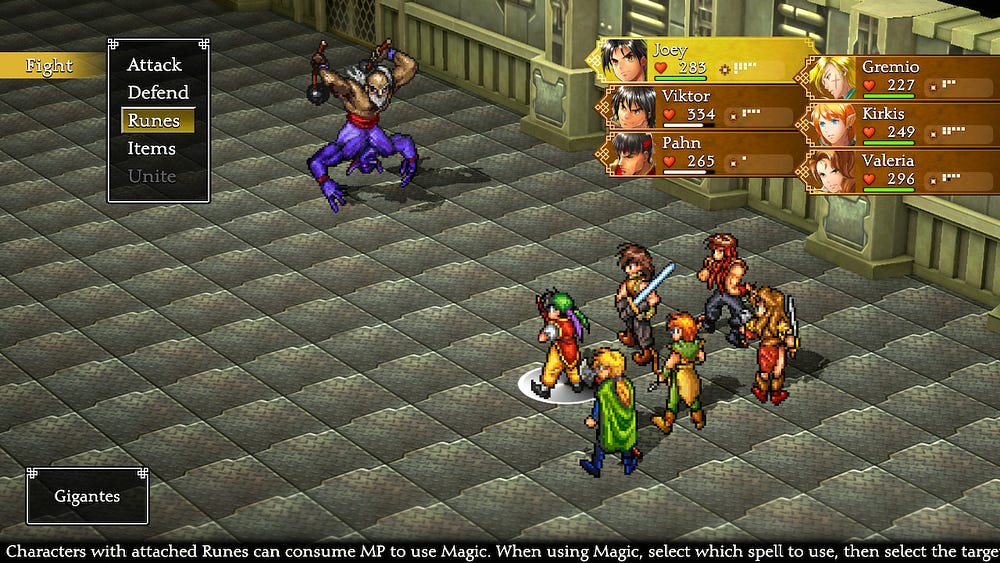 One thing I recall noticing even as a teen was how fluid the battles were, which is one of the reasons I fell in love with the game when I was younger. For a game released in 1995, Suikoden’s turn-based combat is surprisingly fast-paced and snappy, arguably among the quickest on the original PlayStation, and the exact opposite of the tortoise-paced Koudelka. Revisiting it in the remaster only reinforced that impression. Even with a moderate amount of random encounters, I never felt bogged down, since most battles wrapped up in 10 to 20 seconds, often with two or even three characters attacking simultaneously (and enemies doing the same). For weaker foes, the auto-battle feature helps keep everything moving even more smoothly. While standard battles make up most of the gameplay, the one-on-one duels and army battles add variety, even if they’re a bit simplistic by modern standards. Both function kind of like rock, paper, scissors, shoot. By paying attention to what is said during duals, you can win with ease. Later, there are ways to accurately predict how the opposing army will behave in army battles.
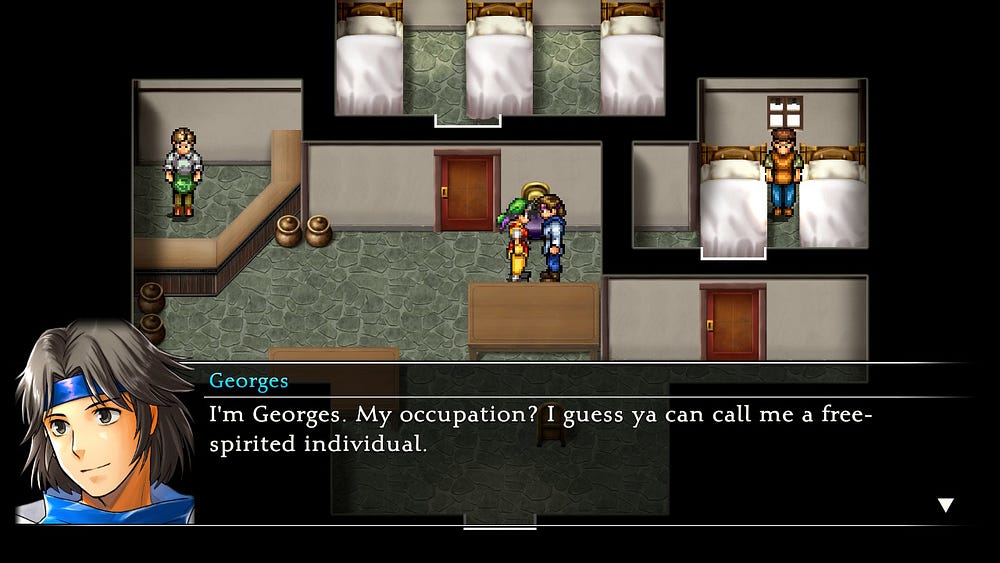
 Outside of battles, though, there are plenty of characters to build your party of six, more than nearly any other RPG I’ve ever played, surpassing even Chrono Cross. Customization takes a back seat as there is only one rune they can equip at a time, which allows for only 3–4 special attacks or magic castings.
 Aesthetically, the remaster is a huge success. There are minor touchups while respecting and maintaining the charm of the original. However, a new coat of paint is only a part of remastering a game, and in some respects, there were some mild disappointments. While I loved that sprinting was now possible from the very start, I was bummed to see that the same clumsy, cumbersome inventory management remains the same. Rather than having a pool from which all characters draw, each character has 10 slots, with 4–5 being taken by equipment. Equipment should have had its own independent slots rather than taking up half of each character’s storage space. Furthermore, there is no way to see how a new piece of equipment impacts each character when purchased from the store.
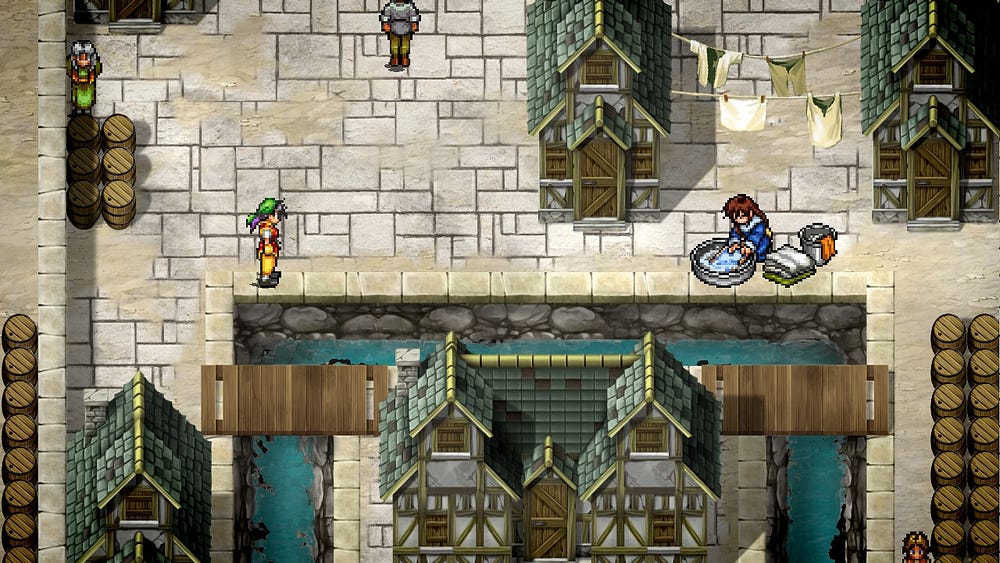 Otherwise, Suikoden has an undeniable allure. The character sprites strike a semi-realistic style that’s both charming and distinctive, a look that effortlessly encourages you to seek out all 108 Stars of Destiny, just to see what new vagabonds might join the resistance, and trust me, there are some personalities with nearly every skill imaginable covered. While it was a bit disappointing to receive some of them so late in the game in a “farewell, I barely knew thee” kind of way, tracking them down was still fun, for the most part. That said, a handful of stars are genuinely frustrating to recruit, either due to narrow recruitment windows or multi-step requirements that aren’t always intuitive. But this is the danger of replaying a beloved old-school game: as a kid, I was breezy and carefree; as an adult, I found myself stressed and overthinking every step, worried I’d miss a recruit. A few times, I even wondered if I was needlessly tainting my memory of the game.
As for the enemies, many are creatively designed, but the bosses feel underwhelming; some are the same size as regular characters and rarely feel imposing, except for the final boss. Towns are inviting, with little details helping them to stand out from typical towns in other RPGs of the late 1990s.
 Because of my constant concerns over missing recruits, one thing I made a concerted effort not to overdo was grinding for rare objects. There are plenty throughout the game, but they can take a large chunk of time to acquire. Thankfully, the game is easy enough that a combination of store purchases, consistent visits to blacksmiths, treasure chests, and the occasional useful item drop from regular progression should be more than enough to see you through to the end credits.
I can already envision some counterpoints to that. Yes, blacksmiths do get very pricey in the last third of the game, and not stopping to grind means you often won’t have a huge reserve of money. With that in mind, and knowing that some characters are forced into your six-person party for certain events, I recommend choosing half a dozen favorites and focusing on building them up, along with any characters locked into specific events, to save on expenses. If you feel so inclined, it also could be worth researching the two characters who are locked into your party for the final dungeon. Anyway, there are ways to make money quickly. I’ll leave it up to each player to find their preferred method, but even as a teen, I found my favorite method with little effort. With a few lucky streaks, I was making 100,000 in about 30 seconds. With some perseverance (and without being discouraged by losses or losing streaks), you can hit the 999,999 cap in about 30 minutes.
With all the bombastic (but still excellent) music tracks that would soon define other big-budget PSX games, Suikoden takes a more earthy, grounded approach to creating an atmosphere. From the organic, wistful-sounding village themes or the subdued, folk-inspired tunes found in other remote areas, the soundtrack captures the humble lives of average citizens across its world. Random encounter music is serviceable, but boss battles are where the soundtrack truly shines, menacing and urgent, daring you to balance drastic, quick measures with careful thought. Oh, and I’ve never been as ok with a failed inventory swap as I have with Suikoden, where a simple quack sound signals that another character’s inventory is full. These random little audible quirks add a layer of humor to a game that is otherwise, in large parts, serious.
Suikoden still holds up remarkably well. As a 1990s game, this is an underrated gem of an RPG, a 95/100 for the PSX version. Even after three decades, its message still resonates, its snappy turn-based battles still feel surprisingly quick, and the touch-ups ensure this game will appeal to a new generation. However, some minor oversights are more like speed bumps rather than dealbreakers or barriers, such as the tedious item management, lack of character-specific customization, and some bosses look less than impressive. Overall, this remains a must-play for fans of the genre, while also being a fantastic jumping-off point for anyone looking to dive into the world of retro RPGs.
Wayback Wednesday Volume 1: Final Fantasy 7 and Chrono Trigger.
Wayback Wednesday Volume 2: Super Metroid and Castlevania: Symphony of the Night.
Wayback Wednesday Volume 3: The Legend of Zelda: A Link to the Past and Lunar: Silver Star Story Complete
Wayback Wednesday Volume 4: Secret of Mana and Wild Arms
Wayback Wednesday Volume 5: Illusion of Gaia and Grandia
Wayback Wednesday Volume 6: Breath of Fire 3 and X-Men Legends
Wayback Wednesday Volume 7: Star Ocean: The Second Story and Super Mario RPG
Wayback Wednesday Volume 8: Demon's Crest and Dragon Quest VI