

Check out Part 1, Secret of Mana, here.
One of the most memorable opening scenes I have ever seen, and one that is etched in my mind to this day, is Jack’s prologue in Wild Arms 1. Jumping out of the way of spikes running from boulders, quick enough to make it over rapidly collapsing platforms, while dodging spears. The first few minutes of this prologue, and also my first experience with the game, are a dizzying whirlwind of crazy maneuvers that show Jack barely averting certain death a few times, coupled with a few cases of luck. What a scene! I admired Sony for throwing players right into the action almost instantly after starting a new game. None of the long, drawn-out introductions of too many other RPGs, just play! The time for the story will come later. That was what was so unique about Wild Arms 1 for the PlayStation: engaging from the get-go. Developed by Media.Vision was published by Sony in North America in 1997. Now, maybe my impression is this way because I randomly chose Jack’s prologue to start, rather than the other two. But the game never loses momentum!
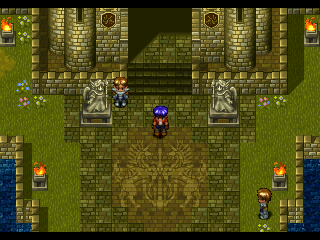 Taking place in a world that resembles the Industrial Revolution, Wild Arms is a far cry from the typical medieval setting of many RPGs. There is a lot of advanced technology buried in Filgaia, where the game takes place. Technology used in a war between the inhabitants of Filgaia and Metal Demons, demons looking to take over and claim the earth as a new home. The residents of Filgaia win and seal the leader of the Metal Demons, Mother, in a castle in a place resembling Antarctica. As the story typically goes, the world lives in relative peace for 1000 years until a small group of demons still existing around the world decides to band together to reclaim Mother.
Some of that technology is known as “Arms”. Rudy, the main character, can find and use some of these Arms. They are guns, and various stats can be upgraded at different costs. Jack, from the prologue, has swords and can learn useful techniques based on hints found throughout the world. Finally, Cecilia is the typical mage and can purchase magic that is written on crest graphs found across the globe. The addition of crest graphs forces players to think before deciding magic they want to buy because crest graphs are limited.
Where the game truly shines is with the tools. Each of the three main characters has four tools they can use to overcome the many puzzles in the game. These range from tools players have likely seen in other games, such as bombs, a grappling hook, lighter, a vase (to put out fires), and a power glove. With the wide range of tools, puzzles can be fairly tricky to solve. There was nothing so hard that I needed a walkthrough; most players shouldn’t need one, but they are not overly simplistic either.
Wild Arms also features Force abilities. Each time a character is hit, and after every turn, a meter gradually fills, capping at 100. Every 25 points, a new Force ability becomes available. Using a force ability depletes the force meter. The higher the level, the more of the meter that is depleted. As your characters gain levels, the default starting point of the force meter increases, too. These Force abilities range from increasing the accuracy of an attack, boosting speed, enhancing the power of an item, to summoning a guardian, and very powerful attacks at level 4. There are twelve in total: some are used almost constantly, while others see little use. I rarely, if ever, used the level 2 Force abilities. To summon the various guardians, runes are required and must be equipped.
There are several sidequests with plenty of optional bosses to find. The hardest of which is in the Abyss, and it provides a huge challenge and is extremely difficult, one of the hardest extra bosses I have faced in the PlayStation era. There is also a battle arena that provides useful prizes.
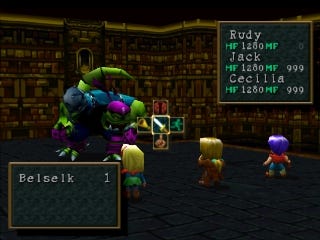 Wild Arms is a slight step up from the later-era SNES games regarding graphics. Other than a few beautiful cutscenes, the game does not look too much more advanced than, say, Treasure Hunter G or Super Mario RPG. That isn’t to say Wild Arms is an ugly game. But it clearly has the look of an early PlayStation game. Still, the game has a unique environment, with obvious inspiration from old Western movies, kick-butt guns, and all!
The soundtrack helps create the tone with acoustic guitars, trumpets, and a style of whistling you would only expect in a Western. This is not your typical fantasy setting. The battle music stands in contrast to the town and dungeon music. It isn’t anything special, but it never gets annoying. The boss music is an improvement and feels more sinister and urgent, and music played in temples, for example, is mystifying.
Overall, Wild Arms is a simple game, but very well-paced. It looks dated, yet its cute aesthetics and puzzles keep players actively engaged in progressing and eventually beating the game. I’d recommend it as a perfect RPG for those new to the genre, as it offers a balanced level of difficulty that’s never overwhelming and gradually increases as the game continues.
Wild Arms 2 featured here!
Wayback Wednesday Volume 1: Final Fantasy 7 and Chrono Trigger.
Wayback Wednesday Volume 2: Super Metroid and Castlevania: Symphony of the Night.
Wayback Wednesday Volume 3: The Legend of Zelda: A Link to the Past and Lunar: Silver Star Story Complete