

So much promise, but it doesn’t match Star Ocean 2's quality.
One of my favorite gaming memories ever was bringing home a beautiful dark blue CD case with “Star Ocean: The Second Story” on it in the summer of 1999. It had just been released, and an employee at FuncoLand had recommended the game after I told him how much I loved Secret of Mana.
 Fast-paced, deep, and with gorgeous earthy music, I was instantly entranced in the world of Expel. The light bursting through the lush green trees as Claude wakes up in Expel at the start of the game is one of the most memorable gaming scenes I've ever experienced. Simple, yet effective and so stunningly beautiful.
I beat Star Ocean: Second Story three times over the years and have fond memories of each playthrough. The game is easy to pick up and learn, but very hard to master, as evidenced by a gargantuan extra dungeon with exceptionally powerful post-game bosses. Tri-Ace did an excellent job balancing between those two extremes (easy to pick up, hard to master) for most of the game.
So that brings me to this review: Star Ocean 3: Till the End of Time. Developed by Tri-Ace and released in the summer of 2004 by Square-Enix, it was the only one in the series for the PlayStation 2. I never got a chance to play this game until 2021, but I remember wondering at the time if it would provide the same magic as its predecessor. When considering the lofty heights set by Second Story, did Till the End of Time meet those expectations? Not quite, but it is still a very solid game!
Each Star Ocean game can be played independently of the others, and the story of this one isn’t dependent on the others but still has the heavy science fiction theme. The contrast of technologically advanced people landing on a planet that looks like it is from the Middle Ages is very intriguing. The protagonists in the story, (you will get a total of 8 out of a possible 10), soon come across the antagonist’s hellbent on taking the planet over. This leads to further, and far greater, conflict that brings about questions about reality itself.
The Second Story wastes no time thrusting you into the thick of things, with a battle occurring within minutes of starting a new game. Comparatively, Till the End of Time starts with a thud. Just running around some resort town, trying to figure out what to do. In fact, for the first few hours, I struggled against the camera, and I kept turning it to get a better idea of where I was. One of the greatest hints I can provide within this review, for newcomers to the game, is to “center” yourself by always pushing the start button. It is amazing how much easier it is to navigate with this simple action. Plus, pressing R2 twice brings up the large map, which is so helpful for exploring.
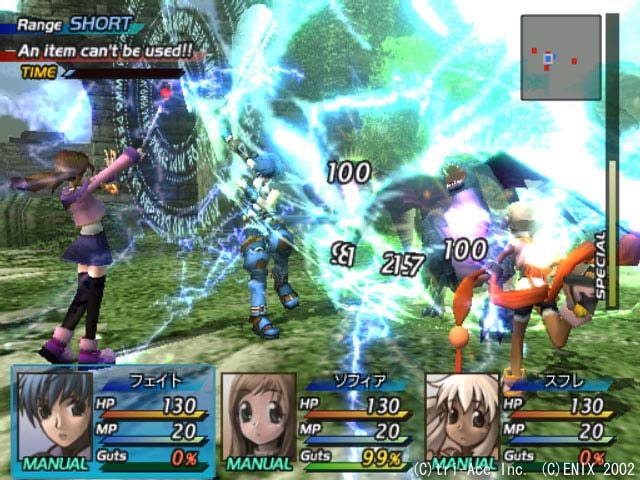
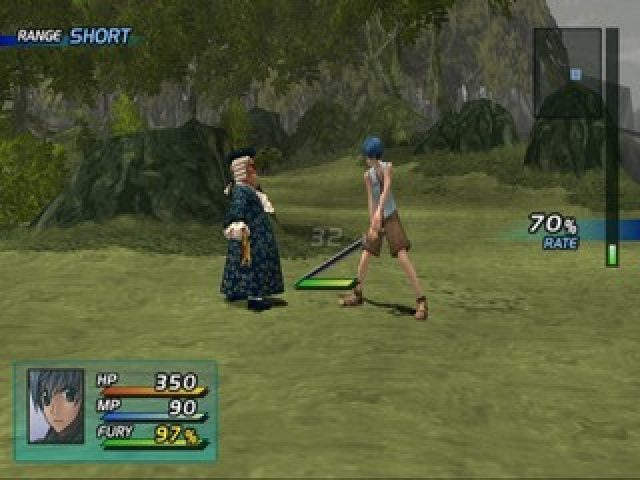
It took a while to get used to having just three people in battles, which are done in real-time, as opposed to 4 from the previous two Star Ocean games. What is interesting about the battle system here is the fury mode. In Star Ocean 2, you could simply mash your way through most battles, but that becomes impossible here because of fury. There is a slow but strong attack that takes more fury and a weaker, quicker attack that takes less. Too many attacks in rapid succession will quickly deplete your fury percentage. If it is at zero, you will remain immobile for about a second. With how fast-paced battles are, a second is a ton of time. If fury is at 100% and you can anticipate a weak enemy strike, you will be guarded if you remain still. However, if you are still at 100% and the enemy lands a strong blow, you will be left immobile for about a second.
All battles start with characters at 100% fury, but if enemies sneak up on you and trigger a rear attack or ambush, everyone starts at 0% and, because of that, is temporarily immobile. Not a big deal in the first half of the game, but this can present a huge problem in the later dungeons. It is great seeing enemies on screen but odd that when approaching them head-on, or even when sneaking up from behind can trigger an ambush or rear attack. In fact, it was downright unfair because, as far as I could tell in my nearly 55 hours of playing, I never once benefited from approaching the enemies from the rear or ambushing them. This was a poor design choice that could have easily been changed.
 Another poor game design choice was the lack of fast travel, which made moving around in Second Story so seamless. In this game, there are no items to warp you out of dungeons, no items to move between towns, not even a ship to fly, so backtracking becomes a real pain. Plus, from what I could tell, and unless I am mistaken, there wasn’t even a map! Some people aren’t good at remembering where some cave or town from 20 hours (and 1–2 weeks of real-time) ago is, which can be a problem.
Another item this game seemed to lack that was very welcome in Second Story and Tales games was the spectacles. Spectacles in Star Ocean 2 allow the player to see boss HP and MP, as well as other stats, which made the game unnecessarily tedious and made a game with so much promise wallow in the depths of average-land.
Another somewhat questionable design choice was MP death. Everyone who has ever played a few RPGs knows that once HP hits zero for everyone, that is it, game over. In “Till the end of time,” characters can also die if MP hits zero, same with enemies. So there are plenty of moves and items that can drain MP, but enemies can drain MP too. This isn’t so much an issue at the end of the game but can be a huge pain in the first 1/4th, or so, of the game when MP totals are still very low.
Two things can remedy this issue. One is easy. Characters get skill points with each level up, which are used towards improving attack, defense (more specifically evasion, blocking attacks, and the ability to sidestep), HP totals, and MP totals. So increase MP levels. The more levels gained, the more skill points earned. So getting to level 70 gives more skill points than getting to level 3. The second is doing a lengthy side quest where you bounce between several towns helping some hapless travelers. But after this side quest, they sell incredibly useful MP regeneration items, including rings that regenerate 3% of a character’s MP every few seconds.
The game has a plethora of different items. It is overwhelming, and many of them can be made via “Item Creation”. Second Story has it too and the way it was implemented in that game was seamless and the system was easy to use, but with such a large variety of options and possible outcomes, almost impossible to truly master. Still, it was player-friendly. In “Till the end of time,” it was the exact opposite. It was a great idea, but it was poorly explained and unintuitive.
For a game mechanic that is so user-unfriendly, unintuitive, and clumsy, you’d think it would be just an extra for those who want to dive deeper into the game. But no, even more so than the previous game, it is required to beat the main game. There is no way someone could beat this game without item creation on a first playthrough, especially blindly (without the use of guides), as late-game bosses are insanely punishing. They hit relentlessly with little to no pause. I didn’t like item creation and tried my best to skip it. But ran into an impasse around a revisit to a Shrine deep into the game with three bosses in a row. At which point I had to reluctantly trudge out of that dungeon, through another one, through a desert, and, eventually, after several other screens, finally to a town to try my luck at item creation.
The whole system is more work than it should be. Whereas a large chunk of Second Story’s could be done in a menu, that is not possible here. First, you have to track down various inventors hidden throughout and, often, either offer them huge sums of money or some obscure item. That is, if you want some of the best items that the game has to offer, like exceptionally strong weapons, armor, and accessories. These can only be obtained once you have a special inventor, like Misty Lear or Chilico. Then you enter a clunky menu and mindlessly cycle through randomly generated numbers, randomly choose one number, hit “create,” and hope for the best. Or just check out a walkthrough created by someone who figured this all out; bless them and their patience, as otherwise it could take hours, or even several days filled with many hours of making random choices of what seems to be a limitless amount of choices. People might claim item creation is not needed, but it is doubtful first-time players can do without it, and only seasoned players on personal challenges can do a no-item-creation challenge and beat the game.
There is also a bonus gauge in battles. It can be as low as 0% or, at least what I saw, as high as 200%! The higher the percent, the quicker it fills up, and with every strike, it fills up. I could never figure out why the percents were the amounts they were. Perhaps it was linked with the difficulty of the enemy? But sometimes, it would drop to 0% and stay that way for a long time. Sleeping at the inn sometimes seemed to raise it, but sometimes not. I was never sure why it would drop as battles went on. Perhaps it dropped every time you were hit, or every time you missed hitting an enemy? Maybe the game explained it, and I missed it.
Once the gauge fills up, every battle after that is known as a “bonus battle” where one of four things can happen: 2x money, 3x experience, increased healing of HP/MP, or increased item drops. This seemed like it could have been a neat gimmick had it been rarer to occur, but I reached nearly 50 bonus battles in a row at one point and around 20–40 several other times. I have no clue how slightly less skilled gamers could get through this game simply battling normally. The 3x experience might seem generous, but the experience gained in normal battles is so minuscule in non-bonus battles; all 3x really does is bring you back to around normal.
Other times, my bonus gauge would be broken, I kid you not, within a second of earning it. It can be broken if an enemy hits you with a critical attack, which is not that uncommon. But only if they hit the character controlled by the player. So what ends up happening is you stand back and use long-range attacks and let the two AI slog through the fights in the interest of keeping the precious bonus chain alive, even if battles take twice or three times as long. Even if more healing items are used to help out the dumb AI. So, in an attempt to make a more engaging, fast-paced battle system, the creation of the bonus gauge may have run counter to that attempt. This game has very sharp difficulty spikes, so keep in mind 3x exp bonuses are practically mandatory to get through the game. Without at least a decent chunk of your battles being 3x experience, it is likely characters will be under-leveled.
It might seem like I dislike the game, but it is actually decent despite those flaws. Battles are still fun and fast-paced. There are plenty of magic and battle skills to learn, and despite things moving so quickly, there is not only fast reflexes, but some strategy involved in succeeding. Look for enemy weaknesses and patterns in their movements and attacks, and strike at the right moment; doing so could be the difference between victory and game over. It is also wonderful to be able to turn off AI-controlled character spells. However, in the case of Nel (or Sofia or any other healer), I did not see an option to instruct them to stand back and heal. In the tactics menu, options are limited to about half a dozen, including going all out, being balanced, and doing nothing. But there is no option to simply heal other members. Still, the game provides so many different healing items that it is hard to run out. Plus, cast times for healing magic and healing items are very quick, especially with an item that can be crafted that halves the time it takes to cast healing magic.
The music is awesome. It reminds me of a darker, but higher-quality version of Second Story. Where Second Story felt like a warm trip through some sunny forests, Till the End of Time really felt bleak and, at times, desperate. Not that this is a bad thing; both games do an amazing job setting the tone with music. There is voice acting in this game, but in battle, the voices were terrible. Cliff, as amazing as he is to have as one of your three characters in battle, sounded like he was hiccuping every time he attacked. Nel makes all sorts of annoying noises, and I had to take Maria out; as awesome as she was as a character, her in-battle voices were just too annoying. However, I failed to see that battle voices could be turned off, an oversight that was totally my fault and an odd oversight since I had found the choice to turn off voices within an hour for Tales of Abyss. Out of battle, there is tons of voice acting, but the volume is so low it is hard to hear. Turning up the volume leads to a shock whenever the music comes on in a town or during battles, so the sound was very unbalanced.
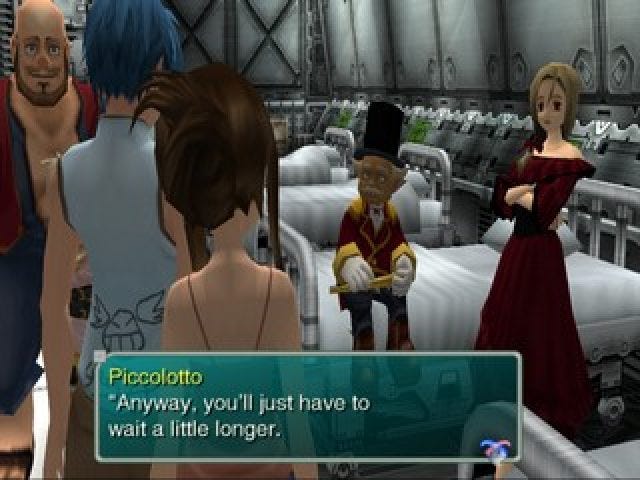 Visuals in Till the End of Time are very well done. Character sprites are detailed and, I am pretty sure, change throughout the game, possibly depending on the armor equipped. However, many of the colors in this game are brown, grey, and black, and, in general, the color palette used made many key things, like treasures, hard to see in various spots of the game. For me, Second Story made use of lush greens, warm yellows, and deep blues. On, what seemed like the opposite end of the spectrum, were the much darker hues of this game. Just the same, it helped to set a unique tone.
Overall, the dungeon design was great, but it was hampered by an idea that, on the surface, seemed like it could be a good idea, but was implemented awkwardly. For many of the maps, there is a completion bonus if you map out 100% of the area, and you can get items that sell for a ton of money. Especially important early on when money is limited. This is amazing, but this leads to extended amounts of time wandering, hugging corners, and retracing steps, several times, through too many rooms. What ends up happening is you will likely have the map open, full screen (R2 twice), and be focused so intensely on that that the game passes you by without fully enjoying the scenery. I had to remind myself to look at the surroundings from time to time because I had spent a lot of time focusing on an arrow on a light green map.
This is a shame, because, as I said, the dungeons were fun to navigate. They are complex without being overbearing. That is, except for a few mini-games found in some of the dungeons. The hauler turtle “game” being the most egregious. The controls were bizarre and seemed to be fighting against me, rather than working with me. Even worse is the very odd, awkward dragon flute experience. Use a walkthrough for that, is all I can say. It was pretty awful, and the way the buttons were mapped, at least on the PlayStation 2, made this portion of the game an absolute burden to complete.
Star Ocean: Till the End of Time isn’t a bad game. It is, in fact, quite ambitious. It had a lot of cutscenes, an awesome battle system, and a crafting system that could have been great, but was cumbersome and very confusing, especially for those trying to avoid guides. This is a solid entry but does not reach the high standards set by its predecessor. Give it a try if you know you won’t be getting another game that matches Second Story’s heights, but it’s still an all-around fun, solid entry into the series.
Wayback Wednesday Volume 1: Final Fantasy 7 and Chrono Trigger.
Wayback Wednesday Volume 2: Super Metroid and Castlevania: Symphony of the Night.
Wayback Wednesday Volume 3: The Legend of Zelda: A Link to the Past and Lunar: Silver Star Story Complete
Wayback Wednesday Volume 4: Secret of Mana and Wild Arms
Wayback Wednesday Volume 5: Illusion of Gaia and Grandia
Wayback Wednesday Volume 6: Breath of Fire 3 and X-Men Legends
Wayback Wednesday Volume 7: Star Ocean: The Second Story and Super Mario RPG
Wayback Wednesday Volume 8: Demon's Crest and Dragon Quest VI
Wayback Wednesday Volume 9: Suikoden I and Jeanne d'Arc
Wayback Wednesday Volume 10: Ranking the first 6 Final Fantasy games
Wayback Wednesday Volume 11: Earthbound and Valkyrie Profile
Wayback Wednesday Volume 12: Legend of Legaia and Secret of Evermore
Wayback Wednesday Volume 13: Threads of Fate and Soulblazer
Wayback Wednesday Volume 14: Radiata Stories and Robotrek
Wayback Wednesday Volume 15: Rogue Galaxy and Vandal Hearts
Wayback Wednesday Volume 16: Chrono Cross and Muramasa: The Demon Blade
Wayback Wednesday Volume 17: Okami and Legend of Mana
Wayback Wednesday Volume 18: Paper Mario and Terranigma
Wayback Wednesday Volume 19: Dragon Quest VIII and Atelier Iris 2: The Azoth of Destiny
Wayback Wednesday Volume 20: Ranking the 6 console Final Fantasy games from the PS1 and 2
Wayback Wednesday Volume 21: Eternal Sonata and Actraiser
Wayback Wednesday Volume 22: Persona: Revelations and Tales of Destiny
Wayback Wednesday Volume 23: Shadow Hearts: Covenant and Dragon View
Wayback Wednesday Volume 24: Ken Griffey Jr. Presents Major League Baseball and Lunar: Eternal Blue
Wayback Wednesday Volume 25: Suikoden II and Xenogears
Wayback Wednesday Volume 26: Azure Dreams and Wild Arms 2
Wayback Wednesday Volume 27: Ar Tonelico and Sword of Mana
Wayback Wednesday Volume 28: Albert Odyssey and Super Paper Mario
Wayback Wednesday Volume 29: Arcana and X-Men Legends II
Wayback Wednesday Volume 30: 10 over-rated classics that haven’t aged well
Wayback Wednesday Volume 31: Dragon Quest IX and E.V.O.: Search for Eden
Wayback Wednesday Volume 32: Tales of Symphonia and Elemental Gimmick Gear
Wayback Wednesday Volume 33: Ys Seven and Brain Lord
Wayback Wednesday Volume 34: Lufia and The Legend of Oasis
Wayback Wednesday Volume 35: Kingdom Hearts: Birth by Sleep and Magic Knight Rayearth
Wayback Wednesday Volume 36: Tales of the Abyss and Crisis Core: Final Fantasy VII
Wayback Wednesday Volume 37: Rhapsody: A Musical Adventure and Legaia 2