

As a general note, the Pixel remasters have difficulty sliders that change experience and money, which can be multiplied by 2x or 4x, but also lowered to .5 if it gets too easy or even 0. There are also options to turn off random encounters. I kept the default settings (1x) and sporadically used no encounter in FF2.
6. Final Fantasy II
Final Fantasy 2 was a game I tried several times in the past, but never managed to get more than a few hours into. I could never get used to the lack of traditional level and stat progression. After finishing Final Fantasy 1 Pixel Remaster (PR) a few years ago, I approached Final Fantasy 2 PR with renewed interest. While the lack of levels is as jarring as it was on the original NES, stat increases come often enough to eventually not be too noticeable. Weapons and spells level up quickly if you make it a point to use them regularly, but the leveling system isn’t fast enough to make a jack-of-all-trades character worthwhile, so it’s better to have each character specialize.
In a sea of huge open-world games these days, it’s refreshing and easy to appreciate the old-school, more streamlined approach, though compared to 1, it felt more meandering and required more back and forth between the same locations, with a lot of open, unused space that exists to take up time. This extends to the dungeons, where several paths lead to dead ends and empty rooms. Coupled with the high encounter rate, exploration tends to feel like a chore.
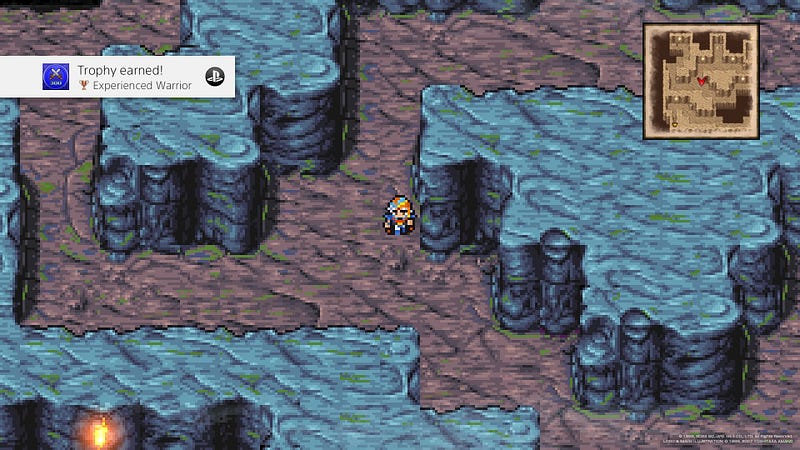 Pixel Remaster version
Battles are not difficult, though the last boss is a tremendous spike in difficulty and an insane war of attrition. As much as people tend to dump on this game, the story is a big step up from 1, with a focus on rebellion and retribution, and while dialogue is straightforward, there are a few instances of depth.
The version I finally beat, the Pixel Remaster, respects the original, and while nothing memorable stuck out, it was enjoyable, even if it is not groundbreaking.
5. Final Fantasy III
Similar to FF1 and FF2, the Pixel Remaster felt like my last-ditch effort to get into Final Fantasy 3. Final Fantasy 3 follows four orphans chosen as the Warriors of Light, but the 4 protagonists are largely blank slates.
The gameplay stands out for its variety of transportation, like chocobos, canoes, and several types of airships, which change how you interact with the world.
3 is the precursor to the job system in Final Fantasy 5, and while not as good, it stands on its own with solid mechanics and plenty of player agency. With 4 characters and 22 jobs, there are 234,256 possible combinations, though not every job is equally viable, and it’s tricky knowing when to switch, since starting over at job level 1 makes that character much weaker for a decent amount of time. Because of that, I tended to stick with jobs and didn’t experiment too much.
Battles are not difficult and feel as easy as the FF1 and 2 remasters, but like them, the final boss is a massive spike in difficulty, even more extreme here than 2. Dungeons are more focused and streamlined here than in 2, and there is a generous supply of treasures throughout.
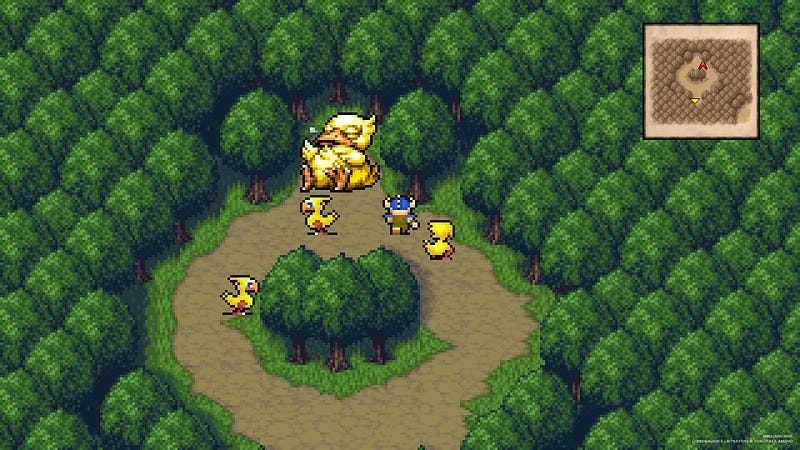 Pixel Remaster version
The Pixel Remaster preserves the original style with a subtle refresh to sprites and backgrounds, along with quality-of-life additions like autobattle, dungeon maps, and autosaves. The music stays true to its roots with newly orchestrated arrangements.
While it may be easier than the original NES version, it remains faithful enough to feel authentic, and at just over 14 hours, the journey was brisk but satisfying.
4. Final Fantasy I
Imagine loving horror movies without watching Hitchcock, comedy without ever seeing Chaplin, or rock music without listening to the Beatles. Could you fathom that? Until 2024, I was guilty of adoring RPGs without beating Final Fantasy. I’ve tried playing the original several times, but always put it down after an hour or two because it felt too archaic. With the 2021 pixel remaster, I decided to give it one last shot, and despite showing its age, I am so happy I did.
The game starts with a character selection, with 1 of 6 classes for each of the four characters, a surprising level of choice for an early NES game. I stuck with Warrior, Thief, White Mage, and Black Mage. The story follows four warriors of light restoring the darkened crystals tied to fire, water, earth, and wind by defeating elemental fiends.
This is done by traversing a world that is shockingly large by 1987 standards, on foot and eventually via canoe, ship, and airship. This is mostly a faithful remake with quality-of-life additions like dungeon maps, which are helpful as dungeons become long and convoluted with branching paths and dead ends as the game advances.
Random battles frequently interrupt exploration, though fighting enemies is basic, with some elemental considerations to account for. Limited grinding is needed, and most bosses go down without much issue, though the last boss was noticeably harder. Like many old-school games, money eventually pours in faster than it can be spent, but it's rough going in the opening hours.
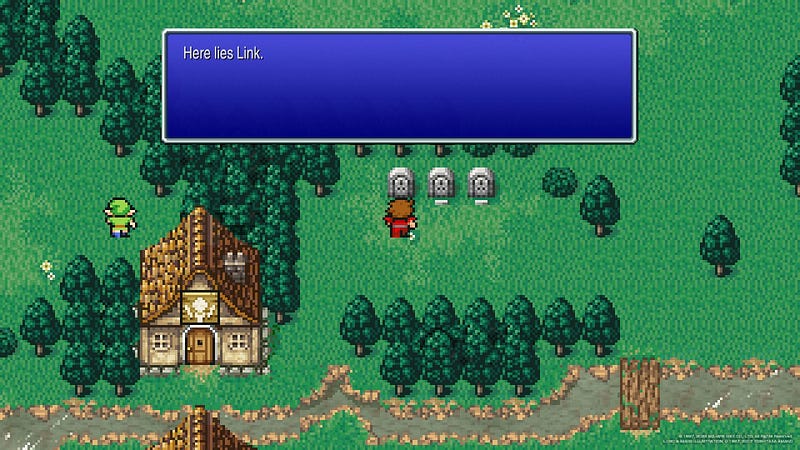 Pixel Remaster version
The Pixel Remaster preserves the original style with a subtle update to sprites and backgrounds, and the musical tracks are updated versions of the NES classics.
It’s short, just under 11 hours, and provides a fantastic glimpse into the series’ origins.
3. Final Fantasy V
There is something special that pulled me into Final Fantasy 5 right away, especially the music that greets you upon booting the game, which is playfully adventurous and hopeful. I first played it way back in 2000 with Final Fantasy Anthology for the PS, and while that was my first experience, a more recent playthrough of a fan translation of the SNES version ended up being my favorite.
The story involves a mage tied to “The Void,” the splitting of the world, and eventually ExDeath as the main antagonist. He is sufficient for the time the game was made (1992), though by modern standards, he was fairly underwhelming, especially compared to later Final Fantasy titles.
The meat of the game is the job system, with 22 unique jobs that allow players to mix and match abilities and customize characters in ways rarely (if ever) seen before. Jobs are unlocked through crystals, and while some are stronger than others, the flexibility is impressive. EXP and Ability Points are gained in battle, and there is a lot of grinding for job mastery. The process was tedious, but the result was worth it to see some of the best skills and characters' power up quickly. I haven’t played the PR version yet, but it includes options that make grinding job levels much more seamless, as a heads-up.
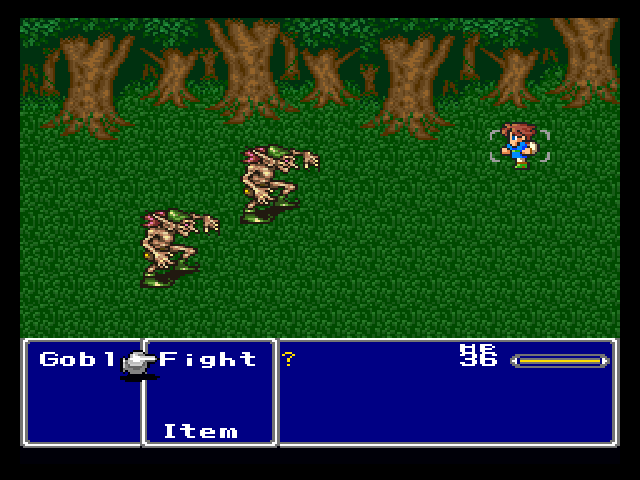 PS Anthology version
Outside the job system, it is a standard RPG with towns, dungeons, and a sizeable world map, along with expected transportation like chocobos and ships. It also builds on the ATB system, making it visible on screen.
The graphics have a certain retro charm, though not much of a step up from IV. The music made a strong first impression and was solid throughout.
Final Fantasy 5 is a good RPG that has aged somewhat decently, saved by its job system and flexibility, and offers an interesting glimpse into RPGs just before the genre’s golden age.
2. Final Fantasy IV
If I could go back in a time machine, I would return to that fall afternoon in the late 90s when I brought home Final Fantasy 4 from FuncoLand and gave up on it after just a few hours. I was underwhelmed and returned it the very next day, even though the negative feelings had slowly started to dissipate by then. A few months later, I realized I had not given the game a fair shake and went back, somewhat embarrassed, to buy it again and give it another shot.
Once I did, it started to click. The enemy sprites are colorful and varied, and the bosses stood out more and more, and I wanted to pummel them all.
The battle theme was the first thing that stuck with me, catchy, memorable, heroic, and impossible to forget, while the boss theme carried a more sinister tone but remained just as effective.
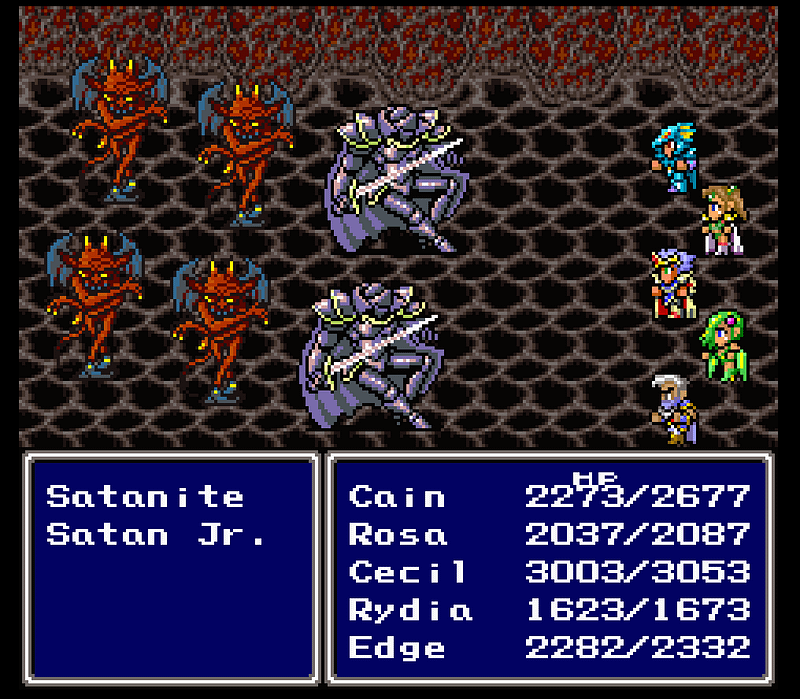 SNES version
As I grew to love the game, there were still aspects that annoyed me, especially the revolving door of characters joining and leaving the party. Even so, each character had a compelling story, and 12 characters can be controlled throughout the game. Battles allow up to 5 characters, more than the first 3 Final Fantasy games. Though the system is simple by modern standards, it’s still engaging, and the pacing of the story is top-notch.
IV is a beautiful relic from the past. I did not immediately enjoy it, but after giving it a second chance, it became an unforgettable journey and an insight into Squaresoft's past.
1. Final Fantasy VI
How can a fictional world trapped inside a tiny cartridge be so riveting, captivating, and enticing? Final Fantasy 6 was groundbreaking, and despite being the sixth game, it marked a change in fortunes for the West back in the mid-1990s. I have beaten it several times in various forms, and despite so many current-gen games and their quality of life additions, it remains easy to return to.
The setting is bleak and dark, one of the best examples of world-building in RPGs in the first half of the 1990s. Gone is the typical fantasy medieval setting, replaced with something closer to an Industrial Revolution mixed with strange technology. The story deals with mature, serious issues involving an uprising against a brutal military dictatorship, led by Kefka, who is detestable and pushed how villainy could be depicted in video game form. Along with Luka from Suikoden II, he is perhaps the worst from the genre in the 90s decade.
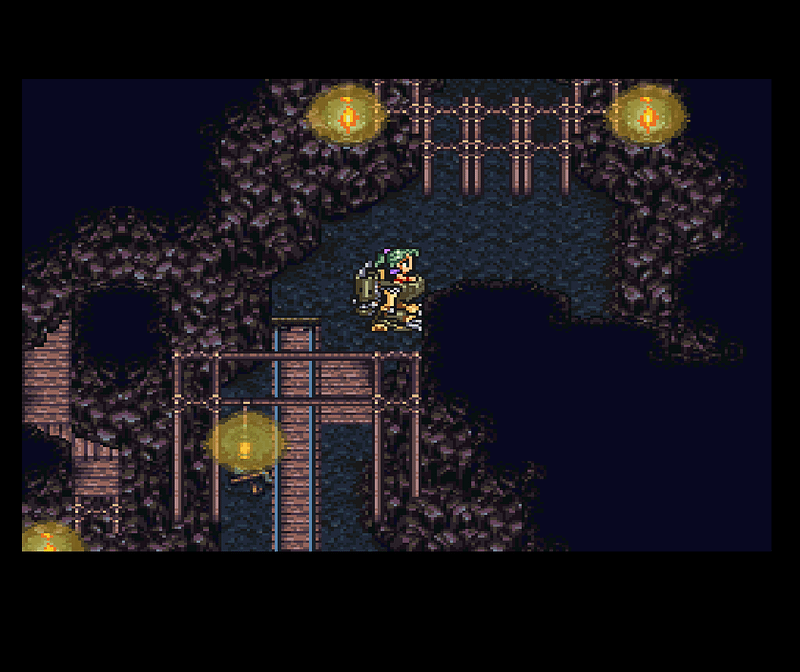 PS Anthology version
The game centers around 14 characters fighting against the Empire, with Terra as the main protagonist, alongside Locke, Celes, and many more. The cast is diverse with different backgrounds that unfold through the journey. The soundtrack is outstanding overall, even if I found the Opera scene cringeworthy and overrated; other tracks stood out far more.
Graphics made a commendable leap in quality from 5, especially in towns, environments, and battle sprites. The skill system is a mixed bag, with some abilities feeling innovative and useful while others felt like a waste of time. Gau, in particular, and I say that via experience, having obtained every last one of his skills in one of my playthroughs. Sabin, Edgar, and Shadow stood out more. Magicite, espers, and relics offer a lot of customization, allowing characters to develop in different ways.
Final Fantasy 6 set the standard for what an RPG is capable of, with a great story, customization options, and an engaging world.
Reviews are based on the versions I beat: Final Fantasy I— Pixel Remaster, Final Fantasy II — Pixel Remaster, Final Fantasy III — Pixel Remaster, Final Fantasy IV— SNES, Final Fantasy V — PS and fan translated SNES version, Final Fantasy VI— SNES and PS versions.
Be sure to check out my reviews of Final Fantasy VII, Final Fantasy XIII, XIII-2, Lightning Returns, and Final Fantasy XV.
Wayback Wednesday Volume 1: Final Fantasy 7 and Chrono Trigger.
Wayback Wednesday Volume 2: Super Metroid and Castlevania: Symphony of the Night.
Wayback Wednesday Volume 3: The Legend of Zelda: A Link to the Past and Lunar: Silver Star Story Complete
Wayback Wednesday Volume 4: Secret of Mana and Wild Arms
Wayback Wednesday Volume 5: Illusion of Gaia and Grandia
Wayback Wednesday Volume 6: Breath of Fire 3 and X-Men Legends
Wayback Wednesday Volume 7: Star Ocean: The Second Story and Super Mario RPG
Wayback Wednesday Volume 8: Demon's Crest and Dragon Quest VI
Wayback Wednesday Volume 9: Suikoden I and Jeanne d'Arc