

This game has potential, but it's far too easy, even on hard.
Reflecting on my time spent with this game in 2001 and 2019, it has all the hallmarks of a PS1 classic RPG at first glance, but sadly there are some glaring issues that could have been fixed. Regardless, there is a certain je ne sais quoi about the game that elicits fond memories of my first playthrough, and there is an unmistakable beauty to the visuals when they are at their best. Note: This is based on the 1998 PlayStation 1 version.
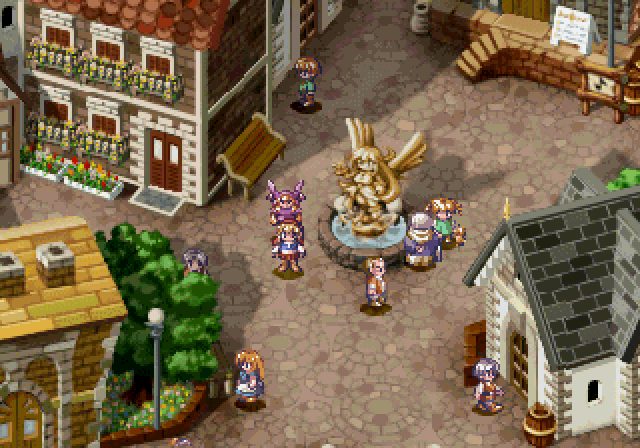 Rhapsody is yet another game in a loaded PlayStation RPG library. If you are eager to dive deeper into the PS catalog for role-playing games, this will scratch that itch for about ten hours, but do not expect too many innovations. In fact, there are a few serious shortcomings you should be aware of before deciding if this is a game for you.
With that said, likely one of the few unique aspects of this game is the occasional musical numbers. I didn’t care for them, but fans of musicals will likely find some things to enjoy; there are about half a dozen songs. On the positive side, the music is very well done and tranquil. It sets a peaceful tone.
The largest issue with Rhapsody is that the game is incredibly easy. The first time I beat it, about 25 years ago, it was a cakewalk; I finished it on level 58 on normal setting. I replayed it in 2019, and even when set to “hard,” and even went out of my way to avoid leveling and it still provided no real challenge. I got to the last boss with ease, at level 38 on hard difficulty.
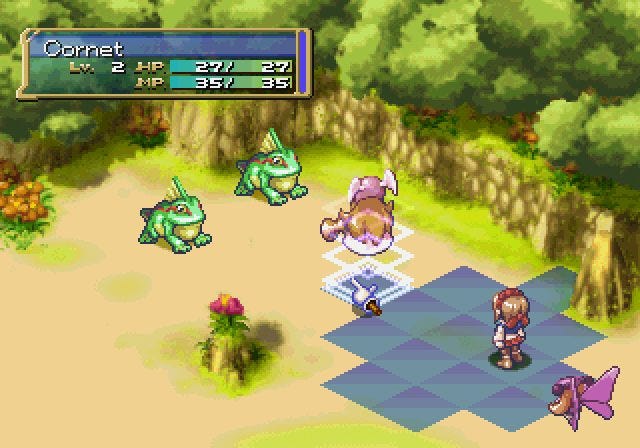 This is a shame because Rhapsody shows a lot of promise and the battle system looks like it could be fun. But when you pulverize every boss placed in front of you as if they are a common enemy, the battle system tends to lose its luster. It is hard to see the difference between normal and hard, and as far as I could tell, the only key difference is you get less EXP and money, by about 1/3rd.
In Rhapsody, you don’t have proper equipment in the sense that you buy or find helmets, armor, gloves, boots, etc. You can only equip accessories, and you have three slots to equip from a limited amount of items that increase offense, defense, intelligence, speed, 1/2 mp usage, and a few others. An odd quirk is that one of the best accessories is available almost right from the start of the game, an item that boosts offense by 20 points. Thus, the equipment management and customization are extremely limited, and you get no say in how your character's stats grow from level to level.
One of the major issues in this game is the lack of creativity in dungeon designs. The first place you go to with enemies, Wonder Woods, shows promise, and the animation and backgrounds are gorgeous. Things only improve when you return, all the way to a restaurant. The attention to detail within this restaurant is quite stunning for its time. But for large portions of the game, the dungeons look the same, with just a palette swap used to help you differentiate between, say, the ice caverns and Salsa Volcano. This is a huge issue for two main reasons: One, it gets boring exploring what is effectively the same place with different hues over and over again. Two, without anything within each dungeon to help you get your bearings, no landmarks, nothing different between the rooms, it is very easy to get lost.
A large majority of the items found within dungeons/caves are not very useful, and there are not many things that dungeons alone have that you can’t buy in shops. The only fun things to seek out are the 15 illustrations and, if you happen across them, some of the accessories, especially much later in the game. This brings me back to my initial point: The later part of the game and in this case, the last dungeon: It still suffers from many of the aforementioned problems but there are a few rooms that show a lot of promise.
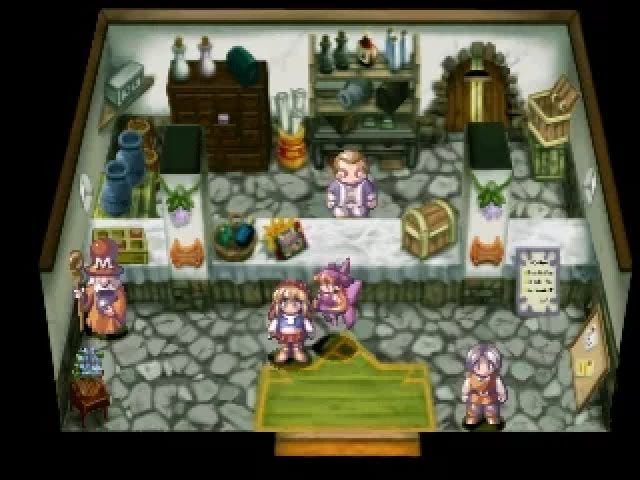 Despite the bland environments, I found the towns and main character and enemy sprites colorful and detailed. That is another thing; there are plenty of puppets you can recruit. The first time I played, I used an assortment of different puppets including but not limited to a baby dragon, an angel-looking puppet, a knight, samurai, frog, and rabbit. The second time I just used the three egg brothers the entire time. If any puppets ever die, you can bring them back to the town of Orange to repair them. This sounds annoying, no revive spell, but you will likely never require this service, so it does not end up being a hassle.
Overall, Rhapsody is a run-of-the-mill RPG that shows a lot of promise and has a few things to like, including character sprites and detailed towns, but suffers from a lot of monotony, especially for a large portion of the dungeons. If the game were harder, the battle system could have been fantastic. Rhapsody is limited as far as equipment and stat growth, as well as limited spells. The ease with which most players can beat this on normal, and even on hard, will make this a forgettable (but not bad) game for all but the most hardcore RPG fan and/or musical fan.
Wayback Wednesday Volume 1: Final Fantasy 7 and Chrono Trigger.
Wayback Wednesday Volume 2: Super Metroid and Castlevania: Symphony of the Night.
Wayback Wednesday Volume 3: The Legend of Zelda: A Link to the Past and Lunar: Silver Star Story Complete
Wayback Wednesday Volume 4: Secret of Mana and Wild Arms
Wayback Wednesday Volume 5: Illusion of Gaia and Grandia
Wayback Wednesday Volume 6: Breath of Fire 3 and X-Men Legends
Wayback Wednesday Volume 7: Star Ocean: The Second Story and Super Mario RPG
Wayback Wednesday Volume 8: Demon's Crest and Dragon Quest VI
Wayback Wednesday Volume 9: Suikoden I and Jeanne d'Arc
Wayback Wednesday Volume 10: Ranking the first 6 Final Fantasy games
Wayback Wednesday Volume 11: Earthbound and Valkyrie Profile
Wayback Wednesday Volume 12: Legend of Legaia and Secret of Evermore
Wayback Wednesday Volume 13: Threads of Fate and Soulblazer
Wayback Wednesday Volume 14: Radiata Stories and Robotrek
Wayback Wednesday Volume 15: Rogue Galaxy and Vandal Hearts
Wayback Wednesday Volume 16: Chrono Cross and Muramasa: The Demon Blade
Wayback Wednesday Volume 17: Okami and Legend of Mana
Wayback Wednesday Volume 18: Paper Mario and Terranigma
Wayback Wednesday Volume 19: Dragon Quest VIII and Atelier Iris 2: The Azoth of Destiny
Wayback Wednesday Volume 20: Ranking the 6 console Final Fantasy games from the PS1 and 2
Wayback Wednesday Volume 21: Eternal Sonata and Actraiser
Wayback Wednesday Volume 22: Persona: Revelations and Tales of Destiny
Wayback Wednesday Volume 23: Shadow Hearts: Covenant and Dragon View
Wayback Wednesday Volume 24: Ken Griffey Jr. Presents Major League Baseball and Lunar: Eternal Blue
Wayback Wednesday Volume 25: Suikoden II and Xenogears
Wayback Wednesday Volume 26: Azure Dreams and Wild Arms 2
Wayback Wednesday Volume 27: Ar Tonelico and Sword of Mana
Wayback Wednesday Volume 28: Albert Odyssey and Super Paper Mario
Wayback Wednesday Volume 29: Arcana and X-Men Legends II
Wayback Wednesday Volume 30: 10 over-rated classics that haven’t aged well
Wayback Wednesday Volume 31: Dragon Quest IX and E.V.O.: Search for Eden
Wayback Wednesday Volume 32: Tales of Symphonia and Elemental Gimmick Gear
Wayback Wednesday Volume 33: Ys Seven and Brain Lord
Wayback Wednesday Volume 34: Lufia and The Legend of Oasis
Wayback Wednesday Volume 35: Kingdom Hearts: Birth by Sleep and Magic Knight Rayearth
Wayback Wednesday Volume 36: Tales of the Abyss and Crisis Core: Final Fantasy VII