
Check out Part 2, Super Mario RPG, here.
Note: This review is based on the original PlayStation version. Be on the lookout for my review of the remastered version at a later date.
Star Ocean for the SNES was one of the most unique 16-bit RPGs ever released. Along with Tales of Phantasia, it changed many minds about what the SNES was capable of and expanded our ideas about what the genre could do moving forward. Both were fast-paced, sometimes hectic, and required quick thinking and swift action, but with strategic undertones that added to the battles' complexity.
Star Ocean: The Second Story, developed by Tri-Ace and released by Enix in the Spring of 1999, was the series introduction to the West. Second Story is a game I have beaten three times. It’s been a few years since I have sunk any considerable time into the game, but it remains firmly rooted in my memories of how amazing games can be and sets a high standard of enjoyment that many games, to this day, struggle to meet.
Starting the game, you pick between two characters, Rena and Claude. I have beaten the game twice with Claude and once with Rena, but I didn’t notice any major differences between the two in the story, and their paths cross very early, and they remain together for the rest of the game. They mostly differ in perspective.
Star Ocean: The Second Story takes place in the future, about 2400, and 20 years after the first game. The game opens with Claude on his first-ever space mission to explore a distant planet under his father’s supervision. Shortly after landing on the planet, he gets too close to an unknown device, despite the frequent orders from his father to back away, and is teleported to a far-flung planet named Expel.
A less advanced planet that probably isn’t too dissimilar to 1500 or 1600s Earth. It is at this point that Rena first comes into contact with Claude and mistakes him for the hero that is spoken about in the Expel’s legends. To get back home, Claude offers to help the people of Rena’s village investigate some odd occurrences, including the arrival of a huge meteor, and eventually, a nasty army of demons. Thus, players are on an epic adventure that will likely span at least 50 hours and lead them to face off against those powerful demons.
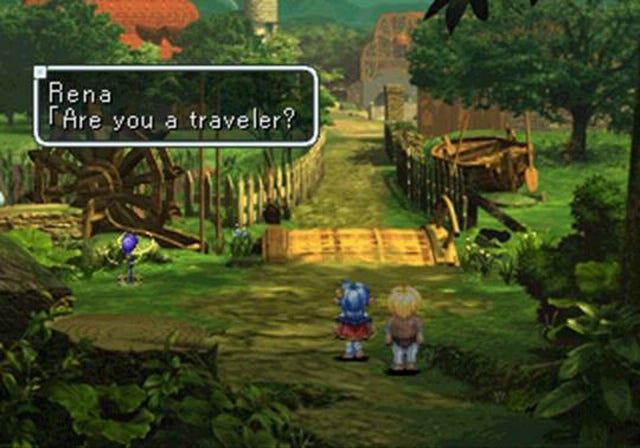
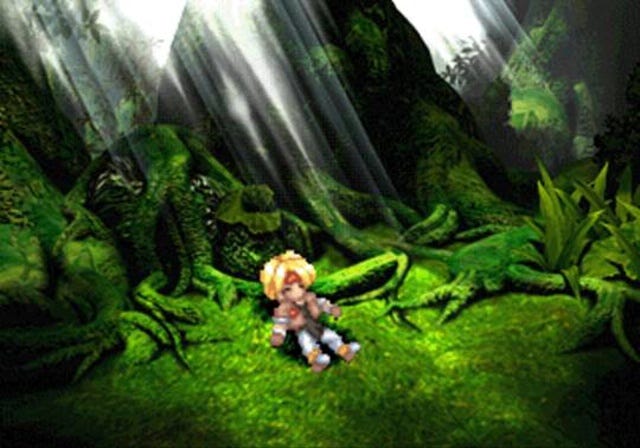 The lush colors and gorgeous graphics that gamers see as Claude wakes up after being transported to Expel are breathtaking. A lot of time, effort, and energy went into creating every area in this game. While battle graphics and character and enemy sprites clearly show their age, it is impressive how fluid their movements are. The towns, each with its unique vibes, are where the game truly shines. They are created with the utmost attention to detail, with beautiful lighting effects that enhance each location, along with interesting shadows in the background and sometimes foreground that add depth to many of the areas you visit. I have traveled extensively through Europe, and I swear some of the towns, such as Port Hilton, Cross, or Lacour, are modeled on the architecture I saw during my travels; they clearly draw inspiration from major European capitals! But it makes Second Story feel so familiar, at last to me. Even the first time I played this before I had traveled anywhere, the world and all of its towns are so inviting and filled to the brim with detail.
 The music is ethereal and earthy at the start of the game in Arlia and many of the early villages. But the music slowly ramps up the intensity as the game progresses. Some of the later, larger towns have serious, grand music, what you might expect in a classy place in Paris or Vienna. Just wait until you get to Port Hilton or Lacour. Dungeon music is futuristic and out of this world. The music for the first few bosses is a letdown. The track changes after the first 5 or 6 fights and is replaced by much better, faster-paced music that indicates you are in for a fierce battle.
There is a lot of voice acting in battles, too, but it is not always good, mostly because characters repeat the same tired lines. On the flip side, hearing some of the things bosses say, especially later in the game, is immersive and can even be slightly intimidating. It adds to the stress of key battles.
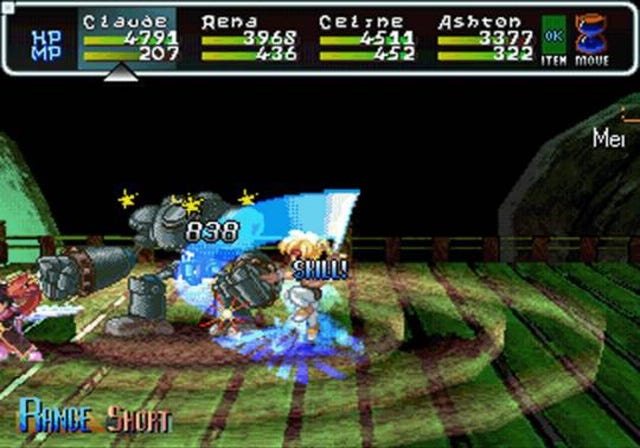
Usually, the gameplay and battle mechanics are my favorite aspects of an RPG, but I was so engrossed in the world that these aspects took a backseat for me. That isn’t to say the battles are an afterthought. They occur rapidly, in real-time, to the point where even some bosses can be beaten in a minute or two. Fights are incredibly engaging, partially because constant attention is required because of how fast they can end for Claude and his party if full attention isn’t paid with quick reflexes.
The only thing I wish Second Story could have had, that “Till the end of time” had was the fury gauge, which adds more strategy to the game in place of the mindless button mashing that will often occur in Second Story. Even with some bosses, simply rapidly pushing the attack button will suffice. That is one thing Second Storie’s predecessors improved on: an emphasis on timely defensive maneuvers and strategic use of various attacks.
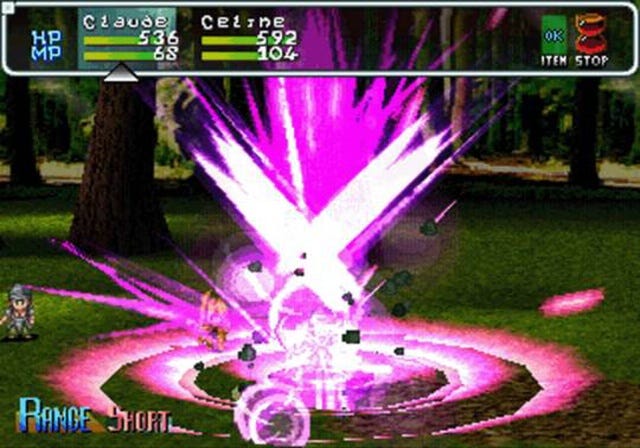 Just the same, Star Ocean (SNES) and Second Story are where that battle system evolved from, and it is still loads of fun. Players control one player of their choice while three others are, for the most part, controlled by the AI. I say for the most part because one of six, or so, orders can be issued to AI characters too, for example, fight like crazy, heal, use magic, and so on. You can even tell an AI character to do nothing! This might be useful if you want to level up a weaker character you want to level up and let the other three pulverize the enemies to help the weaker one get levels.
You can also pause the game and move between characters to assign specific one-time orders. If you need Rena to heal now or for Celine to cast a specific offensive spell, enter the battle and order that to happen!
Out of battle, you can decide what spells characters will use and won’t use by clicking on it to grey it out or clicking again to make sure it is in use. Finally, for the attackers like Claude, Asthon, and Dias, you can assign extra powerful attacks to the shoulder buttons and unleash devastating attacks, called Killer Moves, on enemies and bosses alike. Be aware that there are 12 characters overall, and 8 can be added to a party in one playthrough, so keep that in mind as the game moves along to balance out your party with a mix of attackers and magic users.
There is a pretty complex skill system, too. Each battle gives EXP and SP. These SP (Skill Points) can be used to improve skills and talents such as cooking, alchemy, and music, as well as battle skills to improve evasion or counter-attacking. Each has its benefits, so choosing where to assign these points can require careful planning and foresight. While battle skills have immediate impacts, some non-battle skills are exceptionally useful later in the game, after more prolonged attention, but without the instant results. Just the same, cooking can help to expand your inventory of HP and MP healing items, and crafting can greatly improve weapons.
Best of all, for those who played “Till the end of time” first, the system in Second Story isn’t nearly as complex or cumbersome while still offering a ton of choices and possibilities. You can even pickpocket, depending on how honest you want to be as a gamer. By learning a certain combination of skills, you can learn super-specialty skills too! Each character has a proclivity toward certain skills and, in the end, can do well in just about anything. You can even gain the ability to summon a bird, while in a dungeon, who can shop for you, and return with reinforcements a few battles later. Well-timed, this is incredibly useful.
The Private Action (PA) system helps you get to know characters on a deeper level and see how they interact. These are often light-hearted and work great against the increasingly serious tone of the main game, though sometimes the PAs are rather serious too. These are triggered by pressing square (a little icon will pop up) just before entering a town. Private actions and the choices Claude makes, when presented with options in conversation, go a long way in impacting, positively or negatively, his relationship scores with various characters. Some of these PAs are available for a set amount of time at specific points in the game or have prerequisites to be triggered.
Not only is it not possible to get every character into your party on one playthrough, as I mentioned previously, but there are over 80 different endings in this game, too, which further adds to the replay value. This jumped out to me when I picked up the CD case for the first time in the late 90s: the multiple endings advertised right on the back of the case. Impressive. The ending is based on many factors, including relationship scores with each character, which are, at least partially, dependent on how you respond to them at various junctures in the game, including PAs.
 The few flaws are excusable when considering how much love went into this game. Yes, there are some grammar issues and awkward wording scattered throughout the game. But the main point is clear, and the story is still intriguing, so it is easy to forgive a few issues here and there. Plus, it’s still a huge improvement over some of the more egregious errors, even among the classics, of the SNES era.
It is shocking to me that a game I played for the first time 20+ years ago has stuck with me to this extent. But Star Ocean: The Second Story is that kind of experience, and it is an outstanding RPG that will leave gamers spoiled for choice. So much choice that it is unlikely any two gamers will ever play it quite the same way. There is a lot of room for character development, depending on how strict you are with seeing as many PAs as you can, an almost endless amount of items you can obtain with item creation, and even a massive post-game dungeon with especially challenging extra bosses with HP totals exceeding several hundred thousand! The music sets the tone for the unique world within Second Story, and the graphics, though somewhat dated, still look respectable more than two decades later. For anyone who considers themselves a fan of role-playing games, Star Ocean: The Second Story is a must-play!
Wayback Wednesday Volume 1: Final Fantasy 7 and Chrono Trigger.
Wayback Wednesday Volume 2: Super Metroid and Castlevania: Symphony of the Night.
Wayback Wednesday Volume 3: The Legend of Zelda: A Link to the Past and Lunar: Silver Star Story Complete
Wayback Wednesday Volume 4: Secret of Mana and Wild Arms
Wayback Wednesday Volume 5: Illusion of Gaia and Grandia
Wayback Wednesday Volume 6: Breath of Fire 3 and X-Men Legends