
Is it as bad as people remember?
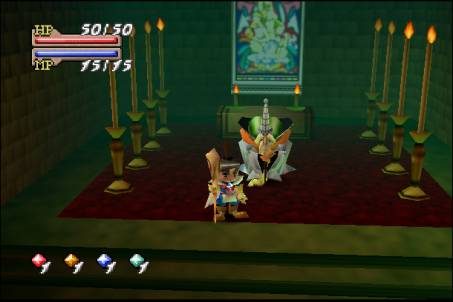 On the opposite end of the spectrum from the amazing RPGs I have played, such as Final Fantasy X and XII, Xenoblade, Star Ocean 2, and Breath of Fire 3, lies another equally small group of RPGs. This group of games is just as disastrous as the aforementioned are incredible. Games such as Dawn of Mana, Time Stalkers, and lesser-known titles such as Ancient Magic, and SMT …if (both for the SNES). Where does the often maligned Quest 64 belong on that spectrum? Like Final Fantasy: Mystic Quest, not as far to the left as many say, but not too much further ahead. In fact, this feels like an updated, 3D version of Mystic Quest.
Developed by Imagineer and released in the summer of 1998 by THQ, Quest 64 had the unenviable task of, almost single-handedly, competing with the numerous RPG juggernauts on the PlayStation. I almost feel kind of bad for Quest 64. It was one of the few role-playing games RPG-starved N64 owners could look to satisfy those genre needs in the late 1990s. One look at a list of PSX RPGs ordered by release dates shows what this game was up against in the second half of the decade. It was doomed from the start, even if it was a competent RPG.
After Ocarina of Time and Mario 64, I took one look at the current lineup of games, scoffed, and traded in my N64 for a PS in the spring of 1999. I will never regret that and feel it was one of the best gaming decisions I have ever made. I did not touch an N64 for more than two decades after that fateful exchange. That is until morbid curiosity got the best of me and I decided to revisit this console and some of its other games, Paper Mario being at the top of my list, but finally trying this game that so many moan about to see what the fuss is about.
Quest 64 has one of the simplest stories imaginable and reminds me of a grade school writing assignment. Set in Cetland, Brian, the one and only protagonist, must set out to find his father, who is looking for a thief who stole some valuables. He has failed to return in a reasonable amount of time. Now, when I say “one and only,” I mean, one and only. There are no partners who join Brian on his quest, and the closest Brian has is a girl who seems to follow him everywhere, Shannon. Most NPCs he comes across offer little to the story and have no real personality of their own. They seem to exist solely to fill up space and because, well, towns need people, right? Even Shannon admits this endgame. The main antagonists you come across have little to no backstory and no motivation for being the horrible souls that they are.
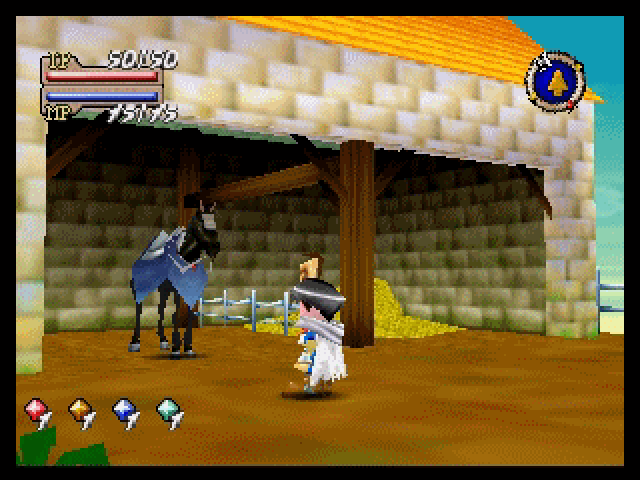 The blocky graphics that characterized this generation of consoles are in full effect here. While enemy sprites are unique and look quite good, exploring the overworld and especially the many tight corridors of the typical dungeon can become a chore. The camera is mostly AI-controlled and tries its best to keep up with Brian, but often gets stuck behind whatever is in the foreground, leaving a distorted mess of graphics obscuring your character and what you are trying to see: your destination. You can press B to change the angle, but as soon as you let go, the camera reverts to some useless angle. I felt like I was constantly fighting against the camera in towns, dungeons, and even battles to simply get a better view. The camera also makes what are usually mundane tasks, like opening a chest or a door, more annoying than usual. You have to be perfectly positioned to do either. I lost count of how many times I tried to place Brian directly in front of a chest, only for him to slowly skid by the chest he was trying to open, the exclamation point quickly flashing on the screen before disappearing just as quickly. The same happens for spirits. You can see them and be right next to them, but unless that exclamation point is over Brian’s head, no getting what you want! A gentle press in the direction of your desired item sends him scooting on by in the other direction and so on, several more times. I think one particular spirit must have taken more than ten seconds!
The music is decent and in parts, even peaceful, such as the town of Limelin and even perfectly mysterious for the long-lost Shamwood. However, other songs are instantly grating, such as the theme for Larapool that sounds like a headache in the form of music. I get it, the world is supposed to, by and large, represent Ireland, but in my three-week adventure there I never heard anything remotely like Larapool, thankfully. Though, I suppose the developers took many creative liberties, as evidenced by the existence of Shamwood, which looks more like Egypt in the center of a land that otherwise looks somewhat like Ireland.
There are a lot of things that most RPGs have that Quest 64 doesn’t. This failure to include these basic components was questionable, and I found their omissions baffling. For example, I don’t recall playing any other RPG with no money. It seems the world of Cetland exists solely on trade, barter, and giving things away. Nearly everything that Brian obtains in this game is generous gifts from the strangers. HP and MP healing items are given away, found in chests, and, in rare cases, dropped by enemies. No options exist to buy any extra items, not that the game requires this, as it’s easy. Even things the locals claim to desperately need, like elemental gems, are later given to him after he defeats the boss. There are no equipment upgrades and no new sword or armor.
Despite the limited number of items in the game, inventory management is a mess, and I didn’t see a way to organize items. Typically, items are listed top-down with a number signifying how many of that item. Here, you have to scroll left to right, and only a few items show on the screen at a time, out of dozens you might have, so a lot of scrolling, joy
There is one world map that can be accessed from the menu, and it is useful enough to gather your bearings. However, the omission of any dungeon map was a glaring oversight. Dungeons are long, winding, and sometimes feel like labyrinths. The fact that the compass is only labeled with North is quite odd too. Sure, it helps to tell if you are going north or south, but not labeling east and west was bizarre and could lead to getting lost in some parts. I got fooled several times in the first half of the game concerning what the camera does after battles or running away from a battle. It often repositions itself, so I thought I had to turn around. But actually, the camera is simply turning around to face the direction you were going. Or tries to. There is still a chance you can get turned around and eventually lost, which is a huge annoyance.
One omission I thought was a good idea, and some games have tried the following to varying degrees of success, is that there are no levels. Instead, every stat has its own experience. Once experience reaches 100%, an extra point is added to that stat. So when an enemy misses you, that adds experience to agility. When an enemy hits you, that adds experience to defense. The damage you take, as well as damage done with the staff, adds experience to HP. MP experience increases with every successful casting of a spell. I liked this idea and found that naturally progressing through the game always led to having just enough of every stat to beat the boss at the end of the dungeon without much trouble or grinding. Although I suppose getting lost and finding your way is a form of grinding.
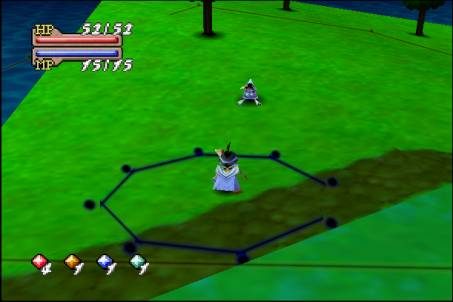 Though the staff is Brian’s only means of physical attack, the main mode of attack, overall, is magic attacks. These are divided into four different elements: water, earth (rock), fire, and wind. I’d highly recommend taking a look at a walkthrough and looking at the various spells obtained from each element and pre-planning, before starting the game, to see how you want Brian’s magic to grow. Not all elements are created equal. Thankfully, I did this and had some idea of how I wanted each element to grow. For example, 7 points into water, immediately upon starting the game, is a must for healing. Water was also my first element to reach a maximum of 50 points, but earth also has some very useful spells. Magic also has experience, and once it hits 100%, you can add a point to one of the four elements. The more points an element has, the more (and theoretically better) spells you can get. Although the usefulness of some late-game spells can be questioned, hence my advice to plan using a walkthrough.
Anyway, I enjoyed this way of gaining spells, but what I disliked, after gaining an extra point via battles, is that the screen pops up quickly and without warning. If you aren’t careful, it’s possible to assign a point to an element you didn’t intend to. This usually worked out in my favor anyway, as I typically wanted to cast a healing spell after the battle and, thus, was already pushing the button for water when the point was accidentally assigned. There is no confirmation message asking “Are you sure you want to assign a point to this element,” so there is no going back, other than restarting from your last save.
Spirits are scattered throughout the world, in dungeons and towns. At times they can be hard to see, so it is important to keep a watchful eye as they help to increase a magic element of your choice by one point. From what I understand, there are nearly 100 of these purple glowing things.
Magic spells can be a powerful tool to dispose of enemies, but there isn’t a lot of variation in spell animations, say, between Rock levels 1, 2, and 3 or water pillar levels 1, 2, and 3. Plus, you can not target enemies and just have to guess if they are in range, leading to frustrating occurrences where the spell is cast over an empty part of the battlefield. Even if the enemies are in range, spells frequently miss the target. When they do land, they usually do a solid amount of damage, especially avalanche!
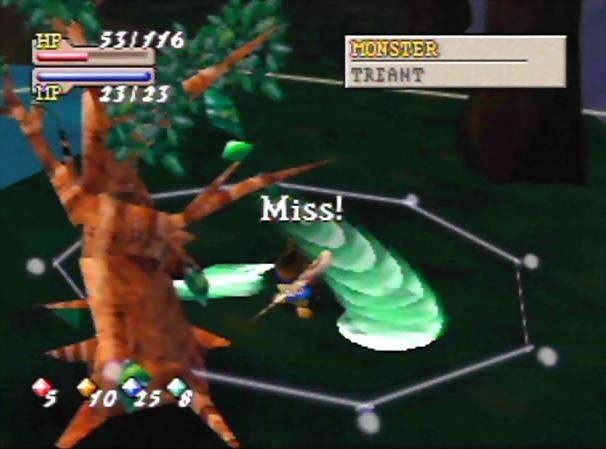 Quest 64 isn’t a tough game, and in the rare case you do die, which could happen a handful of times, there isn’t much of a penalty. All gained stats remain the same, and you are simply sent to the last save point.
Overall, Quest 64 is a simple, flawed game. The story is not engaging, and exploring the world, and especially dungeons, feels unintuitive with a messy camera that seems to work against you. If I didn’t know any better, this could serve as a 3D sequel to Final Fantasy: Mystic Quest because this game is that barebones too. The only player agency is how points are spread across the four elements, but otherwise, there is very little freedom in how Brian develops. This game should take about ten hours, give or take an hour (9:09 for me), and it is simply a below-average relic of the past, only suitable for the biggest fans of the genre who have nothing left on their gaming backlog. I wasn’t missing out on anything regarding this game when I made that trade more than two decades ago.
Wayback Wednesday Volume 1: Final Fantasy 7 and Chrono Trigger.
Wayback Wednesday Volume 2: Super Metroid and Castlevania: Symphony of the Night.
Wayback Wednesday Volume 3: The Legend of Zelda: A Link to the Past and Lunar: Silver Star Story Complete
Wayback Wednesday Volume 4: Secret of Mana and Wild Arms
Wayback Wednesday Volume 5: Illusion of Gaia and Grandia
Wayback Wednesday Volume 6: Breath of Fire 3 and X-Men Legends
Wayback Wednesday Volume 7: Star Ocean: The Second Story and Super Mario RPG
Wayback Wednesday Volume 8: Demon's Crest and Dragon Quest VI
Wayback Wednesday Volume 9: Suikoden I and Jeanne d'Arc
Wayback Wednesday Volume 10: Ranking the first 6 Final Fantasy games
Wayback Wednesday Volume 11: Earthbound and Valkyrie Profile
Wayback Wednesday Volume 12: Legend of Legaia and Secret of Evermore
Wayback Wednesday Volume 13: Threads of Fate and Soulblazer
Wayback Wednesday Volume 14: Radiata Stories and Robotrek
Wayback Wednesday Volume 15: Rogue Galaxy and Vandal Hearts
Wayback Wednesday Volume 16: Chrono Cross and Muramasa: The Demon Blade
Wayback Wednesday Volume 17: Okami and Legend of Mana
Wayback Wednesday Volume 18: Paper Mario and Terranigma
Wayback Wednesday Volume 19: Dragon Quest VIII and Atelier Iris 2: The Azoth of Destiny
Wayback Wednesday Volume 20: Ranking the 6 console Final Fantasy games from the PS1 and 2
Wayback Wednesday Volume 21: Eternal Sonata and Actraiser
Wayback Wednesday Volume 22: Persona: Revelations and Tales of Destiny
Wayback Wednesday Volume 23: Shadow Hearts: Covenant and Dragon View
Wayback Wednesday Volume 24: Ken Griffey Jr. Presents Major League Baseball and Lunar: Eternal Blue
Wayback Wednesday Volume 25: Suikoden II and Xenogears
Wayback Wednesday Volume 26: Azure Dreams and Wild Arms 2
Wayback Wednesday Volume 27: Ar Tonelico and Sword of Mana
Wayback Wednesday Volume 28: Albert Odyssey and Super Paper Mario
Wayback Wednesday Volume 29: Arcana and X-Men Legends II
Wayback Wednesday Volume 30: 10 over-rated classics that haven’t aged well
Wayback Wednesday Volume 31: Dragon Quest IX and E.V.O.: Search for Eden
Wayback Wednesday Volume 32: Tales of Symphonia and Elemental Gimmick Gear
Wayback Wednesday Volume 33: Ys Seven and Brain Lord
Wayback Wednesday Volume 34: Lufia and The Legend of Oasis
Wayback Wednesday Volume 35: Kingdom Hearts: Birth by Sleep and Magic Knight Rayearth
Wayback Wednesday Volume 36: Tales of the Abyss and Crisis Core: Final Fantasy VII
Wayback Wednesday Volume 37: Rhapsody: A Musical Adventure and Legaia 2
Wayback Wednesday Volume 38: Star Ocean 3: Till the End of Time and The Twisted Tales of Spike McFang
Wayback Wednesday Volume 39: The Granstream Saga and Wild Arms 3
Wayback Wednesday Volume 40: Fragile Dreams: Farewell Ruins of the Moon and The Legend of Heroes: Trails in the Sky SC
Wayback Wednesday Volume 41: Shadow Hearts: From the New World and Evolution
Wayback Wednesday Volume 42: Breath of Fire 2 and 7th Saga