

Do you like backtracking? You’ll be doing plenty of that!
I’ll admit I’m not as over the moon as other gamers with this game, which might be odd considering I love the other Tales games. While others might give this an 8 or 9 out of 10 (or 80–90+ out of 100), this is more of a 7/10 type of game for me, and it isn’t entirely Luke that’s the issue. But it’s towards the bottom of my Tales rankings, and I’ve played all of the American-released titles, along with a few fan translations of Japan-only games. For this write-up, I took a deeper dive into character personalities and plot than I normally would, as this is one of the best RPGs for that among games released before 2006, or during the PS2 generation and earlier.
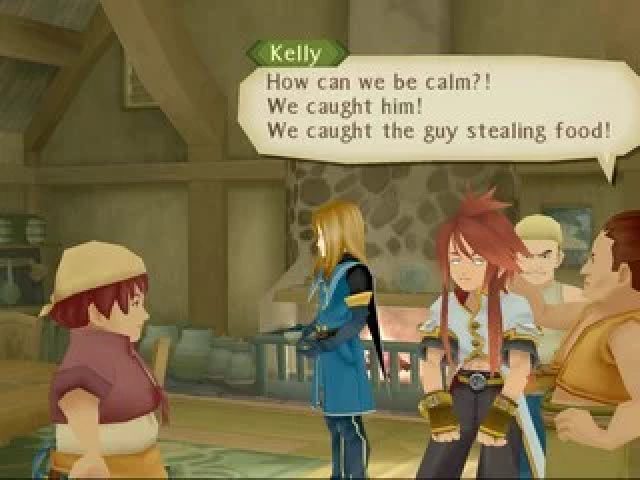 Tales of the Abyss is another in Namco’s long-running Tales series, a series that is now 20 years old! Released in the US in the fall of 2006, 11 years after the first Tales game, Tales of Phantasia for the SNES, it shares many of the same features. While Tales of the Abyss did many things wonderfully, it still has a few glaring flaws which hurt its overall appeal.
Similar to Grandia 2, I didn’t like the main character, Luke, at first. Unlike Grandia 2, however, his character development is special, especially in the second half of the game. It is rare to see characters grow and become so much deeper in the span of an RPG. The character progression does not stop there.
Guy is another person who experiences a lot and is all the better for it by the end of the game. Namco did a fantastic job with Luke and Guy, and they deserve credit for showing two people grow in a mature fashion that wasn’t shallow or cliché like other RPGs.
Not all characters were as likable, and I found Anise’s constant money-grubbing ways quickly tiring, and she fails to grow much further past that.
Jade was also obnoxious to me and went too far, at times, scolding the other party members and sometimes being downright mean. Plus, despite his vast knowledge, he came across as too much of a know-it-all for my tastes. He is witty but, sadly, uses that wit to break characters down more often than not, rather than build them up. Good in places, but exhausting when it becomes all too common.
On the other hand, I found Tear was tough on others and rough around the edges, especially with Luke, was coming from a good place deep down inside. Plus, her advancement, while not as moving as Luke or Guy’s, was still lovely.
Finally, Natalie and her superior attitude were infuriating at first, but a key plot point helped her grow up and become a more valuable contribution to the party. In fact, I laughed when she was knocked down a few pegs in the beginning. But the Abyss does a good job of helping you to feel sympathy later on.
Finally, there is Mieu. Luke is a huge jerk to Mieu at first. I get it, Mieu is irritating, and I always skipped past his dialogue. But he is useful to solve puzzles, by hitting distance switches with fire, breaking walls with “Mieu attack,” and helping Luke float to out-of-reach ladders or platforms. Still, I muted the volume quickly anytime I had to use Mieu. He wasn’t cute, which it seems was what Namco was going for. That was a fail.
Asch is Luke’s doppelganger, of sorts, and the interaction between the two is exceptionally complicated but well done. Finally, there are the six god generals, the story’s main antagonists. Sync was aggravating, and it was a pleasure to wail on him in battle. Dist was flat-out annoying, ostentatious, and over the top. Largo and Van were the two coolest, but I despised Van for how sneaky he was. Arietta has a funny rivalry, of sorts, with Anise. Legretta was the most badass of the six major antagonists and has a history with Tear, her former protege which explains a great deal about why Tear is the way she is.
Watching the characters change so much was fun. However, all of the required backtracking to unravel the plot was, at times, outrageous. There are about a dozen towns, but you better get used to them, as this game requires a ton of bouncing between them, especially Baticul, Daath, Chokomah, and Chesedonia.
Normally this wouldn’t be an issue considering you get a plane early on, much earlier than a lot of RPGs. But it moves slowly on the map, and for a long time, you have to find a small, special spot to move between most of the world and the outer lands where Yulia and Chesedonia are. Auto-pilot comes along far too late in the game, at about the 80% point, and even after the autopilot, there is a ton of required moving about these few towns for a short scene here, another short scene there, yet another one over there, ad nausea. Plus, some of these towns are a pain to navigate, such as the cathedral of Daath, which felt more like a maze than a church. Deciding to do some of the sidequests, like finding the ten stones for Jade’s best attack, only adds to the amount of backtracking; be warned. Even by RPG standards, for someone who is experienced with the genre, the amount of backtracking in Tales of the Abyss is insane.
This is a shame because, at its core, the story is excellent. Luke was kidnapped seven years ago and returns to his family with no memories of what occurred before that. While this sounds like a typical amnesia plot that some games of the genre like to employ, it is much deeper! To protect him, Luke’s family has him confined to a large manor near the town’s castle, wistfully yearning for excitement, which is where the game starts. As his background is slowly revealed, it becomes evident why he has no memory from before the kidnapping. The game starts on a day like any other; Luke is staring out the window and lets out a sigh. This start is low-key, but Luke is quickly thrown into the outside world. It is almost like being thrown to the wolves, and he struggles for a good chunk of the game and is clearly a fish out of water, but slowly learns how to cope.
The future of the world in this game is predetermined, set by Yulia, a revered religious figure. This future is called “The Score,” and following it promises everyone who adheres to it to a T a prosperous life. The Score is documented throughout the world, and a dedicated holy group emerges to make sure these prophecies come true, at all costs. However, the Score predicts war, slaughtering of entire groups of people, and other atrocities. But despite this, far too many people accept these predictions. People justify their actions by saying they are simply following the Score for a successful, good life, and that not following these predictions would lead to far worse. A serious case of “We don’t want to rock the boat” attitude.
There are small pockets of resistance against the score, but does this resistance have pure intentions? Part of their resistance includes the creation of replica people, created to go against the score. In other words, a copy of every single person. Some of these replicas not only start appearing around the world but integrate within society, but many struggle or never find out they are replicas.
At certain points in the game, you can press select to get deeper insights into the character’s current feelings. The novelty soon wore thin as you are constantly being bombarded by the “Press Select” at the bottom of the screen, sometimes with two, three, or even four in a row! After a while, I just got bored with it. Used much more sparingly, these could have been better. Plus, they are just dialogue boxes, rather than actual extra scenes you would get in a game like Star Ocean 2 (PSX). Those extra scenes were actually fun to find! In this game, there are 489 such scenes, called “skits”.
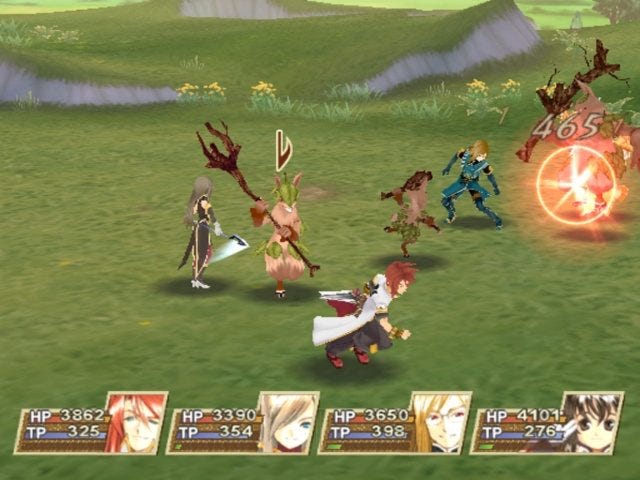 Similar to other Tales games, battles are fast-paced and performed in real-time. It’s important to learn how to link artes to create large combos in Abyss. I struggled to get over 50, though I imagine other more skilled players could easily hit triple digits with the right enemies. Players can only control one character at a time, and the AI controls the other 3. However, it is possible to set up general strategies for the other 3. They can defend, attack the same enemy as the character you control, or an entirely different one. You can control how much they use their artes and what artes they cast via the strategy menu. Some skills aid everyone in battle. There are capacity cores found throughout the world that boost stats too. You are also presented with a grade at the end of battles.
One aspect I never understood was the field of fonons, but it seems magic casters can place elemental circles on the field, and if Luke stands in them and uses a certain attack of the same element, better, stronger attacks can occur. I was never certain if I was doing this correctly and found that mashing X with a few timely button presses got me through the entire game.
In fact, the Abyss is not too difficult, aside from a few late-game bosses, and requires minimal grinding. If only EXP were the sole worry. However, a lot of grinding is needed because the price to upgrade equipment is very high. Even after grinding a lot to get the best gear, it is hard to stock up on healing items as they are also very expensive early. Not until much later in the game, at least 3/4 of the way through, do you ever start to have excess money. For the last boss, I was level 68, but I reckon those levels would have been a lot lower without the frequent extra battles just for money. The game tracks the number of battles, a neat little feature, and I was about 950 with 25 escapes, most of those likely because of one story boss which requires you to escape several times.
At different parts of the game, or via sidequests, characters can earn titles that can be changed in the status screen. While they are often fitting of the character’s personality, I never fully understood the point, or if there were any changed any stats. Though at one point, changing to one of the titles I earned late in the game changed Luke’s appearance. There is also cooking; I found 17 recipes, many of which are well hidden or only obtainable via sidequests. Though I never cooked. This was a shame because in Star Ocean: The Second Story, I was always cooking and it was almost mandatory for a more seamless playthrough of the later dungeons. Here, however, it felt more like an afterthought, especially considering many of those 17 were unlocked in the second half of the game.
Visuals have never been a make-or-break deal for me, but there are better-looking games from the 2005–2007 time period. Personally, the anime-style graphics are very nice, but I could see how others might not be impressed. There are not a lot of cutscenes, but much of the game is voiced, and quite well; for a PS2 game, they are solid. Luke, Guy, and Tear are some of the best. Mieu is god-awful, as is Dist. Some of the other god generals are well done.
The music ranges from excellent, like at Daath (reminding me of older Tales or Star Ocean games), to bearable, such as the battle music, to downright awful, such as the track during the optional puzzles (to organize boxes). Luckily, most of it is, at worst, average. Some are even peaceful, like some of the town and dungeon music. Oddly enough, as great as many of the voices are outside of battle, they are horrendous in battle. I had to mute battle voices via the menu (what a godsend) before I even reached two hours. Trust me, battles are much better without the voices! Those 950 battles would have felt like more of a slog without the ability to turn off battle voices.
Overall, Tales of the Abyss is a solid game that gets weighed down by what sometimes feels like endless backtracking. Plus, there's tons of required grinding in the first half to afford the latest equipment. Addressing these two points would have made Tales of the Abyss feel more seamless, as the flow of the game is greatly bogged down by all the movement between the same few towns. Thankfully, some of its more negative features, such as in-battle voices, can easily be turned off. If you can get past the frequent travel between already visited places, the battle system is inviting enough, and the character development is top-notch by RPG standards. If you liked previous Tales games like Phantasia, Destiny, and Eternia, this is basically an evolved version of those three and will likely be something you will like too.
Wayback Wednesday Volume 1: Final Fantasy 7 and Chrono Trigger.
Wayback Wednesday Volume 2: Super Metroid and Castlevania: Symphony of the Night.
Wayback Wednesday Volume 3: The Legend of Zelda: A Link to the Past and Lunar: Silver Star Story Complete
Wayback Wednesday Volume 4: Secret of Mana and Wild Arms
Wayback Wednesday Volume 5: Illusion of Gaia and Grandia
Wayback Wednesday Volume 6: Breath of Fire 3 and X-Men Legends
Wayback Wednesday Volume 7: Star Ocean: The Second Story and Super Mario RPG
Wayback Wednesday Volume 8: Demon's Crest and Dragon Quest VI
Wayback Wednesday Volume 9: Suikoden I and Jeanne d'Arc
Wayback Wednesday Volume 10: Ranking the first 6 Final Fantasy games
Wayback Wednesday Volume 11: Earthbound and Valkyrie Profile
Wayback Wednesday Volume 12: Legend of Legaia and Secret of Evermore
Wayback Wednesday Volume 13: Threads of Fate and Soulblazer
Wayback Wednesday Volume 14: Radiata Stories and Robotrek
Wayback Wednesday Volume 15: Rogue Galaxy and Vandal Hearts
Wayback Wednesday Volume 16: Chrono Cross and Muramasa: The Demon Blade
Wayback Wednesday Volume 17: Okami and Legend of Mana
Wayback Wednesday Volume 18: Paper Mario and Terranigma
Wayback Wednesday Volume 19: Dragon Quest VIII and Atelier Iris 2: The Azoth of Destiny
Wayback Wednesday Volume 20: Ranking the 6 console Final Fantasy games from the PS1 and 2
Wayback Wednesday Volume 21: Eternal Sonata and Actraiser
Wayback Wednesday Volume 22: Persona: Revelations and Tales of Destiny
Wayback Wednesday Volume 23: Shadow Hearts: Covenant and Dragon View
Wayback Wednesday Volume 24: Ken Griffey Jr. Presents Major League Baseball and Lunar: Eternal Blue
Wayback Wednesday Volume 25: Suikoden II and Xenogears
Wayback Wednesday Volume 26: Azure Dreams and Wild Arms 2
Wayback Wednesday Volume 27: Ar Tonelico and Sword of Mana
Wayback Wednesday Volume 28: Albert Odyssey and Super Paper Mario
Wayback Wednesday Volume 29: Arcana and X-Men Legends II
Wayback Wednesday Volume 30: 10 over-rated classics that haven’t aged well
Wayback Wednesday Volume 31: Dragon Quest IX and E.V.O.: Search for Eden
Wayback Wednesday Volume 32: Tales of Symphonia and Elemental Gimmick Gear
Wayback Wednesday Volume 33: Ys Seven and Brain Lord
Wayback Wednesday Volume 34: Lufia and The Legend of Oasis
Wayback Wednesday Volume 35: Kingdom Hearts: Birth by Sleep and Magic Knight Rayearth