

Where’s Waldo? I used to spend hours poring through these books, not just looking for Waldo, but enjoying every minor detail of every hilarious thing on each page. The world within these books was so varied, and I adored Waldo’s adventures. Adol is cut from the same cloth, which is perhaps why I am so drawn to the Ys series. Like Waldo, Adol has been all around the world and viewed sights and sounds most of us can only dream of. Ys 7 continues with Adol’s travels and occasional misadventures and mishaps.
 You see, sometimes, even if you don’t go looking for trouble, trouble still finds you. Adol and his loyal pal Dogi are addicted to adventure, so it would only make sense that they find themselves in hot water on occasion. But sometimes trouble intervenes when you are simply trying to do the right thing. After saving two flower girls from meat-headed knights in the kingdom of Altago, Adol and Dogi are thrown into prison. Ending up in jail is nothing uncommon, as they seem to wind up in jail more than a kleptomaniac without thieving skills. Fortunately, their reputation as travelers precedes their “crime,” and they are quickly summoned to meet with the king of Altago to investigate mysterious earthquakes. On their journey, Adol and Dogi are joined by seven other friends as they learn that 5 dragons are waking up from a deep slumber to try and prevent a devastating calamity.
Ys has gone through quite a transformation over the course of about a dozen games. The series was famous for its bump combat in 4 of its first 5 games: Ys 1, 2, and both versions of 4 (Mask of the Sun and Dawn of Ys), the only deviation being Ys 3, which was a subpar 2D side-scrolling platformer with RPG elements. Otherwise, in the other 4 games, hurting enemies required running into them at a slight angle, not head-on. It was unique and hard to get used to, but addicting once it clicked. Ys 5 symbolized a turn in the franchise as the combat moved towards something resembling a simplified version of Secret of Mana mixed with The Legend of Zelda: Link to the Past. It was decent but lacked any originality. Ys 6: The Ark of Napishtim improved the combat and is said by some to be one of the best of all the Ys games. The combat has further evolved in Ys 7 with the party system. Ys 8 and 9 are more accessible as they are on the Switch, PS4, and PS5, so if you are familiar with those games, Ys 7 is a more scaled-down, raw version of those two games.
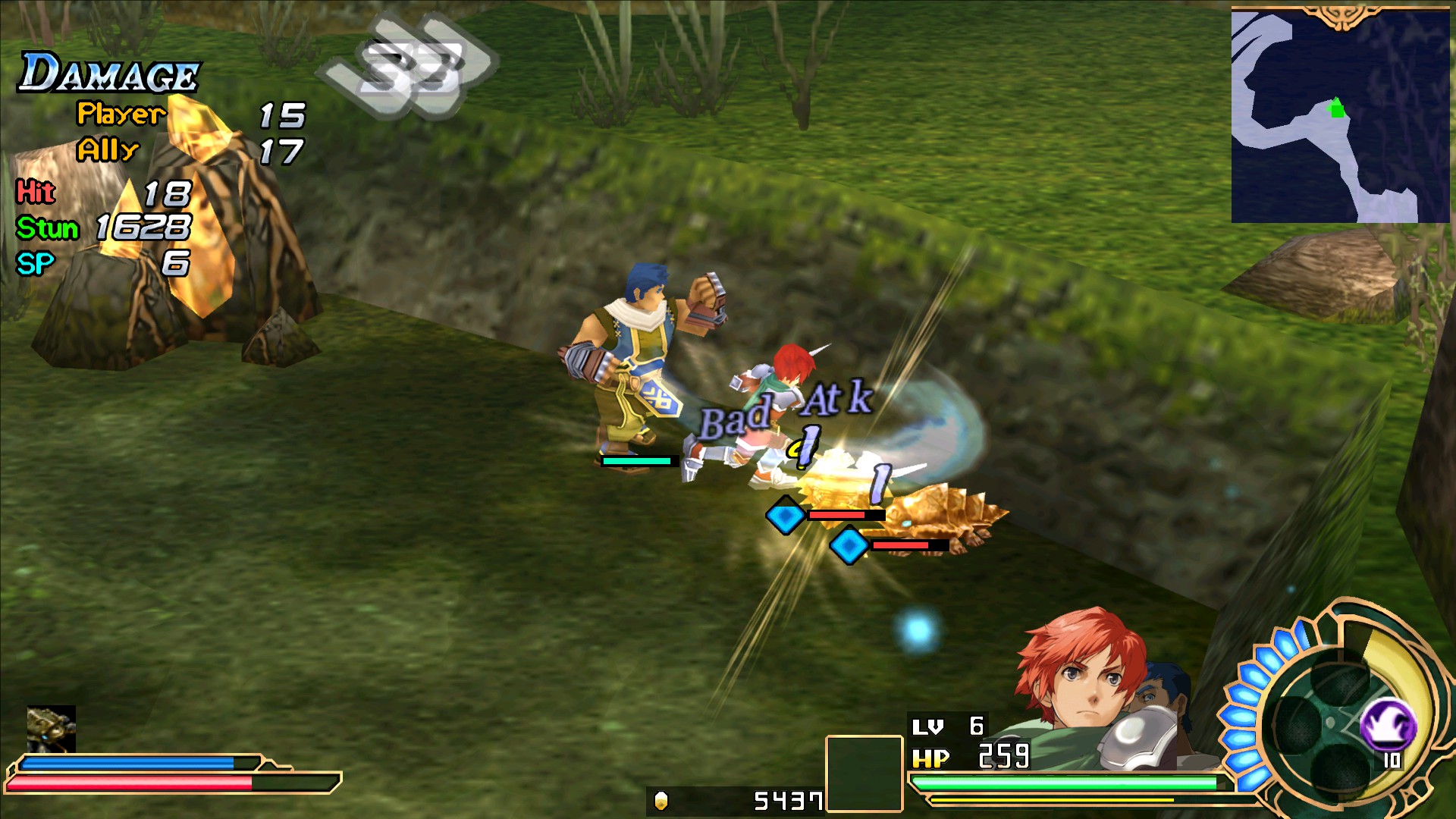
Fighting in Ys 7 is a blast; it just feels somewhat less refined, but it is easy to see this game served as a model for 8 and 9. I mostly stuck with Adol, as he struck me as the most well-rounded, hitting quickly and, later in the game, his best skills can decimate most enemies and seriously hurt any boss. As a hint, charge attacks fill up the SP meter quicker than normal attacks; SP is required for special attacks. Use skills often as they level up! A second meter slowly fills up, and when it is at 100%, it allows for a powerful super attack. Super attacks, when used appropriately, can turn the tide of battle. Switching between three characters of your choice is instantaneous and key to beating all enemies, as different characters have attack bonuses versus different types of foes and likewise are weak versus other types of enemies. The other two are AI-controlled and join in and attack but don’t take damage if they aren’t player-controlled. As long as you have enough healing items and don’t let the other two characters remain at 0 HP, it isn’t common to see the game over screen.
The fast-paced, sometimes heavy instrumental rock is back again, like in previous Ys games, and goes hand in hand with the pacing of the combat. “Rocking the house” for the most part, but suddenly exceptionally stressful during boss battles, many of which are surprisingly tough even on normal difficulty. This is mostly because a lot of focus is required to respond quickly and either roll out of harm’s way or try to guard at exactly the right moment. As long as silly mistakes are not made, most bosses should fall, at worst, within 2 to 3 attempts. Speaking of rolling, I did not see any way to run; you can only roll around to try and speed things up.
This wouldn’t even be such a huge issue, but fast travel is only somewhat useful. At times, your ability to fast travel is completely lost, and it is necessary, for example, to traverse the entire world looking for little symbols to progress the game. One of those cases of “Now I know I saw something like that hours (of gameplay, possibly days in real-life time) ago, but where?”
For those with poor memory, make notes as detailed as possible! There are a lot of places you need to return to after a long gap. This could have been solved by the developers by expanding the world map and adding a few new locations and dungeons, rather than retracing the same places.
Ys has always been heavily gameplay-focused, so it should come as no shock that, even for the time and even considering this is for the PSP, it does not measure up to other triple-A RPGs graphically. Bosses still impress, and villages are generally a warm welcome from the chaos of dungeons and field maps. Dungeons tend to be bland and not too interesting to explore. Maps are somewhat useful in finding your bearings, but some of them are labyrinths where a switch in one room might change something in some far corner of the dungeon far away, so, again, a test of memory. Everything looks familiar, but it can be difficult to see how everything is interconnected, especially when everything is also so similar. Underwater passages connect two rooms you never would have thought would be near each other; falling down random pits takes you to rooms with hidden switch plates, and taking a leap of faith, with the wind cape, onto a windstream that sends you hurtling towards some random platform. If it sounds amusing, great, but it can lead to some confusion, especially late game.
There are a few items at the party’s disposal to help in progressing through each dungeon, found at different, predetermined junctures in the game. The aforementioned wind cape, boots that can walk on spikes, a rock that lights up dark places, another item that lets you breathe underwater, hooks that improve traction on ice, a crystal that lets you walk on lava, an item that helps to withstand poison air, and sap that helps some vines or plants grow rapidly. Not all that dissimilar from what has been seen in the past with Link to the Past or Lufia 2.
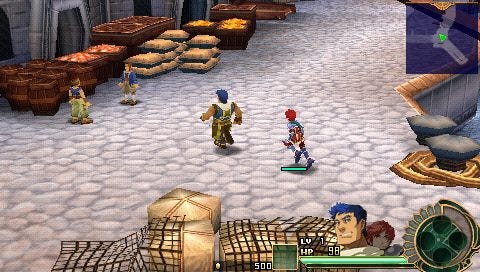 A journal found within is invaluable for those wanting to explore deeper aspects of the game. Mainly the monster list and quest log. There are 20 extra quests throughout the game, the first 12 expiring around 3/4s of the way into the game. Talk to everyone in each town, and it will be easy to find all 20 quests. Most of them aren’t too hard to finish, though a handful of them are time-consuming and require a lot of back and forth between various locations, mainly the two quests where an old woman wants you to check up on a shrine in the forest and another where you have to collect a guy's animals scattered around the world. Another case of, “I saw them in my journeys, but some of the ones I saw were nearly 10 hours’ worth of gameplay ago!” Even new games fail to allow map markers; this game is no different, sadly.
The journal also proves imperative for remembering what monsters drop what items. Trust me, there are few games with as many enemy drops as Ys Seven. It seems every creature has a decent nest egg. Scattered around the world, dungeons are drop points that also have many items. Making it a point to collect items is important to success, as they allow weapons, armor, accessories, and items to be crafted. This is a pretty rudimentary crafting system, but at least intuitive.
The Ys series has been consistently solid, other than 3. Ignoring that one exception, there isn’t a clunker in the bunch. 7 is as good a place as any to start for anyone new to the series, and seasoned fans are likely to like this game a great deal. Take out some of the tedious late-game backtracking, add in a few quality-of-life improvements, and clean up some of the duller dungeon scenery, and you are left with a great, possibly even outstanding game.
Wayback Wednesday Volume 1: Final Fantasy 7 and Chrono Trigger.
Wayback Wednesday Volume 2: Super Metroid and Castlevania: Symphony of the Night.
Wayback Wednesday Volume 3: The Legend of Zelda: A Link to the Past and Lunar: Silver Star Story Complete
Wayback Wednesday Volume 4: Secret of Mana and Wild Arms
Wayback Wednesday Volume 5: Illusion of Gaia and Grandia
Wayback Wednesday Volume 6: Breath of Fire 3 and X-Men Legends
Wayback Wednesday Volume 7: Star Ocean: The Second Story and Super Mario RPG
Wayback Wednesday Volume 8: Demon's Crest and Dragon Quest VI
Wayback Wednesday Volume 9: Suikoden I and Jeanne d'Arc
Wayback Wednesday Volume 10: Ranking the first 6 Final Fantasy games
Wayback Wednesday Volume 11: Earthbound and Valkyrie Profile
Wayback Wednesday Volume 12: Legend of Legaia and Secret of Evermore
Wayback Wednesday Volume 13: Threads of Fate and Soulblazer
Wayback Wednesday Volume 14: Radiata Stories and Robotrek
Wayback Wednesday Volume 15: Rogue Galaxy and Vandal Hearts
Wayback Wednesday Volume 16: Chrono Cross and Muramasa: The Demon Blade
Wayback Wednesday Volume 17: Okami and Legend of Mana
Wayback Wednesday Volume 18: Paper Mario and Terranigma
Wayback Wednesday Volume 19: Dragon Quest VIII and Atelier Iris 2: The Azoth of Destiny
Wayback Wednesday Volume 20: Ranking the 6 console Final Fantasy games from the PS1 and 2
Wayback Wednesday Volume 21: Eternal Sonata and Actraiser
Wayback Wednesday Volume 22: Persona: Revelations and Tales of Destiny
Wayback Wednesday Volume 23: Shadow Hearts: Covenant and Dragon View
Wayback Wednesday Volume 24: Ken Griffey Jr. Presents Major League Baseball and Lunar: Eternal Blue
Wayback Wednesday Volume 25: Suikoden II and Xenogears
Wayback Wednesday Volume 26: Azure Dreams and Wild Arms 2
Wayback Wednesday Volume 27: Ar Tonelico and Sword of Mana
Wayback Wednesday Volume 28: Albert Odyssey and Super Paper Mario
Wayback Wednesday Volume 29: Arcana and X-Men Legends II
Wayback Wednesday Volume 30: 10 over-rated classics that haven’t aged well
Wayback Wednesday Volume 31: Dragon Quest IX and E.V.O.: Search for Eden
Wayback Wednesday Volume 32: Tales of Symphonia and Elemental Gimmick Gear