

Xenogears. A game that, when mentioned, brings memories flooding back to many people who grew up at the height of the PlayStation’s popularity, but also one of the most polemic, non-M-rated games released during the era. A game that had a lasting impact on me, an impressionable 15-year-old, and likely many other teens around the globe.
I loved Xenogears when I played it in 1999, but that love also caused me to hesitate to replay it for nearly 20 years. I rated it a 9.5/10 when talking with my friends back then, but after beating it in the spring of 1999, I put it on a shelf where it remained for two decades, never sure if playing it again would shatter those memories. I finally picked it up again in October 2019, ready to see if Xenogears still holds up, no longer anxious about those concerns.
I was blown away by the topics Xenogears covered pretty much right after putting the disc in my PlayStation on a cold winter day after school in February 1999. On my more recent playthrough, with twenty years of experience and wisdom, I was still able to appreciate the game for the topics it covers, especially when the majority of games, even to this day, shy away from them in favor of a less controversial, easier-to-digest story. Philosophy, religion, mental health, war, corrupt government officials, social classes, terrorism, racism, segregation, and more are all confronted in Xenogears. Though the subject matter is mature, I found these topics were covered on a basic, somewhat superficial level. Of course, I wouldn’t tell my 15-year-old self that.
The character development for the main characters, such as Fei, Elly, Bart, and Citan, is top-notch for its time, and without spoiling, twists, turns, and surprises with characters you thought you were getting to know so well are guaranteed.
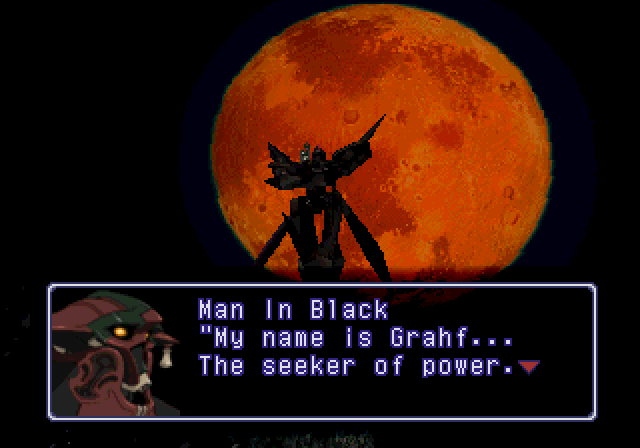 On the other hand, I would have liked to see the developers scale back the number of antagonists, as the backstory and dialogue for many of them were not just forgettable, but glossed over, and sometimes it seemed like characters were neglected for 10, 20, or more hours at a time. A few bad guys took center stage as the plot moved forward, and at least a few of them had intriguing backstories, especially Ramses. The story would have benefited from the “less is more” approach. Fewer enemies, more focus on the ones that remain. Honestly, as it stands, it leaves the story feeling disjointed.
In fact, according to an interview done at E3 in LA in 2017, it was confirmed that the story was incomplete. I won’t get into that much more, as it is beyond the scope of this review, but it confirmed a feeling I had after finishing the game for the second time. It was jumbled, with too many loose ends and too many things introduced but only explored on a simple level. Indeed, this was supposed to be part of a much larger epic. You get that sense while playing, and many gamers will likely be left thinking, “What could have been,” once they become aware of this.
Most of the heroes served a purpose in the story, but I was left wondering what Chu-Chu added. It seemed completely unnecessary, like a poor attempt to cash in on the ever-present mascot trend, and it was nowhere near as interesting as Mog or the Chocobo from the Final Fantasy series. Esmerelda also rubbed me the wrong way and, despite being useful in battle, didn’t add much as a character. I don’t think much would have been lost by removing either of them from the story entirely.
Disc 2 gets a lot of flak from some corners of the gaming community for its extended narration. I have mixed feelings, but some of this criticism is undeserved. Partially because Disc 1 has a lot of text too, and because all that text in Disc 2, at the very least, helps wrap up several loose ends left from the first disc. It also depends on how engaged you are in the story from the start. If you carefully read every detail in Disc 1 and reflect on what is occurring, Disc 2 will likely have a completely different feel than if you speed through the text.
There are several worthwhile payoffs in the closing hours for those who take their time, but if you rush through the first disc, the second will likely be a bore-fest. Granted, it would have been better if what is explained on the second disc had been playable in new towns and proper dungeons, and expressed through more cut scenes, but it is also understandable considering the time constraints the game was under compared with its initial grand vision.
My mixed feelings come from the second half of Disc 2. There is a two-hour (give or take 15 minutes) stretch that will test your patience with its endless text and countless flashbacks. Just a very poor design choice, even considering the time issues. If I could have revived one person to include on the Xenogears team, it would have been Hemingway to focus almost exclusively on the final four or five hours and make it more concise. It was clear time was of the essence on the second disc, as I noticed several errors compared with the first disc and many occasions where text was almost literally repeated.
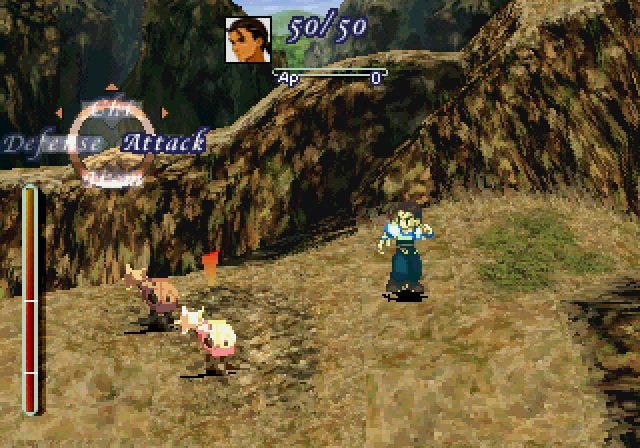 I admit, my younger self was also more impatient, not just with the text but even within battles, and I recall mashing the X, Triangle, or Square button randomly to get through most random battles a little quicker. Any Death Blows gained through this process were purely incidental
With age, I have gained patience and an appreciation for the slow but steady progress required to gain a plethora of different Death Blows as early as possible, especially to face that one infamous boss in the sewers. What I enjoyed on my second playthrough of Xenogears was the level of engagement required during battles. Where many RPGs of that time, and even to this day, are content to let the player rapidly pound a button ad nauseam to breeze through battle after battle, Xenogears expected you to take your time and try new combos, as the slow and steady approach worked to your advantage by making boss battles more efficient through stronger Death Blows acquired earlier.
In this game, you have three different attack buttons: X, Square, and Triangle, accompanied by an AP meter that starts at 4 and eventually grows to 7 as you gain levels. Triangle is a weak attack worth 1 AP, Square is a medium attack worth 2 AP, and X is a strong attack worth 3 AP. It is up to the player to mix and match these attacks while considering the current amount of AP to eventually create combo attacks known as Death Blows, which do far greater damage than a string of normal attacks. Each Death Blow has its own AP requirement, so you have to faithfully use these button combinations several times before mastering them and finally unleashing them in battle.
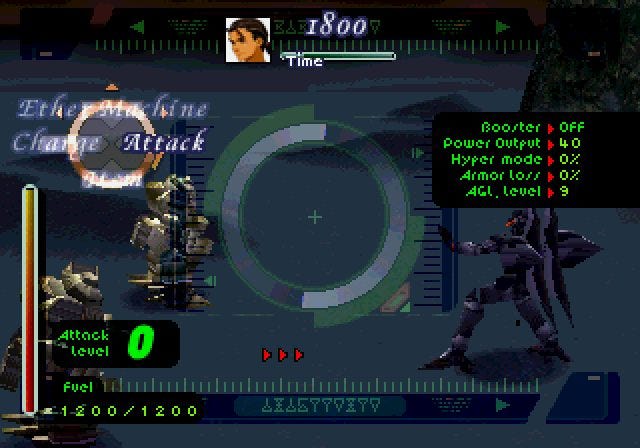 However, you don’t battle just on foot but also in giant mechas known as “gears,” hence the name. While these battles were impressive to look at, upon playing the game a second time, I couldn’t help but wonder if the level of customization could have been vastly improved by adding more options along the lines of Front Mission. Heck, I felt even Metal Max Returns for the SNES allowed for more customization of its tanks than the choices you have here!
You have three characters in battle, and usually one is Fei, though on rare occasions, he will not come along on a mission. As far as, for lack of a better word, grinding (since very little is required), my advice is to pick three characters to go along with Fei and focus on building them up and finding their Death Blows. Why three and not two? Well, for one, there are times Fei is not there. Second, one character rather inexplicably leaves toward the end of the second disc. Although you later find out the reason, it is still annoying. I picked this specific character whenever I had the chance, finding every single Death Blow, only to be blindsided in the last 5% of the game when they left. I don’t want to spoil who this character is, but if you don’t want to use a walkthrough, it is better to focus on one extra character just in case one of your favorites leaves at the end.
Dungeons and other enemy-infested areas, such as mountains and forests, start small and are easy to navigate despite the awkward camera. It is great that it can be rotated 360 degrees, but the farther you advance, the more it hinders exploration rather than helping you find your way. There are a few places that would be incredibly simple in a 2D RPG that could end up confusing gamers in Xenogears, starting with the church basement. Even peaceful zones like Bart’s ship, the Yggdrasil and its various incarnations, and the Thames have needlessly convoluted layouts that left me wondering, “Why does it have to be set up like this?” The layouts could have been much more streamlined, and I left feeling I should not have spent nearly as much time getting used to where everything was instead of simply moving on to the next task. It is a personal source of pride that I made it through the last dungeon and really the large majority (99%) of the game without the aid of a walkthrough. If anyone is eager to do the same, it is possible, but you may very well be tempted to look for solutions a few times!
The poorly functioning camera, at least in part, is what made some of the jumps during platforming sections harder than they should have been. While a good idea at its core, these jumping sections were terribly executed and led to some frustrating moments, including the Tower of Babel, especially when coupled with random encounters. A few times, a random encounter occurred just as I was pushing the jump button to cross a gap, and when the battle ended, my characters had fallen. That, of course, is a personal preference, but I strongly dislike random encounters interrupting actions that require careful, uninterrupted thought, like a precise jump or a difficult puzzle.
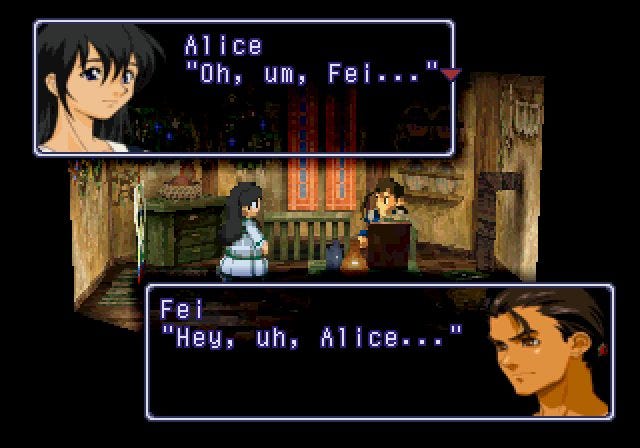 As for the graphics, they have not aged well, a result of 3D gaming still being in its infancy in 1998. Especially compared to some of the gorgeous 2D games like Legend of Mana or Saga Frontier that were stunning. Here, they are pixelated, rough around the edges (and only further marred by the camera), and not pretty to look at. Of course, compared to the story, which is clearly the focus, this is a minor issue. Cut scenes look much better, but the English dubs are laughably atrocious, and the voice acting leaves a lot to be desired, even if used very sparingly.
Xenogears is fairly easy, with only a few notable difficulty spikes. That one boss in the sewers, infamous with nearly everyone who has played the game, is likely to be the first stumbling block. Another occurs toward the end of Disc 1, where the player faces four bosses back to back with no healing in between. Granted, you have two separate parties, but if you make the wrong gear choices, you could be in for a world of hurt and wasted time. I was not happy with the lack of healing here, especially since later battles are much more generous in preparing you for what is to come, including the last battle on Disc 1. At times, the difficulty was uneven, but for the most part it was manageable.
The time to complete will likely range from 40 to 80 or more hours. As a teen, I reached the last save point at 59:33, with Fei at level 76 and Bart and Citan at level 71. On my most recent playthrough, I beat the game in 49:26, with Fei at 73 and Billy and Citan at level 69. There are not a lot of side quests, and the game is easy enough that the extra gear you get during these optional quests is not required.
Xenogears is quite an interesting journey that every gamer should at least attempt. I do not think as highly of Xenogears as I did in the past, but I can still appreciate it for the valuable gaming relic that it is. My younger self was probably more impatient but more forgiving. On my second playthrough, I am more patient with many of the game mechanics but much more critical of other aspects that may have astounded me 20 years ago, such as the awful jump mechanics and sometimes jumbled story, with characters that seem to go MIA for 10 or more hours at a time. This is not the legendary game I remember as a teen, but I still strongly believe it is a solid, albeit incomplete, piece of PlayStation history that should be on every RPG fan’s must-play list.
Wayback Wednesday Volume 1: Final Fantasy 7 and Chrono Trigger.
Wayback Wednesday Volume 2: Super Metroid and Castlevania: Symphony of the Night.
Wayback Wednesday Volume 3: The Legend of Zelda: A Link to the Past and Lunar: Silver Star Story Complete
Wayback Wednesday Volume 4: Secret of Mana and Wild Arms
Wayback Wednesday Volume 5: Illusion of Gaia and Grandia
Wayback Wednesday Volume 6: Breath of Fire 3 and X-Men Legends
Wayback Wednesday Volume 7: Star Ocean: The Second Story and Super Mario RPG
Wayback Wednesday Volume 8: Demon's Crest and Dragon Quest VI
Wayback Wednesday Volume 9: Suikoden I and Jeanne d'Arc
Wayback Wednesday Volume 10: Ranking the first 6 Final Fantasy games
Wayback Wednesday Volume 11: Earthbound and Valkyrie Profile
Wayback Wednesday Volume 12: Legend of Legaia and Secret of Evermore
Wayback Wednesday Volume 13: Threads of Fate and Soulblazer
Wayback Wednesday Volume 14: Radiata Stories and Robotrek
Wayback Wednesday Volume 15: Rogue Galaxy and Vandal Hearts
Wayback Wednesday Volume 16: Chrono Cross and Muramasa: The Demon Blade
Wayback Wednesday Volume 17: Okami and Legend of Mana
Wayback Wednesday Volume 18: Paper Mario and Terranigma
Wayback Wednesday Volume 19: Dragon Quest VIII and Atelier Iris 2: The Azoth of Destiny
Wayback Wednesday Volume 20: Ranking the 6 console Final Fantasy games from the PS1 and 2
Wayback Wednesday Volume 21: Eternal Sonata and Actraiser
Wayback Wednesday Volume 22: Persona: Revelations and Tales of Destiny
Wayback Wednesday Volume 23: Shadow Hearts: Covenant and Dragon View
Wayback Wednesday Volume 24: Ken Griffey Jr. Presents Major League Baseball and Lunar: Eternal Blue