
What do you get when you mix Skies of Arcadia, Star Ocean, Dragon Quest 8, Final Fantasy 12, and add in a pinch of Radiata Stories? Something similar to Rogue Galaxy, released in North America in 2007 by Sony and developed by Level 5 and Japan Studios. That isn’t to say Rogue Galaxy is some derivative of the aforementioned games, far from it, but it is the easiest way to describe it to newcomers.
Rogue Galaxy, as the name implies, takes place across many planets in a fictional galaxy. This is a great idea, and each planet is different, but it feels like a missed opportunity to present truly outlandish planets and locations. There is a planet that looks similar to the Amazon rainforest, one that looks like it could be in Egypt, a water world that could be in the South Pacific, and a few futuristic planets. But nothing that stretches the imagination or pushes the limits of what a planet could be. Just the same, each planet is gorgeous.
The story follows Jaster Rogue, a laborer from a distant planet. He is likable enough, and most of the people he meets have interesting backstories. Some feel somewhat tacked on, like Deego, while others are surprisingly touching, like Steve. In fact, what first felt like some Star Wars castaway, concerning Steve, quickly turned engaging during any of his scenes, usually at save points. Jupis was the perfectly obnoxious antagonist in the first part of the game that you couldn’t wait to beat the living daylights out of. There is even some backstabbing to be found in the game from another character, but it was rather predictable. One interesting thing I found about this game is that every time you load a save, you’re given a brief update on where you are in the story. So, in case you have forgotten where you are in the plot, there are a few paragraphs, somewhat similar to what you might find in the introduction to Star Wars, that will remind you.
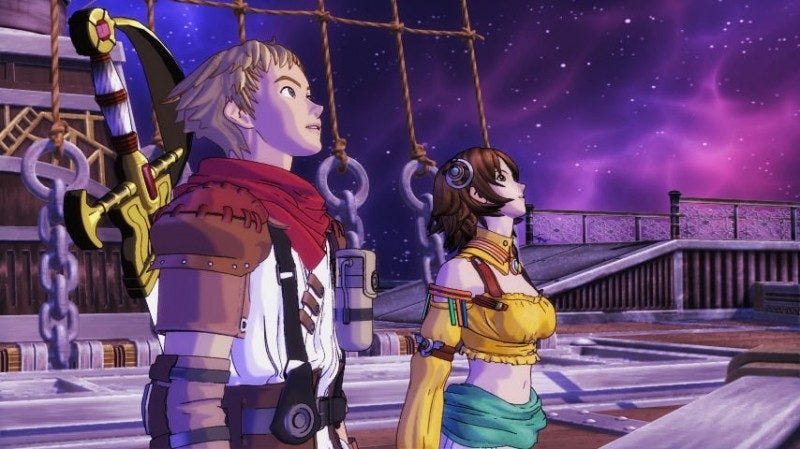
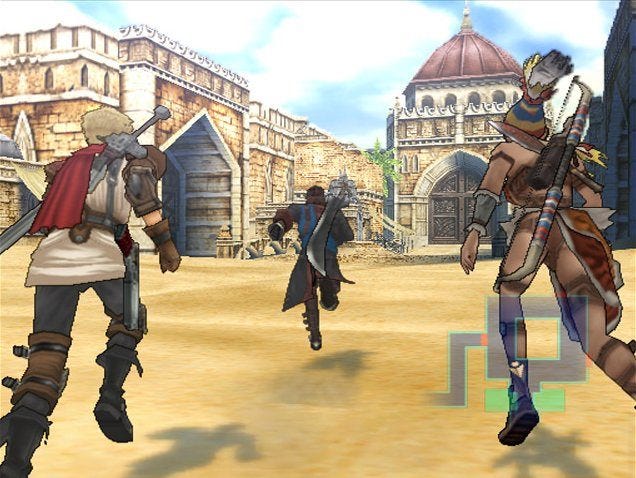
Right off the bat, it is easy to see this game has style. Most reminiscent of Dragon Quest 8 or Wild Arms 3 for character models, Rogue Galaxy boasts gorgeous cel-shaded graphics. Sadly, this does not always extend to dungeons. While there is some stunning attention to detail in places like Burqaqua, or Gladius Tower, some places fail to inspire, especially while in prison (Chapter 4), stretches in the desert, or, sadly, even a certain lair at the end of the game in the last chapter. I have seen better final dungeons in previous console generations! Still, for the most part, the game looks excellent.
 Rogue Galaxy has one of the best songs in RPG history with the Dorgenark theme. I adore jazz, so I admit I am biased, but even setting that aside, it’s a catchy track that gets your feet tapping. It’s rare to find many RPGs that lean into jazz, though Radiata Stories comes to mind. Boss battles here don’t rely on the usual ominous tones, but something about them still stands out. There’s a slight unease, not as intense as other boss themes, but powerful in its own way.
Rogue Galaxy goes out of its way to make sure there is some comedic relief, and there are some scenes that should lead to laughter. Radiata Stories is the only game I can think of for the PS2 that made me laugh more. It was not always a success as Jupis is obnoxious, though I could see the goal was to make him/it a laughable antagonist.
It should be stated that any dislike for specific party members should be set aside; you need to build everyone evenly. I was surprised to find that, by the end of the game, I suddenly had to rely on characters I had barely used. Without getting too close to walkthrough territory, the point is simple: don’t ignore anyone in your party, and don’t neglect equipment upgrades for any of them. Trust me on that.
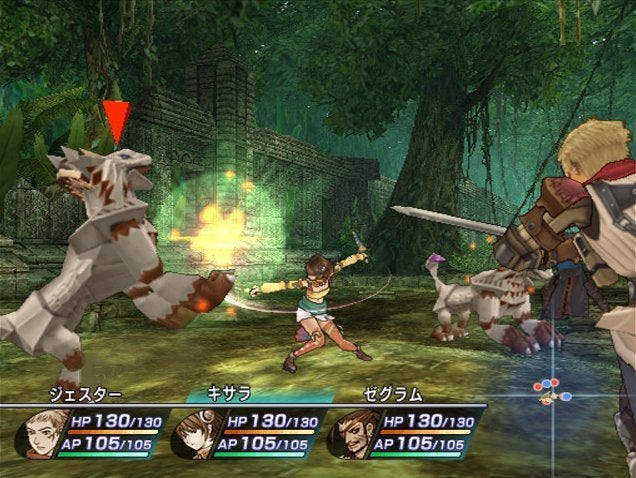 The battle system is a faster-paced version of Final Fantasy 12. Final Fantasy 12 is the gold standard for PS2 games regarding AI-controlled character options. Rogue Stories falls well short of that, but is, otherwise, a simplistic version of that battle system. Most of the game is comprised of rapid attacks followed by long periods of blocking and evading. There is a meter for attack, which slowly decreases with each attack, and once it reaches zero, you can no longer attack and must run around or block and wait for it to fill up to 100% to attack again. This meter is also tied to item usage, and the meter needs to fill before healing items can be used. The same for secondary weapons, which are usually long-range weapons like bows or guns.
There is a synthesis system for primary and secondary weapons, but I never truly understood what I would get until the final product was presented to me. Often, it was only slightly stronger than what I had put into the mix. For those who played Dragon Quest 8, it is very similar to that system. I was able to beat the game, no issue, with minimal use of the weapon crafting system, but considering the large number of weapons available, there seems to be a ton of possibilities. There are many primary and secondary (usually ranged) weapons for each character in chests throughout the worlds and the many shops you come across. This presents a problem that will be addressed shortly.
For those who have played Final Fantasy 10 and 12, something similar to a mixture between the sphere grid and license board exists in Rogue Galaxy. This is a board with many useful stat bonuses and strong in-battle attacks that can only be earned by placing hard-to-find items on a large board. Each character has their own board with specialized attacks and stat bonuses, as well as item requirements that are needed for them. Not all characters require the same items to fill up the board. At first, each character’s board fills up fairly quickly, but as you progress, the best bonuses and attacks require rarer items.
This, along with the weapon synthesis, was very interesting, but it quickly became annoying considering the limited inventory space. Yes, you can shuffle items in and out of your inventory and into storage, but most items are more beneficial and allow for more efficient gameplay by staying in the inventory. After all, as far as I could tell, a weapon in storage can not be found any time you want to synthesize. Or going to a character’s revelation board will not account for items in storage. It was a minor thing that proved to be more annoying than it should have been. I would have preferred a much larger inventory space. Plus, storage can only be accessed at save points. Granted, the game is very generous with save points, but there are so many items you want at hand, at least for me, the storage feels more like a burden.
I won’t mince words, this game is a blast to play, until about 2/3rds of the way through, when players are tasked with navigating through a complex, winding duo of towers where even the map does not help. At this point, the high encounter rate is highlighted. It is difficult to take more than a few steps without having to be thrust into yet another random battle. Battles are fun, but at some point, freely being able to explore far outweighs any temporary fun from random battles. There is an item that lets you avoid random encounters, but it only works for a short time and only protects against lower-level enemies; otherwise, it is worthless. There are a plethora of chests that should make exploring enjoyable. However, every once in a while, these turn into very difficult battles with mimics, battles that are impossible to escape from. Although I never lost to these things, I had a few close calls, and they were always unpleasant and annoying. I felt like it was a cheap temporary difficulty spike. Please, just make all enemies slightly harder and get rid of this cheap gimmick! Each victory earned a hunter point. I had around 50 by game's end, but never found a use for them. Otherwise, battles are easy to escape from; just keep running. I did run into one glitch where I kept running, and running, and running, but never got the prompt to escape or keep fighting. This occurred on the water world that is not part of the main game.
Some challenges randomly pop up at the start of some battles. By beating enemies in a certain amount of time, or without getting hit, or without using the two AI characters, or without using abilities, hunter coins can be obtained. But since I was playing this blind without a walkthrough and also likely missed some early game explanation, I never found a use for these. Using a walkthrough, even just sparingly, would be recommended to understand certain nuances of the game.
There is also a hunter ranking, which increases when you beat a certain number of enemies, and once that ranking hits a certain number, items can be won. Think of it as a College Basketball Top 25 ranking or Top 40 music chart ranking. This monster hunt ranking starts at 100, where Jaster is also ranked, and he slowly climbs up the rankings as he beats more and more specific types of monsters. I ended the game around #40. There are also quarries, specific hidden boss hunts, similar to Final Fantasy 12, that can be found, but I did not seek them out. For a small fee, you earn the right to track them down and beat them.
There is a factory that allows new items to be made. I didn’t make use of this, but it seems to allow for even greater customization. I was happy with the items I could find and purchase, and did just fine with those. Healing items, in this game, are very cheap, thankfully.
There is also another sidequest that involves catching, raising, and mating insect-like creatures. I’ll be honest, I have no interest in games like Pokémon or Digimon and did not take part in this, but there seem to be hours of extra gameplay behind this. I took 46 hours to finish the game, but for those who want to make the most of the insect tournament, factory, and weapon customization, hunter ranking, and monster hunts (quarries), it seems 70+ hours could easily be spent on this game. Thankfully, this is just side content and has no impact, at least for me, on one’s ability to complete the main game.
 Unlike most games that start relatively easy and gradually get harder, Rogue Galaxy feels almost the opposite. It is very rare, even unheard of, for me to die in the first 30 minutes of an RPG. However, two early sub-bosses after Desert Claw completely wiped me out, twice, admittedly. The first few hours are noticeably tough, but the game generally becomes easier as you progress, except for Gladius Tower. Otherwise, especially once you gain access to a few of Jaster’s stronger abilities, the difficulty continues to taper off as the game goes on.
Rogue Galaxy is a unique mix of many different games, and the result is a special RPG for the PS2. Although it gets repetitive at times, mainly chapter 8, it is, overall, a solid adventure with an engaging plot. This is recommended for any fan of the genre.
Wayback Wednesday Volume 1: Final Fantasy 7 and Chrono Trigger.
Wayback Wednesday Volume 2: Super Metroid and Castlevania: Symphony of the Night.
Wayback Wednesday Volume 3: The Legend of Zelda: A Link to the Past and Lunar: Silver Star Story Complete
Wayback Wednesday Volume 4: Secret of Mana and Wild Arms
Wayback Wednesday Volume 5: Illusion of Gaia and Grandia
Wayback Wednesday Volume 6: Breath of Fire 3 and X-Men Legends
Wayback Wednesday Volume 7: Star Ocean: The Second Story and Super Mario RPG
Wayback Wednesday Volume 8: Demon's Crest and Dragon Quest VI
Wayback Wednesday Volume 9: Suikoden I and Jeanne d'Arc
Wayback Wednesday Volume 10: Ranking the first 6 Final Fantasy games
Wayback Wednesday Volume 11: Earthbound and Valkyrie Profile
Wayback Wednesday Volume 12: Legend of Legaia and Secret of Evermore
Wayback Wednesday Volume 13: Threads of Fate and Soulblazer
Wayback Wednesday Volume 14: Radiata Stories and Robotrek