
Check out Part 2, Soul Blazer, here.
Threads of Fate is what you get when clearly a lot of care has gone into making a game, and, for its time, showed a clear path for how 3D RPG games would advance and evolve from 2000 onward.
You can decide to start the game as Mint, who immediately comes off as an obnoxious, spoiled princess, and an older sister to boot, making her behavior even worse. Or you can start with Rue’s story of tragedy, something you will be hit with quickly (within minutes of his story starting) and often. However, to get the most enjoyment out of this game and fully understand the motivations of all characters, it is best to play both stories. Mint’s story should take around 10–12 hours, while Rue’s story will take around 7–9 hours, totalling about 17–21 hours. By PlayStation RPG standards, this is on the shorter side. Not to fear, there is a new game + where stats carry over, so you can get many more hours of enjoyment maxing everything.
Speaking of stats, this game provides a decent level of customization that might not be immediately evident. Did you find a bottle of wine in the underground ruins early in the game, and don’t know what to do with it? Don’t sell it, give it away for free to a shop owner in a back alley. This might seem counterintuitive, but it does two things: 1. Introduces you to the world of stat building, and 2. Gets you a deep discount on those stat-building items. Now players are unlikely to be blown away by the choices; you can pay a small amount to increase HP, MP, strength, or defense. Equipment is even more limited. You have 6 sets, each set including a defense and offensive item, the cost increases incrementally by small amounts of money, and increases defense or offense by 4. That’s it.
On the battlefield, you will climb mountains, run across forests, and dive deep into underground ruins and beyond. During all this fighting, you will not level up, however. There are no levels. If you are hit by enemies enough, your HP will go up. If you use magic, eventually MP increases. On the battlefield, only your HP and MP increase. Using cash to buy equipment helps your strength and defense improve, and the aforementioned shopkeep can sell you items to boost any of the four parameters mentioned before.
Later in the game, you can obtain three types of legendary equipment that further boost Mint and Rue if you collect all three and give them away instead of selling them. After defeating a set number of enemies, you can visit the cook you gave them to, and he will prepare meals that boost your stats. That is about the extent of stat building in this game, but if you want to build a powerhouse or defensive tank, you have resources available if you have the money.
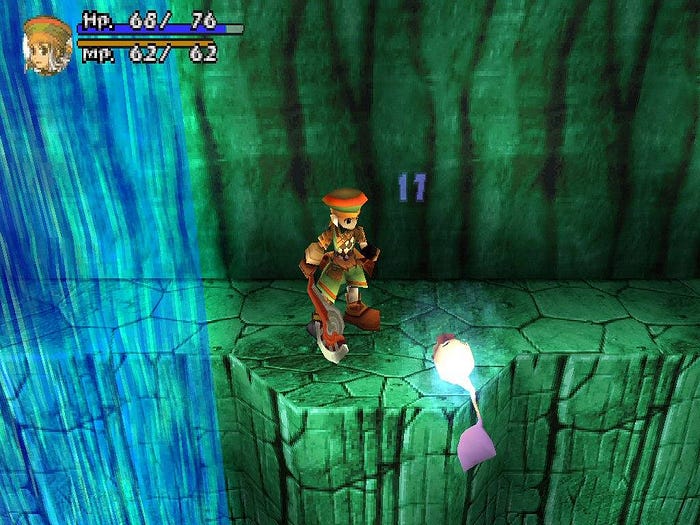 Rue and Mint do not just differ in their backgrounds, attitudes, and general reactions, but also in how they use magic. When Rue kills an enemy, he might get an animal coin. That coin will allow you to transform into that enemy. Outside of a few well-placed barriers and obstacles, this mechanic wasn’t utilized as much as it could have been. It was presented very early in the game but seemed to be an afterthought for much of the game, until the last dungeon, when it was used sparingly and a bit superficially. By transforming into animals that use MP skills, you can increase Rue’s MP total over time. I found Rue’s normal attacks to be more than sufficient and, outside of mandatory usage, did not experiment with his transformations as much as the developers likely wanted.
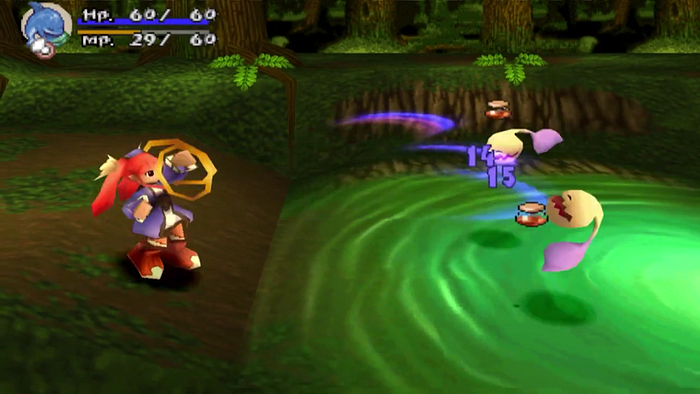 Mint, on the other hand, has a lot of useful spells, and it is likely her MP total will hover around her HP total, maybe even surpassing it by the endgame. Her spells are very powerful, so much so that it is easy to forget that her jumping kick attack is quite powerful and useful, too. I enjoyed the balance between the more powerful Rue, with his occasionally useful transformations, and Mint, who needs to be more clever and defeat enemies with well-timed magic attacks.
Is the game hard? For a seasoned (action) RPG fan, not likely. For someone new to the genre, this could prevent some hurdles. One such example, and one of the hardest boss battles, will occur towards the very start of Mint’s story when you need to face a massive dog. However, this game provides coins: bronze, silver, gold, and platinum, which provide instant revive and thus, a more seamless gameplay experience, especially for beginners, as there is no punishment for losing (other than the boss's HP being revived to full). You won’t have to trudge through a large dungeon or regain stats again.
Some might feel this takes away from the challenge, as coins, especially bronze, are quite plentiful. That is not to say that coins are just for bosses; they can be used at any time in any dungeon with very little consequence. Regarding the dog, even if you lose several times, the stat gains you get during that battle stay with you, so as you use more coins to revive, you are reviving a stronger character, at least as far as HP and MP. However, according to the coin, you only heal 1/4 of your MP if you use a bronze, 1/2 for silver, or all of your MP if you use a gold coin. All coins heal all of your character’s HP.
Some players who are more confident in their skills can sell these coins too. The large majority of this game is easy. One of the hardest parts is a sudden jump in difficulty in Mint’s story, when you get to “Arena 4” and have to fight countless strong behemoths with no healing until you get past the entire portion. This seemed like an unfair difficulty jump, but otherwise, the game is very manageable. It might be a good idea to do some grinding before going to the final location.
 As far as locations, they were limited in this game. Other than the town (the only one) and Mel’s, which has no enemies, Mint’s story had six dungeons, including the final dungeon, one being unique to her story. Rue’s story is shorter, but there are six dungeons too, one of them being unique to his story. So overall, you will see one town, one “friend” (Mel), and seven dungeons throughout both stories, many of which you will have to return to. I would have liked to see a more diverse range of places.
Now that I have mentioned Mel, she does have some mandatory side games you have to play. These are either games that players love or hate, depending on who you ask. I didn’t mind them much, and you can beat them just once each (there are three total) or go for the high score for bonus coins. The jump mechanics can be difficult at times, highlighted by the mini-games, so I just beat them once and moved on. More seasoned platformer fans shouldn’t have an issue, however.
With so much information about the gameplay and mechanics, it is easy to forget the music. This is not the best Squaresoft has to offer, but it’s acceptable. There is nothing likely to stick out, but it does its job, raising tension during boss fights and creating excitement and mystery at other times, especially regarding Prima, the doll.
Overall, this is a solid effort and a nice break from some of the better-known series. If you are looking for a shorter PlayStation RPG that is easy to dive into with a short learning curve, simple gameplay mechanics, and some interesting story quirks (especially as Mint), this is a great game to try.
Wayback Wednesday Volume 1: Final Fantasy 7 and Chrono Trigger.
Wayback Wednesday Volume 2: Super Metroid and Castlevania: Symphony of the Night.
Wayback Wednesday Volume 3: The Legend of Zelda: A Link to the Past and Lunar: Silver Star Story Complete
Wayback Wednesday Volume 4: Secret of Mana and Wild Arms
Wayback Wednesday Volume 5: Illusion of Gaia and Grandia
Wayback Wednesday Volume 6: Breath of Fire 3 and X-Men Legends
Wayback Wednesday Volume 7: Star Ocean: The Second Story and Super Mario RPG
Wayback Wednesday Volume 8: Demon's Crest and Dragon Quest VI
Wayback Wednesday Volume 9: Suikoden I and Jeanne d'Arc
Wayback Wednesday Volume 10: Ranking the first 6 Final Fantasy games
Wayback Wednesday Volume 11: Earthbound and Valkyrie Profile
Wayback Wednesday Volume 12: Legend of Legaia and Secret of Evermore