
Here's a look back at my 2021 playthrough of the GameCube version of Tales of Symphonia in anticipation of a planned replay of the Switch remaster, possibly before the end of 2026. Compared to my more recent reviews, I paid a lot more attention to character development than gameplay, so I’m interested to see what I’ll notice the second time around and what, if any, quality-of-life additions the remaster added.
Tales of Symphonia is one of the few RPGs released for the GameCube, developed and published by Namco Bandai. This could be why it enjoyed so much success in the first years of the new millennium. However, making such a claim and leaving it at that would be short-sighted, as this is a very good, solid game on its own merits, even if RPG enthusiasts who purchased a GameCube were (likely) starved for RPGs.
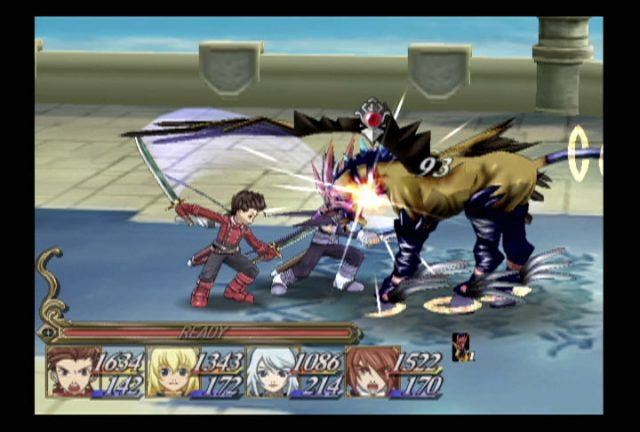 This was the first GameCube game I ever played and, unlike Dawn of Mana, my first PlayStation 2 game ever, was a very charming and mostly positive experience. The animations are unlikely to blow anyone away and, even during its release in 2004, weren’t groundbreaking. But what they lack in flash is more than made up for in personality and character. Towns are overflowing with detail and small touches that might go unnoticed if you're in a hurry. It is with those words that I recommend players slow down, take everything in, and enjoy the various areas. There is a special beauty to this game if you stop to smell the roses.
This is one of those games where taking a deeper dive into each character is worthwhile, so I’ll attempt to do so without spoiling anything. When looking at some of the protagonists. Lloyd is one of the better ones, but a bit of a knucklehead in a beguiling kind of way. He rubbed me the wrong way at first but slowly became more likable as the game progressed.
Perhaps because Genis always attempted to make fun of him but was, in my opinion, not nearly as smart as other characters gave him credit for. Yes, we hear about his intelligence often, but not much evidence is ever shown, and my goodness did I have to bury my face in my hands a few times at his dumb quips.
Colette was cute, but she needed to stop apologizing all the time, as it grew tiresome quickly; the humbleness seemed insincere. Raine was ok and always a source of encouragement and knowledge. Regal was odd in that he tried to explain the reasoning for being in chains, but past a certain point, it seemed self-defeating and was well beyond the point of serving any purpose.
Zelos is disgusting, despicable, and had no redeemable qualities in my eyes that could convince me, and likely most people, that he was capable of being anything more than a sketchy perv on the fringes of society and rejected by everyone. Never mind how he is actually portrayed in the game, which is improbable and unrealistic. The few times he gets a dressing down are worth waiting for.
Story-wise, be prepared because the protagonists and antagonists flip more than a typical pancake, and after a while, their constant switching of alliances became predictable and, past that, a boring plot device. Done once, sure, done as many times as this game, overkill. Plus, how forgiving some characters were in response to this switching of alliances was unlikely and not believable: “Ya sure, you betrayed us, welcome back.”
For those familiar with the Tales series, composer Motoi Sakuraba makes his return here. There is a definite musical style to games with this composer, as well as being similar to the Star Ocean, Valkyrie Profile, and Golden Sun games he has also created music for. There is an ethereal, earthy quality that creates an unmistakable atmosphere. It is as if I am at home deep within a forest with a stream flowing nearby. It is so peaceful and homey.
Sadly, the same can’t be said for the battle music, which had me quickly jumping for the remote to turn down the volume. The aggressively annoying battle utterances made by characters that are commonplace in many post-2000 games. I have played enough RPGs to feel confident in saying that, in battle, voices are appallingly bad and painfully annoying, even post 2020. Star Ocean for the SNES was one of the first games to have voice clips, if I recall correctly, mostly within battles. Thankfully, and really I am thanking God profusely, there is an option to turn them off here. The actual battle theme was surprisingly dull. Outside of battle, the voices were fine but nothing outstanding.
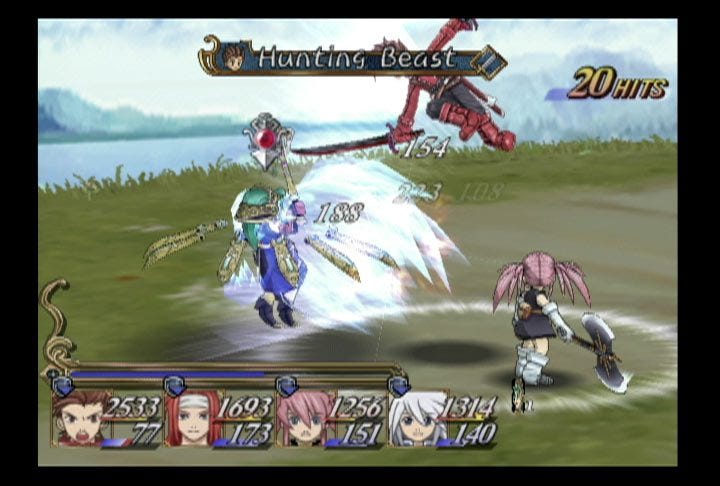 If you have played other older 2D Tales games, battles are very similar in Syphonia. Techniques help to increase damage, and every hit fills up a unison gauge. I didn’t use it much, as most bosses are not that difficult and can be beaten with normal attacks and techniques, as well as paying attention to obvious elemental weaknesses. Just give it a few minutes, and even a boss with 10K+ HP will go down.
Ex-gems help customize characters, but I found it limited. Ex-gems range in levels from 1 to 4, and each character has 4 slots. If you decide to, for example, replace a level 2 gem with a level 4 gem, that level 2 gem disappears forever, which felt needlessly restrictive and kind of unfair. Overall, it is easy to see that Namco wanted to increase character customization, but when compared to Final Fantasy 10/12 or other games around the same era, this pales in comparison.
You can cook in Symphonia, but it’s not nearly as nuanced as other games, even much older titles like Star Ocean: Second Story. You can craft new weapons and armor if you get the correct random drops from enemies as well. This was a nice way, early on, to get slightly stronger weapons and armor, but, at least in my experience, this game mechanic seemed to peter out well before the change over to the second disc, and I was left feeling confused if I should save all of my old stuff or sell it for well-needed cash. In hindsight, past a certain point, it would have been better to sell older equipment, as it seemed like weapon and armor customization was only useful in the first half of the game.
Unless I missed an explanation, transportation in this game is clumsy and, at the start, quite a burden. Fortunately, there is not nearly as much backtracking in this game as there is in Tales of the Abyss.
After the game, I looked at a walkthrough to see if there was something I had missed about the world map, as it was, largely, kind of useless to me. Sure, it showed the entire world, but there were no dots to signify the places I had visited. But it seems you can approach people in each town and pay a certain amount of money to make the world map more useful, including dots that are colored according to the type of location: town, dungeon, etc., something I clearly missed, but it seems like a roundabout way of trying to help players navigate around the two worlds.
Despite the flaws, Symphonia is a good game that could have been great without a few needless additions or unfortunate omissions (an item to allow for a quick exit from a dungeon). While some players might be able to overlook these issues, I still found this to be an endearing game when it’s all said and done. It could be better fleshed out, but it still had an appeal to it, and I would recommend Tales of Symphonia to any fan of RPGs. It is long enough without overstaying its welcome.
Wayback Wednesday Volume 1: Final Fantasy 7 and Chrono Trigger.
Wayback Wednesday Volume 2: Super Metroid and Castlevania: Symphony of the Night.
Wayback Wednesday Volume 3: The Legend of Zelda: A Link to the Past and Lunar: Silver Star Story Complete
Wayback Wednesday Volume 4: Secret of Mana and Wild Arms
Wayback Wednesday Volume 5: Illusion of Gaia and Grandia
Wayback Wednesday Volume 6: Breath of Fire 3 and X-Men Legends
Wayback Wednesday Volume 7: Star Ocean: The Second Story and Super Mario RPG
Wayback Wednesday Volume 8: Demon's Crest and Dragon Quest VI
Wayback Wednesday Volume 9: Suikoden I and Jeanne d'Arc
Wayback Wednesday Volume 10: Ranking the first 6 Final Fantasy games
Wayback Wednesday Volume 11: Earthbound and Valkyrie Profile
Wayback Wednesday Volume 12: Legend of Legaia and Secret of Evermore
Wayback Wednesday Volume 13: Threads of Fate and Soulblazer
Wayback Wednesday Volume 14: Radiata Stories and Robotrek
Wayback Wednesday Volume 15: Rogue Galaxy and Vandal Hearts
Wayback Wednesday Volume 16: Chrono Cross and Muramasa: The Demon Blade
Wayback Wednesday Volume 17: Okami and Legend of Mana
Wayback Wednesday Volume 18: Paper Mario and Terranigma
Wayback Wednesday Volume 19: Dragon Quest VIII and Atelier Iris 2: The Azoth of Destiny
Wayback Wednesday Volume 20: Ranking the 6 console Final Fantasy games from the PS1 and 2
Wayback Wednesday Volume 21: Eternal Sonata and Actraiser
Wayback Wednesday Volume 22: Persona: Revelations and Tales of Destiny
Wayback Wednesday Volume 23: Shadow Hearts: Covenant and Dragon View
Wayback Wednesday Volume 24: Ken Griffey Jr. Presents Major League Baseball and Lunar: Eternal Blue
Wayback Wednesday Volume 25: Suikoden II and Xenogears
Wayback Wednesday Volume 26: Azure Dreams and Wild Arms 2
Wayback Wednesday Volume 27: Ar Tonelico and Sword of Mana
Wayback Wednesday Volume 28: Albert Odyssey and Super Paper Mario
Wayback Wednesday Volume 29: Arcana and X-Men Legends II
Wayback Wednesday Volume 30: 10 over-rated classics that haven’t aged well
Wayback Wednesday Volume 31: Dragon Quest IX and E.V.O.: Search for Eden