

Namco, better known for their arcade titles during the first 20 years of their life, tried their hand at RPGs in the mid-90s to wild success with Tales of Phantasia. However, that game remained in Japan, much to the dismay of avid RPG fans around the globe.
Tales of Destiny, released in 1998, really got the ball rolling as far as representing the Tales series internationally. This is the first Namco role-playing game I ever played, and it is a perfect example of a game that benefits from nostalgia and fond memories with the passing of time. It came at the height of the PlayStation era and checked all of the important boxes for what makes an RPG fun, fast, engaging battles being at the top of that list. I played this game in 1999 and gave it another try in 2019 to see if the game would hold up under the more intense scrutiny that often comes with age.
Upon first glance, this game radiates with brilliant colors. Although not much changed from Tales of Phantasia (SNES, December 1995), it still has an unmistakable charm. It’s clear that villages and houses were painstakingly designed with details often overlooked by other games of the time. Just wander around the houses in the first village to see what I mean!
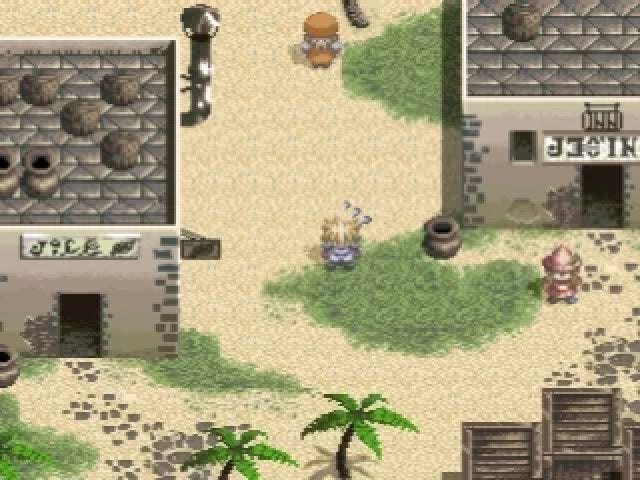 I enjoy small details in life, at times, and one of my pleasures in the first hours of Tales of Destiny was looking at Stahn in the mirror every time he walked by one or at his reflection as he ran over a puddle or the seagulls who would fly away as soon as the heroes approached. Within battles, hero and enemy sprites are somewhat disappointing, however, and bosses looked especially tame. Isn’t the goal of a boss battle to include an intimidating adversary with whom you are sparring? Because in this game, they were lame.
Furthermore, don’t be fooled by how the story starts and by the humorous dialogue in the first half of the game; the story takes a serious turn later on, and some pretty heavy, somewhat controversial topics are covered.
However, character development is average and, at times, feels forced, like the developers had to add in certain cliche scenes to take up a little more time. The scenes that heavily focused on character bonding, for example, felt contrived. The main character, Stahn, is interesting enough, but the game drives home the fact that he is a country boy, almost going as far as to insult those who come from the countryside. I was left wondering, “What is wrong with being a country boy? Is there a problem here?” An example of a game taking a joke with a limited life span, to begin with, and really overdoing it and beating it to death. Thankfully, Namco rebounds by introducing swordians. More or less, talking, living swords, and this often adds an interesting twist to the plot and dialogue, and they level up and gain skills, just like the human characters.
Contrary to common belief, grinding is not required to beat this game. If you don’t use a walkthrough, you will gain enough levels in the process of getting lost and finding your way in the various dungeons. That brings me to my next point: The majority of the second half of the game has a ton of dungeons, but many of them look the same. From the point that you first enter Radisrol until a big plot battle in Belcrant, all of the dungeons look alike, often with simple palette swaps despite having the same general layout. Granted, most of these locations will have a simple gimmick thrown in, like the common dark room with a small circle of light dungeon design trope that became old well before the 100th time it was used, a few years before Tales of Destiny’s release. Minimal effort was made to make these locations slightly different on a surface level. Regardless, most players will be hard-pressed to distinguish and properly name the various dungeons in this part of the game a few hours after completing them all.
Not only do they lack originality, but dungeons can be a pain to navigate, so if you like to get lost, this game is suitable. Otherwise, they can become slightly annoying. Sadly, many of the items that exist to try to make exploration a little easier don’t work as well as they should. Example: The encounter rate is very high, so the holy bottle seems like the perfect solution to this problem. The only issue is that it does not seem to function. I used it a few times, but still found I was getting into a ton of battles, even with enemies much weaker than I was during moments I needed to backtrack.
Thankfully, no random battles exist while sailing around in the ship. Still, 1062 battles in under 30 hours is a lot, and I am left somewhat baffled by the fact that there were a few select moments in the game where enemies were viewable on the screen, including the opening juncture on the ship. If Namco could do this for a few specific instances, why couldn’t they do it for the entire game?
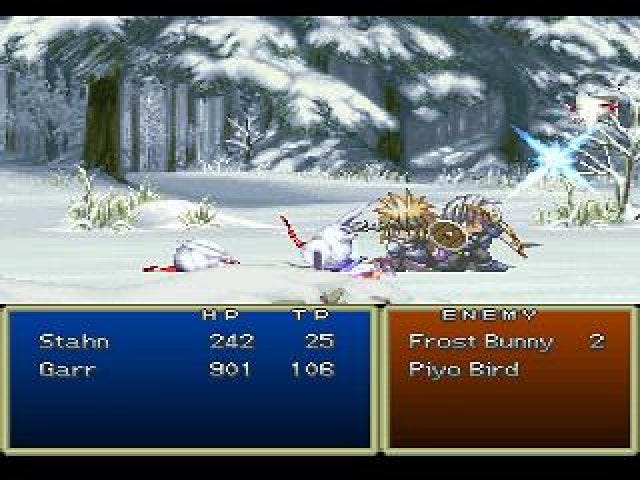 On the other hand, during battles, I had an enjoyable time trying to get my “Max hit bonus” as high as possible. The better the combo you can do during a fight, the more bonus experience you are awarded at the end of the battle.
An interesting idea, at its core, is the fact that there are two different currencies in Tales of Destiny. The commonly used Gald and the lesser-used Lens. Lens could have been an intriguing idea, but it is applied on a superficial level. You get experience, Gald, and Lens after every battle. In every town, there are Lens shops that exchange Lens for Gald at various rates, but those rates never seem to fluctuate much. What do you exchange Lens for? Gald. Even in the Lens shop, the store that sells healing items only takes Gald, which does not seem to make much sense, rendering Lens, for all intents and purposes, useless. Namco might as well have gotten rid of the Lens and given more Gald per battle. There are a few select moments where you can use a ring that shoots Lens to melt obstacles, but otherwise, they were just convenient plot points that had little to no value as a functional, useful gameplay mechanic. Secret of Evermore, released more than three years prior, did a far superior job applying different currencies and even had two instances where you could trade and barter.
The game is not difficult and, sadly, bosses provide little resistance right until the end. Even the average gamer is likely to breeze through boss battles, and any difficulty that may arise can easily be solved by 1 or 2 simple equipment changes and another attempt. Otherwise, the hardest part of Tales of Destiny is simply navigating a few of the more convoluted dungeons and solving a few late-game puzzles.
The music is above average in this game. The battle music, on the other hand, and keep in mind you will likely listen to this 1000 times, gets old quickly. However, town music is fantastic and provides a well-deserved break from the excessive amount of random encounters outside. The music on the world map is decent, but it changes towards the end of the game. This new track does a fantastic job of representing the new situation, the plight of the world, and how dire the situation is. Boss music, as expected, differentiates itself from the common battles and, appropriately, creates a menacing atmosphere. Tracks that play during sad moments in the game sound solemn and fit the mood perfectly. The voice acting is terrible, but thank the lords, there is an option to turn it off. I did so within 30 minutes and enjoyed the battles a heck of a lot more without the inane speaking.
As for game length, I clocked in at 28:47, and Stahn was level 54 at the last save point on my first playthrough in 1999. In 2019, the time of completion was very similar, clocking in at 28:05 at the last save point, though considering Stahn’s ending level (49) and battles (967, though I ran a lot more this time), I was probably a little slower on the most recent playthrough.
Still, those eager to start Tales are looking at nearly 30 hours, if not more, of gameplay. There are a few extras you can complete at the end. Plus, other than your four primary characters, there are optional ones you can pick up. On my first playthrough, I did not bother getting anyone else. My second time, I got Karlyl and Bruiser, and I believe there are a few other extra characters you can find as well, adding a little replayability on top of the few side quests. There is a long optional dungeon you can try, though I did not end up trying it on either playthrough. It is supposed to be very long and could add another 5+ hours of gameplay.
Overall, Tales of Destiny holds a special place in my distant memories, but with a more discerning, more experienced look, this recent playthrough didn’t hit the same high marks. Still, those who want an RPG with a unique battle system, where battles often end in seconds, should check this game out. Despite the shockingly high encounter rates, this is still worthwhile for those new to the series, want a look at the origins of the Tales of series, or who just want more fast-paced fights.
Wayback Wednesday Volume 1: Final Fantasy 7 and Chrono Trigger.
Wayback Wednesday Volume 2: Super Metroid and Castlevania: Symphony of the Night.
Wayback Wednesday Volume 3: The Legend of Zelda: A Link to the Past and Lunar: Silver Star Story Complete
Wayback Wednesday Volume 4: Secret of Mana and Wild Arms
Wayback Wednesday Volume 5: Illusion of Gaia and Grandia
Wayback Wednesday Volume 6: Breath of Fire 3 and X-Men Legends
Wayback Wednesday Volume 7: Star Ocean: The Second Story and Super Mario RPG
Wayback Wednesday Volume 8: Demon's Crest and Dragon Quest VI
Wayback Wednesday Volume 9: Suikoden I and Jeanne d'Arc
Wayback Wednesday Volume 10: Ranking the first 6 Final Fantasy games
Wayback Wednesday Volume 11: Earthbound and Valkyrie Profile
Wayback Wednesday Volume 12: Legend of Legaia and Secret of Evermore
Wayback Wednesday Volume 13: Threads of Fate and Soulblazer
Wayback Wednesday Volume 14: Radiata Stories and Robotrek
Wayback Wednesday Volume 15: Rogue Galaxy and Vandal Hearts
Wayback Wednesday Volume 16: Chrono Cross and Muramasa: The Demon Blade
Wayback Wednesday Volume 17: Okami and Legend of Mana
Wayback Wednesday Volume 18: Paper Mario and Terranigma
Wayback Wednesday Volume 19: Dragon Quest VIII and Atelier Iris 2: The Azoth of Destiny
Wayback Wednesday Volume 20: Ranking the 6 console Final Fantasy games from the PS1 and 2
Wayback Wednesday Volume 21: Eternal Sonata and Actraiser