

Sword of Mana, released in 2003 for the Game Boy Advance by Square Enix and Brownie Brown, is the 5th game released in the Mana franchise and the second handheld Mana game. Like the previous four games, it is an Action RPG.
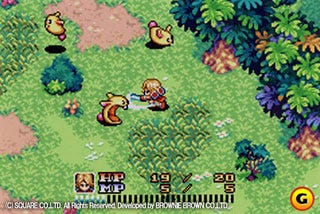 It’s difficult to follow up on a classic, that much is obvious. But this game was tasked with following not one, but two well-renowned, beloved games. While not reaching the heights of Secret of Mana or Seiken Densetsu 3, this is still a worthwhile entry in the Mana series. Also, at this time, please note that this review is largely based on the hero’s path, with only occasional mention of the heroine, as experience will slightly vary according to who you choose at the beginning.
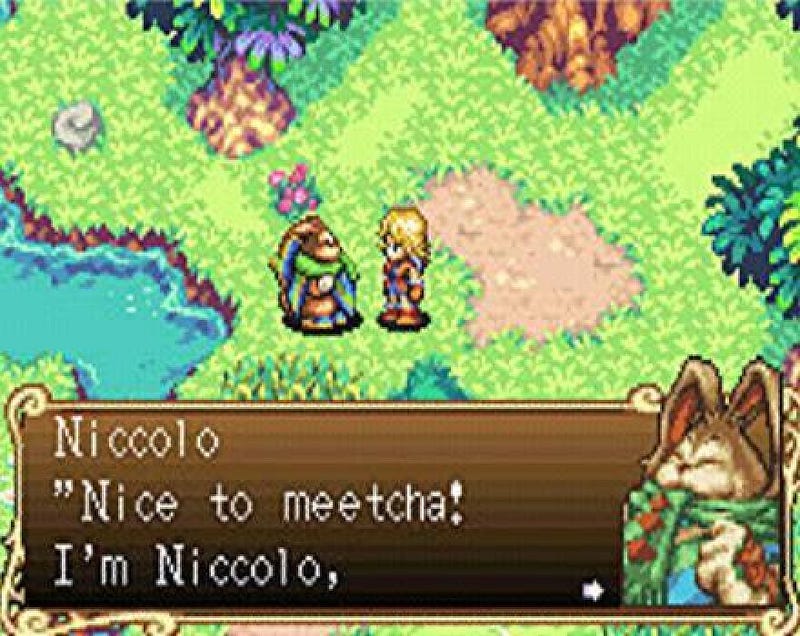
At the start of the game, you have a choice between a male or a female protagonist. Later on, the gender you did not choose will join up as a computer-controlled ally. Sadly, the AI in this game is a step back from Seiken Densetsu 3, and this ally remains largely incompetent other than serving as a decoy for more difficult boss battles. Other than that, the ally is only able to use one weapon and never impacted the outcome of battles to any extent.
The story begins with an extremely tragic event, and introduces the main antagonist in the form of a flashback. As you travel throughout the land, you learn of other awful details such as kidnappings, the abuse of Mana (a common theme throughout the franchise), and the hero’s goal of finding the Mana Sword. The story also centers around the hero’s desire to find vengeance for the terrible misfortune suffered in the past. There was potential for a stronger plot, but character development is a weak point in this game, and other than the very start and very end, not much is said about your character or their background.
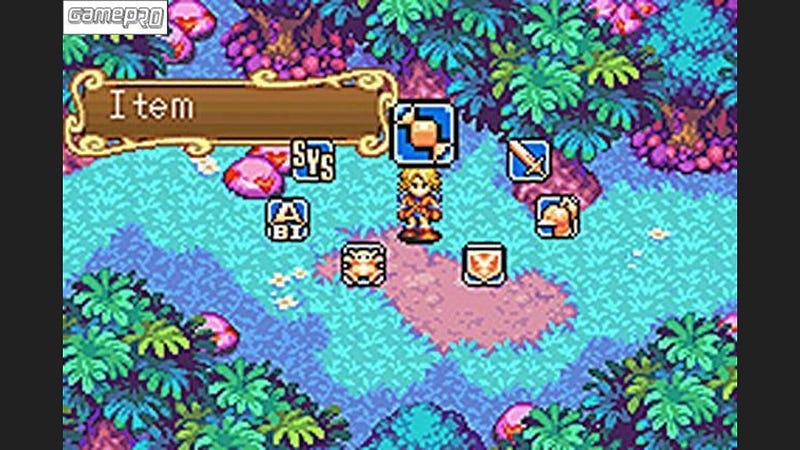 Those who have played Seiken Densetsu 3 will notice some familiar game mechanics making a return in this game. There is the day-night cycle, a seven-day cycle with each day being assigned a different element (as well as the Mana Holy Day; Shade and Luna are not assigned days) and the ring menu, just as functional and easy to use as previous Mana games.
Like Legend of Mana, this game sports an orchard, and although a neat idea, the way it was implemented, as well as its overall usefulness to the game, felt superficial, as if it was an afterthought. Forging equipment, though another nice idea, made the game even easier than it already was. There is also a meter that slowly fills up with each successful hit and, after several strikes, allows for a powerful attack. Thankfully, the large charge times from Secret of Mana are gone and, in its place, the system utilized in Seiken Densetsu 3 for using powered attacks.
People familiar with Legend of Mana will instantly feel at home with the art style in Sword of Mana. It is a scaled-down version of Legend of Mana and sports some of the best hand-drawn animation on the Game Boy Advance outside of Magical Vacation, which Brownie Brown also developed. The scenery is diverse and an absolute pleasure to look at with the utmost attention to detail in each area. Don’t be surprised if, after clearing the screen of enemies, you pause to admire the views. No doubt, each screen in the game was painstakingly and lovingly drawn. Many of the enemies you come across in Sword of Mana will look familiar to veterans of the series, though some foes are unique to this game. All of the enemies, and especially bosses, look incredible.
The game is limited by the GBA as far as music quality but still finds the occasional opportunity to shine, the boss battles being the best example. The village and town themes are two songs that provide a perfect respite from the trials and tribulations just outside and are likely to make anyone feel at ease. Haunted Mansion is memorable because it fits the environment so well, feeling supernatural and eerie. Glass Desert is perhaps the best song because it sounds so ambitious, but at the same time, slightly imposing. The dungeon theme is not bad at first, but gets old quickly. Overall, there are more than three dozen tracks, but a handful of them were overused.
 The game is likely to take around 40–50 hours. I reached level 67 and finished at 44:47. Just like Secret of Mana, weapons and magic receive levels the more you use them, so grinding for levels can take up a large portion of that time. All of my weapons and elements were over level 30, and I don’t want to think about how much time, of those nearly 45 hours, was spent grinding.
There are eight weapons, and the sword (level 50) and whip (level 41) struck me as the most useful throughout the large majority of the game. Keeping with the theme of eight, magic is split into eight different elements and is referred to as spirits. Every time you find a spirit, it will strengthen that element. Find a Luna spirit and that will strengthen the Luna element. Some spirits are very well hidden and require a decent list of prerequisites, some not obvious. Learning enemy weaknesses and how to attack each one, while not paramount, will make disposing of them much quicker, so it is important to be well-rounded and come into this game with the idea that there will be some trial and error to see what type of weapon or magic is most effective against each adversary.
Overall, this does not reach the heights of the SNES releases but still serves as a respectable follow-up to the aforementioned games. If you are looking for an enjoyable, action-packed game on the go, this is a wonderful choice. While some of the gameplay mechanics seem cosmetic and surface-level, there are enough interesting innovations to keep the average gamer busy for several weeks.
Wayback Wednesday Volume 1: Final Fantasy 7 and Chrono Trigger.
Wayback Wednesday Volume 2: Super Metroid and Castlevania: Symphony of the Night.
Wayback Wednesday Volume 3: The Legend of Zelda: A Link to the Past and Lunar: Silver Star Story Complete
Wayback Wednesday Volume 4: Secret of Mana and Wild Arms
Wayback Wednesday Volume 5: Illusion of Gaia and Grandia
Wayback Wednesday Volume 6: Breath of Fire 3 and X-Men Legends
Wayback Wednesday Volume 7: Star Ocean: The Second Story and Super Mario RPG
Wayback Wednesday Volume 8: Demon's Crest and Dragon Quest VI
Wayback Wednesday Volume 9: Suikoden I and Jeanne d'Arc
Wayback Wednesday Volume 10: Ranking the first 6 Final Fantasy games
Wayback Wednesday Volume 11: Earthbound and Valkyrie Profile
Wayback Wednesday Volume 12: Legend of Legaia and Secret of Evermore
Wayback Wednesday Volume 13: Threads of Fate and Soulblazer
Wayback Wednesday Volume 14: Radiata Stories and Robotrek
Wayback Wednesday Volume 15: Rogue Galaxy and Vandal Hearts
Wayback Wednesday Volume 16: Chrono Cross and Muramasa: The Demon Blade
Wayback Wednesday Volume 17: Okami and Legend of Mana
Wayback Wednesday Volume 18: Paper Mario and Terranigma
Wayback Wednesday Volume 19: Dragon Quest VIII and Atelier Iris 2: The Azoth of Destiny
Wayback Wednesday Volume 20: Ranking the 6 console Final Fantasy games from the PS1 and 2
Wayback Wednesday Volume 21: Eternal Sonata and Actraiser
Wayback Wednesday Volume 22: Persona: Revelations and Tales of Destiny
Wayback Wednesday Volume 23: Shadow Hearts: Covenant and Dragon View
Wayback Wednesday Volume 24: Ken Griffey Jr. Presents Major League Baseball and Lunar: Eternal Blue
Wayback Wednesday Volume 25: Suikoden II and Xenogears
Wayback Wednesday Volume 26: Azure Dreams and Wild Arms 2