
893,000,000 is a gigantic number. But those were the numbers, as of 2025, of Mario games that have been sold worldwide since the early 1980s. It could be said, with, I’d say, relatively limited arguments to the contrary, that Mario is the mascot for video games as a whole. It is difficult, perhaps even impossible, to find a more significant success story within this particular form of media and even in all forms of media. He has constantly played the starring role, most notably in three famous NES platformers, and a fourth (and the true sequel to the original Mario) that didn’t immediately make it out of Japan.
But his character has also graced games from other genres: puzzles, education, sports, and racing, as well as transcending gaming and appearing in movies, TV, comics, all sorts of merchandise, and even a recently completed theme park in Japan. He is the quintessential case study for anyone taking a Media Studies class, especially looking at how media has evolved with the times and the advertising that helped Mario and his friends to become such hits.
One such evolution is the superb Super Mario RPG from 1996, beloved by many RPG fans, and even non-RPG gamers. It would take four years until fans of the game were finally assuaged with another Mario RPG, “Paper Mario” for the N64, a solid, well-done game that created a sizeable cult following. It took another four years for “The Thousand-Year Door” to be released for the GameCube and improved on everything from the previous game, which was already very good in its own right. The first two Paper Mario games were well-known for their puzzles and, for the most part, were very similar regarding game and battle mechanics.
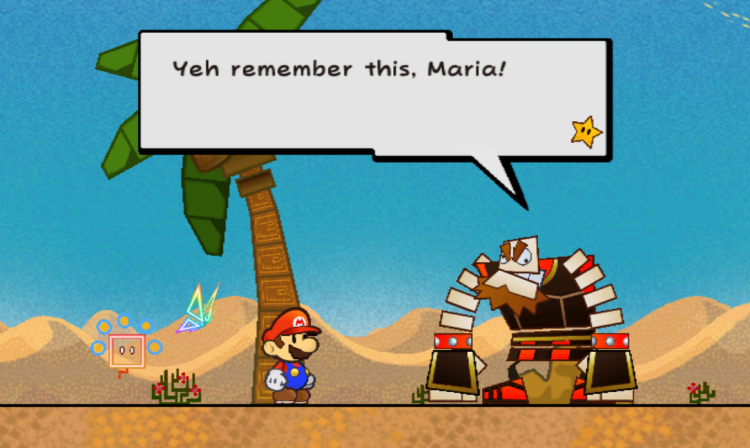 The 2007 release of “Super Paper Mario” saw innovations within the Paper Mario series. While some complained about the switch away from turn-based or found the change jarring, the battles occurring in real time allowed for faster-flowing action.
For all three of these Paper Mario games, puzzles can be tough, but the challenge in this particular game is in overcoming the switch between 2D and 3D, as a lot of what is needed to progress is hidden behind walls and other things in 3D view that can’t be seen in 2D, or vice versa. The constant switching between the two modes can get tiresome later in the game, but it is necessary to advance in each level, and being in 3D makes it easy to bypass many burdensome enemies.
 However, in other ways, this is more simplified than the first two Paper Mario games. For example, sadly, badges have been completely done away with, and there are only a handful of purchasable items at a limited number of shops. A few healing items, some attack spells, and stat-boosting items, overall totaling at most about three dozen items. There is no room for customization, and unlike the first two games, it isn’t possible to select a stat to increase after each level up. Instead, each level alternates between an increase of 5 HP or 1 attack.
Mario is eventually joined by three other characters, and switching between them is required in every level of the game. There are several pixl’s, that are kind of like faeries that also aid in the journey, including the useful boomer, a bomb to blow up weak spots in walls, as well as enemies and Thoreau, who can grab enemies, allowing your heroes to throw them. Barry acts kind of like Sonic; pressing square at just the right moment will enable spikes to surround your hero and hurt any enemy close by, including ones trying to hop on Mario. Slim is like a built-in cheat code, turning characters invisible. Though it’s not possible to attack in Slim mode, proper timing with Slim makes it possible not to get hit by any boss. Cudge is a hammer that breaks large blocks and can do serious damage, but is harder to get into position to avoid damage, compared to Barry or Boomer.
There are a few other pixls that function outside of battle to overcome obstacles or solve puzzles, such as Tippi, who uncovers hidden areas by scanning the screen, or Dotti that shrinks characters so they can enter small (mouse) holes. As you can probably discern, there are tons of hero/pixl combinations and sadly, no buttons are mapped on the controller that I could see to quickly cycle through heroes and pixls in-game. Instead, frequent trips to the menu for any changes, which is annoying when puzzles require repeated character and/or pixl switches in a short amount of time.
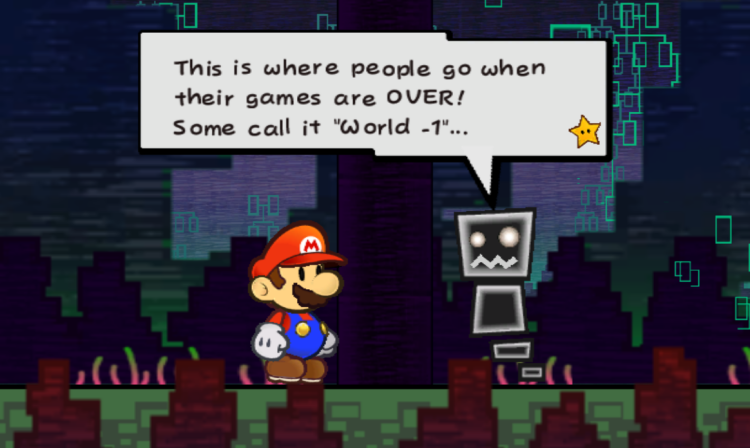
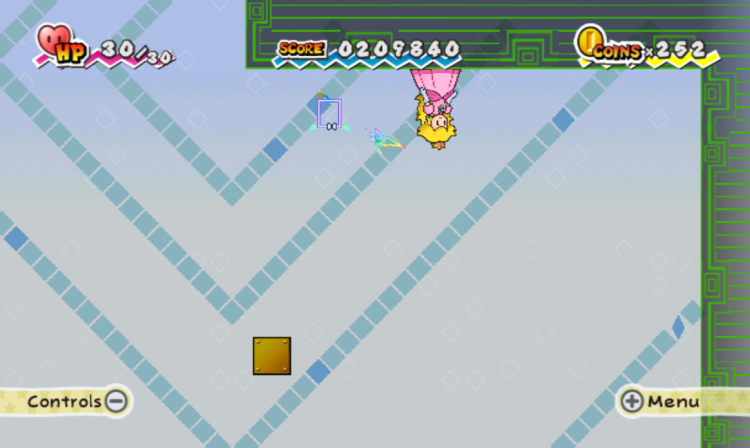 The vibrant worlds are inviting, and each of the 8 chapters is broken into 4 parts in classic Mario style. Other than a few poor examples of level design, like the Whoa Zone (pictured above) or Underwhere, which can get confusing, levels are a blast. Considering all the flashy graphics many games of the time tended to prioritize, there is a very obvious preference for the old school aesthetic. For example, when one of the characters grabs a star, they turn into a humungous pixelated version of their character, paying homage to the 8-bit Mario games. The star allows you to rampage through the level, destroying everything in their path for a few seconds. This game has a style that’s appealing to the eye, with the characters looking like thin pieces of paper against a 2D backdrop and, during dimensional shifts, against a 3D background, though it looks less impressive than the 2D vantage point.
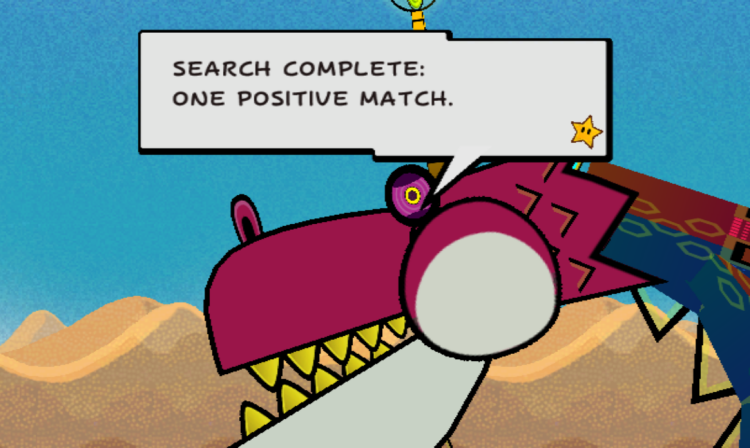 Most of the bosses look amazing, and if some of them (pictured above) didn’t look so cute, they might even be imposing. To be fair, some of the bosses are hideous but tend to be easier. Unfortunately, this game never posed too much of a challenge, and most enemies and bosses had very clear, telegraphed attack patterns.
Other sound effects and tracks bring up memories of older Mario titles. Super Paper Mario wears its inspiration on its sleeve, for sure. The music is simple, nothing memorable, but catchy just the same.
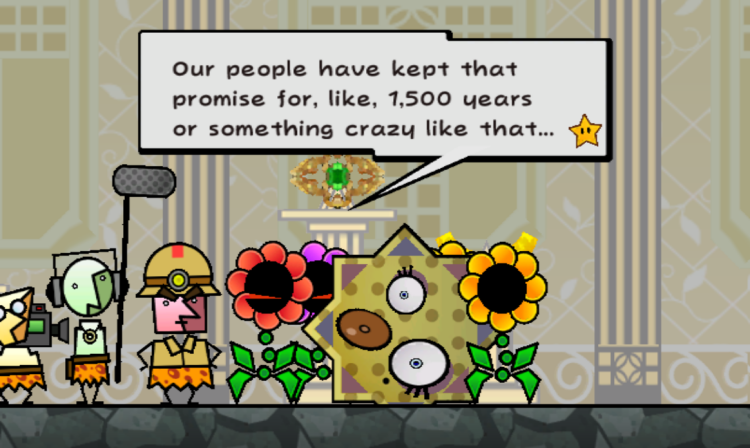 As is the case with previous Paper Mario games, the gameplay takes center stage over the story. While nothing atrocious, it is cliché, filled with tropes, with minimal dialogue. Though there are some humorous lines sprinkled throughout the adventure. The story starts with, surprise surprise, Princess Peach being kidnapped. Not too long into the game, Count Bleach, the game’s main protagonist, is introduced; he wants to use Peach to, get ready for another commonplace plot device, destroy the world. The story doesn’t get much more intriguing than that, it is surface-level and nothing complex. The overall goal is to collect 8 pure heart pieces. Flipside is the hub city of the game, with a mirror that can be accessed later on, leading to Flopside, where everything is the opposite. By carefully and fully exploring both of these areas, all 8 worlds can eventually be explored if the proper items and pixls are first found.
Super Paper Mario is unlikely to blow anyone away, but it is good, honest fun, with a few hiccups along the way, but otherwise is an easy game to get into and can be beaten fairly quickly. It is likely to take most people 15–25 hours (17:54 personally), and most gamers will likely end with levels around 15–20 (16 for me). If you are looking for a shorter game starring a famous mascot that is laid back, give this a shot!
Wayback Wednesday Volume 1: Final Fantasy 7 and Chrono Trigger.
Wayback Wednesday Volume 2: Super Metroid and Castlevania: Symphony of the Night.
Wayback Wednesday Volume 3: The Legend of Zelda: A Link to the Past and Lunar: Silver Star Story Complete
Wayback Wednesday Volume 4: Secret of Mana and Wild Arms
Wayback Wednesday Volume 5: Illusion of Gaia and Grandia
Wayback Wednesday Volume 6: Breath of Fire 3 and X-Men Legends
Wayback Wednesday Volume 7: Star Ocean: The Second Story and Super Mario RPG
Wayback Wednesday Volume 8: Demon's Crest and Dragon Quest VI
Wayback Wednesday Volume 9: Suikoden I and Jeanne d'Arc
Wayback Wednesday Volume 10: Ranking the first 6 Final Fantasy games
Wayback Wednesday Volume 11: Earthbound and Valkyrie Profile
Wayback Wednesday Volume 12: Legend of Legaia and Secret of Evermore
Wayback Wednesday Volume 13: Threads of Fate and Soulblazer
Wayback Wednesday Volume 14: Radiata Stories and Robotrek
Wayback Wednesday Volume 15: Rogue Galaxy and Vandal Hearts
Wayback Wednesday Volume 16: Chrono Cross and Muramasa: The Demon Blade
Wayback Wednesday Volume 17: Okami and Legend of Mana
Wayback Wednesday Volume 18: Paper Mario and Terranigma
Wayback Wednesday Volume 19: Dragon Quest VIII and Atelier Iris 2: The Azoth of Destiny
Wayback Wednesday Volume 20: Ranking the 6 console Final Fantasy games from the PS1 and 2
Wayback Wednesday Volume 21: Eternal Sonata and Actraiser
Wayback Wednesday Volume 22: Persona: Revelations and Tales of Destiny
Wayback Wednesday Volume 23: Shadow Hearts: Covenant and Dragon View
Wayback Wednesday Volume 24: Ken Griffey Jr. Presents Major League Baseball and Lunar: Eternal Blue
Wayback Wednesday Volume 25: Suikoden II and Xenogears
Wayback Wednesday Volume 26: Azure Dreams and Wild Arms 2
Wayback Wednesday Volume 27: Ar Tonelico and Sword of Mana