
Suikoden II is, low-key, one of the best RPGs on the PlayStation, and part of that is the quality of its plot. I’ve always said even an average book beats some of the best gaming stories, but this game certainly puts my belief to the test. It’s a story of betrayal, authority, and rebellion.
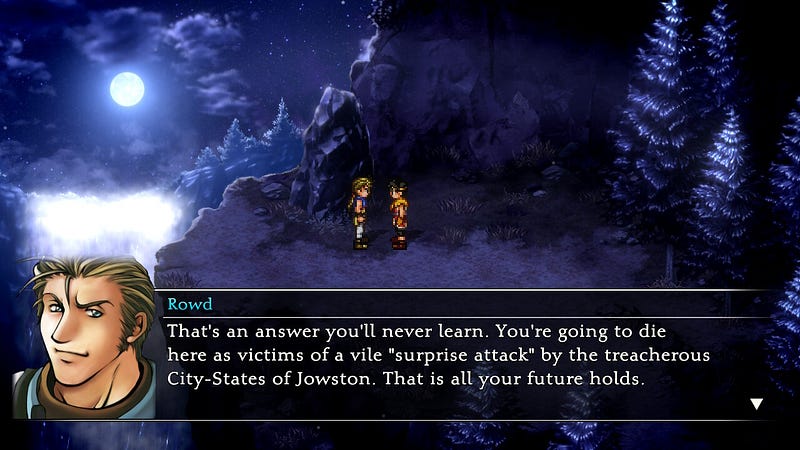 But it’s also a story as old as mankind, pitting governments against one another in the struggle for superiority, with all the innocent people caught in the middle. People who simply want to live life and go about their day-to-day tasks. There are poignant scenes throughout the game of people holding on to hope that the war will end, dedicated to the prospect of peace, and also beaten by the effects of a lasting war. Suikoden II also shows how deeply loyalty can run, sometimes to their detriment.
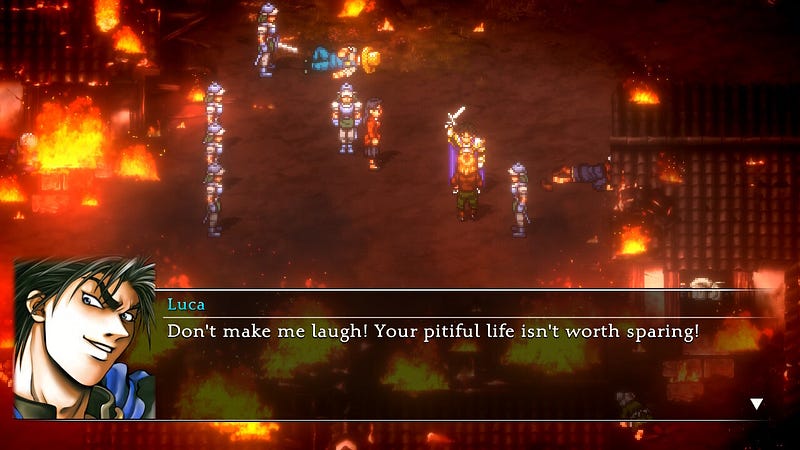 Standing in the way is the hyper-sociopathic Luka Blight. He is bloodthirsty and brutal, and that is seen within the first few hours. I don’t think he had as much screen time as Kefka from Final Fantasy VI, but I’d place both as top 5 RPG villains ever. The scariest thing about him is that people throughout history and to this day are like that. He was a realistic evil, terrifying, and the multi-phase battle against him is epic, to say the least. My least favorite part of the game was the long, drawn-out vampire subplot with Viktor, most of which is explored towards the end. But that is a small part of the game, and overall, the military intrigue is engaging and enough to easily offset that.
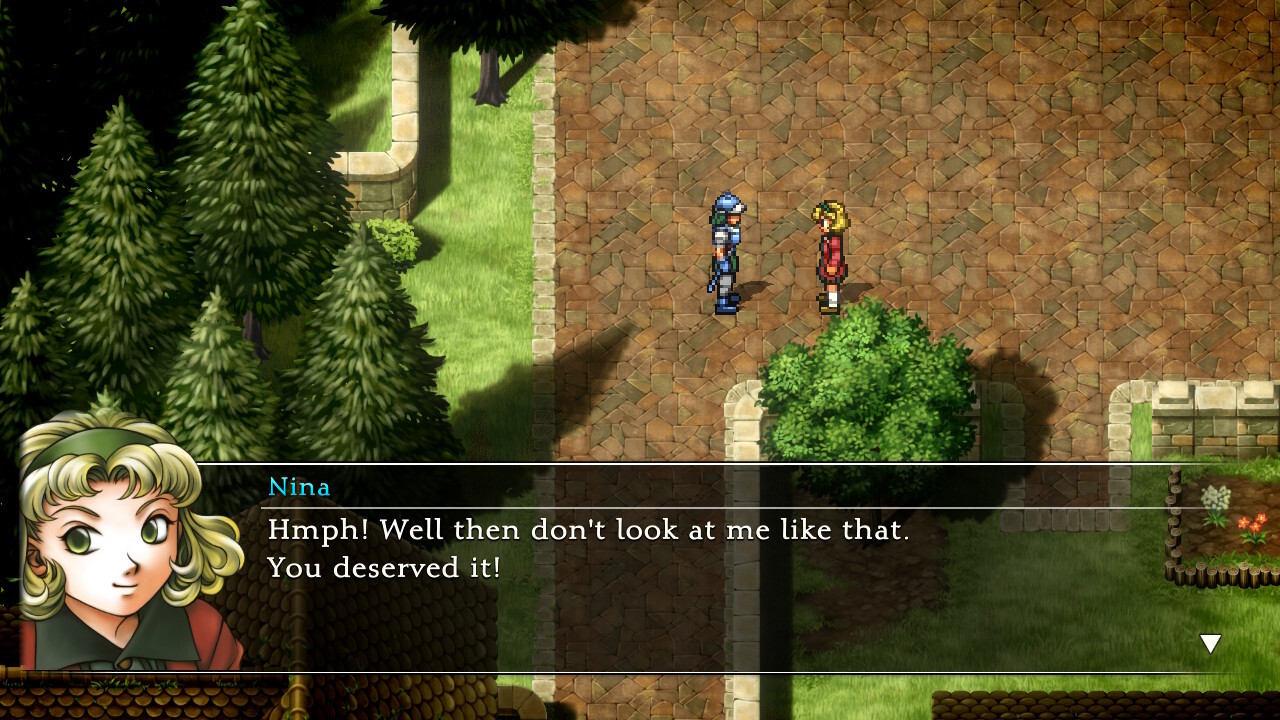 The plot, by itself, is reason enough to play Suikoden II, but when you add in the fact that there are 108 recruitable characters, it’s all the more incredible. As stressful as it can be for completionists to track every recruit down, especially on a blind playthrough as I attempted, I have yet to find a game that can mirror the first two Suikodens and that adrenaline rush of adding someone new to your army. It’s been over 20 years since I last played this game, and I never forgot that little jingle every time someone is added to the party. This is the motley crew to end all motley crews, with a wide array of personalities. Considering the length of the game, 30 hours on both playthroughs for me, there is a surprising amount of depth to all of them, with distinctive looks and mannerisms.
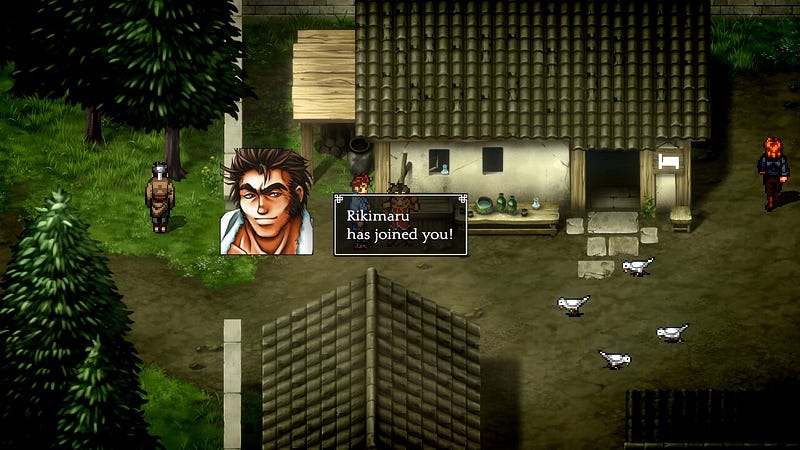 Some of the characters help the castle, which serves as your army’s headquarters, grow to level 4 eventually. They provide valuable services such as running shops, building an elevator, or offering fun mini-games. Be aware that some of the 108 stars will only join if your castle is at a high enough level. 72 characters can be brought into battle, and even with 6 in battle, it might feel astronomical at first. However, I found it easy to bring characters up to speed, and levels come rapidly in the late game, so experimenting isn’t penalized much. I often brought someone 10 or 20, or more levels below my hero, and by the end of the dungeon, they were just as strong and striking the boss with solid hits. Considering the huge party, not much grinding is needed.
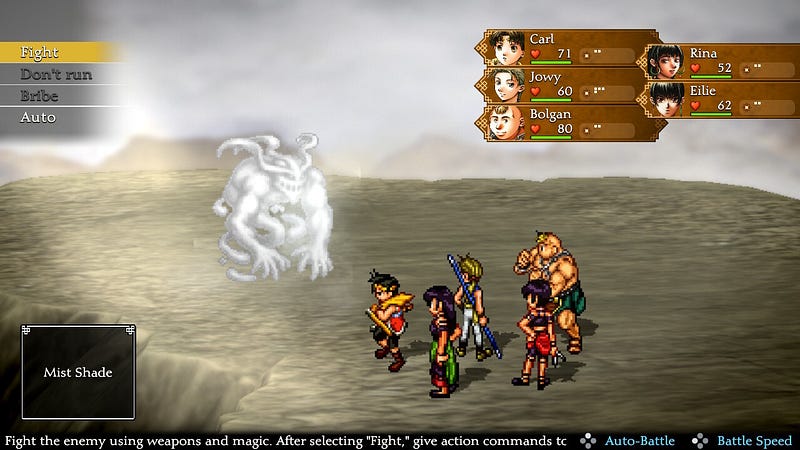 In fact, one of the few faults of the game is that it is too easy. In the second half of the game, bosses hit like a truck, but they have such low HP totals that it hardly matters. I never saw a game over, though I was threatened two or three times.
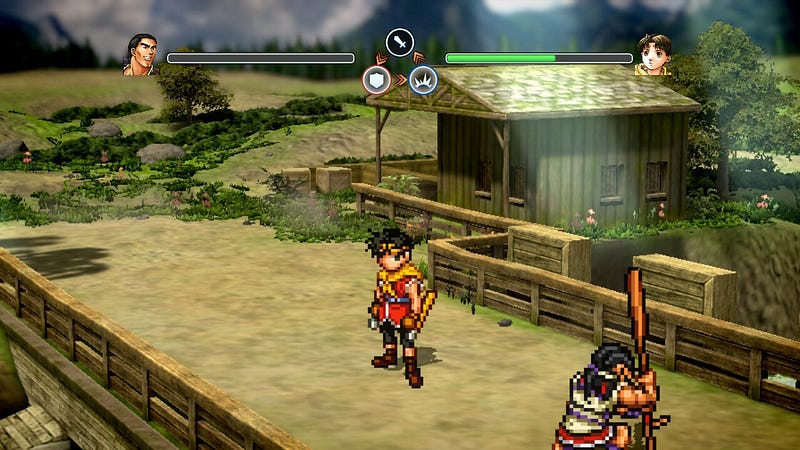 The game mixes standard party battles with duels and large-scale army encounters, giving it more variety than most RPGs from the era. I thought duels were well done. They didn’t need to be complex, as the narrative importance was never understated. They function like rock-paper-scissors-shoot.
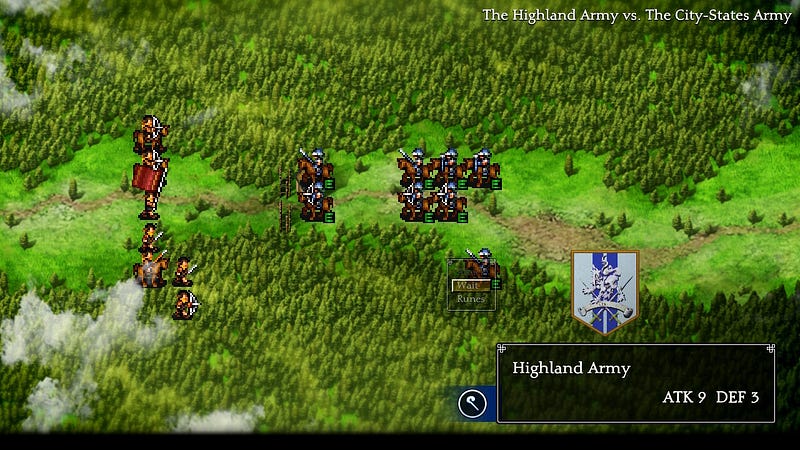 I could have done without the tactical battles. There are maybe a dozen, but I never felt like I was entirely free in them, partially because movement was so limited. I wasn’t expecting anything like Shining Force or other full-fledged tactical battles like Vandal Hearts, but I wish they had been fleshed out more.
My other gripe with the game was that it closes off large portions of the map for long stretches. Sometimes, certain areas were inaccessible more than once in the game. This is mostly what added to my stress regarding recruits. Miss a window to find someone, and it might be a very long time until you can return to that town to get them. In a few cases, recruitment is time sensitive; by and large, II is more flexible than I, and most characters are not missable. I’d still recommend looking up the short list of missable stars.
There are some notable customization options for your chosen characters, and I’d recommend building up to at least 18. First off, weapons can, eventually, be tempered to level 16. It can get extremely pricey, but the game is generous with money in the back half. Runes can be attached to weapons at blacksmiths for added effects as well.
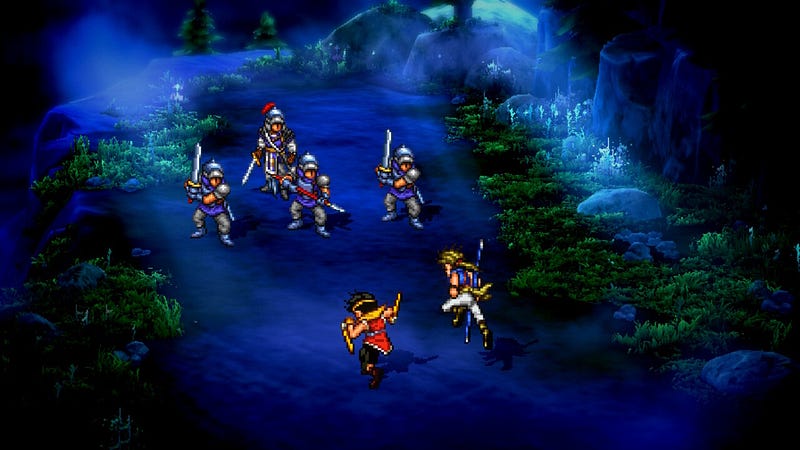 Runes can also be attached to one or both of your hands and offer between 1 and 4 attack, healing, or support spells. Unite attacks are when two or more heroes combine for powerful damage, sometimes, but not always, coming with downfalls like leaving one of the characters immobilized for the next turn. This is one of the best reasons to experiment with party composition, though sometimes those involved in the unite attacks are obvious, like the traveling gypsy family, Rina, Eilie, and Bolgan.
As much as I love this game, and it’s for sure a Top 25 of mine, I wasn’t even aware of some of the side content until late into my second playthrough, such as the cooking, farming, fishing, and dancing, but that can add a significant number of hours, at least ten, I’d imagine.
What’s interesting for me is that the first time I beat this, around 2001, it took me 30:23 with my hero finishing at level 62. In 2026, it was just 13 minutes more, at 30:26, my hero was at level 60. Although I’m almost certain I had far more characters above level 40 compared to 2001. Interestingly, my save is still at GameFAQs, 25 years later, and it could be fascinating to compare notes on my two playthroughs separated by two and a half decades.
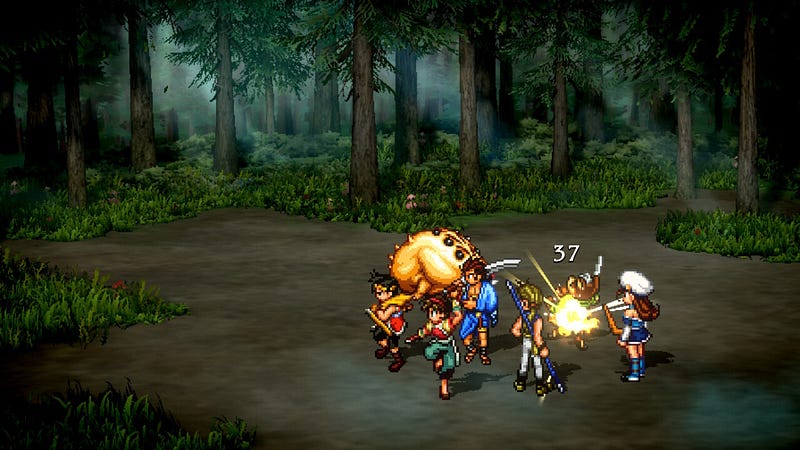 Yes, I was faster in my youth, and, honestly, I used the 2x and occasionally 3x battle speed added in the remaster, so I was likely much faster back in the day. Don’t misunderstand me, however: speeding up battles isn’t even needed as they flow at a brisk pace in Suikoden II, perhaps some of the briskest in the PS era. Think the opposite of Koudelka, sorry, had to take a shot at the snail’s pace of those battles.
Anyway, I appreciated that Konami largely remained faithful to the original, similar to the treatment Star Ocean 2 received, with some quality-of-life additions, though not as many.
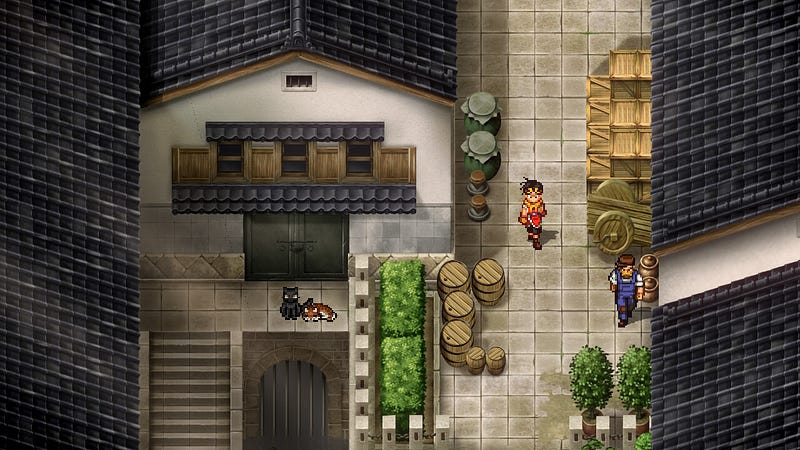 There is an understated beauty to most of the tracks. In the small villages and hamlets, there is a wistfulness, while major events are highlighted by dramatic music that helps some of the most important scenes feel so melancholy. And trust me, there are some bittersweet moments.
In an era (late 90s and early 2000s) where many games have aged poorly and look rough by today’s standards, Suikoden II still has an unmistakable charm. It has aged well visually, especially compared to many late-PS1 titles that leaned into 3D. The 2D sprite work and pre-rendered backgrounds give it a timeless quality that many polygon-heavy games from that era lack. The towns are inviting, the character sprites are diverse, and the enemies and boss models are impressive. I wouldn’t quite put it on par with Breath of Fire 3 in terms of how well it has aged, but it stands among the best-looking RPGs of the PS era, alongside Star Ocean.
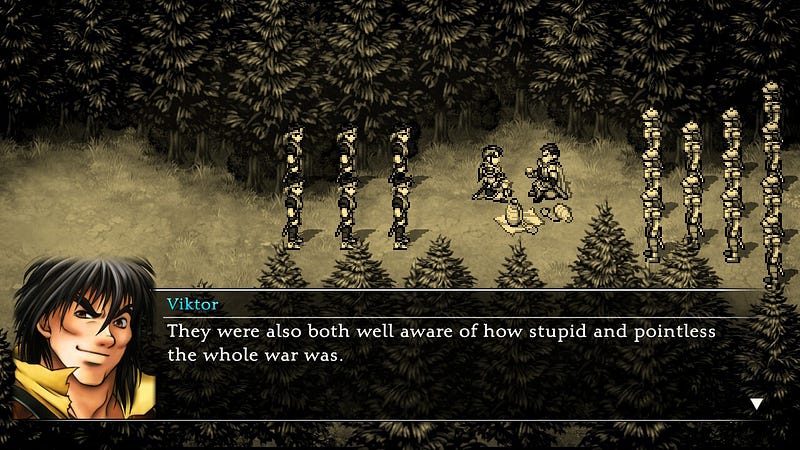 Suikoden II is an obvious classic that holds up remarkably well despite a few issues; it’s remembered for its touching soundtrack, in-depth storytelling, character interactions, and retro aesthetics that have aged well. It’s too easy, but it has so much going for it that it hardly matters. It’s a must-play for any fan of the genre.
Wayback Wednesday Volume 1: Final Fantasy 7 and Chrono Trigger.
Wayback Wednesday Volume 2: Super Metroid and Castlevania: Symphony of the Night.
Wayback Wednesday Volume 3: The Legend of Zelda: A Link to the Past and Lunar: Silver Star Story Complete
Wayback Wednesday Volume 4: Secret of Mana and Wild Arms
Wayback Wednesday Volume 5: Illusion of Gaia and Grandia
Wayback Wednesday Volume 6: Breath of Fire 3 and X-Men Legends
Wayback Wednesday Volume 7: Star Ocean: The Second Story and Super Mario RPG
Wayback Wednesday Volume 8: Demon's Crest and Dragon Quest VI
Wayback Wednesday Volume 9: Suikoden I and Jeanne d'Arc
Wayback Wednesday Volume 10: Ranking the first 6 Final Fantasy games
Wayback Wednesday Volume 11: Earthbound and Valkyrie Profile
Wayback Wednesday Volume 12: Legend of Legaia and Secret of Evermore
Wayback Wednesday Volume 13: Threads of Fate and Soulblazer
Wayback Wednesday Volume 14: Radiata Stories and Robotrek
Wayback Wednesday Volume 15: Rogue Galaxy and Vandal Hearts
Wayback Wednesday Volume 16: Chrono Cross and Muramasa: The Demon Blade
Wayback Wednesday Volume 17: Okami and Legend of Mana
Wayback Wednesday Volume 18: Paper Mario and Terranigma
Wayback Wednesday Volume 19: Dragon Quest VIII and Atelier Iris 2: The Azoth of Destiny
Wayback Wednesday Volume 20: Ranking the 6 console Final Fantasy games from the PS1 and 2
Wayback Wednesday Volume 21: Eternal Sonata and Actraiser
Wayback Wednesday Volume 22: Persona: Revelations and Tales of Destiny
Wayback Wednesday Volume 23: Shadow Hearts: Covenant and Dragon View
Wayback Wednesday Volume 24: Ken Griffey Jr. Presents Major League Baseball and Lunar: Eternal Blue