
Shadow Hearts was a unique game, flaws and all. It had a certain “je ne sais quoi” that can best be described as otherworldly, phantasmal, somewhat eerie, and occasionally macabre. It’s hard to pinpoint exactly, but it did a fantastic job creating a distinct environment. The trilogy has reached cult classic status, and while the first game fell short of those lofty heights (for me), it was still oddly charming. The second game, Covenant, has made several admirable improvements while missing the mark in a few key areas.
Covenant is set at the beginning of World War I in an alternate reality. It’s important to complete the first game before diving into this one, as Covenant takes place six months later and builds on the bad ending of the first game.
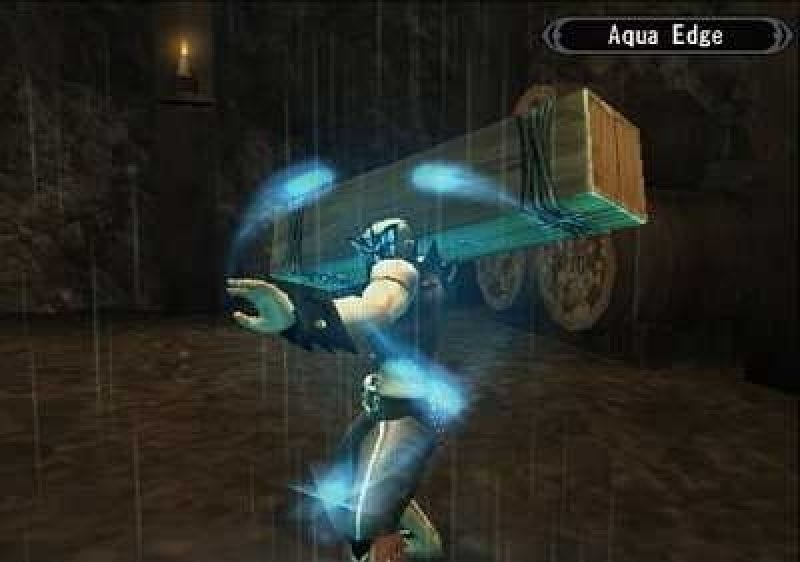 The main protagonist, Yuri, returns from Shadow Hearts and is joined by a motley crew of vagabonds: Karin, a lieutenant in the German military; Gepetto, an eccentric puppeteer; Blanca, a wolf-dog with subtle human qualities; Joachim, a wrestling-obsessed vampire and somewhat of a dunderhead; Lucia, the fortune teller; and Anastasia of the Romanov family of Tsarist Russia. Perhaps this group’s most “normal” member is Kurando, an honorable swordsman from Japan.
The game features a compelling main antagonist, whose devastating and emotional backstory adds depth to justified feelings, despite questionable and increasingly drastic actions. There are some poignant scenes towards the end of the game, some of the most touching I’ve seen in an RPG.
As a bonus, as someone who loves to travel (57 countries!) I enjoyed checking out several countries, by my count 9, including a few places I’ve been to in real life. Like Illusion of Gaia, it’s interesting to see videogame depictions of real-life places.
For those familiar with the first game, Shadow Hearts 2 uses the ring system. Once you push attack from the menu, a circle appears on the screen, and a green meter starts at the top of the ring and does a full 360, relatively quickly. Spread across this ring are small areas highlighted in red, taking up anywhere from 5–25% of the ring for each red area.
Once you get the hang of it, likely within 5 to 10 minutes, it becomes second nature. When the meter sweeps across one of the red parts, push X. However, realize that just as much, possibly even more of that ring is not red, and if X is pushed while the meter sweeps past a non-red part, your attack ends. Or, if casting magic (usually split into 1–3 blue portions), the casting will fail. Because of this, the game isn’t a button-mashing affair, and your full attention for the entirety of the game is required, even when using a healing item, which can potentially fail.
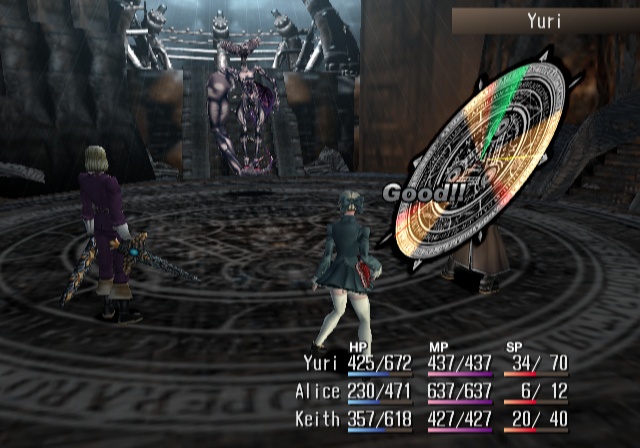 Throwing a wrench into this system is the fact that enemies can cast spells that shrink your ring so it is half the size and tougher to see, speed up the meter so it sweeps around the ring twice as fast, or at irregular speeds, cut the amount that red segments take up by half or, the worst, turn the meter invisible, leaving you to your own devices. You'd better have a good memory of what the ring looks like for every attack. Yes, every attack and spell has a slightly different layout!
Unlike in the first game, characters have customizable rings with hit areas ranging from 1 to 5, which get smaller as more areas are selected. Hit and strike expansions can make these hit areas larger and thus easier to strike in the heat of the moment. One add-on effect can be equipped to a ring as well, such as defense, attack, evasion down, poison, etc. Each add-on is ranked from 1 to 4; the higher the rank, the more likely these effects hit the enemy, and of course, the highest rank, 4, is late in the game and difficult to find.
Battles are great, but the game suffers from tedious dungeon design, which isn’t helped by an awkward mini-map, so even if battles are innovative, they feel exhausting over time. You can see your immediate surroundings, but there is no way to zoom out and see the entire dungeon, which consists of long branching corridors, dead ends, and frequent camera angle switches. Later on, this extends to moving platforms, so, taking all of that into consideration, it can be incredibly easy to get lost while looking for a switch or key or finding your way to the boss.
By the way, this game is jam-packed with bosses, too many. I say this because the strategy never changes: Buff and do a four-character combo as soon as possible. Combos are high-risk, high-reward, with the possibility of excellent rewards. By forgoing 1–3 character turns, you can link multiple characters together. As long as you don’t miss an attack and push one of four possible linking buttons, X, Square, O, or Triangle at the correct time to continue the combo. Quickly hitting the proper button ensures a character’s attacks will segue into the next. As a result, damage output increases. However, miss the linking button, and the combo will fail, costing you as many as 4 attempts to do damage. Later in the game, the most formidable bosses will rip you a new one if you overplay your cards. I was great at combos but had a few misplaced presses. I only did combos if the characters could go before the boss. Luckily, there is a visible turn order, which helps to plan. My advice is never to have a planned combo that includes a character whose turn is due after the boss.
Crests add an extra layer of depth to battles. Dozens of well-hidden crests add magic attacks to all characters except Yuri and Korando. The stronger and better they are, the more points they take up, and each of the 6 crest users has a limited number of allotted points to equip crests. Yuri and Kurando don’t fully lose out as they can morph into several powerful beings. Yuri can collect soul points, which are used to unlock stronger beasts to morph into.
Covenant pulls out all the stops for side quests too; they are in abundance, to say the least! However, somewhat annoyingly so, most aren’t available until reaching the final dungeon for the first time. Each of the eight characters has a unique quest; there are challenge fights that, for example, require winning 5 fights in a row while poisoned, with the stipulation that you can’t use status healing items, an item trading quest that spans the majority of the game and much of the world, and several other side missions. Unlike the first game, where your party was constantly in flux, Covenant is steady, and party members don’t usually come and go. Eventually, eight teammates end up joining.
With that said, if you have a steady party of 4, just be ready for the game to force your hand in many of the side quests, as several require 1 or even 2 specific characters to be used. Even if those 1 or 2 are weak, the game isn’t so hard that it’s an issue, and you can still select 3 or, at worst, 2 powerful characters, which is enough to progress through anything. Levels come quickly, every 45 minutes of gameplay on average, and I reached level 63 by the last boss, 47 hours later.
Making a return from the first game is the lottery. You play the lottery by finding well-hidden tickets in dungeons and towns. They are tough to find, but with a keen sense of discovery, they can be located. It is worth the hassle to gather them, as there are several useful items. 17 lottery members will take tickets and allow one spin. Like battles, the lottery uses the ring system. Like the first game, items lack a description, so it is either a crapshoot or a walkthrough will be needed to know what each item is, as the game doesn’t explain the function of items unless you’ve already seen the item outside of battle, which occurs some of the time. The items for Lottery Member 17 are decent, but the prizes get better as you move closer to Lottery Member 1, except for Member 2, whose items were surprisingly average. The best items are challenging to obtain with a fast spinner and prizes located on a space of 1 millimeter (1mm) or 1 degree out of 360.
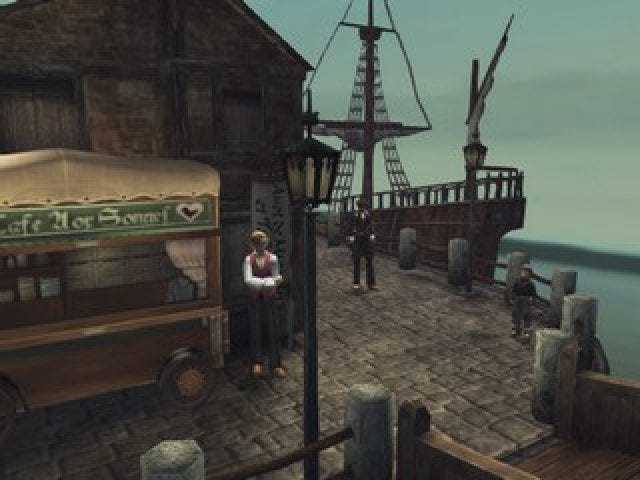 This game might not win any beauty contests, but it’s a noticeable improvement over its predecessor. The arcane atmosphere compensates for the otherwise average visuals. I still prefer the bizarre supernatural horror vibes of the first game; its enigmatic charm feels more subdued in Covenant. On the plus side, the game boasts a wealth of cutscenes that stand out and add to the narrative. While the indoor dungeons were too drab and uninspired, the outdoor areas were picturesque.
Enemy sprites were solidly designed with some neat magic animations. The dungeons were a sticking point for me. I have no issue with maze-like areas, but in that case, it is a necessity to have a better, more user-friendly, and adjustable map, and the angle of the camera was constantly changing. With the PS2, it was expected that characters would have more agency over the camera. Frequent random encounters can make navigation all the more difficult, increasing the likelihood of getting turned around or lost. Doubly annoying when being interrupted in the middle of trying to solve one of the many puzzles.
The battle music in the first game was bothersome, but it has improved slightly in Covenant. The boss theme, while unsettling and providing a necessary sense of stress and threat, isn’t particularly catchy. On the other hand, the various town themes, especially the streets of Yokohama and the Foreigners' Cemetery themes, are gorgeous and peaceful. The music helped some of the tedious dungeons to stand out more than they would have otherwise.
Shadow Hearts 2: Covenant made significant strides forward with some notable stumbling blocks. While I missed some of the off-kilter quirkiness of the first game, this installment still boasts an intriguing narrative with a memorable antagonist and an endearing cast of protagonists. Granted, encounter rates start to become overbearing by the end while navigating through some of the labyrinths, but overall this is one of the better turn-based systems I’ve seen. If you played the first game and even remotely liked it, this is worth it, but as enjoyable as this game is, I would not recommend it before trying the admittedly inferior first.
Wayback Wednesday Volume 1: Final Fantasy 7 and Chrono Trigger.
Wayback Wednesday Volume 2: Super Metroid and Castlevania: Symphony of the Night.
Wayback Wednesday Volume 3: The Legend of Zelda: A Link to the Past and Lunar: Silver Star Story Complete
Wayback Wednesday Volume 4: Secret of Mana and Wild Arms
Wayback Wednesday Volume 5: Illusion of Gaia and Grandia
Wayback Wednesday Volume 6: Breath of Fire 3 and X-Men Legends
Wayback Wednesday Volume 7: Star Ocean: The Second Story and Super Mario RPG
Wayback Wednesday Volume 8: Demon's Crest and Dragon Quest VI
Wayback Wednesday Volume 9: Suikoden I and Jeanne d'Arc
Wayback Wednesday Volume 10: Ranking the first 6 Final Fantasy games
Wayback Wednesday Volume 11: Earthbound and Valkyrie Profile
Wayback Wednesday Volume 12: Legend of Legaia and Secret of Evermore
Wayback Wednesday Volume 13: Threads of Fate and Soulblazer
Wayback Wednesday Volume 14: Radiata Stories and Robotrek
Wayback Wednesday Volume 15: Rogue Galaxy and Vandal Hearts
Wayback Wednesday Volume 16: Chrono Cross and Muramasa: The Demon Blade
Wayback Wednesday Volume 17: Okami and Legend of Mana
Wayback Wednesday Volume 18: Paper Mario and Terranigma
Wayback Wednesday Volume 19: Dragon Quest VIII and Atelier Iris 2: The Azoth of Destiny
Wayback Wednesday Volume 20: Ranking the 6 console Final Fantasy games from the PS1 and 2
Wayback Wednesday Volume 21: Eternal Sonata and Actraiser
Wayback Wednesday Volume 22: Persona: Revelations and Tales of Destiny