
The most unlikely hero stars in a sometimes humorous tale.
The PS2 was overflowing with RPGs, and Radiata Stories was one of the many gems that slipped through the cracks. This is a shame because it offers a solid adventure for those who seek out the game. While it is unlikely to blow most gamers away, Radiata Stories, developed by well-known Tri-Ace and released by Square-Enix in the autumn of 2005, is a commendable effort with some unique aspects that separate it from the many RPGs of the era.
Jack, the main character, can better be summed up by some of the in-game quotes about him than anything I could say. A quote from Thanos, the receptionist at Vancoor, midway through the game, seems most appropriate. “I don’t know if he is stupid or brave.”
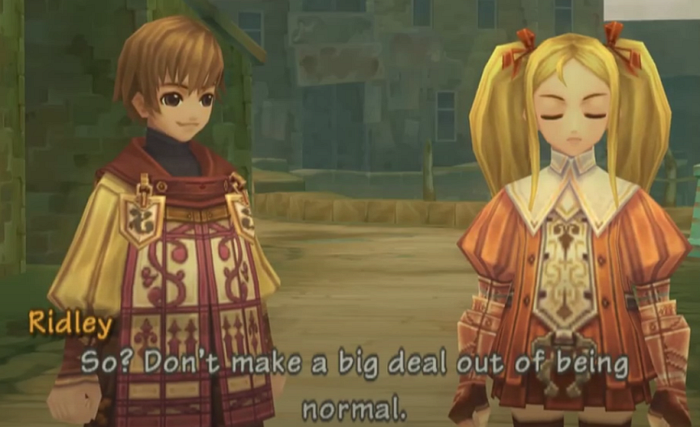
Indeed, Jack isn’t your typical RPG protagonist. He lumbers about for much of the game, puttering around in an uncoordinated manner, and is reluctant, at times, to partake in new missions and is late to many important briefings. He can be childish and petty at times, and his actions are more reminiscent of a teenager being forced out of bed too early on a Saturday. For example, after being late to a meeting and being scolded by Ridley, the next morning, he quickly runs past Ridley just so he can be first and brags about being on time, to which Ridley simply and correctly points out:
 Jack is just as likely to respond and find himself in the heat of some pointless squabble as he is to slay some dangerous beast. The thing is, something is endearing about his character; he is always true to himself and never wavers from his convictions. This extends to the story as a whole, one that, though immature, is still hilarious.
Throughout his journey, it’s possible to recruit 175 different characters. However, collecting everyone will take at least two playthroughs. Because of the large cast of partners, the party is fluid and always changing. Some characters are very easy to recruit, but oftentimes they are some of the worst of those 175. The better, stronger characters require much more effort.
An effort that is not always worth it. Like several post-2000 RPGs, Radiata Stories uses a time-based system where the clock is always ticking; day turns to night and back to day. I can’t think of any other game before 2012 (before Xenoblade Chronicles) that did such a good job of showing a town in an RPG filled with so many unique individuals. Radiata Stories does an impressive job of showing a town filled with hundreds of NPCs going about their daily business at all hours of the day, walking to and from various locations. It is a good idea, but without the ability to freely move time, like in Xenoblade, collecting any more than a few dozen NPCs for your friend list can become burdensome. Had this mechanic been slightly tuned, it would have been impeccable. As it stands, the player is sometimes left to the whim of the clock, and that includes basic things such as shopping at some stores which, for the most part, open at obvious times but sometimes, also at very inconvenient, less obvious times. However, sleeping at your house to pass that time, which most players wouldn’t be faulted for trying, can have the unintended consequence of accidentally advancing the plot, something that happened to me several times.
There are a lot of likable characters, like Lark and Ridley, and I found the communication between Ridley and Jack cute in a grade-school kind of way. But there are just as many unlikable characters. Some of them can be jerks for seemingly no reason. I decided not to purchase anything at one store, and after returning a few days later, the shopkeeper copped an attitude and was bitter with Jack. I could not stand others, like Ganz or Cross. Still, the story, regardless of the choices you make, mandates you cooperate with some of these characters, and Jack even bemoans this at one point. The game centers around the tension between humans and non-humans, building up to an important choice Jack must make near the climax of the story.
The world of Radiata is, though very small by PS2 RPG standards, colorful and a delight to look at. As I said, the main town is filled with 100s of characters, each with their unique facial expressions, gait, and reactions to outside stimuli, such as a kick from Jack. Yes, one of the most enjoyable parts of this game, strangely enough, is just running around kicking objects and even people. Sometimes the reactions are amusing, other times they lead to fights.
Because the world is small, there aren’t many opportunities to explore. Out of town, it is mostly simple paths, and you can never go off them. I see many things off in the distance, but they remain that way for the entirety of the game, which is a shame. On occasion, on the world map, there is a split or two, but otherwise, it is very linear, one of the most linear worlds I have seen in this genre post 2000. Dungeons are not much different and, for the most part, are surprisingly small. However, even in this small world, it is hard to ignore the lack of save points. That took some talent from Tri-Ace to, on one hand, create such a small world and still manage not to offer enough saving opportunities, but this game pulled that off somehow!
The battle system is a cross between Tales of Destiny, Star Ocean, and more traditional action RPGs. It is fast-paced, done in real-time, and requires quick thinking and reaction. It is engaging, but the downfall is that you have little control over the three party members that accompany Jack. You can give commands, but they are limited and don’t come close to the customization possible in a game that came out around the same time, Final Fantasy 12. To me, this is inexcusable, and having access to a few commands that you have to purchase at a bookstore doesn’t make matters any better, nor is it worth it.
As far as controlling Jack, he has a basic attack (circle), and every time it lands, a combat point is added to the combat meter. Pushing circle several times allows for a short combo attack. Once the meter reaches 10, he can execute a combat skill, worth 10 points for stronger attacks. This meter can run up to 100, at which point a volty blast can be used. However, Jack has to spend time with one weapon, sword, spear, or ax before learning combat skills, which get better and better with more enemy kills and, eventually, the volty blast. So, despite learning about the volty blast in a tutorial very early on, you do not have access to it for some time. Just the same, these attacks do tremendous damage and make the game much easier. For example, one strike took off 7% of the final boss’s HP in mere seconds!
Radiata Stories utilizes the linking system. These links reminded me of a playbook from a sport. Jack and his three current party members can line up in any number of formations, like the box link or circle link, etc. Each link has positives and negatives, but my primary focus was to use them to gain new skills for Jack.
Jack starts with one skill, “luck-up,” and upon completing a tutorial a few hours into the game about links, he can eventually learn more skills. How? By linking up with party members for at least a moment in about 15 different battles. Once that is done, Jack learns whatever skill that/those party members have. The most useful skills for me were Strength Up and Defense Up. Thankfully, they can be changed, on the fly, within battles. That means, if I were getting ready to use a volty blast, I would switch to strength up, and as soon as that was done, I would switch back to defense up until my combat meter hit 95 or so, before switching back to strength up. There are other skills such as evasion-up, earth defense (or any other element), HP up, prevent confusion, poison, blind (or many other status effects), etc. Each character you recruit has one skill that Jack can learn.
A few hours into the game, Jack meets Thanos, mentioned above, and Thanos offers several side quests throughout the game. They are all easy and usually give either a good amount of money or a useful item, sometimes both. Even after completing all of these quests and spending time recruiting a few dozen characters, the game only took me about 26 hours. There is, it must be stated, a split around the 2/3rds point of the game where players have one of two paths they can take. If players have a save point around that time, going back and doing the other side of the story could add another 10 hours. Replaying the game and going for all 175 recruitable characters could take a total of at least 60-70 hours.
Radiata Stories never really takes itself too seriously, and this is extended to the music. Much of it is very light-hearted, and I appreciated the, at times, jazzy feel. One of the town songs reminded me of the jazz song, I think it was called Chiquitita, which isn't exactly the funniest song to have glued in your mind for the duration of the game, and I got tired of it. Otherwise, the battle theme is catchy, and I enjoyed that.
Radiata Stories is a game that has come and gone, but it should not be forgotten. There are some solid ideas that, if tweaked and expanded on by a renowned developer, could lead to an epic game. Imagine this game with a more flexible time system and the world of Dragon Quest. Still, even with the absence of an expansive world and a flawed time/clock mechanic, this is a humorous game that should not be missed.
Wayback Wednesday Volume 1: Final Fantasy 7 and Chrono Trigger.
Wayback Wednesday Volume 2: Super Metroid and Castlevania: Symphony of the Night.
Wayback Wednesday Volume 3: The Legend of Zelda: A Link to the Past and Lunar: Silver Star Story Complete
Wayback Wednesday Volume 4: Secret of Mana and Wild Arms
Wayback Wednesday Volume 5: Illusion of Gaia and Grandia
Wayback Wednesday Volume 6: Breath of Fire 3 and X-Men Legends
Wayback Wednesday Volume 7: Star Ocean: The Second Story and Super Mario RPG
Wayback Wednesday Volume 8: Demon's Crest and Dragon Quest VI
Wayback Wednesday Volume 9: Suikoden I and Jeanne d'Arc
Wayback Wednesday Volume 10: Ranking the first 6 Final Fantasy games
Wayback Wednesday Volume 11: Earthbound and Valkyrie Profile
Wayback Wednesday Volume 12: Legend of Legaia and Secret of Evermore
Wayback Wednesday Volume 13: Threads of Fate and Soulblazer