
In 1999, I traded in my N64 for a PlayStation and never regretted it for even a second. There were occasional glimmers of curiosity about one particular unique-looking game I would sometimes see in gaming magazines in 2000 and 2001. Still, for the most part, I was too busy diving into the gigantic library of RPGs for the PSX to care.
Released late in the life cycle of the N64, Paper Mario proves to be the bittersweet swan song for competent N64 RPGs. Yes, the N64 finally got a good, solid JRPG (sorry Quest 64), but it is sad it came so late. I was hesitant to give this a try, what with the absence of Squaresoft and all. But those fears were soon put to rest.
Mario is known for being brave and loved by multiple generations around the world. He was brave in this game with his choice to stick with more old-school, 2D graphics. The result is a sight to behold, and I can say, more than two decades later, the game has aged very well.
You won’t see the flash of the PSX Final Fantasy games, but there is a down-to-earth charm that many of the flashiest games lacked that this has in spades. It is easy to see that every region was created with the utmost care and attention to detail.
Paper Mario tells a very simple story. This is the weak part of the game; granted, there is some humor in the dialogue, which at least makes the story feel fresher. Mario has to collect 7 stars that will help him become strong enough to defeat Bowser, who has managed to make himself invincible. Mario must partake in this perilous journey to save Peach.
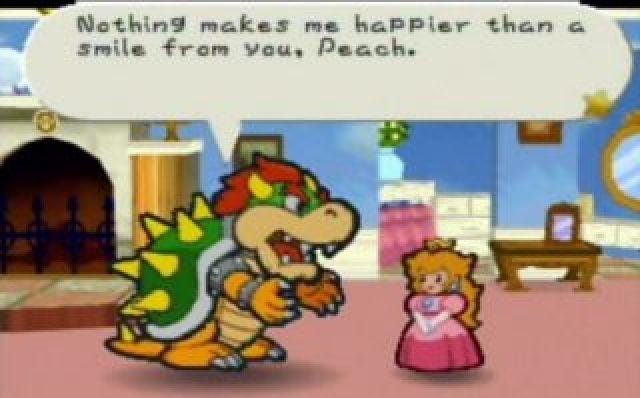 Okay, the story at its core is boring, thankfully saved by some occasional wit or a comedic-relief boss who keeps hounding Mario throughout the game, only to fail in increasingly outstanding ways.
However, I thought it was an interesting twist to allow players to control Peach between Chapters (there are 8) as somewhat of a segue from one chapter to the next. Controlling the person being held captive was a neat innovation, at least how it was presented in Paper Mario. Of course, being a prisoner, Peach lacks the firepower to fight back, so she relies solely on stealth to sneak around the castle, eavesdrop, and find items that will help Mario in his mission. Because placing items in a special chest in Bowser's castle somehow makes their way to Toad Town, and another chest for Mario to get to. Oh well, don’t question it. The items she finds are useful, and that is all that matters. Aided by a special friend, Peach and Mario can communicate through this third party and work on strategies.
Overall, gameplay and game mechanics are simple. There are just two things for Mario to equip: boots and a hammer, all upgrades found. The hammer lets Mario smash blocks in his way. Like Zelda, further upgrades allow him to smash stronger and stronger blocks. Boots allow him to break weak parts of the floor or jump higher.
Level-ups are also basic and allow you to increase just one statistic out of a possible 3: HP, FP (flower points, which function as MP), and BP, Badge points.
Mario can purchase and find many badges throughout the game. The more BP, the more badges he can equip. The best badges require a lot of BP, some as many as 6. This is a lot of BP, considering each level only yields an increase of 3 BP. If you cycle through HP, FP, and BP, you might only get enough BP to equip the best badges every 6 levels, and there is a maximum of 27 levels in this game. 30 is the maximum amount of BP.
Paper Mario does an excellent job of always having far too many intriguing and useful badges than you can equip. Just when you think that an addition of 3 BP after a level will finally allow you to equip all the badges you want, there always seems to be another interesting badge or two right around the corner. As an example, defense up and attack up cost 6 BP each, so combined, that is 12 BP! So even by the endgame, if you have those two equipped, and you really should, you are left with just 18 BP to play around with. Because, after all, who doesn’t want stronger attacks and extra coverage against unrelenting enemy attacks?
Star pieces can also be found scattered and hidden well throughout the world. These can be traded for badges at Merluvlee’s home near Toad Town.
Mario will come across 8 partners on his long journey. They fight alongside him, though only one at a time. Out of battle, they all have unique skills that will help to progress in dungeons and even find nice items hidden in various towns. I thought these were well implemented, except for tattle, which struck me as useless out of battle and not worth a turn in battle. Otherwise, they were integrated well into the dungeons and, if anything, I would have liked to see even more obstacles requiring their use. Each partner can be upgraded two times, which allows for even more powerful attacks in battle. Entire guides could, and probably have been written, just about these 8 partners and better utilizing them in battle.
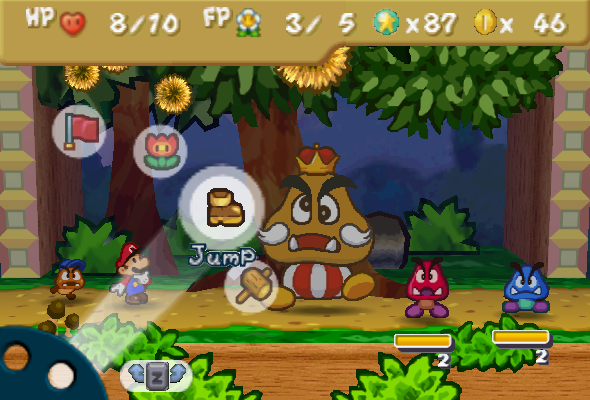 What I enjoyed about the battles, well, a blessing and a curse, is that they keep players actively engaged. A well-timed button press can strengthen an attack or help Mario reduce or even negate an enemy attack. It isn’t just pressing. Other times, you have to hold a button and release it at the right time. Other times, it is pressing the right combination or tapping very quickly. But, as I said, this can be a curse if you have poor timing or don’t execute properly, resulting in weak attacks, or even 0 damage, or greater damage when on the defense. The battle system brings a whole new meaning to high risk, high reward, but also steep punishments for failure to press buttons correctly. There is even a badge that grants players more leeway for timing regarding button presses!
Special attacks require FP, some as many as 8! My endgame FP total was 50, so clever use of FP is paramount to success. This is made harder by the small number of items Mario can carry at any one time. There are so many items for so many possible situations, but most likely, most of those limited item slots will be taken by strong FP healing items. That or use 3 BP to equip a badge that allows for auto FP healing (1 FP per round).
Grinding isn’t really possible in this game. While each level only requires 100 experience, each new level means the same enemy gives a lot less experience, and that amount quickly drops off. I wish there had been a little more leeway.
Enemies can be seen on the screen and avoided, but are hard to avoid. Running from a battle costs money, unless you have a specific badge to avoid that, and once you are at a high enough level, and it isn’t even that high, there are no rewards for defeating enemies. But there is a badge that allows Mario to quickly get rid of weak enemies. So there’s that.
Defeated enemies drop hearts (one heart heals 1 HP) and flowers (heals FP). But they spread out in all sorts of random angles and disappear frustratingly quickly. I lost 100s of coins because of this. Why can’t they stay on the screen longer?
While most end-game stats in the majority of RPGs have numbers in the 100s and 1000s, most players are likely to max out not too far beyond 50 for HP or FP, and even against the last boss, my hits were doing 5–10 HP of damage to a boss who had just under 100 HP. Realize that you are dealing with much smaller numbers in this game.
As Mario frees each new star, he gains a new star power that uses various amounts of star energy. I used the power that allowed me to heal 5 HP and FP a lot, and later smooch, which heals 20 HP as well as Star Storm. I didn’t personally find the others very useful. Each star freed equals another full star meter.
Once the 7th star is saved, you will have 7-star meters (aka, 7-star energy), along with the 7-powers each star gave. Each star power takes anywhere from 1 to 3 off the star meter (star energy). Especially early in the game, when you have just 3 or 4-star meters (star energy), the star meter will empty rapidly. However, it can be charged, about 3/5ths of one meter, by focusing, and are also filled when Mario is attacked or uses a basic attack. And yes, there is a badge to increase the amount of star energy recovered when Mario focuses. This was a neat addition to make battles a little more nuanced. If you’ve just started the game and battles aren’t doing it for you, at least wait until you get the first star.
Some side quests and extras can extend this game well beyond 20 hours, perhaps even to 30 hours or more. There was some cooking that I did not partake in at all.
There are a handful of tough extra bosses and an entire extra sewer dungeon that can only be tackled in bits and pieces, and must be revisited often once Mario obtains new friends to go along with him on his journey, or other parts of this sewer can only be explored once his hammer or boots are upgraded. Though annoying and filled with some tough bosses, exploring is highly worth it. I collected a bunch of letters, but forgot who I had to go back to, so they remained in my inventory until the end. But collecting letters is another side quest, as well as reading them at the post office, all addressed to the 8 partners who tag along with Mario.
There is also a dojo in town where you can fight tough battles for rewards. There is also a casino, but I can’t stand them in real life, never mind artificial ones in video games, so I can’t say anything about that. As side quests that add to the story are great, but ones that waste time and break up the flow of the story strike me as meaningless, regardless of any reward.
The music is typical Mario, upbeat and pleasant in the villages, ominous in the dungeons and other areas filled with enemies. My two favorite tracks were the tension-filled boss theme and the music that played when Bowser appeared. Most gamers have seen Bowser many times, so it takes a special kind of music to create a foreboding atmosphere instead of the “Been there, done that” kind of feel. On the other hand, a second boss theme that was played for some bosses, though good, was too upbeat.
Paper Mario proves there are a lot more possibilities for Mario in RPG settings. The story is largely contrived and cliched, even by video game standards, but at the same time, there is a beauty in its simplicity. Plus, it’s visually striking and has all the classic Mario-sounding tracks, but in updated early 2000s form. This is not a spectacular game, but it is a solid game that is easy to get into and fun to beat. I’d recommend this for RPG fans and gamers, in general.
Wayback Wednesday Volume 1: Final Fantasy 7 and Chrono Trigger.
Wayback Wednesday Volume 2: Super Metroid and Castlevania: Symphony of the Night.
Wayback Wednesday Volume 3: The Legend of Zelda: A Link to the Past and Lunar: Silver Star Story Complete
Wayback Wednesday Volume 4: Secret of Mana and Wild Arms
Wayback Wednesday Volume 5: Illusion of Gaia and Grandia
Wayback Wednesday Volume 6: Breath of Fire 3 and X-Men Legends
Wayback Wednesday Volume 7: Star Ocean: The Second Story and Super Mario RPG
Wayback Wednesday Volume 8: Demon's Crest and Dragon Quest VI
Wayback Wednesday Volume 9: Suikoden I and Jeanne d'Arc
Wayback Wednesday Volume 10: Ranking the first 6 Final Fantasy games
Wayback Wednesday Volume 11: Earthbound and Valkyrie Profile
Wayback Wednesday Volume 12: Legend of Legaia and Secret of Evermore
Wayback Wednesday Volume 13: Threads of Fate and Soulblazer
Wayback Wednesday Volume 14: Radiata Stories and Robotrek
Wayback Wednesday Volume 15: Rogue Galaxy and Vandal Hearts
Wayback Wednesday Volume 16: Chrono Cross and Muramasa: The Demon Blade
Wayback Wednesday Volume 17: Okami and Legend of Mana