

I’ve wanted to include Muramasa: The Demon Blade in my Wayback Wednesday series for some time, but I’ve never been sure if it quite makes the cut for being “old enough.” I never had a clear line for release dates in this series, but I suppose this one might draw it: pre-2010. It sits right on the cusp of retro and modern. Even so, for the most part, I aim to cover games that are at least 20 years old. But this one is too good to pass up.
Visually stunning. By the way, also a blast to play!
There is a time and a place for the long haul in the world of video games; titles that can easily meet and exceed 100 hours, such as Xenoblade Chronicles, Persona 5, Zelda: Breath of the Wild, various Final Fantasy and Dragon Quest titles, and so on. If you want to dive headfirst into some complicated game mechanics with robust character customization, those games, for starters, can scratch that itch too. But sometimes the need for something shorter and simpler may creep up for many of us who love to game. If the game is innovative and high quality, even better. Muramasa easily checks all of those boxes.
What games can we recall that are visually and stylistically alluring and awe-inspiring? Legend of Mana might come to mind, Ni No Kuni can’t be ignored, Dragon Quest 8 and 11 are two blockbuster choices, and Child of Light, Hollow Knight, and Ultros are indie games with boatloads of visual charm. Well, move over, rightful contenders, Muramasa may very well have dethroned all of the aforementioned classics.
Sometimes a game can coast on one aspect, and though there aren’t any weak points to be found here, the painting-like scenery helps Muramasa to stand out. Each new area is a treat to take in and become immersed in. Though each screen can be run through in under a minute, even considering battles, taking time to enjoy the finer things in life is the best advice possible. Look at the backgrounds, the crashing waves, and the swaying trees, for this is an inviting world!
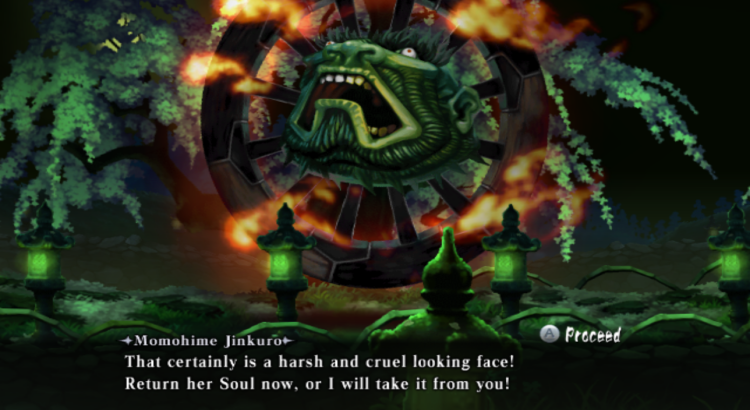
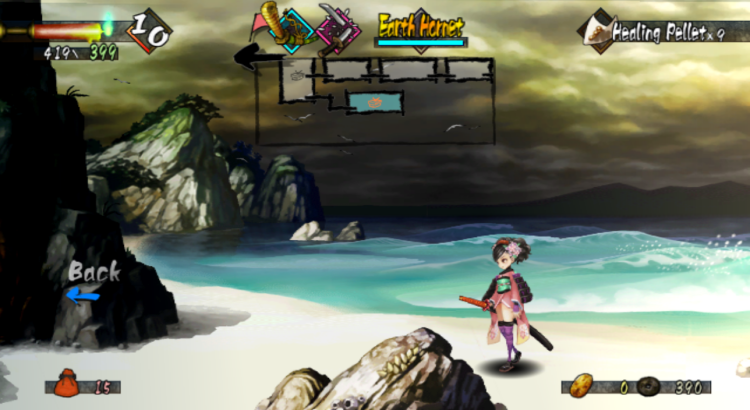 The music certainly helps to create a one-of-a-kind, engaging experience. In fact, the final boss battle for Momohime (“Inscrutable Stratagem”) has some of the best music, boss battles, or otherwise that I’ve heard in the hundreds of RPGs I have beaten. It is dripping with tension, urging gamers to keep up with the frantic tempo and the boss’s heavy-hitting onslaught.
The voiceovers during battles are what I have always dreamt of, understated and used sparingly, further adding to the severity of the moment. In an uncommon move, the voices have not been dubbed and instead, simply given subtitles to accompany the Japanese spoken dialogue.
This, coupled with many of the tracks, especially in the small towns, adds a certain mystique that is hard to find in many other games, past or present. I’ve never been to Japan (though I spent two years in China and took 10 weeks to travel around 5 Southeast Asian countries), but I get heavy vibes of ancient Japanese mythology and Buddhism mixed with special respect being paid to feudal Japan. Muramasa is what I imagine the result of those three aspects being mixed would look like. It is truly a jaw-dropping, distinct, somewhat quirky journey, further enhanced by tracks such as “Dim Twilight A” and “Dusky A”. Whatever the developers were going for, my intuition tells me they nailed it.
 So the scene is set, and that is fantastic because it masks the fact that the gameplay, when you get down to it, is simple. The same button to attack is also used to defend, which works better than you’d think. However, jumping and double jumping are used with the up button, which was annoying to get used to, and there are some buttons mapped as shortcuts to use items, such as healing items. Powerful attacks can also be completed, and it is of the utmost importance to always pay attention to blades and katanas as they frequently break, temporarily leading to weaker strikes. It is possible to switch weapons instantly, and up to three can be equipped, each with its unique power move. Combos are counted, and I scored well over 500 hits on the centipede boss, but sadly, there doesn’t seem to be a status screen keeping track of any in-game statistics. Most battles last well under 30 seconds.
There is a relatively straightforward forging system where new blades can be created and equipped, all dependent on souls collected from dead enemies, as well as the current level. I was able to create 73 total blades in my run-through of the game with Momohime and Kisuke. Food can also be cooked for healing and temporary stat gains.
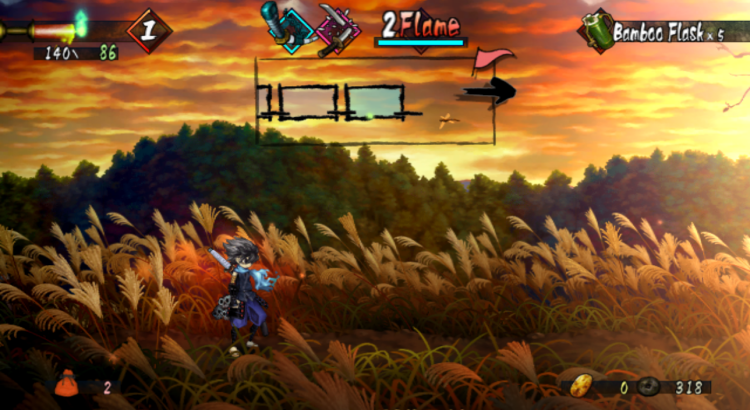 The game can be played in two modes, which I later found out are difficulty modes. Muso is normal, and Shura is hard. According to the game’s description, Muso plays in hack-and-slash mode while Shura is in stealth mode. For both characters, I used Muso because I am not typically good at beat ‘em up type games, but Muso was, for the most part, easy. I’d recommend starting with Kisuke; his campaign was shorter and easier to complete.
However, each story is worth playing through because they are vastly different, with each character coming from drastically different backgrounds. Now, scenery-wise, both players traverse through 90% of the same areas. The beginning stages of tedium started to set in towards the end of Kisuke's playthrough, but the game was short enough (just over 15 hours for both characters) that it did not come close to feeling like a full-blown issue.
The story centers around a lord who thirsts for the demon blades, and after finding them, unleashes unimaginably powerful demons from hell as well as ancient gods.
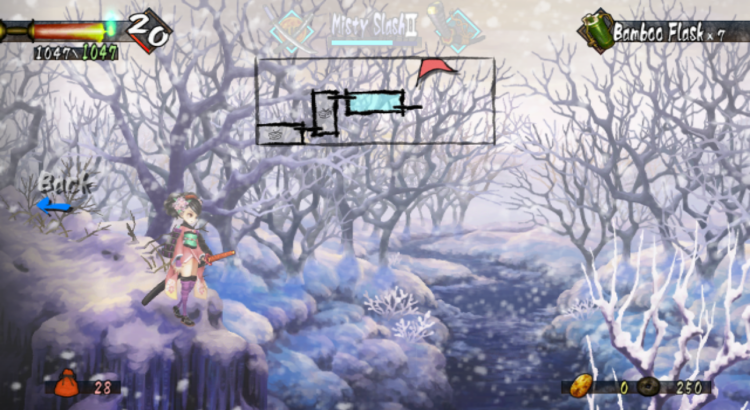 Muramasa is a short game with a tutorial lasting just a few minutes, meaning the learning curve is excellent for a gamer looking for something to jump right into and advance quickly and consistently. This is a perfect example of a game that can be completed in a long weekend. Come for the enticing painting-like backdrop, and stay for the addictive, fast-paced combat.
Wayback Wednesday Volume 1: Final Fantasy 7 and Chrono Trigger.
Wayback Wednesday Volume 2: Super Metroid and Castlevania: Symphony of the Night.
Wayback Wednesday Volume 3: The Legend of Zelda: A Link to the Past and Lunar: Silver Star Story Complete
Wayback Wednesday Volume 4: Secret of Mana and Wild Arms
Wayback Wednesday Volume 5: Illusion of Gaia and Grandia
Wayback Wednesday Volume 6: Breath of Fire 3 and X-Men Legends
Wayback Wednesday Volume 7: Star Ocean: The Second Story and Super Mario RPG
Wayback Wednesday Volume 8: Demon's Crest and Dragon Quest VI
Wayback Wednesday Volume 9: Suikoden I and Jeanne d'Arc
Wayback Wednesday Volume 10: Ranking the first 6 Final Fantasy games
Wayback Wednesday Volume 11: Earthbound and Valkyrie Profile
Wayback Wednesday Volume 12: Legend of Legaia and Secret of Evermore
Wayback Wednesday Volume 13: Threads of Fate and Soulblazer
Wayback Wednesday Volume 14: Radiata Stories and Robotrek
Wayback Wednesday Volume 15: Rogue Galaxy and Vandal Hearts