
Don’t sleep on this game; it’s a blast!
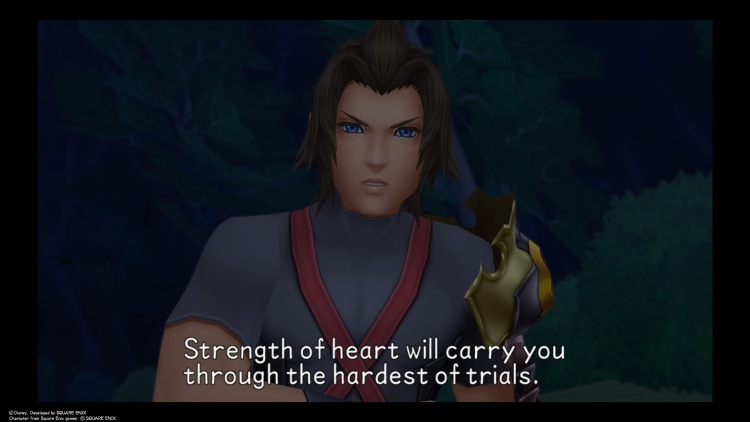 What came before Sora? Birth by Sleep is a prequel to the first Kingdom Hearts, exploring the background of Keyblade apprentices Terra, Aqua, and Ventus 10 years before the first game, split into three scenarios that parallel and occasionally intersect.
So if Terra is Earth and Aqua is water, why Ventus? Ventus is the Latin word for wind, which is something I learned. The developers missed the chance to add Ignis (fire) as the master, who is instead named Master Eraqus. Instead, Ignis is left for a boss in the game. Anyway, the trio must stop Xehanhort’s plan to create the legendary χ-blade to unlock Kingdom Hearts and rule over all worlds. Along the way, the trio fights the Unversed, manifestations of negative emotions. The three heroes have different playstyles; Terra is the best at physical attacks, Ventus is the fastest, and Aqua is the magic user, though she is almost as fast as Ventus by the end. They share many abilities but also have some unique skills too.
The game started with promise but, towards the end, got repetitive, revisiting the same areas. While it is unrealistic to expect exclusive worlds for each character, at the very least each world could have been expanded to allow each character to explore new parts with occasional overlap and crossed paths. The few times this happened, such as mini-Ven looking for materials in a huge room, were examples of how this could have been done more frequently. My other gripe is that it’s possible for players to miss the final chapter. Luckily I got it playing blind, but be aware, and possibly have a checklist of the required reports that need to be found. The three chapters are tied together in one 15–20 minute final chapter. I would have liked to see a lengthier, more substantial finale, perhaps with a party of three (two AI-controlled) running through at least one extra world.
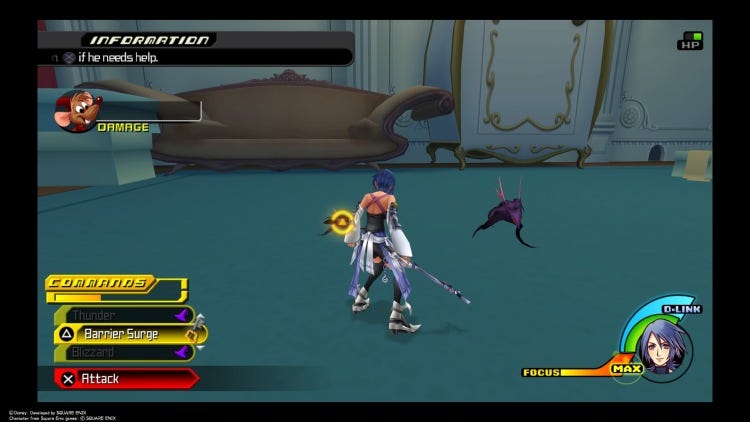 While the combat is an improvement over 1, it is still a far cry from 2. Some of the issues with the camera in 1 resurface here. Do you know those headcams put on trail bikers? It resembles that. It can work, but when quick action is required, sometimes you must grit your teeth and take a stab in the dark. This is a hack-and-slash with some timely dodges required during more intense moments, but also know that planning properly is paramount to success.
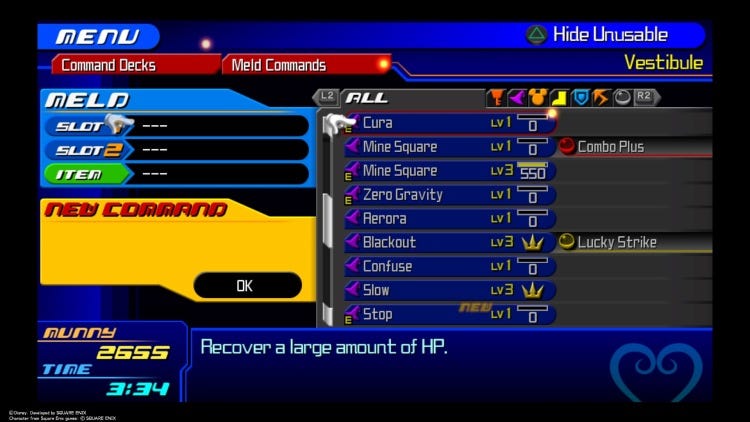 I enjoyed the customization options, with the command deck being at the forefront in helping to fine-tune for any challenge. At the start of the game, options are limited but quickly expand. These options, battle commands, can be purchased from Mog or, better yet, drops from enemies or combined in the melding section. This is one of those games where you will spend a lot of time in the menu replacing abilities and mixing two abilities to make a new one (mend). While losing some abilities you’ve grown attached to is a bummer, the result is usually much better. While mending, crystals can be affixed to the final product, offering stat increases, including the ever-important HP modifier. HP can only be increased from crystals via mending and beating bosses.
Trust me, you will need every bit of HP too; some of the bosses in this game hit like an angry bull running alongside a bulldozer with a tidal wave not far behind ready to strike the finishing blow. I was surprised at how hard not just some of the closing bosses were, but even a few from the start of the game, like the first boss in Terra’s chapter, can lay ruin if you aren’t careful. Late-game bosses move with the grace of a gazelle while striking like a Sabin-supplexed freight train. So, fight against that camera, try to time your dodge, and find an opening for a strike or two before retreating.
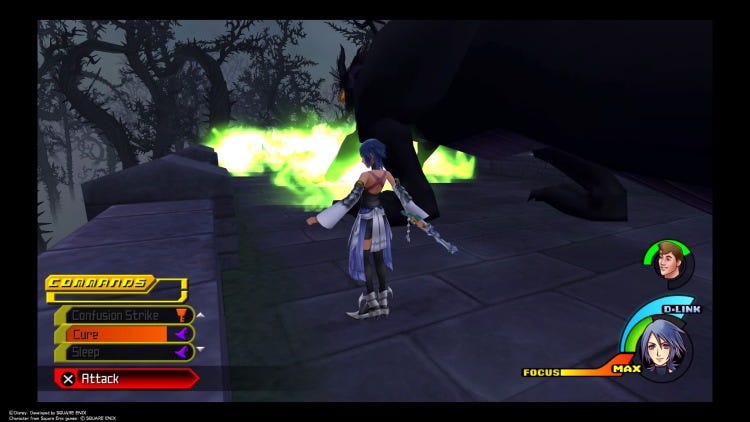 I had nasty flashbacks of camera issues from Kingdom Hearts 1 for this battle, where the only source of safety seemed to be where I was placed in the above picture, an awkward placement, but the only way I could survive the boss onslaught, as it seemed it was certain death anywhere else.
The time delay between strike and dodge was noticeable. But also, healing leaves you open to some of the fastest enemies, and if hit in the middle of casting, it can be interrupted while starting the charge, a double punishment. Successive hits lead to a gauge that, once filled, leads to the surge command and eventually, the storm command. These powerful attacks are equal parts flashy and fierce and help to turn the tide of the toughest battles.
D-Links are a way to draw power from specific allies forged along the way. They were occasionally useful to me, but I usually preferred to stick with my character and my personalized deck rather than dealing with a predetermined deck of the D-Link. I used them and even got both power-ups for many of them, but some you get too late in the game to ever use in any practical sense.
There are several mini-games, sadly, some foisted on the player, blocking the way toward progression. All three of these necessary games can be found in Disney Town. Terra must race, Ventus has some odd ice cream game, and Aqua has a chaotic game that can only be explained as some cross between soccer with subtle characteristics of volleyball with fruit as balls.
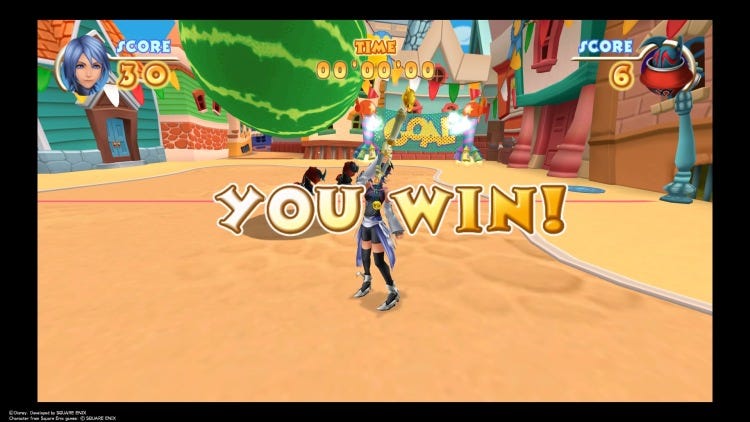 If you watched Futurama and know of Blernsball, it felt like the “multi-ball” inning where multiple balls are released onto the field at once, and chaos ensues. That is “Fruitball” in Birth by Sleep. Have you ever disliked something despite being good at it? Like Dewey from Malcolm in the Middle playing “Bumper Stumpers”, a game somewhat resembling mini bowling, I kicked butt in Fruitball, winning 30–6 but disliked every moment of it and could not wait to be done. The ice cream mini-game took several attempts and was cumbersome.
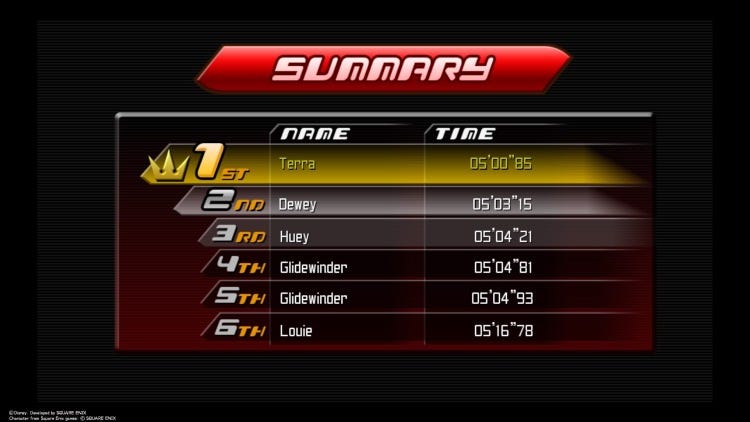 I dislike racing games, but I don’t mind it as side content in other genres. Racing functions well in Yakuza 5, for instance, but in Birth by Sleep, the controls were too slippery and difficult to adapt to. I won my second race and had no interest in pursuing it beyond that. I wasn’t a fan of the command board, and after trying for five minutes, I quit. It reminded me of a mini-game I played in Lost Judgment.
Like in Kingdom Hearts 1 and 2, the voice acting is superb. What a treat that an all-star cast from different Disney movies assembled to lend their voices. The music, too, is instantly recognizable, although, interestingly, one of the most catchy tunes in the game plays during visits to the Mysterious Tower. It has this inexplicable ominous allure that I found to be captivating and memorable.
Similar to my approach with previous games in the series, I won’t name specific Disney worlds in the interest of keeping that unique element of surprise. However, I admire the faithful and impressive portrayal of these worlds in the series, including Birth by Sleep. Each location perfectly reflects the essence of the respective movies, offering an intimate tour of each location.
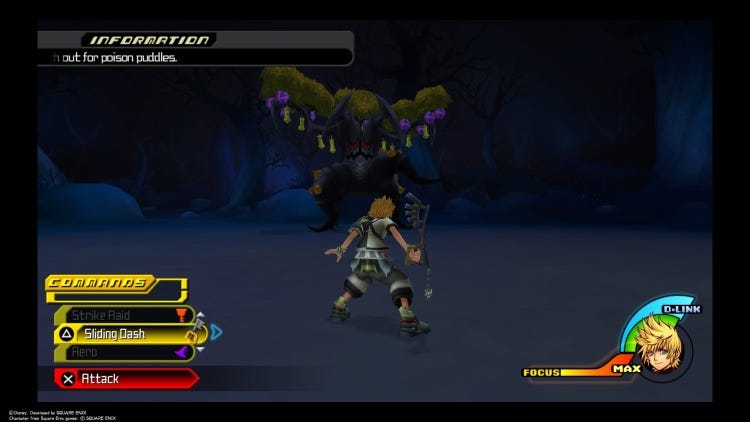 Considering this is a PSP game, Kingdom Hearts: Birth by Sleep is an impressive accomplishment. Much like 2, it is a streamlined experience that offers gamers plenty of freedom to adjust and adapt. While the story didn’t draw me in as I had hoped, the main characters are still likable. Overall, if you liked the direction Kingdom Hearts 2 took the series, this is a great game to try. For first-timers to the series, it is hard to recommend simply because much of the plot would not make sense. Still, if you want a taste of the series and don’t care where you start, this is fantastic and should take 20 to 30 hours.
Wayback Wednesday Volume 1: Final Fantasy 7 and Chrono Trigger.
Wayback Wednesday Volume 2: Super Metroid and Castlevania: Symphony of the Night.
Wayback Wednesday Volume 3: The Legend of Zelda: A Link to the Past and Lunar: Silver Star Story Complete
Wayback Wednesday Volume 4: Secret of Mana and Wild Arms
Wayback Wednesday Volume 5: Illusion of Gaia and Grandia
Wayback Wednesday Volume 6: Breath of Fire 3 and X-Men Legends
Wayback Wednesday Volume 7: Star Ocean: The Second Story and Super Mario RPG
Wayback Wednesday Volume 8: Demon's Crest and Dragon Quest VI
Wayback Wednesday Volume 9: Suikoden I and Jeanne d'Arc
Wayback Wednesday Volume 10: Ranking the first 6 Final Fantasy games
Wayback Wednesday Volume 11: Earthbound and Valkyrie Profile
Wayback Wednesday Volume 12: Legend of Legaia and Secret of Evermore
Wayback Wednesday Volume 13: Threads of Fate and Soulblazer
Wayback Wednesday Volume 14: Radiata Stories and Robotrek
Wayback Wednesday Volume 15: Rogue Galaxy and Vandal Hearts
Wayback Wednesday Volume 16: Chrono Cross and Muramasa: The Demon Blade
Wayback Wednesday Volume 17: Okami and Legend of Mana
Wayback Wednesday Volume 18: Paper Mario and Terranigma
Wayback Wednesday Volume 19: Dragon Quest VIII and Atelier Iris 2: The Azoth of Destiny
Wayback Wednesday Volume 20: Ranking the 6 console Final Fantasy games from the PS1 and 2
Wayback Wednesday Volume 21: Eternal Sonata and Actraiser
Wayback Wednesday Volume 22: Persona: Revelations and Tales of Destiny
Wayback Wednesday Volume 23: Shadow Hearts: Covenant and Dragon View
Wayback Wednesday Volume 24: Ken Griffey Jr. Presents Major League Baseball and Lunar: Eternal Blue
Wayback Wednesday Volume 25: Suikoden II and Xenogears
Wayback Wednesday Volume 26: Azure Dreams and Wild Arms 2
Wayback Wednesday Volume 27: Ar Tonelico and Sword of Mana
Wayback Wednesday Volume 28: Albert Odyssey and Super Paper Mario
Wayback Wednesday Volume 29: Arcana and X-Men Legends II
Wayback Wednesday Volume 30: 10 over-rated classics that haven’t aged well
Wayback Wednesday Volume 31: Dragon Quest IX and E.V.O.: Search for Eden
Wayback Wednesday Volume 32: Tales of Symphonia and Elemental Gimmick Gear
Wayback Wednesday Volume 33: Ys Seven and Brain Lord
Wayback Wednesday Volume 34: Lufia and The Legend of Oasis