
Not a grand slam but still a solo shot.
There’s nothing inherently wrong with simplicity, but when you go that route, you’d better be addicting. Tetris is a classic example of this, and sports games are another genre that thrives on gripping gameplay because, at their core, there’s not much to them. Some of the most engaging sports games of the 1990s and early 2000s, like NBA Jam and Knockout Kings 2000, stand out for their addictive progression. Knockout Kings 2000, for instance, lets players rise through the ranks, boosting stats in a way that feels almost like an RPG. Homer Simpson’s boxing career in The Simpsons, Season 8, Episode 3: “The Homer They Fall” comes to mind too, with the neat montage of his progression through the ranks of local boxers.
Baseball, while America’s pastime, can be a slow, drawn-out affair that stretches over three hours, making it a tough sell for anyone not already a fan. That’s where Ken Griffey Jr. Presents Major League Baseball steps in. I have fond memories of this game from the late 1990s, when it served as an occasional break from RPGs. Recently, I became nostalgic for it after stumbling on a YouTube video about the game.
In Ken Griffey Jr. Presents Major League Baseball, most games are a brisk 15–20 minutes, cutting out the usual baseball filler, catcher/pitcher meetings, endless batter timeouts to step outside the batter's box, and those obnoxious real-life commercial breaks, so those who struggle to last the duration of a real-life game don’t need to worry. A simple button press shortens the 7th-inning stretch to just a second. What’s left is the meat of the game: fastballs, curveballs, double plays, home runs, and all the excitement that makes baseball so compelling.
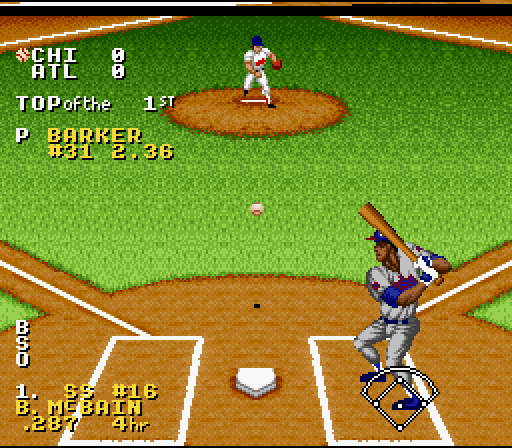 The learning curve isn’t steep. Playing as the Braves, I lost my first few games, but by my 20th contest, I’d already won 13 and finished the regular season with a 122–40 record and clinched the World Series with a 4–2 series win over the Yankees.
I kept auto-fielding on, which helped because manual fielding is tough. The batting mechanics were easy to pick up, and I found that pushing one of the eight directions (up, down, right, left, or any diagonal) also helped with hitting. For players with 9 or 10 speed, like Hook, bunt singles are a breeze.
Once on base, base running can be frustrating with the AI sometimes sending a player to the next base during a shallow pop fly, leading to frantic button-mashing to get them to turn back.
My star player, Evans, hit 75 home runs, drove in 201 RBIs, and batted over .400, which would be the best season ever in real life. So who is Evans? Well, due to licensing issues, the developers couldn’t use real player names, so they got creative, inventing names for every player on every team. You can rename players yourself to their real names, but it’s a time-consuming process.
Pitching, on the other hand, is more difficult. I had a few strikeouts per game, but never more than 3 or 4. There are some exploits to get opposing batters to swing at wild pitches, but I never got it to work more than once or twice per at-bat, never three times. Throwing inside, almost hitting the batter, sometimes works as well. Sadly, fielders, like baserunners, also make dumb choices, like throwing home with the bases loaded rather than going for the easy out at first, as almost every single Little League coach has ever said. I suppose players can be faulted for choosing auto-fielding over manual in that case.
The most enjoyable aspect of the game was the rare occurrences in the span of a full 162-game season; I had 2 inside the park home runs, oddly enough in the span of 3 games, and turned two triple plays, one in the World Series, and had 2 turned against me. As is said in real life, the dog days of summer give way to some surprises from time to time to keep you on your toes and break up the monotony.
For stat lovers, there’s a lot of data to digest: pitcher ERAs, batting averages for every player, and more. However, given how small the game is (well under 1 megabyte), I would have liked a deeper dive into player performance. For example, there’s no way to track how many doubles or triples a batter has or to view a team’s winning streak or record against specific opponents. The only way I could figure out, for instance, that I was 13–0 against the Giants on the season was by manually going through the calendar month by month and counting up the “W”s and “L”s (wins and losses).
What the game lacks in stats, it makes up for in graphics. Each of the 28 stadiums is faithfully recreated, with iconic features like the Green Monster in Boston or the ivy-covered walls in Chicago. For a mid-’90s SNES title, the animations are impressively fluid and expressive. A strikeout is followed by a defeated sigh or an exasperated “Oh, come on!”
Sometimes, even the bat snaps made famous by Frank Thomas. When a player is thrown out after a ground ball, they shake their head in disappointment, and there are plenty of opportunities for stunning leaps to secure the next out. Overall, this is a great-looking game for its time.
The swift gameplay is paired with a rocking soundtrack, giving the game an arcade-like vibe. The music is energizing without being overbearing, and it even feels more urgent in the later innings. Even if you tried to get bored, it’s hard to with the upbeat, instrumental tracks pumping through the speakers. The bass lines are infectious and add so much to the game.
With each game lasting 15–20 minutes, a full season will take around 40 to 50 hours. Although I don’t want to think about how long one 27-inning game went, a walk-off home run in the bottom half of the inning finally ended the marathon. The game can sometimes be frustrating with a 1990s approach to AI that seemingly tries to prevent you from doing too well, with ill-timed batter droughts or opponent hot streaks. If a full season seems too time-consuming, there are 26- and 78-game seasons that might help you get used to game mechanics, such as learning manual fielding, which takes time to adjust to.
Regardless of the length of the season, this is an alluring game by sports game standards and one I’d recommend to retro game enthusiasts, whether you like the sport or even if you are only mildly interested in baseball, as I am. Indeed, this is an addictive game!
Wayback Wednesday Volume 1: Final Fantasy 7 and Chrono Trigger.
Wayback Wednesday Volume 2: Super Metroid and Castlevania: Symphony of the Night.
Wayback Wednesday Volume 3: The Legend of Zelda: A Link to the Past and Lunar: Silver Star Story Complete
Wayback Wednesday Volume 4: Secret of Mana and Wild Arms
Wayback Wednesday Volume 5: Illusion of Gaia and Grandia
Wayback Wednesday Volume 6: Breath of Fire 3 and X-Men Legends
Wayback Wednesday Volume 7: Star Ocean: The Second Story and Super Mario RPG
Wayback Wednesday Volume 8: Demon's Crest and Dragon Quest VI
Wayback Wednesday Volume 9: Suikoden I and Jeanne d'Arc
Wayback Wednesday Volume 10: Ranking the first 6 Final Fantasy games
Wayback Wednesday Volume 11: Earthbound and Valkyrie Profile
Wayback Wednesday Volume 12: Legend of Legaia and Secret of Evermore
Wayback Wednesday Volume 13: Threads of Fate and Soulblazer
Wayback Wednesday Volume 14: Radiata Stories and Robotrek
Wayback Wednesday Volume 15: Rogue Galaxy and Vandal Hearts
Wayback Wednesday Volume 16: Chrono Cross and Muramasa: The Demon Blade
Wayback Wednesday Volume 17: Okami and Legend of Mana
Wayback Wednesday Volume 18: Paper Mario and Terranigma
Wayback Wednesday Volume 19: Dragon Quest VIII and Atelier Iris 2: The Azoth of Destiny
Wayback Wednesday Volume 20: Ranking the 6 console Final Fantasy games from the PS1 and 2
Wayback Wednesday Volume 21: Eternal Sonata and Actraiser
Wayback Wednesday Volume 22: Persona: Revelations and Tales of Destiny
Wayback Wednesday Volume 23: Shadow Hearts: Covenant and Dragon View