

My experience with Earthbound is a case study on how opinions can change over time.
(Check out Part 2, Valkyrie Profile, here.)
I will get this out of the way immediately. When I first played Earthbound in the late 1990s, I hated it. No, that’s not right, I abhorred it. I quit within a few hours, content with the effort I had put in and resolute that I would never pick it up again, and moved on to other games, figuring this would be a mere speed bump in my overall gaming history. This lasted for over a decade, and I remained steady in my internal “1” ranking of the game.
But life happens, and I was sick as a dog for an entire year spanning part of 2011 and part of 2012. Bedridden for the duration and with not much else to do other than reading and writing from time to time, I quickly burned through all of my favorite PSX and SNES games and even some of my not-so-favorite games.
As I started to dive into the less-than-thrilling catalog of PSX and SNES RPGs, a thought started to creep into my mind, slow but steady: Earthbound. Earthbound wants your attention! Give Earthbound another shot! I won’t say it was the perfect experience, and it wasn’t without incident or annoyance, but my opinion of the game slightly changed as I plodded and grinded to the end. I reluctantly played and even beat it, but I still hadn’t given it a fair shake. I didn’t realize that at the time. It was a real 5/10 experience for me, maybe even 4.5.
A half-decade later, in the cold months of November and December of 2018, I picked up an SNES mini on a trip to Texas. Yes, the south of Texas and parts of the North of Mexico were going through some odd cold front, and I needed something to cozy up to as I stayed inside to beat the cold. Secret of Mana, Final Fantasy 6, Zelda: A Link to the Past, and Super Mario RPG instantly jumped out at me, and those four games alone were worth the price of admission since my SNES console, with those four games and more, was 4000 km (2500 miles) away in Maine. Plus, I’d finally be able to try Castlevania and Super Metroid for the first time, and as a bonus, Megaman X and Donkey Kong Country were always my favorite go-to Non-RPG games when I needed a break from the genre. Well, it was colder for longer than anticipated that winter, and I quickly sped through all of those, and as I went to pack away my SNES mini, I couldn’t escape a nagging feeling growing inside. “Earthbound man, give it another shot!”
I unpacked my SNES mini and set it up again, and I am glad I did. The tired cliche about the third time being a charm was true in this sense. Upon playing it for the 3rd time, Earthbound really started to open up to me, and I saw it for the quirky game it truly was. My goal for my third playthrough was to slowly and methodically make my way through the game and take my time. I wanted to stop and smell the roses, so to speak, and I had a lot more fun on my second full playthrough.
The game stars Ness, who, within minutes of starting a new game, leaves his house with his best friend Pokey to investigate a meteor that has crashed on the outskirts of his town. They quickly find that a race of evil alien beings has used their powers to spread hatred through the world and turn animals, people, and even some inanimate objects into belligerent killing machines. A bee, yes, a bee, from the future no less, gives Ness instructions to collect songs from eight different locations to stop this evil from spreading around the world. The journey Ness makes takes him to truly unique areas, and he is soon joined by Paula, Jeff, and Poo. Very few games can rival the diversity and range of places seen in Earthbound, as well as the assortment of different NPCs that aid Ness and company in their travels. A real motley crew if I do say so myself!
Ness, Paula, Jeff, and Poo find themselves in many engrossing situations, including but not limited to a tour bus of a famous jazz group and trapped in a mall. They visit several famous real-world landmarks and other areas based on real-life places. In the interest of not spoiling anything, I will leave those up to players to discover, but it makes the game all the more relatable.
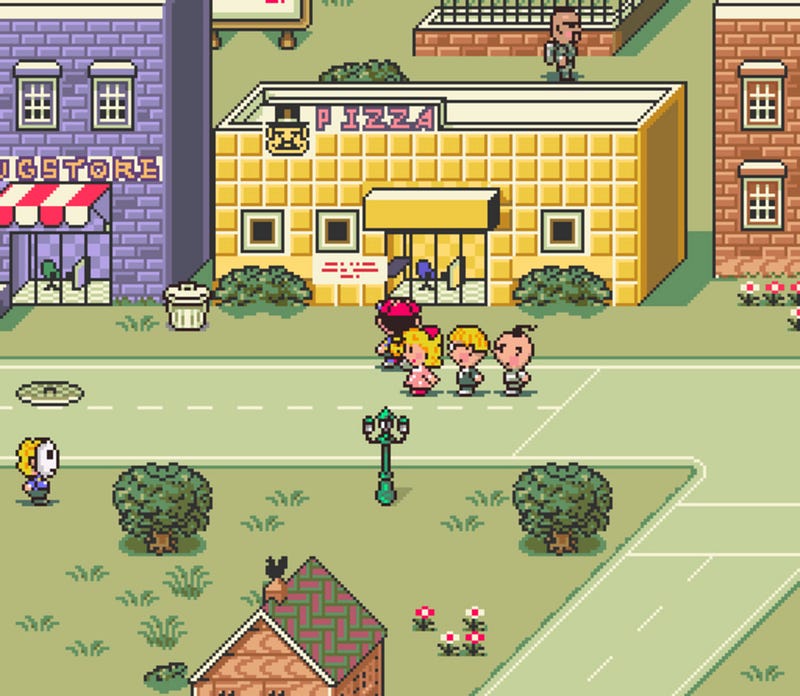 The graphics won’t win any awards, and even by the standards of 1995, when the game was released, they were already outdated. But there is a certain unique allure to how the game is presented. Unlike Final Fantasy 6, for example, or almost any other RPG from the SNES or even PSX, characters aren’t the size of the town they are approaching on the world map. Rather, everything is more or less at the proper scale. There is no world map, and every town, dungeon, and location is seamlessly connected. Unlike most games of the time, Earthbound is not seen from a top-down view. Instead, almost as if you are sitting on a park bench and watching the world go by, this is the perspective here, but in 2D. Towns are large, colorful, and detailed, and it was a pleasure to slowly make my way through each location, as each place has its own vibe and personality.
Enemies are eccentric and unorthodox, with names that are just as unconventional. There are spiteful crows, Pogo punks, cranky ladies, and new-age hippies. The enemy designs are just as unique as the name implies. It was always a blast walking into an area, wondering what kind of odd foe you would run into next. It adds to the excitement of exploring a new dungeon.
 The music is off-beat and peculiar, though not bad, and further adds to the atmosphere and overall environment of the game. One of the tracks at the very end of the game is one of the most freaky, disorienting, dear I say scary tracks I have heard in an RPG, ever. The battle theme is also slightly off-putting, but not outright bad. Thankfully, other tracks in towns and dungeons are fantastic. The only other track that quickly gets exhausting to listen to was out in the desert.
Thankfully, there are no random encounters in this game. Instead, enemies can be seen on screen and avoided, though trying to avoid them is hit or miss, and sometimes they are much faster than Ness. In the end, it is better not to avoid enemies, fight everything you come across, and don’t escape from battles if you can help it. By doing this, levels should generally be high enough to overcome any challenge.
Earthbound does have odd, sometimes brutal, or unfair difficulty spikes, especially during a kidnapping plot point in the mall, which is where taking things slowly comes into play. Don’t be in a rush to beat this game, like I was in 2011, or it will beat you down relentlessly. Rather, in my 2018 playthrough, I was more diligent and methodical, and was rewarded for the slower pace, and my enjoyment increased because of this.
Sneaking up on enemies, represented by a green swirling screen, allows players to go first. Likewise, enemies can sneak up on you and get to go first, in this case, represented by a red swirling screen. When both enemy and Ness meet face to face, a black, neutral screen swirls, and things continue as normal. It was fun to sneak up on enemies and not just advantageous, but almost obligatory in the late game.
When Ness and company get stronger, battles with weaker enemies are done automatically and in a split second, with the bonus of still getting EXP. Once Ness is super overpowered, much weaker enemies who used to intimidate will now run from Ness and his friends! How satisfying it was to watch enemies who once acted as the bullies, run with their tales between their legs, wimps!
One of the more innovative features to be seen in battles is the rolling damage meter. Example: Ness has 300 HP, and an enemy strikes for 400 damage. Screwed, right? Not quite. From 300 HP, Ness’ HP steadily starts to decline towards 0, odometer style. If you get a healing item or spell on time, you can reverse the damage and heal. Not bad! Just be aware, the HP declines at a rapid rate, but timely healing saved my butt on several occasions, especially late game. Or, you can try to outright win the battle before HP reaches 0. I did that a lot too, and on many occasions, prevented a decent chunk of damage from happening. One time, I won a battle with Ness at 1 HP! Talk about “just in the nick of time”!
PSI and PP function as Magic and MP, seen in most other RPGs. There aren’t a lot of different PSI attacks, but they are useful, especially late game, in getting rid of troublesome groups of enemies. When using a PSI attack, a bunch of funky, psychedelic-like colors appear on the screen.
One of my greatest gaming pet peeves, and it was expressed in Earthbound, too, is the seemingly arbitrary, limited inventory space in games. It is especially limited in this game, and this issue is made worse not just by the plethora of key items you pick up, but by never knowing when, or if, you’d need them again. Hindsight and a vague recollection helped me more in my latest playthrough. I was able to make better use of inventory space on the second playthrough, lessening my vexation compared with 2011. But for first-time players, item management is likely going to be a nightmare and one of the greatest aggravations. Plus, having to navigate through the menus, time and again, to move items between characters was burdensome and clunky.
Another inconvenient mechanic is how money is managed. Unlike most games where money is gained via defeated enemies, Ness has to locate an ATM and withdraw money that his father had put into his account. So Ness is old enough to travel around the world, sometimes to destitute, sketchy places, but he can’t handle his own money? Does his father have to do it for him? What? The ATM itself is realistic, but the whole process of getting money is unnecessary and irritating. Plus, for certain plot points when money is required to give to someone, it feels like an ATM has never been so far away!
So, just withdraw everything at all times? Not quite. Though there is technically no game over, similar to many Dragon Quest games, Ness revives at the most recently used save point with half his money. So, undo sometimes an hour or more progress and reset? Or trudge on, 50% poorer? Or, just take out what you think you will need and leave the rest in the bank and hope for the best, that you have enough to cover whatever expense comes your way? Why does the money management in this game feel like such a chore? Money management in real life is, in games, it shouldn’t be.
With that said, once you develop an understanding of how things work and figure out workarounds for the flaws, the game becomes more bearable. Plus, it is still a joy to explore every last one of the quirky locations in the game and meet up with all sorts of interesting NPCs. This is a game that has grown on me over the years, and my number one piece of advice is to be deliberate in your approach to Earthbound. For as silly as the game can be, if you try to recklessly race through this game, especially on a first (blind) playthrough, it may very well chew you up and spit you out. This is a solid game, one that has come a long way since my initial 1/10 first impressions.
Wayback Wednesday Volume 1: Final Fantasy 7 and Chrono Trigger.
Wayback Wednesday Volume 2: Super Metroid and Castlevania: Symphony of the Night.
Wayback Wednesday Volume 3: The Legend of Zelda: A Link to the Past and Lunar: Silver Star Story Complete
Wayback Wednesday Volume 4: Secret of Mana and Wild Arms
Wayback Wednesday Volume 5: Illusion of Gaia and Grandia
Wayback Wednesday Volume 6: Breath of Fire 3 and X-Men Legends
Wayback Wednesday Volume 7: Star Ocean: The Second Story and Super Mario RPG
Wayback Wednesday Volume 8: Demon's Crest and Dragon Quest VI
Wayback Wednesday Volume 9: Suikoden I and Jeanne d'Arc
Wayback Wednesday Volume 10: Ranking the first 6 Final Fantasy games