

I’ve beaten every mainline Dragon Quest except the fourth and tenth. As far as the first seven games are concerned, one thing that never changed was the simplicity of each game. There were no overly complex game mechanics to get used to or steep learning curves. The games were challenging, but not because of convoluted game design. When I finally played 8 in 2021, my main question was whether that old-school charm could survive the leap to 3D. The immediate and most obvious answer, after completing Dragon Quest 8, is a resounding yes, for the most part.
The story revolves around Dholamagus, who steals an ancient magical staff and turns the tiny king Trode and his beautiful princess Medea into a hideous green goblin and a beautiful white horse. Trode was an annoying, self-righteous, self-important, and whiny little thing, but his interaction with Yagus was humorous and provided some comic relief. The hero and Trode, eventually joined by Yagus, Jessica, and Angelo, set out to break the spell cast on Trode and Medea. Like the previous games, especially 6 and 7, every town seems to have its dilemma that needs to be solved as you progress towards solving the overarching main issue. I always found the issues in each town, especially in DQ6 and 8, very interesting, and they add a unique vibe and personality, as no two towns have the same problems. However, the evil spreads further than initially realized, leading to an epic journey.
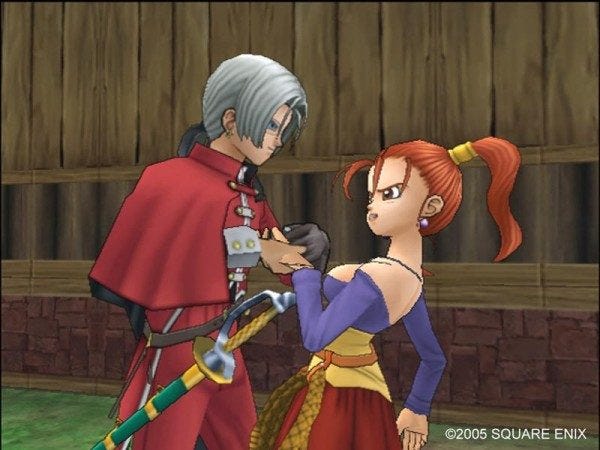 My main gripe with the characters is the tired, silent protagonist trope. The main hero of Dragon Quest 8 is like that, and I never got to know him. Even Crono from Chrono Trigger had more reactions than the hero here. He lacks expression, and I found it impossible to relate to him. This is a shame because Jessica and Yangus were intriguing characters with, by videogame standards, solid character development, though nothing as deep as Tales of Abyss (PS2) or FFX (PS2). I found Angelo to be an obnoxious, one-dimensional womanizer. But there were no redeeming qualities to make his appeal seem realistic. The antagonists in the game, including Dholamagus, are believable and have decent backstories. Especially a certain antagonist related to Angelo.
Visually, the cel-shaded graphics and environments are a sight to behold. Graphically, the transition from 2D to 3D is flawless. They fit right in with the previous games in style and presentation. If 6 or 7 were in 3D, I could imagine a world like this. The best-looking areas are the forests, densely packed with lush green trees, but dungeons and caves were drab, bland, and left a lot to be desired.
The enemies are far more detailed than ever before and, at times, downright silly, as evidenced by the laughter the liquid metal slimes elicited from my non-gamer girlfriend, who just happened to look up from her book when I was fighting a few. In general, enemies are colorful, detailed, and have interesting, unique, and even goofy facial expressions and movements. Just wait until you see an enemy trip over themselves during an attempted critical, missing completely as they fall to the ground in a pathetic heap! Or the equally goofy underpants dance, among other crazy dances!
Score another point for Dragon Quest 8 from the non-gaming crowd, as the peaceful town music drew praise from that same non-gamer mentioned above! Don’t get me wrong, it was a gorgeous track, but at the same time, I felt like I was being serenaded to sleep, and at times, I did feel my eyes getting heavy. The town music is that effective! Indeed, the music by composer Koichi Sugiyama is gorgeous, varied, addictive, and, dear I say, world-class. By the PlayStation 2 era, “videogame music” is no longer merely “videogame music” but has reached such high standards and quality that some music could be in an orchestra. The world map music is playful and adventurous, dungeon music is a perfect mix of intimidating and mysterious, and battle music is engaging, yet threatening. I would have liked the boss music to ramp up the intensity another notch, but it wasn’t bad.
This is the first DQ game to feature voice acting. I will say that out of the many people I know in the UK and Ireland, from London, Manchester, Liverpool, Glasgow, Edinburgh, Dublin, Cork, and beyond, I have never heard a voice even remotely close to the accents in this game, so I am not sure what it is supposed to represent, but a few of my British friends were perplexed, too! Jessica’s voice, probably the best in the game, reminded me of the English of a Serbian friend who speaks at a high level. The two voices are nearly identical! In the end, the voices aren’t awful, per se, just odd, and I was not sure what the localizing team was going for. It is nice to sit back and listen, rather than read a wall of text, just the same. Other than Trode, who sounded like a demented, annoying version of Yoda.
Dragon Quest 8 is a standard turn-based RPG with very few deviations from the standard formula set nearly two decades before the game was released. Thankfully, the pace of battles is much more fluid than the turn-based games that came before it, and battles can end quickly. Plus, battles are no longer in first-person view, and you can see everyone on the screen.
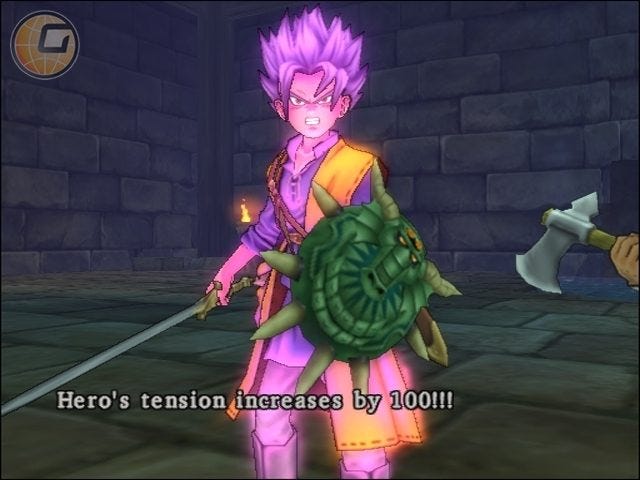 The tension system is an interesting twist to battles. You can spend several turns building up one or multiple characters’ strength using a “Psyche up” command in the battle menu. It starts by raising by 5, which leads to a slightly more powerful attack, and can be increased by 20, 50, and finally 100. The enemies are unlikely to sit idly by and watch you gain strength. They have tons of attacks that can interrupt your tension, including putting you to sleep, confusing you, knocking you down, or killing you. Some bosses even have ice attacks that knock the tension of every character back down to 0. I learned it was better to strike at 20 tension rather than risk getting it to 100, only for the boss to act next and knock it back down to 0 before I could attack with 100 tension. Learning boss patterns and attacks is paramount to success and helps to keep gamers engaged in every round during longer battles.
Dragon Quest 8 also has a skill system where you gain skill points after every level, starting at level 4. It functions as a simplified version of the job system from Dragon Quest 6 or Final Fantasy 5. After each level, a certain number of skill points can be distributed between different skills; each character has five different skills. This provides some flexibility regarding how players can build their characters. When points accumulate in specific skills, new abilities, magic skills, and stat boosts are earned. This offers some freedom in developing characters without the overwhelming amount of choice found in DQ6 or FF5. This can be either a positive or a negative, depending on how much flexibility you want, but other games do offer more; just be aware of that.
There is also an alchemy system. Mixing two items, and eventually, much later in the game, three, into a pot, there is a good chance something stronger, sometimes a heck of a lot stronger, will result. The way this system is set up in this game is a low-risk, high-reward. If the mix fails, you will know immediately and get your items back. So there is never a fear of losing important items forever. Plus, most of the time, if not all of the time, I used alchemy, the resulting item was always better. Very low risk if not, no risk at all. But some of the items are very impressive and, at worst, “meh” and merely “slightly better”.
While the game works hard to maintain the old-school aesthetics within a new 3D setting, mostly to enormous success, there were some failures, too. In the first hour of the game, I was running around, wondering how and where I could save.
“No, it couldn’t be,” I said to myself as it became abundantly clear.
“For real?” I exclaimed in disbelief.
Do I have to go back to the church to save? Not just that, but before characters learn a revive spell, the only way to revive someone is also to go back to a church. I got sick of dragging coffins in Dragon Quest 6, barely excusable even then. Want to know how much more experience is needed for the next level? Church. These were unnecessary holdovers from the older games that did not need to remain in a PlayStation 2 game and are unjustifiable. Yes, the characters look phenomenal, but Level-5 couldn’t make the amount of experience needed more accessible? Come on.
Some things are outdated and referred to as old-fashioned for a reason. Love of old school games aside, some mechanics need to die. I’m not even asking for the ability to save anywhere; I am not that spoiled or feel that entitled, but at least sprinkle them out here and there, perhaps just before a boss battle, for example. Dragon Quest can still be Dragon Quest without some of the old-school mechanics.
There are a few side quests of note. There are two casinos that I did not use at all. By the end of the game, I had 1000 tokens that I was gifted at various parts of the game. I used them for an agility ring for an alchemy mix, and that was it. I have never been a fan of casinos, but they exist, and there are some solid prizes, it seems. There is also a monster arena. I reluctantly tried, at first, but ended up having a blast. There are some viewable enemies on the world map. Upon defeating them, you can recruit them to join your team and fight for you in the monster arena. There are about 8 ranks, and each rank has better prizes. Recruiting the right monsters to beat ranks B, A, and S was a fun challenge. Plus, defeating viewable monsters provides you with monster coins, which can be sold for cash. Cash is not always easy to come by, so this is a welcome, well-needed source of money, especially early on. Finally, mini medals return in DQ8, and there are 116 to find, well hidden around the world and inside dungeons, houses, etc. Once you return a predetermined amount, wonderful prizes are given. It is highly worth seeking mini medals, as some prizes are excellent.
If players are going for the true ending, don’t be surprised to take as much as 70 hours to beat the game. I took about 65 hours. There are extras after the second ending that could extend that amount into the 80s or even 90 hours. At times, the game does seem to drag on too much, and could have been condensed into 50 hours or so. A chunk of those hours is spent running around the gigantic world map looking for well-hidden treasures. Almost too well hidden. I noticed that Yagus’s “nose for treasure” never seemed to work. The goal was to alert the player of nearby treasures without giving away exact locations. “X number of treasures nearby”, something like that, right? If that was not what it was for, I missed the point.
 Holy waters and padfoot didn’t seem to work well, and often, I still found myself getting into numerous battles after using them. Even more annoying, running from battles has an unusually low success rate, annoyingly so, and sometimes it would require 3–5 attempts. If I don’t want to fight, I don’t want to fight, so let me go, I will deal with the consequences of fewer fights later! Yeesh! Give gamers more credit for their choices, Level-5! So, fairly high encounter rates with ineffective “avoid battle” spells and items, coupled with poor “run from battle” rates, made the game repetitive by around the 50-hour mark.
My gripes aside, this is a well-done game with boatloads of charm and unlimited potential. It is held back by a strict, almost stubborn adherence to the old school. The thing is, with a few tweaks to modernize a few of those outdated mechanics, this would have been a legendary game. Still, this gives me hope for when I eventually try Dragon Quest 11, as, if 8 has anything to say for it, the series is in the right hands and headed in the right direction. It is a solid game, well worth anyone’s time.
Wayback Wednesday Volume 1: Final Fantasy 7 and Chrono Trigger.
Wayback Wednesday Volume 2: Super Metroid and Castlevania: Symphony of the Night.
Wayback Wednesday Volume 3: The Legend of Zelda: A Link to the Past and Lunar: Silver Star Story Complete
Wayback Wednesday Volume 4: Secret of Mana and Wild Arms
Wayback Wednesday Volume 5: Illusion of Gaia and Grandia
Wayback Wednesday Volume 6: Breath of Fire 3 and X-Men Legends
Wayback Wednesday Volume 7: Star Ocean: The Second Story and Super Mario RPG
Wayback Wednesday Volume 8: Demon's Crest and Dragon Quest VI
Wayback Wednesday Volume 9: Suikoden I and Jeanne d'Arc
Wayback Wednesday Volume 10: Ranking the first 6 Final Fantasy games
Wayback Wednesday Volume 11: Earthbound and Valkyrie Profile
Wayback Wednesday Volume 12: Legend of Legaia and Secret of Evermore
Wayback Wednesday Volume 13: Threads of Fate and Soulblazer
Wayback Wednesday Volume 14: Radiata Stories and Robotrek
Wayback Wednesday Volume 15: Rogue Galaxy and Vandal Hearts
Wayback Wednesday Volume 16: Chrono Cross and Muramasa: The Demon Blade
Wayback Wednesday Volume 17: Okami and Legend of Mana
Wayback Wednesday Volume 18: Paper Mario and Terranigma