I spent the last half of 2011 and the first half of 2012 mostly bedridden and sick. It wasn’t a pleasant experience, and I struggled to occupy my time and maintain my sanity, especially during the long, arduous New England winter days. I had spent several years away from gaming but found solace in rediscovering old SNES and PS1 RPGs. As I tore through the catalog of RPGs from both systems at a breakneck pace, I redirected my attention to finding a new interest, anything would do.
I opted for the Nintendo DS because its portability would let me use it during my weekly, lengthy doctor visits. The little handheld served its purpose and got me through some tough appointments and bitterly cold days. Life carried on, my health improved, and I moved to Washington, DC to try and start the next chapter of my life. I wanted to pack light as this was an impromptu trip and I had no idea if I would succeed in jumpstarting my stagnant career. So off to the attic, my trusty DS went along with many other beloved mementos, where it would stay for about a decade.
On a trip back home in 2022, I took interest in exploring the attic to see what was in those boxes I had packed so long ago. I had nothing in particular in mind, but I was more interested in seeing what kind of time capsule I had created. I waded through boxes of baseball cards, sports trophies, and classic rock CDs before finally stumbling upon a clunky little purple device. Could it be? It was an old DS! I pushed the power button as a joke, and lo and behold, it turned on and still had a charge! I brought it back home a week later, but it stayed mostly in storage at my new flat until the next summer, just after seeing Dragon Quest 9 on sale on a local website similar to eBay.
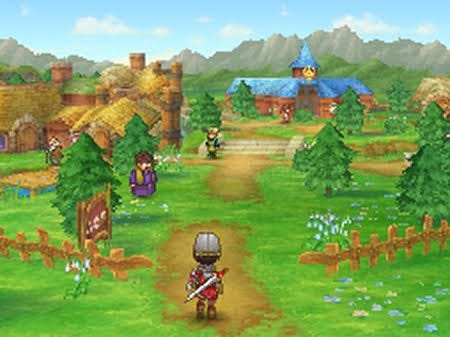 “Isn’t that for the…” I thought to myself before pausing, “It is, it’s for the Nintendo DS! I have that (now)!”
From there, my faithful handheld would be the center of attention for a wonderful two-week journey with, other than 4 and 10, one of the last Dragon Quest games I had yet to play. It was memorable, to say the least!
The game got off to a rocky start, in my mind, after I saw the character creation screen. Although Dragon Quest games typically feature non-talking heroes, the lack of a distinct, set protagonist felt impersonal to me, at first. Granted, there are a ton of options to create your heroes.
Once I got past my initial disappointment, the story opened up and was one of the better ones in the series. At its core, I love the message: be benevolent, do good deeds, and help those in need. The more positivity the main character spreads, the faster the World Tree, Yggdrasil, can produce special fruits for the protagonist and his people, the Celestrians, to reach the Realm of the Almighty. The initial gameplay focuses on spreading goodwill, making the game seem like it might be short. Alas, evil entities strike down the Starflight Express that was set to take everyone to the Realm of the Almighty. The force of the attack scatters the fruit all around the earth, and thus, the game truly starts, centered around the goal of recovering the stolen fruit and restoring peace to the land.
This is not a difficult game, compounded by the fact that you can switch classes as often as you want (once you reach Alltrades Abbey). Each class starts at level 1, so you can level each one up 15 or 20 levels fairly quickly and use the earned skill points in the most favored and/or powerful skills possible. I found ten classes in a blind first playthrough, and each class has 5 skills. Each skill goes to 100 points and has several physical and magic attacks and stat bonuses on the road to being maxed. For example, putting 42 points into the sword skill adds +20 to attacks as long as a sword is equipped. Other bonuses stay with your character even after a class switch, such as HP increasing by 60 after placing 90 points into courage. Nothing to scoff at considering how low HP totals always are in Dragon Quest games. Also, these stat bonuses stay with your character no matter what class they transfer to, which helps when going back to level 1 class because the character in question will be a lot stronger than a typical level 1 character.
The point of saying all of that is that there are a plethora of different ways to build your four characters. Although some skills overlap across classes, I’d still estimate there are a total of about 30 different skills, at least, so nearly 3000 points to have a fully mastered character, talk about a time commitment for 100%! Something I can’t imagine making after 55 hours. Still, mixing and matching skills from different classes to create specialized builds should prove to be a lot of fun for most RPG fans!
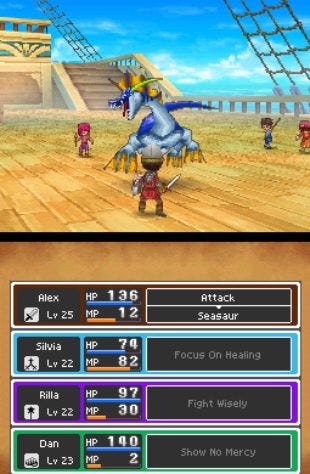 For all the complexity that those potential character builds bring, the battles are about as basic as they come. It is unlikely you’ll ever have more than a dozen different options at any one time, a maximum of maybe a dozen and a half, but in most situations, it’s the same few attacks that get the job done.
If you’ve played Dragon Quest 8, tension makes a return. Skip a turn to increase tension (attack power). The main character can also egg on the other three party members. Tension increases by 5, 20, 50, and finally, about half of the time, to 100, so there is a slight chance one character could be at full tension in two turns. As long as the character with the tension is not interrupted, they can do massive damage. Strung together with a double up (lowers defense while increasing attack) and double-edged sword, I was able to one-shot and two-shot some late-game bosses. Unlike 8, not enough bosses use disruption wave, which knocks tension down to 0.
Of course, the double-edged sword does massive damage in exchange for doing a portion of the damage back at the attacking character with the risk of immediately killing them off. But, unlike most other Quest games, dead characters still get experience. Depending on your frame of mind, this might be a welcome change, or severely hinder the challenge of a game that’s already easier than most, if not all other DQ games and that slowly diminishes as you progress.
The annoyance of having to drag a coffin around and hightail it back to town to pay a priest to revive said character still exists for the first 1/3rd to 1/2 of the game. An antiquated game mechanic to say the least, as well as the inability to save or find out how much experience to the next level unless talking to a priest. Thankfully, some modernization is evident with the ability to see enemies on screen, lessening the tedium of getting lost and into tons of unwanted battles. Better yet, weaker enemies typically flee on the field, mostly for better, but occasionally for the worse. (Come here, metal enemies!)
Finally, a coup de Grace is a special attack each character has depending on their class (or vocation), which leads to one of the following: powerful attacks, healing, stat increases, or other useful moves (like guaranteed theft of a chosen enemy).
Oddly enough, higher-level characters receive more experience than lower-level characters. So teaming a level 1 character with three level 30s and beating up a few metal enemies won’t see the level 1 skyrocket nearly as rapidly as you might think. I suppose, considering how the game is structured, this makes sense but was a little difficult to get used to.
Like in Dragon Quest 8, the Krak pot returns, allowing players the option to experiment with alchemy. Recipes can be found on bookshelves across the world in towns and dungeons, but it’s unlikely much will be found by just winging it, as some recipes are specific and not easy to guess. The DQ8 version was better as it was more intuitive and, for the most part, I forwent it in 9, finding the most powerful purchased or found equipment to be not just suitable, but more than enough.
There are also a ton of sidequests which can add a significant amount to the playtime. Too many of them were simple fetch quests or kill “X” amount of enemies, but there was merit to completing some of the other, more thoughtful quests that, for instance, encouraged using class-specific attacks to enrage an enemy before killing it or poison an enemy and let it die from the poison damage. Quests like those two have deeper insight into the battle mechanics.
However, counting grottos and optional randomized dungeons, I’m inclined to say it is too much side content. Like Xenoblade Chronicles (over 300 quests), you risk diverting from the main story and getting mired in optional missions. I’ll admit I’m likely the odd man out for having that sentiment, and I’m sure plenty of gamers would greatly appreciate all of the side stuff. Just know you can likely pump 100s of hours into this game if you choose.
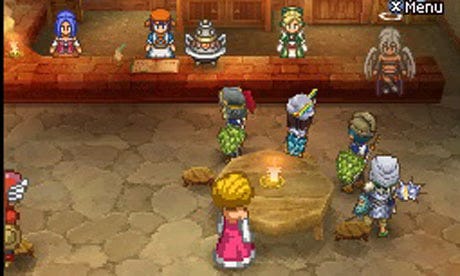 Those familiar with Level-5’s games, such as Dragon Quest VIII, Jeanne d’Arc, Ni No Kuni, or Rogue Galaxy, will instantly recognize their distinctive style here. The aforementioned games have a unique charm and aesthetic that’s impossible not to fall in love with, exuding brilliant colors and emanating with detail and one of the best-looking games on the DS.
Dragon Quest music is well-regarded, and for good reason. Nearly every track does an impeccable job of enhancing the story and striking the right mood. The music ranges from witty and playful to sorrowful and sullen, and even mysterious, capturing every mood conceivable throughout the lengthy journey. This series is at its best when it is enigmatic, and several cases in the game exemplify that, from simple moments of exploration deep in a cave to coming across a seemingly abandoned town.
While it’s fairly easy and perhaps even understandable to critique some of the few instances of archaic game design, Dragon Quest 9 does enough right in terms of visuals and audio to make it a worthwhile game. I wish it were more challenging, but the story should be engaging enough to keep you captivated throughout.
Wayback Wednesday Volume 1: Final Fantasy 7 and Chrono Trigger.
Wayback Wednesday Volume 2: Super Metroid and Castlevania: Symphony of the Night.
Wayback Wednesday Volume 3: The Legend of Zelda: A Link to the Past and Lunar: Silver Star Story Complete
Wayback Wednesday Volume 4: Secret of Mana and Wild Arms
Wayback Wednesday Volume 5: Illusion of Gaia and Grandia
Wayback Wednesday Volume 6: Breath of Fire 3 and X-Men Legends
Wayback Wednesday Volume 7: Star Ocean: The Second Story and Super Mario RPG
Wayback Wednesday Volume 8: Demon's Crest and Dragon Quest VI
Wayback Wednesday Volume 9: Suikoden I and Jeanne d'Arc
Wayback Wednesday Volume 10: Ranking the first 6 Final Fantasy games
Wayback Wednesday Volume 11: Earthbound and Valkyrie Profile
Wayback Wednesday Volume 12: Legend of Legaia and Secret of Evermore
Wayback Wednesday Volume 13: Threads of Fate and Soulblazer
Wayback Wednesday Volume 14: Radiata Stories and Robotrek
Wayback Wednesday Volume 15: Rogue Galaxy and Vandal Hearts
Wayback Wednesday Volume 16: Chrono Cross and Muramasa: The Demon Blade
Wayback Wednesday Volume 17: Okami and Legend of Mana
Wayback Wednesday Volume 18: Paper Mario and Terranigma
Wayback Wednesday Volume 19: Dragon Quest VIII and Atelier Iris 2: The Azoth of Destiny
Wayback Wednesday Volume 20: Ranking the 6 console Final Fantasy games from the PS1 and 2
Wayback Wednesday Volume 21: Eternal Sonata and Actraiser
Wayback Wednesday Volume 22: Persona: Revelations and Tales of Destiny
Wayback Wednesday Volume 23: Shadow Hearts: Covenant and Dragon View
Wayback Wednesday Volume 24: Ken Griffey Jr. Presents Major League Baseball and Lunar: Eternal Blue
Wayback Wednesday Volume 25: Suikoden II and Xenogears
Wayback Wednesday Volume 26: Azure Dreams and Wild Arms 2
Wayback Wednesday Volume 27: Ar Tonelico and Sword of Mana
Wayback Wednesday Volume 28: Albert Odyssey and Super Paper Mario
Wayback Wednesday Volume 29: Arcana and X-Men Legends II
Wayback Wednesday Volume 30: 10 over-rated classics that haven’t aged well