

Brain Lord is an action RPG developed by Produce and released for the SNES in North America in late 1994. Although not as well known or polished as Secret of Mana or even other Enix-published action RPGs like Illusion of Gaia and SoulBlazer, this is still a somewhat overlooked, underrated game that requires at least some passing attention and perhaps even a full playthrough if Brain Lord ends up catching your fancy.
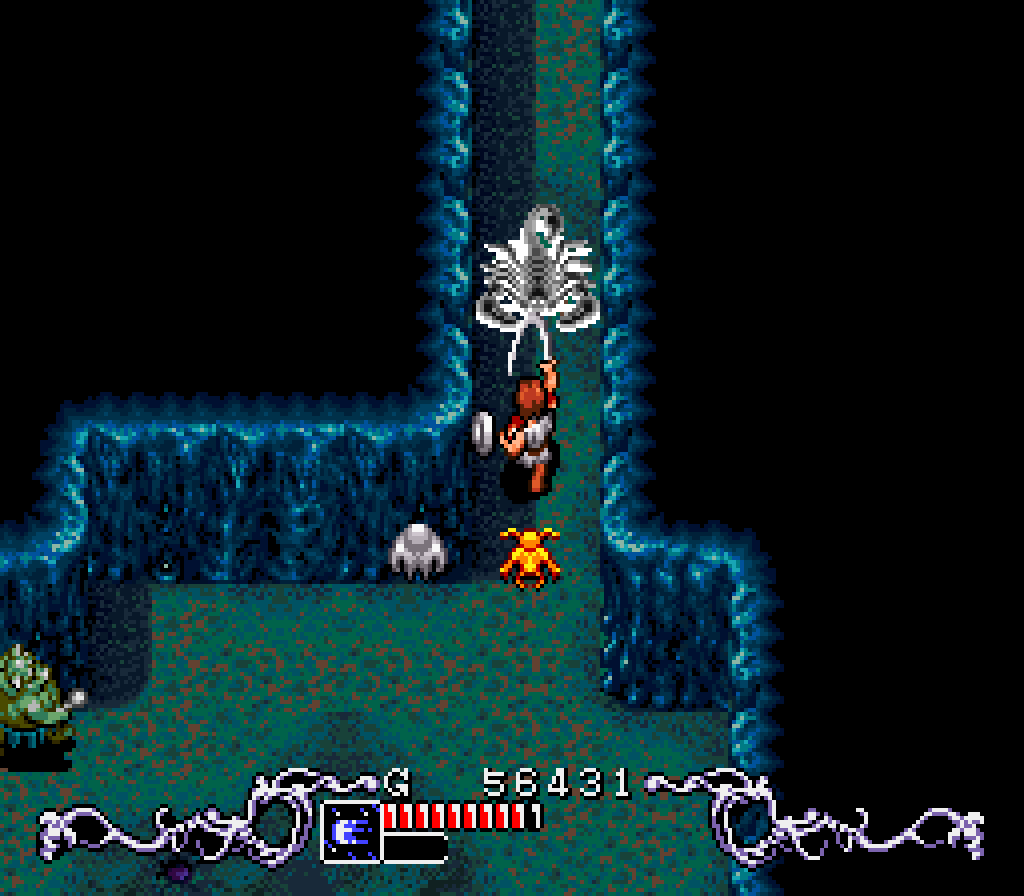 If you thought the puzzles in Lufia 2 were perplexing, and some of those were indeed tough, Brain Lord brings the difficulty of puzzles to a whole new level. This is a thinking person’s game that is heavily focused on figuring out riddles. Every one of the five dungeons is jam-packed with new challenges that will keep you on your toes but deep in thought at the same time, trying to figure out how to advance.
Although it can be tough to figure out how to progress, I would strongly recommend making an honest attempt to solve everything on your own. I wish I had practiced what I preach; two or three times, I had to resort to a walkthrough, but figuring out some of the harder puzzles was rewarding.
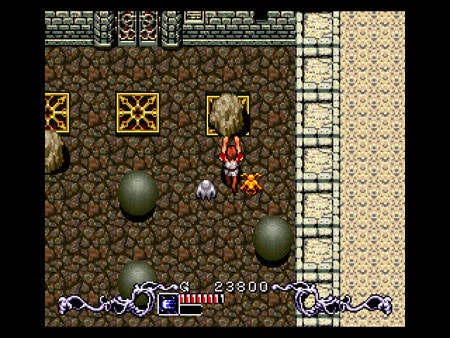 While on the subject of puzzles, I have to say that ones that don’t require jumping are bearable. However, ones that involve jumping can be downright nasty and incredibly difficult, and require the utmost patience and several attempts. Sometimes it will feel like the controls are off or the timing regarding how platforms move is odd. Be ready for possible slowdown that will rarely, if ever, benefit you and almost always hinder you, especially when several monsters are on screen.
By the way, five dungeons do not seem like a lot, but they are gigantic, and some of them require several hours! Thankfully, there are several save spots and warp points, making the task of beating each dungeon a little less daunting. Sadly, there are only two small towns, though the second one has a battle arena, which is fun as a little diversion. Though the arena is not likely what you think it is. Instead, it is for placing bets on which monster, out of two, will win in a battle. This is a decent way to earn some money, though if you need a lot, it feels ineffective. There are also multiple weapons: sword, ax, boomerang, bow, and whip. I usually stuck with the sword and flail and found the bow to be kind of useless for the most part, but it was refreshing to have options, just the same. It is not just the puzzles that present a challenge, but bosses are hard as well and will likely require several attempts before you can obtain victory.
Various Jades found throughout the game help you in numerous ways, though I stuck with two for almost the entire time: The first heals you, and the other helps with strength. On rare occasions, I used a light jade to help light up a room, but other than that, I did not see much of a purpose behind the other jades, though other players might differ in their approach. Some enemies drop little blue balls that, when eaten by the jade, allow them to gain experience and eventually level up.
Plot-wise, the story is thin, and the NPCs that tag along felt like more of a hindrance than a help; even in the rare cases when they helped, I would have preferred to do things on my own. Getting rid of them would have felt like an addition by subtraction and would have made Reemer's journey feel a little more epic. Anyway, the paper-thin plot centers around a son looking for his father, who disappeared years ago when attempting to vanquish a violent dragon. If you didn’t get my point earlier, Brain Lord is heavily focused on puzzles to the point where the story takes a distant back seat.
Most of the music just kind of exists without being irritating, but without making any kind of impact either, and this goes double for the town music and field music that you traverse in between towns and dungeons. Dungeon music does not get much better than mediocre as well, though the second dungeon has music that, while not great, is somewhat mysterious and bearable for longer periods. Overall, if someone were to take typical elevator music and make a 16-bit videogame version, Brain Lord would be close. The Ice Cavern improves matters quite a bit, at least, and the boss music is awesome and befitting of the fast pace of the game while creating a perfect amount of tension. It is probably the best track in the game.
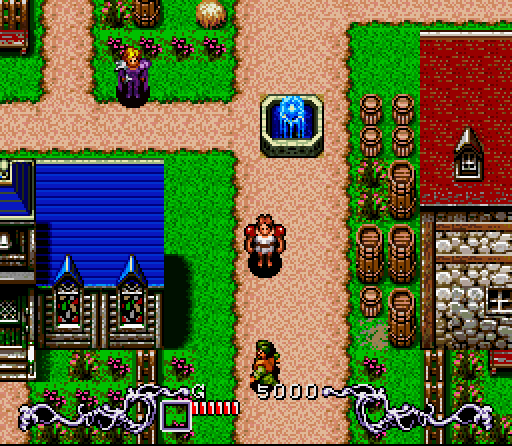 Visually, the game resembles 7th Saga, which is not a shock, seeing as they share the same developer, Produce, and were developed within nine months of each other. I would not be shocked if some stuff was reused from the 7th Saga. The main hero, Remeer, would fit in as an 8th hero in 7th Saga and, in fact, the name, with a slight change, was used in both 7th Saga and Mystic Quest (7th Saga 2). Dungeons are drab, towns look dull, and enemies are fairly uninspiring, but where the game shines is with the bosses, showing the game's full potential. They are gigantic and, though grotesque, animated with the utmost attention to detail. Seeing bosses made me wonder why the dungeons, NPCs, and towns could not look as cool.
Overall, Brain Lord is a game that has largely been forgotten, and though it is unlikely to blow anyone away, it has worthwhile puzzles to solve and huge bosses to beat, and it feels like you accomplished something, videogame game-wise, upon completion. If you don’t want a game that will pamper you and demand your full mental attention, this is the perfect game to try.
Wayback Wednesday Volume 1: Final Fantasy 7 and Chrono Trigger.
Wayback Wednesday Volume 2: Super Metroid and Castlevania: Symphony of the Night.
Wayback Wednesday Volume 3: The Legend of Zelda: A Link to the Past and Lunar: Silver Star Story Complete
Wayback Wednesday Volume 4: Secret of Mana and Wild Arms
Wayback Wednesday Volume 5: Illusion of Gaia and Grandia
Wayback Wednesday Volume 6: Breath of Fire 3 and X-Men Legends
Wayback Wednesday Volume 7: Star Ocean: The Second Story and Super Mario RPG
Wayback Wednesday Volume 8: Demon's Crest and Dragon Quest VI
Wayback Wednesday Volume 9: Suikoden I and Jeanne d'Arc
Wayback Wednesday Volume 10: Ranking the first 6 Final Fantasy games
Wayback Wednesday Volume 11: Earthbound and Valkyrie Profile
Wayback Wednesday Volume 12: Legend of Legaia and Secret of Evermore
Wayback Wednesday Volume 13: Threads of Fate and Soulblazer
Wayback Wednesday Volume 14: Radiata Stories and Robotrek
Wayback Wednesday Volume 15: Rogue Galaxy and Vandal Hearts
Wayback Wednesday Volume 16: Chrono Cross and Muramasa: The Demon Blade
Wayback Wednesday Volume 17: Okami and Legend of Mana
Wayback Wednesday Volume 18: Paper Mario and Terranigma
Wayback Wednesday Volume 19: Dragon Quest VIII and Atelier Iris 2: The Azoth of Destiny
Wayback Wednesday Volume 20: Ranking the 6 console Final Fantasy games from the PS1 and 2
Wayback Wednesday Volume 21: Eternal Sonata and Actraiser
Wayback Wednesday Volume 22: Persona: Revelations and Tales of Destiny
Wayback Wednesday Volume 23: Shadow Hearts: Covenant and Dragon View
Wayback Wednesday Volume 24: Ken Griffey Jr. Presents Major League Baseball and Lunar: Eternal Blue
Wayback Wednesday Volume 25: Suikoden II and Xenogears
Wayback Wednesday Volume 26: Azure Dreams and Wild Arms 2
Wayback Wednesday Volume 27: Ar Tonelico and Sword of Mana
Wayback Wednesday Volume 28: Albert Odyssey and Super Paper Mario
Wayback Wednesday Volume 29: Arcana and X-Men Legends II
Wayback Wednesday Volume 30: 10 over-rated classics that haven’t aged well
Wayback Wednesday Volume 31: Dragon Quest IX and E.V.O.: Search for Eden
Wayback Wednesday Volume 32: Tales of Symphonia and Elemental Gimmick Gear