

A glitch kept me from seeing the ending of Eternal Mana, the first game in the Atelier Iris series, so I started the second game with mild trepidation and hesitation. It wasn’t that the first game was terrible because it wasn’t. It was cute and had an engaging, though complicated, crafting system with a respectable plot. The Azoth of Destiny contains many of the first game’s mechanics, with the same unbearably adorable graphics to boot. It also makes some improvement over Eternal Mana.
The game’s two main characters, Felt and Viese, live in the peaceful, pacifist world of Eden, an amazing videogame representation of the afterlife or what some might refer to as heaven, and really, it is a serene, pleasant place where nothing goes wrong, and violence and other similar words aren’t in anyone’s vocabulary.
So where does the problem come from? Felt and Viese are two aspiring alchemists, and while Felt spends his days dreaming about distant lands, Viese remains studious and quickly advances through the ranks. One day, while making a pact with a mana spirit, elemental beings that help alchemists, a strong earthquake strikes Eden, shocking all the inhabitants. Suddenly, monsters appear, and while fleeing, Felt stumbles across a powerful sword, the Azure Azoth, and in King Arthur style, pulls the legendary sword out from its resting place.
Instructed by voices from the sword, Felt heads to the church in the center of Eden and proceeds to enter a portal to another world. But not before Viese gives Felt a parting gift, the share ring. Viese maintains residency in Eden, where she creates items from alchemy and, via the ring, shares the items with Felt to aid him in his perilous journey in the monster-infested world of Belkhyde. Right off the bat, Felt isn’t in his perfect world anymore as he struggles to find his way through the desert.
It was neat getting to switch between Felt and Viese, each in their world, but still able to share items and write letters to each other via this magical ring. Most of the game is with Felt, who explores, beats enemies, and checks out dungeons, like any other RPG. Though limited time is spent with Viese, she is integral to Felt’s success as her crafting proves paramount to his advancement through the world of Belkhyde. You can switch between these two at any save point. Savvy gamers will take note that, although Viese doesn’t fight any battles in Eden, she still has a level and HP values as well as other stats. Later in the game is one of my least favorite parts, where she has to venture out of her comfort zone, greatly underpowered.
Anyway, when Felt is found in the new world, he is found by the third main protagonist, Noin, and brought back to her village. While Felt and Viese are endearing characters, Noin wasn’t all that interesting and at times overbearing, but overall tolerable. The character I couldn’t stand was Poe, a young, womanizing little fairy who was one-dimensional and had absolutely no depth. This little cretin spends most of the game lusting over one woman after another. When he finally does get a girl, somehow, he complains about her and his new situation, is ungrateful, and continues to hit on every girl he sees while also pining over Viese, a girl everyone else, including Viese, has made abundantly clear he has zero chance with. Plus, it is kind of creepy that he seems to be somewhere in his teens while the girl he marries, who, for some reason unbeknownst to me, fancies him, is an adult. Odd form, Gust, very odd form.
I don’t like reptiles, but Gust redeemed themselves because they somehow managed to make a reptile-humanoid character likable in Gray, who Felt comes across early in the plot, and one that strongly reminded me of Gryzz from the little-known Albert Odyssey from the Sega Saturn. Gray is the tank that rarely succumbs to even the strongest attacks.
Fee rounds out the sextet, and her story arc early on was too predictable and hamfisted in the enemy turns ally kind of way. But she was otherwise a cool addition to the party.
Atelier Iris 2 doesn’t concern itself with flashy, up-to-date graphics and instead is content with creating a lush, colorful 2D style that harkens back to the second half of the 1990s. Simple, but filled to the brim with charm, each location is lively and crafted with the utmost care.
What impressed me were some of the late-game boss sprites, some taking up a decent chunk of the screen. The heroes still had enough room to shine; it was a perfect balance of showing imposing bosses while not overshadowing the protagonists.
Enemy sprites are also well done, but more diversity would have been better; then again, that can be said for many RPGs. One beautiful thing about old-school-style role-playing games is that a lot of time isn’t wasted on viewing the same special attack animations over and over. Special attack animations in Atelier Iris 2 are over in seconds, but, at the same time, still look fantastic.
For those who have played Eternal Mana, the alchemy system is back for Azoth of Destiny, but thankfully, it is less convoluted and more streamlined. It felt like, at times, much of the first game was spent in the menus, tweaking various minor things just to get new items.
For this game, the process is simplified, and players are likely to get the majority of items without much effort by the end. Even better, most of the items created by alchemy are either useful in battle or to overcome obstacles in dungeons.
I found a use for every single piece of equipment as well. If anything, I was sometimes wishing for more. That is because every piece of equipment has skills that can be permanently learned after a certain amount of SP, kind of like EXP, is earned in battle. Once a skill is mastered, the item can be unequipped and a new one equipped to learn the next skill.
However, often I found there just weren’t enough recipes to make up-to-date equipment with new abilities. Still, it was a welcome change to see a more manageable alchemy system for this title. There is a weapon crafting system that is similar to alchemy and is generally linear, with the occasional choice to make between two different possible upgrades. In the end, regardless of the choice made, the strongest weapon is the end result.
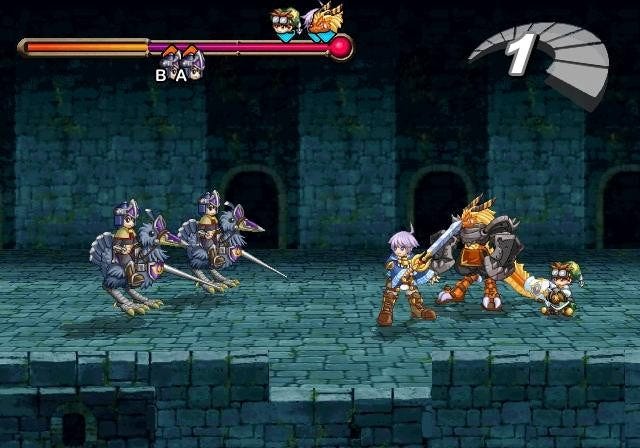 The battle system is turn-based but adds a slight dose of strategy with a time gauge that can be manipulated to the player’s advantage with the right moves. It isn’t anything overly in-depth, but it does encourage greater engagement rather than mindless button-mashing. Charge attacks build up a skill meter while break attacks delay the enemy. While this attack sounds like a no-brainer to abuse, in theory, it has to be stated that using this attack has two downfalls: it does not charge up the skill meter and sends the character using the break attack far down the time gauge, slowing them down and leaving them inoperable for several enemy turns. So, at best, it is good to use on occasion. Some of the skills, especially late game, are incredibly powerful, so the best strategy is to focus on charge attacks to build the skill meter up.
The battle system has a lot of potential, but is hampered by the fact that enemies and bosses go down without much issue. I admit to getting arrogant and blitzing through the first 16 chapters, of 22, where I was in mid-20s levels by the start of chapter 17. Suddenly, chapter 17 enemies, namely in the graveyard, started to appear in numbers of 3, 4, and 5, and some of these larger groups hit hard and fast and were, overall, nasty. It was a sudden difficulty spike, and though much of the game is easy, 3 or 4 bosses from chapters 17 and on provided a respectable challenge. Though I never lost, I had to think and carefully act during these fights. I ended up with levels between 30–32, which were enough to feel challenged by the last boss, but, to still take down on my first attempt. I didn’t see the game-over screen, but the threat existed a few times in the last few chapters. The point being, don’t let the first 75% or so of the game lull you into a false sense of security; there are a few tough spots in the last quarter of the game.
Random encounters occur in this game, but Gust tried to soften the blow by adding a meter. When the color of the meter reaches red, a battle is imminent, and the meter's lowering shows how many enemies are left in the region. Once it hits zero, there will be no more battles. However, exiting the area to the world map or entering a save point resets this meter. Plus, it doesn’t change the fact that random encounters happen too often and later in the game, the meter decreases too slowly.
There are a few alchemy items that prove to be a godsend in this game that, thankfully, come at a low cost. See, most items, like healing items, are created with mana essence, rather than by purchasing. Getting more of these essences requires you to interact with your surroundings and transform gems into this essence, which allows you to create more of a specific item, namely, healing. But some of the items that proved to be incredibly useful allowed you to skip all random battles. I would use that item, make my way to the save point near the boss, and level up as needed there, getting free healing when needed. The second is an item that allows you to return to the entrance, and finally, an item that allows you to see chests, doors, and ledges that still need to be found in every area of the game. With all the twisting paths, this last item saved tons of time!
Careful exploration of the two worlds is exceptionally important. Despite having tons of winding paths with far too many intersections, no map, even a rudimentary one, exists to help in figuring out where you’ve been and where you haven’t. Get used to trekking over the same beaten path and looking through places, some with dense fog or other heavily forested places, for some elusive chest with a recipe needed to continue the game or some important item. See, without recipes, you can’t do much with alchemy, and some of these recipes are very well hidden and require a keen eye to spot. This game would have done well to implement some kind of system to aid in navigation. Sadly, no overworld exists in this game, no little areas to connect each town or dungeon. Instead, there is a Super Mario World-style map system. I missed the first game, which showed how different areas were all interconnected. In Azoth, many places just felt disconnected and/or disjointed.
With all that time spent exploring, music plays an important role, and here it’s mostly peaceful, though I found one particular track in one of the caves with fire to be jarring and very unpleasant. The tracks weren’t memorable otherwise. There is voice acting, which is surprisingly serviceable and good, and other than Poe, there wasn’t a single character I dreaded having to listen to.
This game isn’t without its faults, but it showed some clear improvements over the first, especially with crafting and the battle system. For those who like old-school RPGs, this is, for sure, a game players should try out.
Wayback Wednesday Volume 1: Final Fantasy 7 and Chrono Trigger.
Wayback Wednesday Volume 2: Super Metroid and Castlevania: Symphony of the Night.
Wayback Wednesday Volume 3: The Legend of Zelda: A Link to the Past and Lunar: Silver Star Story Complete
Wayback Wednesday Volume 4: Secret of Mana and Wild Arms
Wayback Wednesday Volume 5: Illusion of Gaia and Grandia
Wayback Wednesday Volume 6: Breath of Fire 3 and X-Men Legends
Wayback Wednesday Volume 7: Star Ocean: The Second Story and Super Mario RPG
Wayback Wednesday Volume 8: Demon's Crest and Dragon Quest VI
Wayback Wednesday Volume 9: Suikoden I and Jeanne d'Arc
Wayback Wednesday Volume 10: Ranking the first 6 Final Fantasy games
Wayback Wednesday Volume 11: Earthbound and Valkyrie Profile
Wayback Wednesday Volume 12: Legend of Legaia and Secret of Evermore
Wayback Wednesday Volume 13: Threads of Fate and Soulblazer
Wayback Wednesday Volume 14: Radiata Stories and Robotrek
Wayback Wednesday Volume 15: Rogue Galaxy and Vandal Hearts
Wayback Wednesday Volume 16: Chrono Cross and Muramasa: The Demon Blade
Wayback Wednesday Volume 17: Okami and Legend of Mana
Wayback Wednesday Volume 18: Paper Mario and Terranigma