
I was hesitant to pick up Ar tonelico after my experience with another Gust game, Atelier Iris: Eternal Mana, and its disastrous ending glitch. Plus, I wasn’t in the mood for a potentially cumbersome synthesis system. Thankfully, Ar Tonelico is an improvement over that title in several ways, including crafting, but still has its pitfalls.
Storywise, Ar Tonelico is just as relevant today as it was nearly 20 years ago when it was first released. That is because in this game, a mysterious virus appears, and it is up to the protagonists to eradicate it. The game also deals with technology that we are just starting to see or will see soon. The world is split between the technologically advanced tower of Ar Tonelico and the landmass below it, known as the lower world, which is reminiscent, perhaps, of the 1900s in real life. The tower is largely run via computers, which is why it is so prone to virus attacks. Within this world, there are two races: humans and Reyvateils, a manufactured race designed to outlast humans. There are certainly transhumanism vibes going on in this game.
In the main party, there is a mix of humans and Reyvateils. The main character of the game is Lyner, a well-intentioned knight who falls from the tower at the start of the game and lands in the lower lands. At this point, he meets two Reyvateils, Misha and Aurica. Aurica is a very shy girl who is the daughter of a human and a Reyvateil. She lacks confidence because her skills are seen as weak and, thus, she is labeled with the lowest possible class of Reyvateils, D. Other classes are C, B, the stronger A, and the strongest class, S. Misha is a childhood friend of Lyner and has powerful skills.
Another character they meet along the way is Jack. He seems cool at first because he fits that lone wolf stereotype, right down to how he dresses, but once he opens his mouth, that aura is lost, and in its place is a dog who has no respect for most women. The reaction of the other characters is spot on, and it is funny to see them call Jack out, especially when he hits on poor Claire.
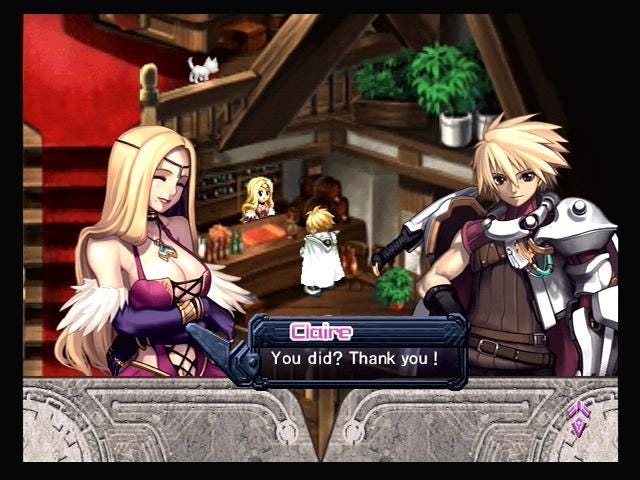 Krusche is a competitive business lady who tries to be snarky with Misha, but I found that her lines often fell flat.
There is also Radolf, part of the church, one of the rare members who respect Reyvatelis, as they tend to be openly disrespected by many in the world, so I held Radolf in high regard for the duration of the game as it’s not easy to go against the grain.
Finally, there is the peaceful, diplomatic Ayatane who seemed to be out of the main party more than in it, and Shurelia, whom Lyner looks up to. Compared to Misha and Aurica, she joins way too late while trying to serve the same purpose as those two. I wish she had joined earlier, especially regarding diving.
Now, what is diving? It’s how humans mix with Reyvatelis and allows Lyner to go into the psyche of Misha, Aurica, and Shurelia. However, he can’t just do this whenever he feels like it. Each girl holds deep secrets, and the further he dives, the more reluctant they become to let him delve deeper. Thus, it’s important to frequently talk to all three girls at inns and save point resting spots.
However, that is not so simple either, as Lyner must collect talk points at various junctures in the game, represented as little blue dots. With these talk points, he can bring up certain subjects at inns or rest stops in dungeons. These talks slowly increase trust between Lyner and each girl, eventually allowing him to dive, which can be done at a few shops around the world. Beyond improved trust, each girl will be able to craft stronger magic to use in battles. The idea about talk points and diving might even seem complex or overwhelming, but once you get used to this mechanic, it quickly becomes simple to grasp.
Diving is also where you use the DP gained in battle. For a small amount of DP, and I always had more than enough, you can witness certain scenes that portray a part of the girl’s past or a hidden part of her personality or mental state, depicted in the form of a simple map, not all that dissimilar from the world map in a game like Super Mario World or Donkey Kong Country. The big yellow star shows the point you should go to next on this map. The map takes on the forms of many different scenes, sometimes filled with thorns, etc. They are all very easy to complete and require watching scenes, with only a few higher-level dives requiring battles. The end of some scenes will lead to new magic being crafted, but not much beyond that. Once I realized how simple it was, it quickly got boring, and the later levels were more of a drag. There is no groundbreaking writing found here, aside from a few interesting tidbits, but credit to Gust for trying something new. It just should have been fleshed out more.
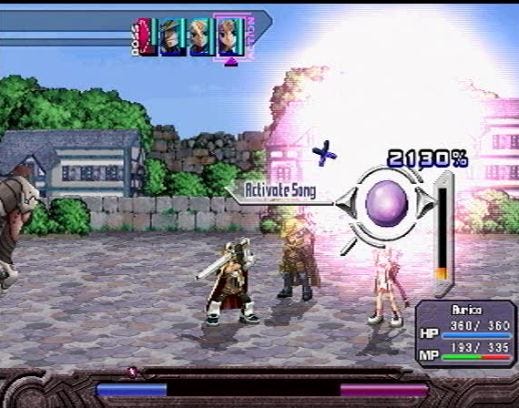
So once you have new magic for the Reyvatelis, they will function better in battle; just be aware you can only have one in battle at a time. They don’t fight and must be protected as, defensively, they’re exceptionally weak. They use this magic in the form of a song. By singing, they slowly drain their MP and stop at zero, at which point they become unusable. So perfect timing is required to get the most out of Misha, Aurica, and Shurelia. The longer each girl sings, the stronger her song becomes, as evidenced by the percentage near her sprite.
As far as healing, I didn’t notice too much of a difference in how much they healed even as the percentages skyrocketed. With attack songs, however, higher percents noticeably changed attack strength. So mostly I just let the girls sing until their MP was nearly drained, and then unleashed an attack. Songs can also improve the attack or elemental defense, speed, attack, and other stats of the party.
Some enemies and bosses target Misha, Aurica, or Shurelia, and it is up to the other three fighters to defend the girl because if you don’t, they are usually taken out in one hit. But it is easy to know when to defend, as a red ring will appear around her sprite. Other than this, battles are standard fare.
 There is a crafting system, much like Gust’s other series, Atelier Mana, but thankfully in this game, it’s less complicated. Most craftable items require materials that can easily be found at shops, bags, or chests in dungeons. Even without putting much thought into this aspect of the game, I was able to craft 95% of the stuff I came across. Some of the late-game crafts required difficult-to-find ingredients, but I was still able to, with relative ease, craft strong enough items to beat the game in under 30 hours.
This game is broken down into three phases, where the third is optional according to how you respond to a late-game question, so save often. Thankfully, I did because there are a few points towards the end of Phase 2 and within Phase 3 where the game can end abruptly. I largely played this blind but kept a walkthrough open to avoid an unwanted ending.
Dungeon design was sensible and intuitive until the very end of the game. Sadly, the last two dungeons are a huge meandering annoyance, and suddenly the rules the game previously set up don’t seem to apply. It was a shame because it dropped what was quickly becoming an instant classic into an average RPG overall. Just have patience at the end, is my advice.
Most of the music was jarring and eventually resorted to playing the game muted and listening to podcasts for the majority of the playthrough. The opening song to start the game is an example of that. It was just too high-pitched, and even one of the boss themes had the same vocals. The sad thing is, some of the instrumental music was well done.
There is voice acting, and as usual for the PS2, outside of battle it is impressive; it adds a lot to every major scene, but within battles, it’s different, with the same few inane, sometimes undecipherable phrases. For example, if anyone can tell me what Ranolf says during many of his special attacks, I’d love to know. ‘It’s God's will?” “Plan”? What?
Graphically, the game looks better suited for the PlayStation era, as it didn’t take advantage of the PS2's full potential, and even Final Fantasy 10, which came out 6 years earlier, looks better. But, with that said, there is a certain charm in the visuals, and the enemy and boss sprites are varied. It’s a colorful world, and the sprites have a unique, slender look that reminded me of the Tales of Abyss sprites, but more endearing here.
Overall, this game would have been excellent with a better soundtrack, and, had it ended after Phase 2, with a better-designed last dungeon to follow. Most of Phase 3 feels like endless legwork between already seen places. Just the same, the battle system is engaging, and the story is solid, so give this a try if you want a lesser-known RPG for the PS2.
Wayback Wednesday Volume 1: Final Fantasy 7 and Chrono Trigger.
Wayback Wednesday Volume 2: Super Metroid and Castlevania: Symphony of the Night.
Wayback Wednesday Volume 3: The Legend of Zelda: A Link to the Past and Lunar: Silver Star Story Complete
Wayback Wednesday Volume 4: Secret of Mana and Wild Arms
Wayback Wednesday Volume 5: Illusion of Gaia and Grandia
Wayback Wednesday Volume 6: Breath of Fire 3 and X-Men Legends
Wayback Wednesday Volume 7: Star Ocean: The Second Story and Super Mario RPG
Wayback Wednesday Volume 8: Demon's Crest and Dragon Quest VI
Wayback Wednesday Volume 9: Suikoden I and Jeanne d'Arc
Wayback Wednesday Volume 10: Ranking the first 6 Final Fantasy games
Wayback Wednesday Volume 11: Earthbound and Valkyrie Profile
Wayback Wednesday Volume 12: Legend of Legaia and Secret of Evermore
Wayback Wednesday Volume 13: Threads of Fate and Soulblazer
Wayback Wednesday Volume 14: Radiata Stories and Robotrek
Wayback Wednesday Volume 15: Rogue Galaxy and Vandal Hearts
Wayback Wednesday Volume 16: Chrono Cross and Muramasa: The Demon Blade
Wayback Wednesday Volume 17: Okami and Legend of Mana
Wayback Wednesday Volume 18: Paper Mario and Terranigma
Wayback Wednesday Volume 19: Dragon Quest VIII and Atelier Iris 2: The Azoth of Destiny
Wayback Wednesday Volume 20: Ranking the 6 console Final Fantasy games from the PS1 and 2
Wayback Wednesday Volume 21: Eternal Sonata and Actraiser
Wayback Wednesday Volume 22: Persona: Revelations and Tales of Destiny
Wayback Wednesday Volume 23: Shadow Hearts: Covenant and Dragon View
Wayback Wednesday Volume 24: Ken Griffey Jr. Presents Major League Baseball and Lunar: Eternal Blue
Wayback Wednesday Volume 25: Suikoden II and Xenogears
Wayback Wednesday Volume 26: Azure Dreams and Wild Arms 2