

Classic RPG charm that is sure to captivate.
Check out Part 1: Demon's Crest, here.
The legendary Dragon Quest 6 (DQ6) was, if not the holy grail, at least the holy trinity of untranslated SNES RPGs in the mid and late 1990s, which also included games like Seiken Densetsu 3 and Star Ocean.
Sometimes we forget how “hard” we had it as gamers back in the day because seemingly everything is being localized now. Thankfully, kind folks were working behind the scenes to cushion the blow of yet another gem remaining in Japan. In the early 2000s, DQ6 finally got an unofficial fan translation, which was unfinished but, of course, better than being lost to time. I’ve beaten the game twice, first thanks to a fan translation group, around 2010, and more recently, the official Android release.
Let’s be clear, this isn’t just a retro game, it’s a work of art, point blank. Yes, I am aware there are claims that video games aren’t and can’t possibly be art, ever. But this is wrong; games were imaginative, expressive, artistic powerhouses long before this debate gained attention in the early 2000s (it started as early as the late 1980s). The SNES is, in my eyes, where this becomes abundantly clear: games can be aesthetically gorgeous, visual feasts, and sources of inspiration.
There is a consistent aura of mystique in DQ6. Behind the more evident whimsical nature, subtle undertones of darkness and tension arise. It is very hard to describe in words the tone this game sets because I’ve never seen anything quite like it, which is where the brilliance in DQ6 lies.
The game was ahead of its time in its use of shading, shadows, and lighting. It created a feeling similar to the first few seconds after waking up, when you can’t distinguish dream from reality. Am I awake? Still asleep? DQ6 is firmly in this in-between world. Perhaps Persona 4 Golden’s piano-tinged nighttime scenes are the closest modern resemblance.
It doesn’t stop there; it's the enchanting tracks, the eeriness of an unexplored dungeon, and compositions that enhance the scenery. Some of the sound effects in the early Dragon Quest games, including 6, are timeless and can be found even in Dragon Quest 11. The emotional depth each song adds to the game is unmatched by games that came even decades later. No shock, because, in general, this is a series known for excellent soundtracks and sound effects.
It was the audiovisual that kept me hooked; otherwise, even by the standards of the time, the battle system wasn’t breaking any new ground. For a 1995 game, it had the polish but lacked the innovation gamers had come to expect from the SNES.
Thankfully, the job system offered plenty of customization, but progressing through the tiers of each job was cumbersome and required a lot of grinding. To the point where, in my second Android playthrough, this memory was still clear in my mind, and I spent time working out plans for each character and how they would progress, to avoid some of the monotony from the first playthrough. This helped make the experience more seamless.
I enjoyed the contrast between dream and reality, one of the major themes of the game, and how they blur together in a bizarre mélange. In every town, there is something off, and the group of heroes led by the unnamed, silent protagonist must figure out how to save the inhabitants.
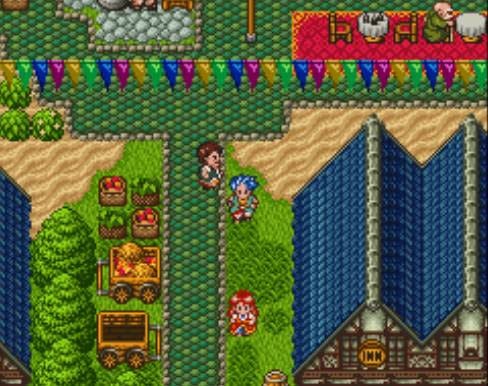 In the first town, for example, everyone is turned to stone (ELO anyone)? In the second town, the water source is contaminated, and as they travel the world, they encounter about a dozen other issues. This helps break DQ6 into manageable portions, while the larger mystery of what’s behind these strange events remains. Even with each town’s problems, one town’s issue is often the opposite of a previous town’s. The developers and writers didn’t hold back; this isn’t a cheery game, though there is the occasional comedic relief. Thankfully, it isn’t as overdone as more modern games with cutesy mascot characters.
Dragon Quest 6 is the quintessential 16-bit RPG. It is a lovely game, even considering the occasional grind, because each town brings a new unpleasant revelation that must be unraveled and is a multisensory treat for anyone who dives into it. If you haven’t tried it yet, be sure to add it to your backlog!
Check out my review of Dragon Quest XI here.
Wayback Wednesday Volume 1: Final Fantasy 7 and Chrono Trigger.
Wayback Wednesday Volume 2: Super Metroid and Castlevania: Symphony of the Night.
Wayback Wednesday Volume 3: The Legend of Zelda: A Link to the Past and Lunar: Silver Star Story Complete
Wayback Wednesday Volume 4: Secret of Mana and Wild Arms
Wayback Wednesday Volume 5: Illusion of Gaia and Grandia
Wayback Wednesday Volume 6: Breath of Fire 3 and X-Men Legends
Wayback Wednesday Volume 7: Star Ocean: The Second Story and Super Mario RPG