

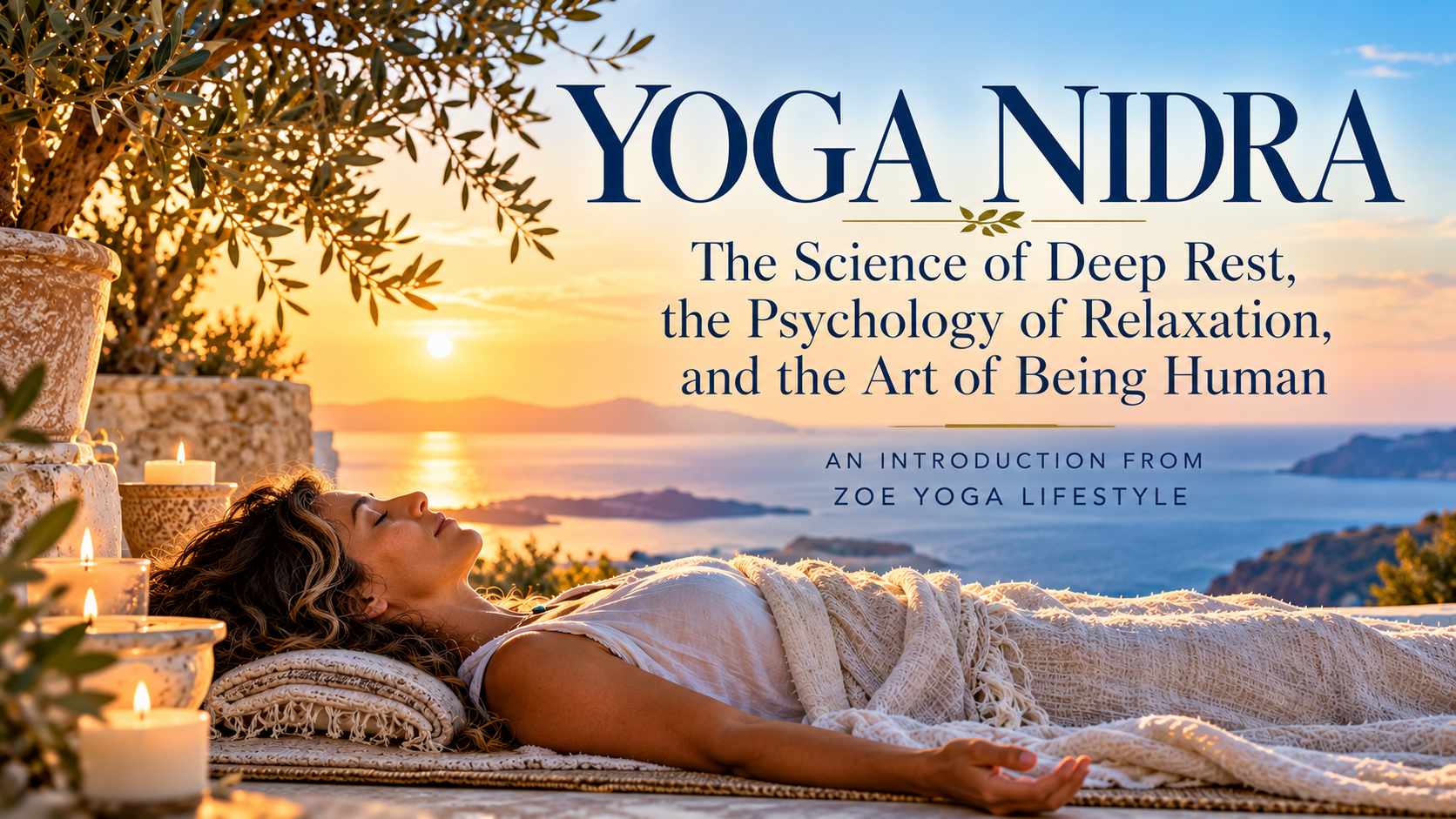
Yoga Nidra: The Science of Deep Rest, the Psychology of Relaxation, and the Art of Being Human
What ancient yogic wisdom, modern research, and 20 years of teaching have taught me about the importance of rest.
There is a difference between being still and truly resting.
You can spend eight hours in bed and wake up exhausted. You can sit on the couch for an entire afternoon while your mind continues to race through yesterday’s conversations, tomorrow’s responsibilities, and everything you haven’t yet figured out.
You can be physically still while your mind is working overtime.
And you can spend so much of your life responding to what the world asks of you that you forget what it feels like to simply be.
This is one of the reasons I want to begin my Yoga Nidra series here at ZOE Yoga Lifestyle.
After 20 years of teaching Iyengar Yoga, and through my ongoing work with Spine-Safe Yoga, the SQUARE 1 System, neuromotor re-patterning, somatic movement, breathwork, and Yoga Nidra, I have become deeply interested in the relationship between our bodies, our attention, and the experience of being human.
My work has never been only about physical postures.
It is about how we inhabit ourselves, how we relate to our bodies, and how we navigate the complicated reality of being alive.
Yoga Nidra offers a different entry point into that conversation.
It invites us to explore rest without having to achieve anything first.
And the science behind this practice is fascinating.
What Is Yoga Nidra?
Yoga Nidra is a guided contemplative practice often translated as yogic sleep.
Typically practiced while lying down or resting in a supported position, it guides your attention through a sequence of experiences that may include body awareness, breath, sensation, emotion, imagery, and intention.
Unlike a conventional yoga class, Yoga Nidra does not require you to perform physical postures or move through a sequence of exercises.
The practice takes place primarily through listening and awareness.
You are invited to rest while following a gentle progression of instructions.
Sometimes you may feel deeply relaxed. Sometimes you may drift toward sleep. You may notice thoughts coming and going, or you may experience moments when your attention feels quieter than usual.
There is no single experience you must achieve.
You do not have to empty your mind.
You do not have to force yourself to relax.
You do not have to be good at meditation.
You simply begin where you are.
Traditional Yoga Nidra draws on yogic contemplative practices, while contemporary approaches vary in their structure and emphasis. Non-Sleep Deep Rest, or NSDR, is a more recent umbrella term for guided practices intended to encourage deep rest without requiring sleep. The terms overlap, although they are not identical.
At ZOE Yoga Lifestyle, I offer Yoga Nidra as a guided opportunity to explore deep relaxation, awareness, and a different relationship with the constant activity of everyday life.
You can practice in bed, on a couch, or wherever you can find a comfortable and supported position.
You do not need special equipment, flexibility, or previous yoga experience.
You need only a little time and a place to rest.
The Science of Deep Rest: What Happens in the Brain?
Let’s begin with what researchers are investigating.
Our brains are active throughout waking life, but brain activity is not uniform. Attention, relaxation, meditation, and sleep can involve different patterns of electrical activity.
Researchers use electroencephalography, or EEG, to measure electrical activity in the brain. These measurements allow scientists to investigate changes in brain-wave patterns during meditation and other states of consciousness.
Yoga Nidra research has explored changes in alpha and theta activity, patterns associated in various contexts with relaxed wakefulness, attention, and meditation.
Some studies have reported changes in these patterns during Yoga Nidra. However, findings differ between studies, and no single brain-wave pattern can fully explain a person’s subjective experience.
A systematic review published in 2026 examined 12 EEG studies involving 326 participants. The researchers reported promising findings but noted considerable variation across studies, making definitive conclusions difficult.
Explore the research on Yoga Nidra and brain activity.
Why does this matter?
Because it suggests that guided rest is more than simply lying down with your eyes closed. Researchers are investigating measurable changes in attention and brain activity during the practice.
But we must be careful not to confuse a promising area of research with a settled scientific explanation.
Yoga Nidra is not a magic switch that turns off the mind.
It is a practice that gives attention somewhere to go, while allowing the body to rest.
And that alone opens up some interesting possibilities.
Does One Hour of Yoga Nidra Equal Four Hours of Sleep?
You may have heard the claim that one hour of Yoga Nidra is equivalent to four hours of sleep, or that a short NSDR session can replace several hours of nighttime rest.
I understand why this claim captures people’s attention.
When you are exhausted, the possibility of receiving hours of restoration in a fraction of the time sounds wonderful.
However, there is no established scientific conversion showing that one hour of Yoga Nidra equals four hours of sleep or a particular amount of REM sleep.
The claim appears in discussions of Yoga Nidra, but it should not be presented as a clinically proven fact.
Sleep is a complex biological process involving different stages, including REM sleep and several stages of non-REM sleep. These stages have distinct characteristics and contribute to different aspects of physical and cognitive functioning.
Yoga Nidra is a guided relaxation and meditation practice. A person may remain awake, move toward sleep, or fall asleep during a session.
These experiences are not interchangeable.
Researchers have investigated the relationship between Yoga Nidra, physiological relaxation, and sleep, but the available evidence does not establish that a session can replace a specified number of hours of sleep.
So, if Yoga Nidra does not replace sleep, why is it worth practicing?
Because rest does not have to replace sleep to be valuable.
A guided practice may provide an opportunity to pause, reduce the demands placed on your attention, and experience a period of intentional relaxation.
It can complement healthy sleep habits. It cannot guarantee that you will feel as refreshed as you would after adequate sleep, and it should not be used to justify sleeping less.
At ZOE Yoga Lifestyle, I would rather help you understand what this practice may offer than promise you something the science has not established.
Your well-being deserves honesty.
The Psychology of Rest: Why Is It So Hard to Slow Down?
Have you ever sat down to rest, only to remember everything you still need to do?
Have you noticed that when the external world becomes quiet, your internal world can become louder?
You may replay a conversation, anticipate a difficult interaction, revisit a memory, or start mentally organizing the next three days.
You are physically still, but your attention continues to respond to demands.
This is one reason relaxation can feel surprisingly difficult.
We live in a culture that rewards activity, productivity, and visible accomplishment. Many of us become accustomed to measuring our days by what we complete.
Even our leisure time can become another opportunity to improve ourselves.
We exercise to become fitter. We meditate to become calmer. We rest so we can work more efficiently tomorrow.
There is nothing inherently wrong with those intentions. But they can make it difficult to experience rest without turning it into another assignment.
Yoga Nidra offers a different possibility.
Rather than asking you to solve a problem or produce a particular result, the practice invites you to follow a sequence of guided experiences.
You may notice the contact between your body and the surface beneath you. You may become aware of your breathing. You may notice thoughts arriving and passing without needing to follow each one.
This is not about suppressing thoughts or emotions.
It is an opportunity to practice noticing without automatically responding to everything you notice.
A thought can arise without becoming your next task.
A sensation can be present without demanding an immediate solution.
A moment can exist without needing to be made productive.
Yoga Nidra is not psychotherapy, and it does not automatically resolve anxiety, trauma, or emotional distress. However, guided relaxation and mindfulness-based practices are being investigated as complementary approaches to psychological well-being.
For some people, the experience of resting without needing to accomplish anything may be meaningful in itself.
What Does the Clinical Research Tell Us?
Interest in Yoga Nidra has expanded into clinical research, with studies examining its potential relationship to stress, anxiety, depression, and sleep.
The findings are promising, but the limitations matter just as much as the positive results.
1. Stress, anxiety, and depression
A systematic review and meta-analysis published in the Annals of the New York Academy of Sciences, with an issue date of February 2026, examined 73 studies involving 5,201 participants.
The researchers reported improvements in stress, anxiety, and depression across the studies they analyzed.
These are encouraging findings. However, the review also identified methodological limitations and considerable variation in how Yoga Nidra was delivered. The authors cautioned that the estimated benefits may be larger than the true effects.
In other words, the evidence suggests that Yoga Nidra deserves further investigation as a complementary practice, but it does not establish that the practice is a replacement for established mental health treatment.
Read the systematic review and meta-analysis on Yoga Nidra and mental health.
2. Sleep quality and insomnia
Researchers have also investigated whether Yoga Nidra may help people experiencing sleep difficulties.
A systematic review of six randomized controlled trials, published in 2026, examined 244 participants across several populations. The studies reported improvements in some sleep-related measures, although the findings varied.
The researchers identified limitations in the available trials, including concerns about study quality and risk of bias.
This means Yoga Nidra may be a useful complementary practice for some people experiencing sleep difficulties, but stronger studies are needed to establish how effective it is and which approaches are most beneficial.
Read the systematic review of Yoga Nidra and sleep disorders.
3. Why randomized controlled trials matter
A randomized controlled trial, or RCT, compares an intervention with one or more control conditions, assigning participants to groups through randomization.
These trials can help researchers determine whether changes are associated with an intervention rather than simply reflecting the passage of time, participants’ expectations, or other influences.
However, not every trial is equally reliable. Sample size, study design, the choice of comparison group, the way outcomes are measured, and whether results can be replicated all influence how confidently we can interpret findings.
That is why I believe it is important to approach emerging wellness research with both curiosity and discernment.
We can recognize that Yoga Nidra may have meaningful benefits without claiming that every proposed benefit has been conclusively demonstrated.
The science is developing. That is a reason to keep learning, not a reason to overpromise.
Yoga Nidra and the Nervous System
At ZOE Yoga Lifestyle, nervous-system awareness informs the way I approach somatic movement, breathwork, neuromotor re-patterning, and deep rest.
The autonomic nervous system helps regulate functions such as breathing, heart rate, and digestion. Its activity changes in response to internal and external conditions.
When life becomes demanding, some people experience tension, restlessness, difficulty settling, or a persistent sense of being on alert.
Others may feel depleted, disconnected, or overwhelmed by even ordinary responsibilities.
These experiences have many possible causes. They cannot all be explained by one nervous-system state, and no single practice will work the same way for everyone.
But we can explore what helps us relate to our bodies with greater awareness.
During Yoga Nidra, you are invited to rest in a supported position and follow gentle verbal guidance. You may notice areas of tension, become aware of your breathing, or find that your attention has a place to settle other than the constant stream of daily demands.
Some people experience this as soothing. Others may initially find stillness unfamiliar or uncomfortable.
A trauma-informed approach makes room for both possibilities.
You can adjust your position, open your eyes, change your focus, pause the recording, or stop altogether. You do not have to push through discomfort to prove that you are doing the practice correctly.
Relaxation is not something another person should force you to experience.
It is an invitation you can explore at your own pace.
This is especially important for anyone whose experiences have made stillness, closed eyes, or inward attention uncomfortable. In those circumstances, adapting the practice or working with an appropriately qualified professional may be helpful.
The goal is not to make your body obey an instruction to relax.
It is to create an experience in which you have choices.
Why Yoga Nidra Is Personal to Me
Yoga Nidra isn’t simply a practice I teach. It’s a practice I live.
I practice daily, whether I have 20 minutes or an hour to give myself. It has become an important part of how I navigate my life, particularly through periods when my body has asked more of me than I ever expected.
For seven years, I have lived with a structural disability. Then, last year, I sustained a bicondylar tibial plateau fracture—a serious fracture of the upper part of my shinbone near the knee. After surgeries, hospitalization, and months of rehabilitation, I am still learning to walk again.
My relationship with my body and movement has changed profoundly. There are yoga postures I cannot practice right now. I cannot walk far, and there are many other things I once did that are no longer accessible to me in the same way.
But my practice hasn’t disappeared.
Yoga Nidra gives me a way to stay connected to myself when so much about how I inhabit my body has changed. It reminds me that my relationship with my body doesn’t have to depend on what I can physically accomplish.
When I’ve been awake through the night because of pain, a Yoga Nidra practice can help me feel more refreshed and settled. It gives me an opportunity to turn inward, notice what’s happening in my body, and become more attuned to my nervous system.
I notice how I feel. I notice my breath. I notice tension, sensations, and the subtle shifts that can be easy to miss when life is asking us simply to get through the day.
The practice helps me feel grounded and centered. It gives me space to settle, to become more present, and to reconnect with myself in the middle of circumstances I cannot always change.
For me, this is one of the most meaningful aspects of Yoga Nidra: even when my physical world becomes smaller, my capacity to be present with myself is still something I can nurture.
I cannot always choose how my body feels. I cannot simply will away pain or make my recovery move faster. But I can create moments in which I stop struggling to do more and allow myself to experience what is here.
Some days, that might mean 20 minutes. Other days, I may have an hour.
It isn’t about achieving a particular state or doing the practice perfectly. It’s about returning to myself, again and again.
After 20 years of teaching yoga, my own experience has deepened my understanding of what it means to meet the body where it is—not where we think it should be, not where it used to be, and not where we hope it will be tomorrow.
Yoga Nidra doesn’t replace medical care, rehabilitation, or the practical work of recovery. It is one of the ways I care for myself alongside those things. I am thankful to be coming out of the structural disability via a holistic method like chiropractic but not, called Hydrostuctural. My knee, leg and hip continue to heal with PT, and slowly learning to walk again.
And perhaps that is part of what it means to be human: learning to live within reality while still finding moments of rest, connection, and presence.
This is why deep rest is at the heart of ZOE Yoga Lifestyle. Not because life is always peaceful, or because we can make every difficult thing disappear, but because even in the midst of pain, limitation, and uncertainty, we deserve moments in which we can simply be.
Sometimes, those moments begin by lying down, closing our eyes, and allowing ourselves to rest.
How Yoga Nidra Fits Into My Work at ZOE Yoga Lifestyle
Yoga Nidra is an important part of my work, but it exists within a much broader teaching practice.
My professional background includes 20 years of teaching Iyengar Yoga, an approach known for its attention to alignment, precision, props, and the relationship between body and posture.
My work today also includes Spine-Safe Yoga, somatic movement, breathwork and orientation, neuromotor re-patterning through the SQUARE 1 System, and Yoga Nidra / Non-Sleep Deep Rest.
These are distinct approaches. Each offers a different way to explore movement, awareness, physical support, or rest.
Here is how they fit within ZOE Yoga Lifestyle.
Iyengar Yoga
My background in Iyengar Yoga informs my understanding of alignment, structure, attention, and the thoughtful use of support in yoga practice. Although my teaching has evolved, this foundation remains an important part of my professional history.
Spine-Safe Yoga
My current Spine-Safe Yoga teaching emphasizes thoughtful, adaptable approaches to movement that take spinal considerations seriously. It is not about pushing through pain or assuming that one movement sequence suits every body.
SQUARE 1 System and Neuromotor Re-patterning
My work with the SQUARE 1 System brings another dimension to my teaching through neuromotor re-patterning. This is distinct from Yoga Nidra and from traditional yoga postures.
Somatic Movement, Breathwork & Orientation
These practices invite attention to bodily sensation, breathing, and our experience of the environment. They offer ways to explore movement and awareness without making physical performance the central goal.
Yoga Nidra / Non-Sleep Deep Rest
This is the focus of this article: a guided practice of rest and awareness that can be explored without a traditional physical yoga sequence.
Travel Deeper Wellness Retreats in Greece
My longer-term vision also includes Travel Deeper Wellness Retreats in Greece, bringing wellness practices into an environment that invites people to step away from familiar routines and experience a different pace of life.
Together, these offerings reflect the wider philosophy of ZOE Yoga Lifestyle.
I am interested in more than what we can make our bodies do.
I am interested in how we can relate to our bodies, how we move through the world, and how we create room for rest within the realities of everyday life.
You Do Not Have to Be Good at Meditation
If you have tried meditation and found yourself thinking about groceries, family, finances, work, or something that happened years ago, you are not doing anything wrong.
The mind produces thoughts.
Yoga Nidra does not require you to eliminate them.
You can listen to the guidance and still think. You can become distracted and return your attention to the practice. You can feel relaxed one day and restless the next.
You may even fall asleep.
None of these experiences means you have failed.
You also do not have to lie perfectly still if that position is uncomfortable. You can use pillows, adjust your body, or experiment with a supported seated position.
If focusing on your breath feels uncomfortable, you can listen to the words instead.
If the practice becomes distressing, you can stop.
The practice should be adaptable to the person, rather than requiring the person to conform to a rigid idea of what relaxation ought to feel like.
At ZOE Yoga Lifestyle, I want to offer practices that meet people where they are.
Not where they think they should be.
How to Begin Your Yoga Nidra Practice
You do not need an elaborate routine to begin exploring deep rest.
Here are a few simple suggestions.
1. Find a comfortable position.
Choose a bed, sofa, or mat, and use pillows or blankets to support yourself. If lying down is uncomfortable, find a supported seated position.
2. Begin with a short session.
Try a guided practice of 10 minutes. You can explore longer sessions as you discover what feels comfortable and useful for you.
3. Listen without trying to achieve anything.
You do not have to control your breathing, clear your mind, or manufacture a particular feeling. Simply follow the guidance where it feels appropriate.
4. Allow your experience to change from day to day.
Some days you may feel settled. Other days you may feel restless or fall asleep. You do not need to judge the practice by how peaceful you felt.
5. Give yourself a moment before returning to your day.
When the recording ends, take your time opening your eyes and changing position. Notice how you feel before moving on to your next activity.
If you experience persistent insomnia, significant anxiety, depression, or other health concerns, consider Yoga Nidra as a possible complement to appropriate professional care rather than a substitute for it.
You do not have to wait until you are exhausted to make time for rest.
You can begin with a few minutes today.
Where to Begin Your Yoga Nidra Journey
Understanding Yoga Nidra is one thing. Experiencing it for yourself is where the real discovery begins.
You don’t need special equipment, previous yoga experience, or the ability to move your body in any particular way. You simply need a comfortable place to rest and a willingness to give yourself a few moments without needing to accomplish anything.
Begin with my free Yoga Nidra / Non-Sleep Deep Rest practice on YouTube.
Visit ZOE Yoga Lifestyle on YouTube to explore my free guided practices and begin experiencing the benefits of intentional rest for yourself.
This is an opportunity to become familiar with the practice and discover what it feels like to turn your attention inward without the pressure to perform, achieve, or get anything right.
When you’re ready to bring more of this experience into your everyday life, explore Let Your Body Unwind — my 10-minute guided somatic practice, available for $9 with lifetime access through ZOE Yoga Lifestyle on Buy Me a Coffee.
It’s a gentle way to create a little space in your day to reconnect with your body, soften unnecessary tension, and give yourself permission to pause.
You don’t have to transform your life in one sitting. You can begin with ten minutes. You can begin with one breath. You can begin exactly where you are.
That’s the heart of this practice: learning to meet yourself, and the reality of being human, with a little more awareness and a little less pressure.
Explore the practices:
Free Yoga Nidra / Non-Sleep Deep Rest practices: ZOE Yoga Lifestyle on YouTube
Let Your Body Unwind — a 10-minute guided practice for $9, with lifetime access: https://buymeacoffee.com/zoeyogalifestyle
The Art of Being Human
There is something I keep returning to in my work: the reality that being human is complicated.
We experience joy and disappointment, connection and loneliness, confidence and uncertainty. We make decisions, respond to circumstances, care for others, and try to understand ourselves along the way.
There is no single practice that makes all of this simple.
Yoga Nidra will not eliminate the demands of life. It will not guarantee that you sleep perfectly or that every difficult feeling disappears.
But it offers a space in which you can pause.
A space in which you do not have to perform a posture, produce an answer, solve a problem, or be available to everyone else for a little while.
You can simply listen.
You can notice.
You can rest.
For me, this is an important part of what ZOE Yoga Lifestyle is about: exploring ways to navigate reality with more awareness, finding opportunities for deep rest, and making space for the experience of being human without turning every moment into another project of self-improvement.
My work brings together the precision and awareness of my Iyengar Yoga background, Spine-Safe Yoga, the SQUARE 1 System, neuromotor re-patterning, somatic movement, breathwork, and Yoga Nidra.
Each modality offers a different doorway.
This article is the beginning of our conversation about Yoga Nidra: what it is, what researchers are discovering, what we still do not know, and why intentional rest deserves our attention.
You do not have to believe in a miracle to begin.
You do not need to understand every detail of the science.
You can start by giving yourself permission to pause.
And perhaps, in that pause, you can discover a little more room to meet yourself and the life you are living.
With care,
Dina 🤍 | ZOE Yoga Lifestyle
20 Years Teaching Experience | Trauma-Informed Teacher
My teaching modalities: Iyengar Yoga • Spine-Safe Yoga • SQUARE 1 System • Neuromotor Re-patterning • Somatic Movement, Breathwork & Orientation • Yoga Nidra / Non-Sleep Deep Rest (NSDR) • Travel Deeper Wellness Retreats in Greece
Explore guided practices and resources: https://buymeacoffee.com/zoeyogalifestyle
Educational disclaimer: This article is intended for general educational and wellness purposes. Yoga Nidra is not a substitute for adequate sleep, medical assessment, or mental health treatment. Research findings are evolving, and individual experiences and outcomes vary.