

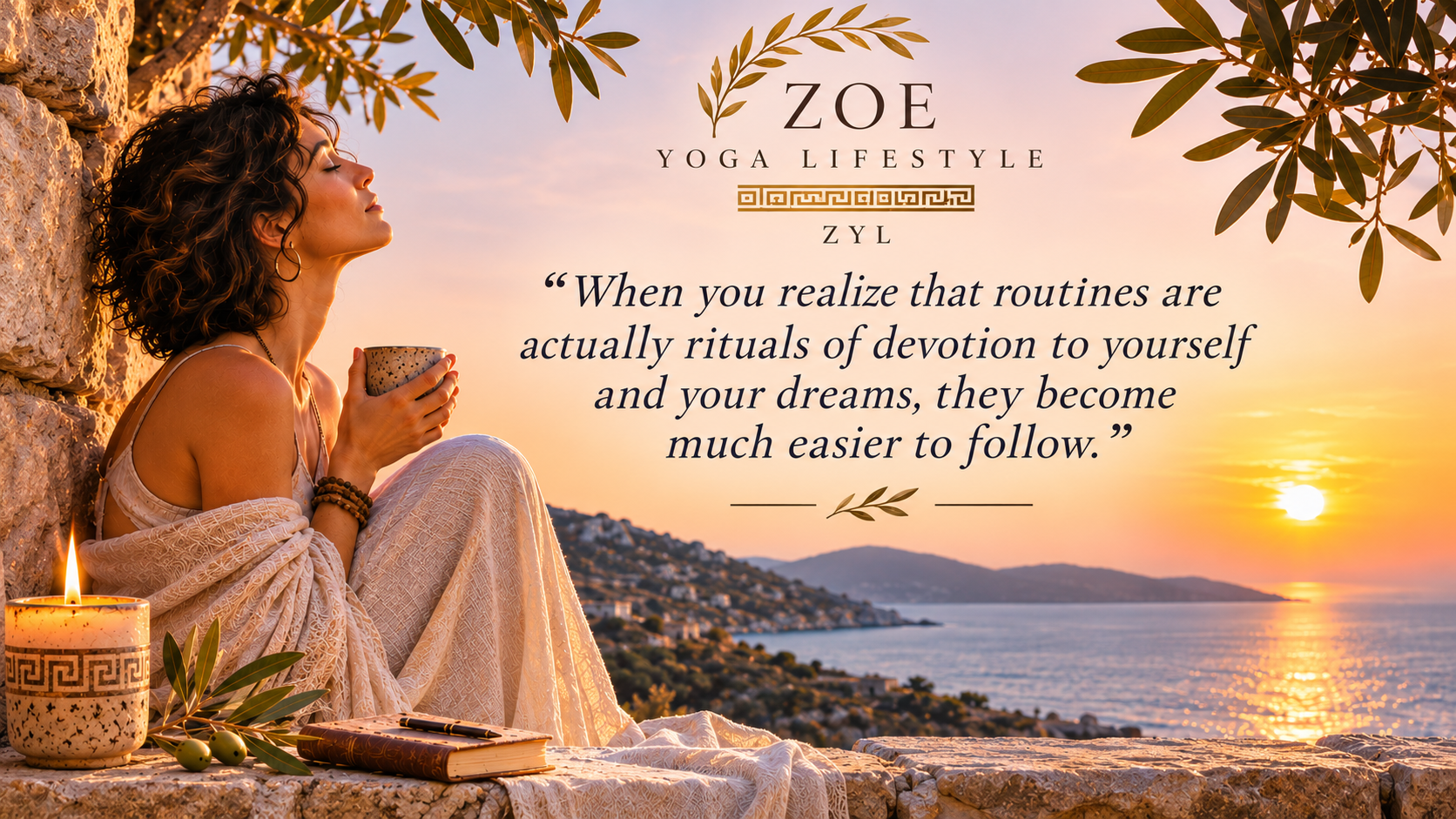
When Routines Become Rituals: The Art of Creating a Life You Love
What if the things we do every day aren’t simply routines to get through, but rituals that help us create the life we want to experience?
We often think of routines as schedules, habits, or things we need to accomplish. We make lists, set alarms, and try to become more disciplined about following through.
But there’s another way to look at our daily practices.
What if making breakfast, taking a morning walk, moving your body, lighting a candle, journaling, or setting aside time to rest were actually small expressions of devotion to yourself?
The difference between a routine and a ritual isn’t necessarily the activity. It’s the intention and awareness we bring to it.
And that shift can change how we experience our everyday lives.
Why Routines Matter
Our brains and bodies benefit from consistency.
Having familiar rhythms throughout the day can reduce decision fatigue, provide structure, support healthy sleep patterns, and make it easier to follow through on the things that matter to us.
Think about the simple things that help establish a foundation for your day:
Waking up around the same time.
Getting natural morning sunlight.
Drinking enough water.
Eating nourishing meals.
Making time for movement.
Getting outside and connecting with nature.
Creating periods of focused work and intentional rest.
Establishing a calming evening routine.
These aren’t complicated practices, but their cumulative effect can be meaningful.
When we create predictable patterns, we spend less energy deciding what to do next and more energy actually participating in our lives.
We also begin creating space for the things that often get pushed aside when life becomes busy: our health, creativity, relationships, personal growth, and well-being.
The Role of Routine in Nervous System Regulation
Our nervous systems are constantly responding to our environments and experiences.
When life becomes unpredictable, stressful, or overwhelming, we can find ourselves operating in a reactive state.
We may struggle to slow down, sleep well, concentrate, or make time for ourselves.
This is one reason consistent routines can be particularly valuable.
For someone healing from prolonged stress or Complex PTSD (CPTSD), predictable daily activities can provide important opportunities to rebuild a sense of stability, agency, and self-trust.
When experiences of trauma have disrupted our sense of safety, having familiar anchors throughout the day can help create a greater sense of predictability.
Small commitments to ourselves become opportunities to practice consistency.
And this isn’t exclusive to trauma recovery.
We all experience periods of uncertainty, stress, transition, and overwhelm. Having supportive daily rhythms can help us navigate those experiences with greater intention.
A routine doesn’t eliminate stress or guarantee nervous-system regulation. But it can create an environment that makes caring for ourselves more accessible.
Rebuilding Your Relationship With Yourself
There’s something meaningful about following through on a commitment you’ve made to yourself.
Not because you have to prove anything, but because you are demonstrating that your needs matter.
When we consistently make time for movement, nourishment, rest, and personal reflection, we begin strengthening our relationship with ourselves.
We become more familiar with what we need.
We learn to recognize when we’re tired, when we need movement, when we need connection, and when we need quiet.
For those recovering from trauma, this can be especially important in rebuilding self-trust and reconnecting with personal agency.
But it’s equally valuable for anyone who wants to become more intentional about how they spend their time and energy.
The goal isn’t to become a perfectly disciplined person.
It’s to become someone who makes room for their own well-being.
When Routine Becomes Ritual
A routine is something we repeat.
A ritual is something we experience with intention, awareness, and meaning.
Consider the difference:
Drinking your morning coffee becomes an opportunity to pause and arrive in the day.
Lighting a candle becomes a moment of stillness.
Taking a walk becomes an opportunity to reconnect with nature and your senses.
Preparing a meal becomes an expression of nourishment.
Making time for movement becomes an opportunity to listen to your body.
Setting aside time to rest becomes an acknowledgment that you don’t have to be productive every moment of the day.
The activities themselves may be ordinary, but the experience becomes something more meaningful.
Instead of rushing through another item on your to-do list, you begin experiencing the little moments that make up your life.
You begin to recognize that caring for yourself doesn’t have to be reserved for special occasions.
It can be woven into the ordinary.
Make Time to Reconnect With Your Body
One of the most valuable routines we can establish is making time to experience our bodies rather than constantly asking them to perform.
We spend so much of our day thinking, planning, working, responding, and managing responsibilities that we can lose touch with the physical experience of being alive.
This is where intentional movement becomes meaningful.
Setting aside even 10 or 20 minutes for Somatic Movement gives you an opportunity to slow down, notice sensations, explore gentle movement, and develop a more attentive relationship with your body.
Rather than focusing on performance or achieving a particular shape, the emphasis becomes awareness.
How am I feeling today?
What sensations am I noticing?
What kind of movement feels appropriate for me?
Can I move without judging or pushing myself?
And then there’s rest.
Not scrolling, multitasking, or simply collapsing at the end of an exhausting day.
Actual intentional rest.
Making time for Yoga Nidra / Non-Sleep Deep Rest can become another meaningful daily ritual.
Setting aside 10, 20, or 30 minutes to lie down, listen, and allow yourself to experience stillness is a way of making restoration part of your life rather than something you only get around to when you’re exhausted.
Movement and rest are not opposites.
They are complementary parts of caring for ourselves.
Some days we need to move. Other days we need to be still. Learning to recognize the difference is part of developing a more conscious relationship with our bodies.
The Art of Witnessing
There is another important element to creating meaningful daily practices: learning to witness yourself.
Instead of judging your emotions, criticizing your body, or becoming frustrated with yourself for not being further along, you begin practicing observation.
You notice.
You become curious.
You allow yourself to experience what is happening without immediately needing to change it.
This is The Art of Witnessing.
It is an invitation to develop a different relationship with the experience of being human.
Your daily rituals can become opportunities to practice this awareness.
A few conscious breaths before beginning the day.
Noticing the warmth of sunlight on your skin.
Feeling your feet against the ground.
Listening to the sounds of nature.
Allowing yourself to rest when you need rest.
These moments bring attention back to the present, where life is actually happening.
Ritual Should Create Freedom, Not Another Obligation
There’s an important distinction between creating supportive routines and becoming rigid about how we think our days should unfold.
Our routines should serve our lives, not become another source of pressure.
Some days your body may welcome movement. Other days it may need rest.
Some mornings you may have the energy for a longer practice. Other mornings, a few minutes of quiet may be enough.
A healthy ritual is flexible.
You can adapt it, change it, or return to it after a few days away.
Consistency doesn’t mean perfection.
It means creating practices that are sustainable and meaningful enough that you want to return to them.
Moving From Getting Through Life to Participating in It
Perhaps one of the most beautiful things about establishing daily rituals is that they change our relationship with the ordinary.
We stop waiting for vacations, special occasions, or some future version of ourselves to begin enjoying life.
We begin finding meaning in the everyday.
You aren’t simply preparing breakfast. You’re nourishing yourself.
You aren’t simply moving your body. You’re reconnecting with yourself.
You aren’t simply resting. You’re allowing yourself to experience rest without having to earn it.
You aren’t simply lighting a candle. You’re creating a moment that belongs to you.
Whether you’re navigating a season of healing, managing a busy life, pursuing personal goals, or simply wanting to feel more present, the small things you do consistently can help shape the quality of your days.
Routines create structure.
Rituals bring intention.
And intention changes how we experience the life we’re creating.
Your daily life is not just something to get through. It is something you get to participate in creating.
Let your routines become rituals. Let your rituals become expressions of self-devotion. And allow the ordinary moments of your life to remind you that you are worthy of your own care and attention.
You don’t have to wait for life to slow down to begin living intentionally. You can start with the next small thing you do.
Continue Exploring Your Own Practices
At ZOE Yoga Lifestyle, I explore the relationship between the body, nervous system, deep rest, and the experience of being human.
If you’d like to begin incorporating these practices into your own life, there are several ways to explore.
Start with something free.
Visit ZOE Yoga Lifestyle on YouTube for free Somatic Movement, Yoga Nidra / Non-Sleep Deep Rest, and other accessible practices you can incorporate into your day.
Make deeper space for rest and restoration.
My monthly ZYL memberships offer guided Yoga Nidra, Somatic Movement practices, and monthly reflections designed to help you create meaningful time for yourself.
Explore The Sanctuary and Deep Rest memberships through Buy Me a Coffee.
A little generosity goes a long way.
If these teachings, reflections, and free practices have brought something meaningful into your life, you can also make a voluntary donation through Buy Me a Coffee.
Your generosity helps make it possible for me to continue creating accessible practices and resources for people navigating the complexities of being human.
Thank you for being here.
With warmth,
Dina 🤍 | ZOE Yoga Lifestyle
20 Years Teaching Experience | Trauma-Informed Teacher
Somatic Movement • Yoga Nidra / Non-Sleep Deep Rest • Breathwork • Neuromotor Re-patterning • Square 1 System • Spine-Safe Yoga • Travel Deeper Wellness Retreats in Greece
Explore ZOE Yoga Lifestyle on YouTube