
Related Papers
Evaluation of a Rotary Engine for Hydrogen Compression and Expansion
Hybrid Liquid Air & Hydrogen Energy Storage System: A Smart Grid Solution
A Hybrid Liquid Air and Hydrogen Combustion System for Grid-Scale Energy Storage
The Elemental Harmonics Hypothesis – A Unified Theory of Quantum-Chemical-Biological Coherence
Abstract
The global transition to renewable energy necessitates advanced, large-scale storage solutions to overcome the intermittency and geographic diversity of sources like solar, wind, hydro, geothermal, and tidal power. Current battery-dominated storage faces challenges related to resource scarcity, finite cycle life, and environmental concerns. This paper proposes a novel, smart, multi-input hybrid system that integrates diverse renewable inputs with a cascading storage architecture: capacitor banks for instantaneous response, flow batteries for medium-term duration, Liquid Air Energy Storage (LAES) for short-term bulk power, and hydrogen for long-term/seasonal storage. A key innovation is the use of an AI controller to optimally manage energy allocation across this portfolio. The system is designed to run during periods of excess renewable generation, converting cheap, otherwise-curtailed energy into dispatchable power. Furthermore, it creates a symbiotic relationship with digital infrastructure by using the cold exhaust from the LAES process for high-density computing cooling, drastically reducing the energy footprint of AI data centers. This model unlocks multi-vector revenue streams, positioning the system not just as a storage solution, but as a profitable, foundational component of a modern, resilient, and decarbonized energy ecosystem.
1. Introduction
The global energy landscape is undergoing a profound transformation driven by the decarbonization imperative. The rapid deployment of variable renewable energy (VRE) sources, solar, wind, hydro, geothermal, and tidal, is creating unprecedented challenges for grid stability and reliability. The inherent intermittency of these sources leads to periods of energy surplus (curtailment) and deficit, necessitating robust, large-scale, and long-duration energy storage (LDES) solutions.
While lithium-ion batteries have dominated the early stages of the storage market, they present significant limitations for grid-scale, long-duration applications, including resource scarcity, degradation over finite cycles, thermal runaway risks, and end-of-life environmental disposal issues. A singular technological approach is insufficient to meet the multi-faceted demands of a fully renewable grid.
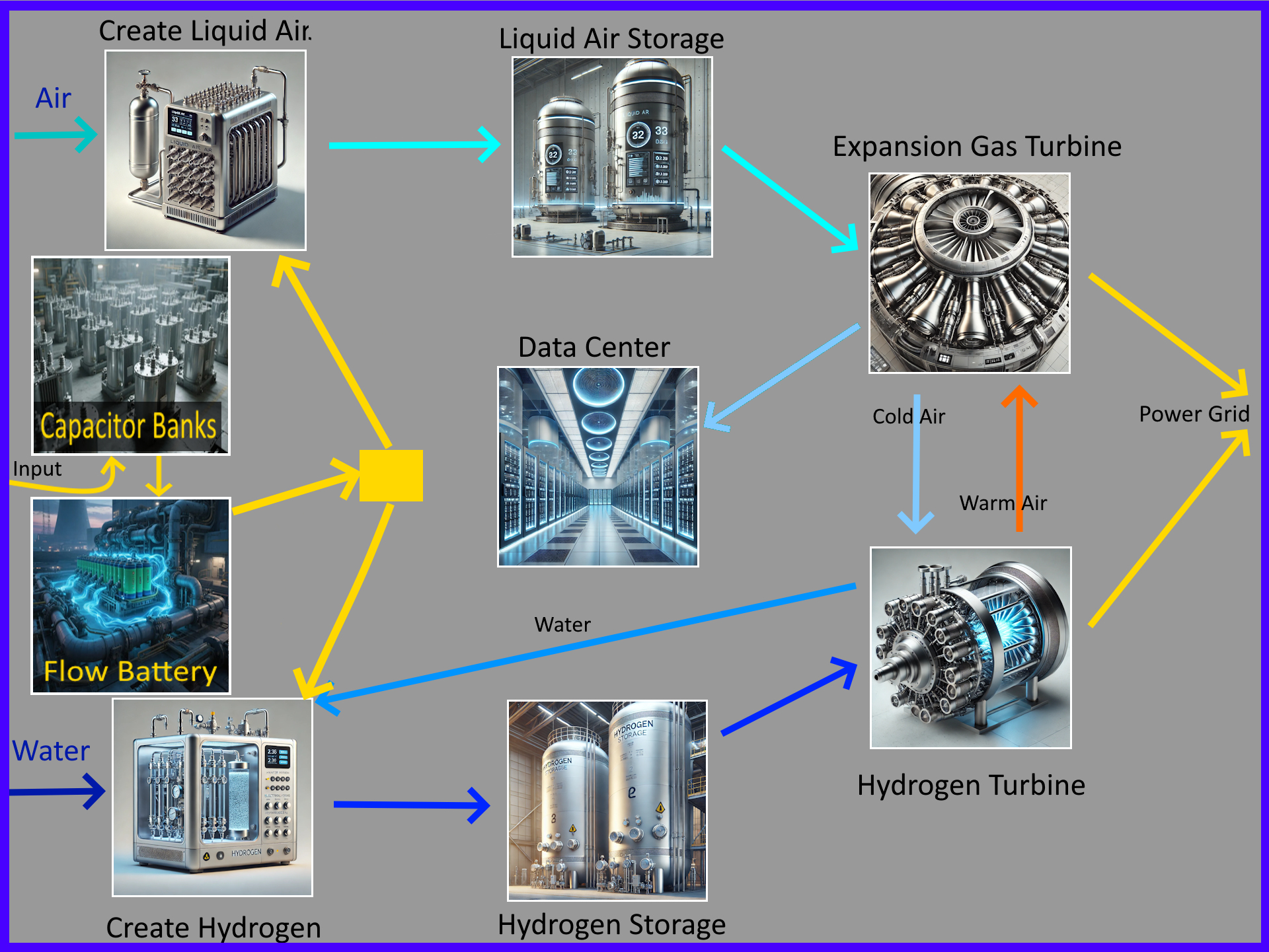
This paper proposes a holistic solution: a smart, multi-input hybrid energy storage system that synergistically combines the strengths of multiple storage technologies. By integrating capacitor banks, flow batteries, Liquid Air Energy Storage (LAES), and green hydrogen production/combustion within an intelligent AI-managed framework, the system provides a seamless response to grid fluctuations across all time scales. A pivotal innovation lies in its symbiotic integration with the digital economy, specifically by repurposing the "waste" cold from the LAES process to cool high-density AI computing data centers. This creates a powerful economic and operational synergy, dramatically improving the total efficiency and economic viability of both the energy storage facility and the data center.
2. System Overview and Design Philosophy
The system is conceived as an integrated energy hub, designed specifically to capitalize on the diverse and often complementary nature of renewable energy inputs. Its core design principle is to capture, store, and dispatch energy in its most technologically and economically appropriate form, creating a cascading defense against grid instability.
The entire process is initiated by excess, low-cost power from connected renewable sources (Solar PV, wind farms, hydroelectric, geothermal, or tidal generators). This energy is the primary "feedstock" for the system. An AI Controller acts as the central nervous system, making real-time decisions on energy allocation based on predictive analytics, grid conditions, and market signals.
3. System Architecture: Multi-Input Renewable Integration and Cascading Storage
3.1. Renewable Energy Inputs
The system is agnostic to the source of renewable power, designed to interface with a diversified portfolio. This diversity mitigates risk and creates a more consistent energy supply for the storage system. For instance, solar provides daytime power, wind can generate at night, while geothermal and hydro can offer a stable baseload, ensuring the storage system operates at high capacity factors.
3.2. The AI Controller - The System's Brain
A sophisticated AI controller orchestrates all energy flows. Utilizing machine learning algorithms and real-time data feeds (weather forecasts, electricity prices, grid frequency, asset state-of-charge), it performs continuous, predictive optimization. Its key decision-making functions include:
Source Selection: Prioritizing which renewable input to draw from based on cost and availability.
Storage Allocation: Determining the optimal storage technology to charge (Capacitor, Flow Battery, LAES, or Hydrogen Electrolyzer).
Dispatch Scheduling: Deciding when, at what power, and for how long to discharge each storage asset to maximize revenue and grid support.
4. The Cascading Storage Portfolio
The storage technologies are layered in a complementary hierarchy to handle power demands of different durations and response times.
4.1. Capacitor Bank (Millisecond to Second Response)
Function: Provides instantaneous grid ancillary services, primarily frequency regulation and voltage support. It handles very short, sharp fluctuations that are too rapid for electrochemical batteries, preventing grid degradation.
AI Decision: The AI controller deploys the capacitor bank autonomously and instantly to maintain grid power quality, participating in high-value frequency response markets.
4.2. Flow Battery (Second to Hour Response)
Function: Acts as a high-cycler, medium-term buffer. Its power and energy are decoupled, allowing for cost-effective duration scaling. It handles the ramp-up period before larger systems like LAES come online, smooths renewable output over minutes to hours, and performs intra-day arbitrage.
AI Decision: The AI uses the flow battery for rapid, sustained discharges for peak shaving and as a reliable bridge during transient cloud cover or wind lulls.
4.3. Liquid Air Energy Storage - LAES (Short-Term Bulk Power - Minutes to Hours)
Function: This is the workhorse for short-term, high-power discharges. When a significant grid demand spike is predicted or occurs, the LAES is dispatched to provide bulk power for several hours. Air is liquefied and stored in insulated, low-pressure tanks at -196°C.
The Strategic Role of Liquid Oxygen (LOX): The air separation unit within the LAES process inherently produces liquid oxygen (LOX) as a byproduct. While compressing and storing oxygen is less efficient than nitrogen, it serves a critical strategic purpose. The LOX tank acts as a rapid-response, short-duration power reserve for the hydrogen turbine. This allows the system to respond almost instantly to large, short-term power deficits by combusting hydrogen with the readily available LOX, without needing to draw down the main long-term hydrogen reserves. This justifies the "inefficiency" of LOX storage as a cost of achieving superior grid responsiveness.
4.4. Hydrogen (Long-Term and Seasonal Storage - Hours to Months)
Function: This is the system's long-duration, continuous power source. During periods of extreme energy surplus, the AI controller diverts power to electrolyzers to produce green hydrogen, which is stored in underground salt caverns or inerted tanks.
AI Decision: Hydrogen is deployed for multi-day grid events, seasonal storage (e.g., saving summer solar for winter heating), and for ensuring continuous power during prolonged "dunkelflaute" periods—times of low wind and solar generation. It is the backbone for energy security and long-term price arbitrage.
5. System Synergies and Efficiency
The system's superiority is derived from synergistic loops that create benefits beyond the sum of its parts.
Optimal Energy Allocation: The AI controller ensures energy is stored and dispatched in the most economically optimal form, creating a "virtual battery" with perfectly tailored characteristics for every grid need.
Enhanced Water Sustainability: The system recovers approximately 90% of the water used in electrolysis from the exhaust (as water vapor) of the hydrogen combustion turbine. This closed-loop cycle drastically reduces the system's freshwater footprint, a critical factor in water-scarce regions.
Utilization of Excess Hydrogen: Surplus hydrogen, beyond what is needed for foreseeable power generation, can be diverted to power the air liquefaction plant. This creates a virtuous cycle, converting long-term hydrogen storage into more readily dispatchable LAES capacity, enhancing the system's flexibility.
Waste Cold Energy Recovery for High-Density Computing: The cold exhaust from the liquid air expansion process is a valuable byproduct.
Direct Efficiency Gain: This sub-zero air is ducted directly to cool AI server racks. This eliminates or drastically reduces the energy consumption of traditional computer room air conditioning (CRAC) units and chillers, which can account for 30-40% of a data center's total energy use.
Economic & Operational Benefits: Co-locating this hybrid energy storage facility with an AI data center creates a powerful economic model. The energy plant provides stable, renewable power and free cooling, while the data center provides a reliable, high-value customer for both electricity and thermal management services. This directly lowers the total cost of ownership (TCO) for the data center and creates a stable revenue stream for the storage facility.
Improved Computing Performance: More effective and consistent cooling allows AI servers to operate at higher sustained clock speeds without thermal throttling, potentially increasing computational throughput and reliability.
6. Safety and Scalability: Underground Oxygen-Free Containment
A significant advantage of this system is its safe and space-efficient storage potential, making it viable for large-scale deployment.
Underground Storage: Both liquid air and hydrogen can be stored in underground tanks or repurposed salt caverns. This minimizes land use, protects against environmental hazards and extreme weather, and enhances public safety. This approach is ideal for co-located industrial parks.
Oxygen-Free Hydrogen Containment: The risk of hydrogen explosion is drastically mitigated by storing hydrogen in an oxygen-free environment, such as a nitrogen-inerted atmosphere. This acts as a built-in fire suppression system, preventing combustion even in the event of a leak. Advanced sensor networks and robust safety protocols provide further assurance.
7. Economic Model and Revenue Streams
The system is a versatile, profit-generating asset capable of capturing value from multiple, often overlapping, revenue streams.
7.1. Energy Arbitrage and Wholesale Electricity Markets: The AI controller buys electricity during periods of low cost (often during renewable curtailment) and sells it during peak demand hours at significantly higher prices. The multi-storage architecture allows it to participate in arbitrage across all time scales.
7.2. Grid Services and Ancillary Markets: The system's rapid-response capabilities allow it to sell critical grid stability services, which often provide higher margins than energy arbitrage. This includes frequency regulation (from capacitors and flow batteries), operating reserves (spinning and non-spinning), and voltage support.
7.3. Sale of Molecular Products: Hydrogen and Oxygen: The system transforms electrons into valuable molecules, decoupling it from pure electricity price volatility. Surplus green hydrogen can be sold for industrial decarbonization, clean transportation, or gas grid injection. The liquid oxygen (LOX) byproduct can be sold to industrial and medical customers.
7.4. Thermal Service: "Cooling-as-a-Service" for Data Centers: This is a foundational and highly lucrative synergy. Revenue can be generated through fixed service contracts, shared savings models, or a bundled "Power + Cooling" Power Purchase Agreement (PPA) with a co-located data center.
7.5. Environmental Credits and Policy Incentives: The system's 100% renewable profile qualifies it for carbon credits, Renewable Energy Credits (RECs), and government grants or tax incentives (e.g., Investment Tax Credits, Production Tax Credits) for clean energy and hydrogen.
7.6. Reliability and Capacity Payments: Grid operators pay for guaranteed future capacity. The system can secure steady capacity payments by committing to be available during future peak periods, providing a predictable revenue floor.
7.7. Reduced Curtailment and Grid Upgrade Deferral: The system provides value to renewable generators by reducing their curtailment losses. For transmission operators, it can alleviate congestion and defer costly grid upgrades, a value that can be captured through specific tariffs.
8. Conclusion: A Future-Proof, Intelligent Energy Hub
As global energy demands rise and the penetration of renewables increases, the limitations of single-technology storage solutions become starkly apparent. This hybrid LAES-Hydrogen system, augmented with flow batteries, capacitor banks, and intelligent AI control, offers a robust, adaptable, and sustainable pathway forward.
By intelligently combining technologies into a cascading storage portfolio and creating powerful synergistic loops for water, waste energy, and critical digital infrastructure cooling, the system achieves a level of efficiency, reliability, and economic viability that no single technology could achieve alone. The strategic use of liquid oxygen for short bursts and hydrogen for sustained power, managed by a predictive AI, ensures optimal grid support. The ability to directly underpin the growing AI industry with both low-carbon power and ultra-efficient cooling positions this hybrid system not just as an energy storage solution, but as a foundational, profitable component of the modern digital economy. With its multi-vector revenue model and scalable architecture, this approach is positioned as a critical enabler for a fully decarbonized, resilient, and intelligent power grid.