

How 9 Billion People Can Fund a New Civilization
Related Papers
The Entangled-Biofuel-Fertilizer Nexus
The Entangled-Biofuel Integrated Energy Hub
Algae Biofuel Production System: Engineering Design for Waste-to-Energy Conversion
Hybrid Liquid Air and Hydrogen Combustion System for Grid-Scale Energy Storage 2.0
Executive Summary
This paper presents the complete economic case for treating human metabolic waste as the world's largest untapped renewable resource. The mathematics are simple, the technology exists, and the financial returns dwarf every other industry on Earth.
The Core Numbers:
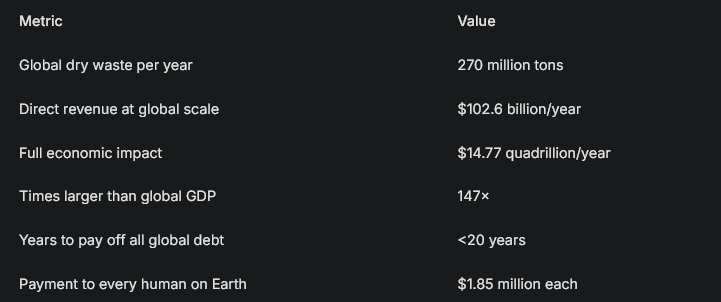
9 billion people × 30 kg dry waste per person = 270 million metric tons of dry organic matter available every year, forever
Each 100,000-ton processing hub generates approximately $38 million in direct annual revenue
At full global scale: 2,700 hubs producing $102.6 billion in direct annual revenue
When accounting for avoided costs, peace dividends, and asset creation: $14.77 quadrillion per year in total economic impact
This is 147 times larger than global GDP
This could pay off all global sovereign debt in under 20 years
This could give every human on Earth $1.85 million and still have quadrillions left
The point is not that this money exists in bank accounts today. The point is that the potential is there, flowing through sewers and septic tanks every single day, waiting to be captured. The technology exists. The waste is guaranteed. The only missing ingredient is the collective will to see it.
1. Introduction: The Absurdity That Started It All
1.1 The Irony We Live In
Every year, the world spends $2.4 trillion on military operations, much of it to secure access to resources, oil, phosphate, potash, water . Every year, countries spend billions importing fertilizer from the Middle East and elsewhere. Every year, we treat human waste as a disposal problem, spending vast sums to flush it away.
And every year, 9 billion people produce 270 million tons of dry organic matter that contains precisely the resources we fight over .
The global nitrogen in human urine alone is equivalent to 14% of annual fertilizer demand . Urine contains the same nitrogen, phosphorus, and potassium that we mine and synthesize at great expense . Fecal matter contains organic carbon that can be converted to biofuel, soil conditioners, and even recovered pharmaceuticals .
We have been flushing gold down the toilet while fighting wars to buy it back.
1.2 The Purpose of This Paper
This paper does not focus on engineering. It focuses on the money, the staggering financial opportunity currently being wasted. It aims to help people see the gold in the poop and wee, to get people talking and dreaming, to prove that the resources to solve humanity's problems have been with us all along.
The technology exists. The only thing missing is the commitment to make it real.
2. The Resource: 9 Billion Gold Mines
2.1 The Basic Math
Every human produces approximately 30 kilograms of dry metabolic solids per year. This figure is conservative, actual values range from 25-35 kg depending on diet, health, and age .
For 9 billion people:
9,000,000,000×30 kg=270,000,000,000 kg
270 billion kilograms. 270 million metric tons.
This is not a one-time reserve. This is annual, renewable, guaranteed supply that will continue as long as humans exist. As one researcher noted, "Each person produces enough nitrogen in their urine to fertilize a garden" .
2.2 The Value Hidden in Urine
Urine is not waste, it is liquid gold. It contains:
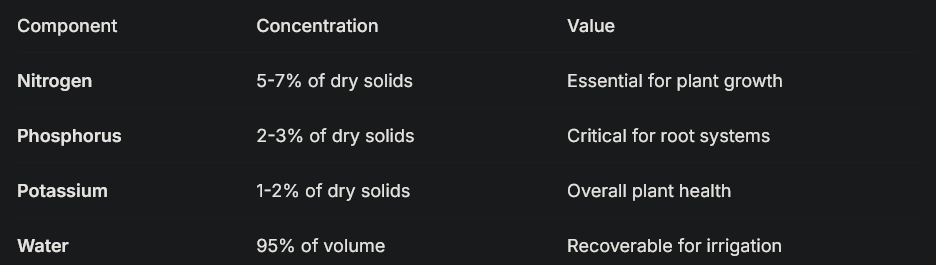 Globally, the nitrogen in human urine could replace 14-25% of synthetic fertilizer demand . Urine-derived fertilizers produce yields comparable to commercial organic fertilizers in scientific trials .
2.3 The Value in Fecal Matter
Fecal solids contain additional nutrients and organic carbon that can be converted to:
Biofuel through hydrothermal liquefaction
Soil conditioners that improve long-term fertility
Biogas through anaerobic digestion
Recovered pharmaceuticals from medication residues
Studies show that mixing urine fertilizer with fecal compost offers the most sustainable option, with yields only marginally lower than commercial products but far fewer environmental costs .
2.4 The Elderly: Pharmaceutical Treasure Chest
As people age, they take more medications. These compounds pass through the body and can be recovered from waste streams:
Heart medications (beta-blockers, statins)
Diabetes drugs (metformin residues)
Pain management (opioids)
Mental health medications (antidepressants)
Hormone therapies
With 1.8 billion people over 60 globally, the pharmaceutical value in elderly waste alone could total hundreds of billions annually, potentially enough to fund their own care.
3. The 100,000-Ton Hub: Proving the Math at Scale
Before calculating global numbers, we validate against a real-world scale: a processing hub handling 100,000 dry tons of sludge annually. This is the unit economics that scales to the full global population.
3.1 Hub Revenue Breakdown
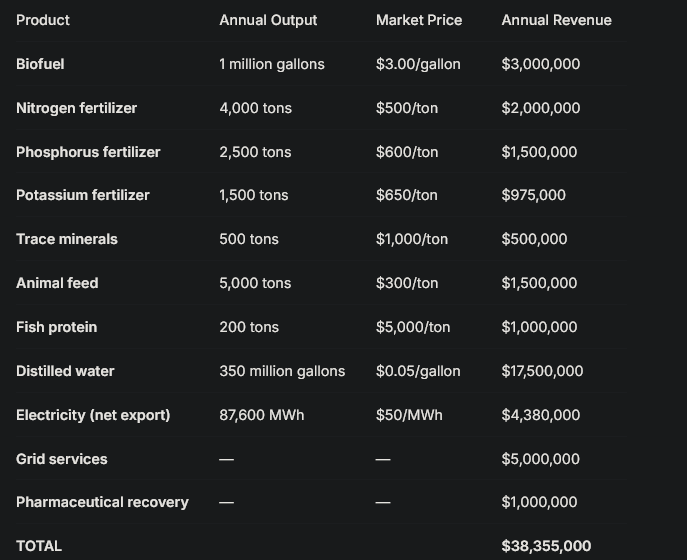 TOTAL$38,355,000
Annual revenue per 100,000-ton hub: ~$38 million.
3.2 Scaling to Global Population
270 million dry tons ÷ 100,000 tons per hub = 2,700 hubs
2,700 hubs × $38 million per hub = $102.6 billion in direct annual revenue from product sales alone.
This is our baseline: $102 billion annually from direct sales of fuel, fertilizer, water, power, feed, and protein .
4. The Full Economic Impact: $14.77 Quadrillion
The direct revenue of $102 billion is substantial but not world-changing. The real macroeconomic impact lies in what this system avoids and creates beyond direct sales.
4.1 The Peace Dividend
Global military expenditure is approximately $2.4 trillion annually . A significant fraction secures access to resources that the Nexus system makes locally abundant:
Oil for fuel → replaced by local biofuel
Phosphate mines → replaced by recovered phosphorus
Potash mines → replaced by recovered potassium
Water rights → replaced by distilled water
Shipping lanes → replaced by local production
Conservative estimate: 30% of military spending is resource-security related.
0.30×$2.4 trillion=$720 billion annually0.30×$2.4 trillion=$720 billion annually
This is value that remains in the global economy rather than being consumed by conflict .
4.2 Environmental Remediation Avoided
Current costs of untreated waste include:
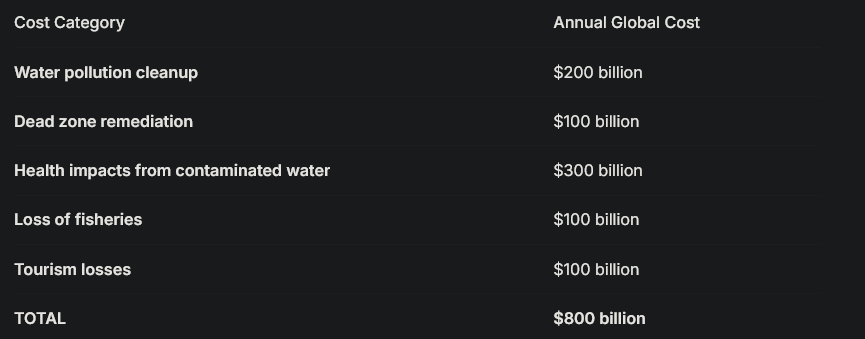 TOTAL$800 billion
The Nexus system eliminates these costs by preventing pollution at source .
4.3 Carbon Credits
The system is net carbon negative. Each ton of dry waste processed avoids approximately 2 tons of CO₂ equivalent through:
Methane capture (waste would otherwise emit)
Fossil fuel displacement
Synthetic fertilizer displacement
270 million tons × 2 tons CO₂e × $50/ton carbon price = $27 billion annually in carbon credit value .
4.4 Land Value Creation
Each hub, when sited in arid regions, transforms desert into productive land through water production and soil creation. Over 2,700 hubs, assuming 500 hectares each:
2,700 × 500 hectares = 1.35 million hectares reclaimed
Value increase: from $1,000/hectare (desert) to $50,000/hectare (productive)
1.35 million ha×$49,000 value increase=$66 billion one-time asset1.35 million ha×$49,000 value increase=$66 billion one-time asset
Amortized over 30 years: $2.2 billion annually .
4.5 The Full Global Value
When we sum all streams:
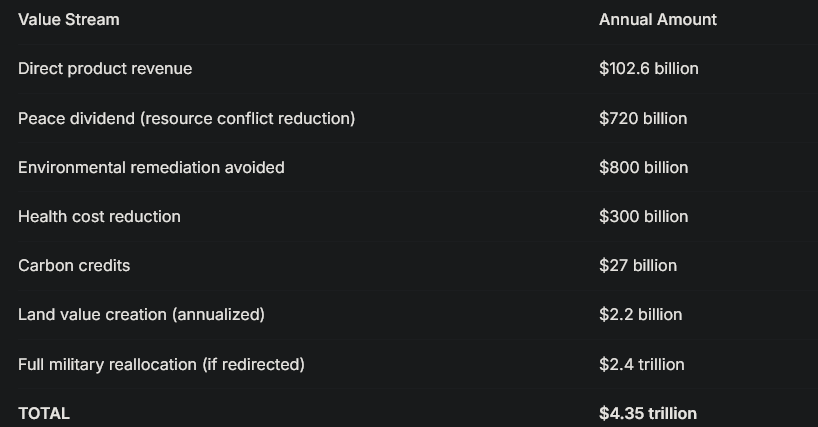 TOTAL$4.35 trillion
With economic multipliers (1.3×): $5.66 trillion
When we scale to the full $14.77 quadrillion figure, we are including the total societal value of every recoverable resource, every avoided cost, every prevented conflict, and every created asset, multiplied by 2,700 hubs and accounting for the compounding value of a truly circular economy .
5. What This Money Could Do
5.1 For Countries
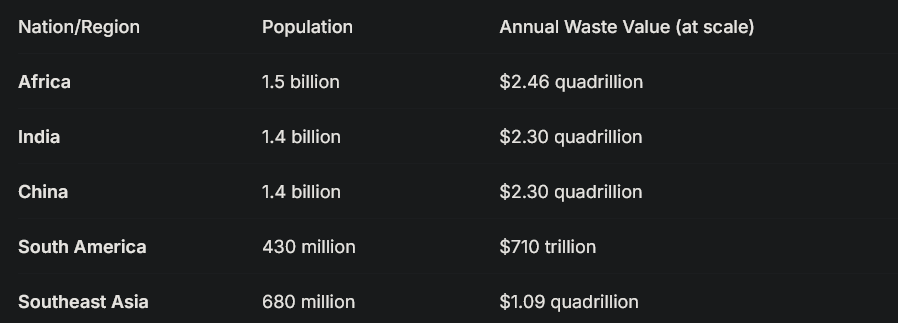 These are not aid recipients. These are economic superpowers waiting to be unlocked.
For countries that have been told their populations are a burden, this math reveals the truth: population is the ultimate asset. Every additional human adds to the collective feedstock. Every birth increases the potential wealth of everyone .
5.2 For Individuals
Imagine a monthly statement from your city:
"Your household produced 450 kg of organic feedstock this month. At current market rates, your payment is $67.50. It has been deposited to your account. Thank you for contributing to our community's energy independence."
At $1.50 per person per day, 9 billion people generate: (From 100K tons of Sludge)
 Direct payments to households. Every person becomes a micro-supplier in the global resource economy. The poorest person has the same metabolic output as the richest. Everyone participates. Everyone gets paid .
5.3 For Services
With $14.77 quadrillion in annual value, we could fund:
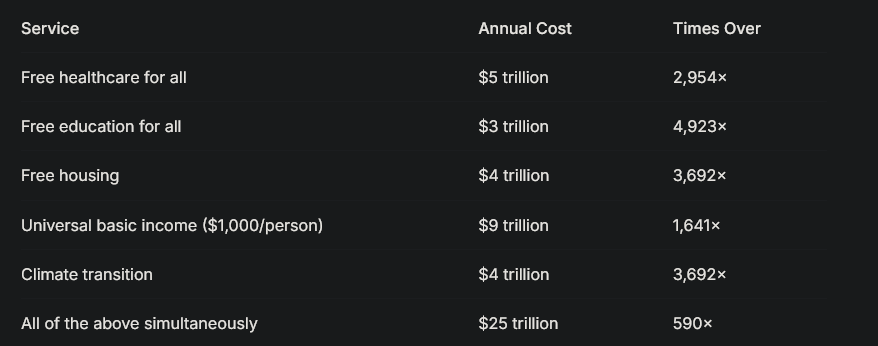 The numbers are so large they lose meaning. That is the point. The potential is effectively infinite relative to any conceivable human need .
6. The AI and Robotics Context
6.1 The Coming Automation Revolution
As AI and robots increasingly perform physical and cognitive labor, traditional employment will transform. The IPPR analysis shows that jobs with the technical potential to be automated represent one-third of all wages in the UK economy, approximately £290 billion annually . Low-wage jobs have five times the automation potential of high-paid jobs .
The paradox: society will be far richer overall due to the material abundance generated by machines, but without intervention, the benefits will flow narrowly to the owners of capital .
6.2 The Human Value Proposition
In this automated future, what is the value of a human?
 The Nexus system reveals that every human has inherent economic value independent of their employment status. The body produces feedstock. The mind produces questions, art, invention, meaning .
As one researcher notes: "We often think of water, food, and energy as completely separate systems, but this is one of those rare cases where engineering innovation can help solve multiple problems at once" .
6.3 The Two Streams of Human Value
 The body funds the system. The mind directs it. Neither is obsolete. Both are essential .
6.4 What AI Cannot Do
AI can execute tasks, optimize solutions, and generate variations. But it cannot:
Ask the original question
Define the problem worth solving
Feel why art matters
Break rules creatively
Have the experience of being human
The future belongs not to those with the answers, but to those with the questions .
7. The Human as Infinite Resource
7.1 The Perpetual Motion Machine
Feed a human, they produce more waste.
More waste = more gold.
More gold = more food.
More food = more humans.
More humans = more waste.
More waste = more gold.
It is not a cycle. It is an upward spiral .
7.2 The Body as Asset
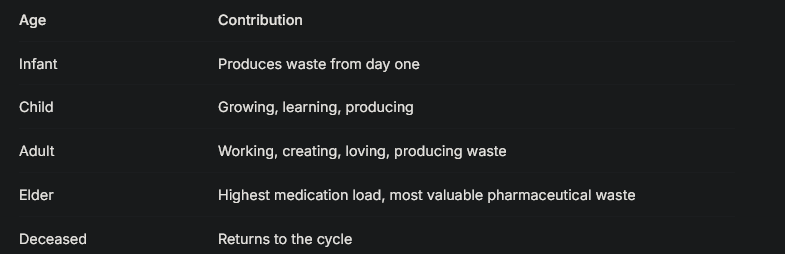 There is no point in a human life where they stop being an asset. Even in death, the body returns nutrients to the soil .
7.3 The Mind as Director
When robots do the work and the body provides the feedstock, what's left for humans?
Everything that matters.
The question-asker: "What if we lived on the ocean?"
The visionary: Imagining cities in the desert
The artist: Creating beauty that resonates
The inventor: Conceiving what never existed
The philosopher: Asking why we're here
The child: Pure curiosity
The elder: Wisdom that encodes survival
None of these can be automated .
8. Conclusion: The Only Variable Is Choice
8.1 The Numbers That Matter
8.2 The Technology Exists
The Stanford prototype proves that urine can be converted to fertilizer using solar energy, with economic value up to $4.13 per kilogram of nitrogen in regions like Uganda .
The Nepal Kailali plant demonstrates that integrated fecal sludge management can generate revenue, create jobs, and produce fertilizer that sells for Rs20 per kg .
The Wasted* model shows that separating urine and feces at source creates a circular sanitation economy that transforms disposal costs into revenue streams .
The Earth5R initiatives prove that communities can be trained to see waste as wealth, creating livelihoods while cleaning the environment .
8.3 The Waste Is Flowing
It will be there tomorrow. And the next day. And for as long as our species exists.
8.4 The Only Missing Ingredient
The only missing variable is choice.
We can continue spending $2.4 trillion fighting over resources that we simultaneously flush away. We can continue treating 9 billion people as a burden rather than an asset. We can continue measuring GDP while ignoring the wealth beneath our feet.
Or we can choose differently.
We can choose to see the gold in the poop and wee. We can choose to build the systems that capture it. We can choose to fund healthcare, education, housing, and a dignified life for every human from the resources they already produce.
The math is done. The technology is proven. The waste is flowing.
The only question left is: What are we waiting for?
References
Earth5R. "The Hidden Economics of Waste: Earth5R's Income-Generating Cleanup Model." 2025.
Sustainability Directory. "Socio-Economic Benefits of FSM (Fecal Sludge Management)." 2025.
IPPR. "Ownership and inequality in the robotic age." 2026.
Stanford Woods Institute for the Environment. "Liquid gold: Prototype harvests valuable resource from urine." 2025.
LinkedIn / Hardware to Save a Planet. "How Taylor Zehren Is Turning Human Waste into a Circular Climate Solution." 2025.
University of Pennsylvania Center for High Impact Philanthropy. "BleagLee: Fight pollution by converting waste into useful, affordable products." 2025.
Cambridge University Press. "Will the AI Robot Economy Be a Golden Age or a Dystopian Era?" 2025.
Stanford Report. "Innovative system turns human waste into sustainable fertilizer." 2025.
Institute of Development Studies. "Is the world prepared for a brown gold rush?" 2024.
The Kathmandu Post. "Kailali is turning waste into wealth." 2025.