

A Complete Circular System for Sustainable Fuel, Power, Water, and Food Production in Arid Regions
Abstract
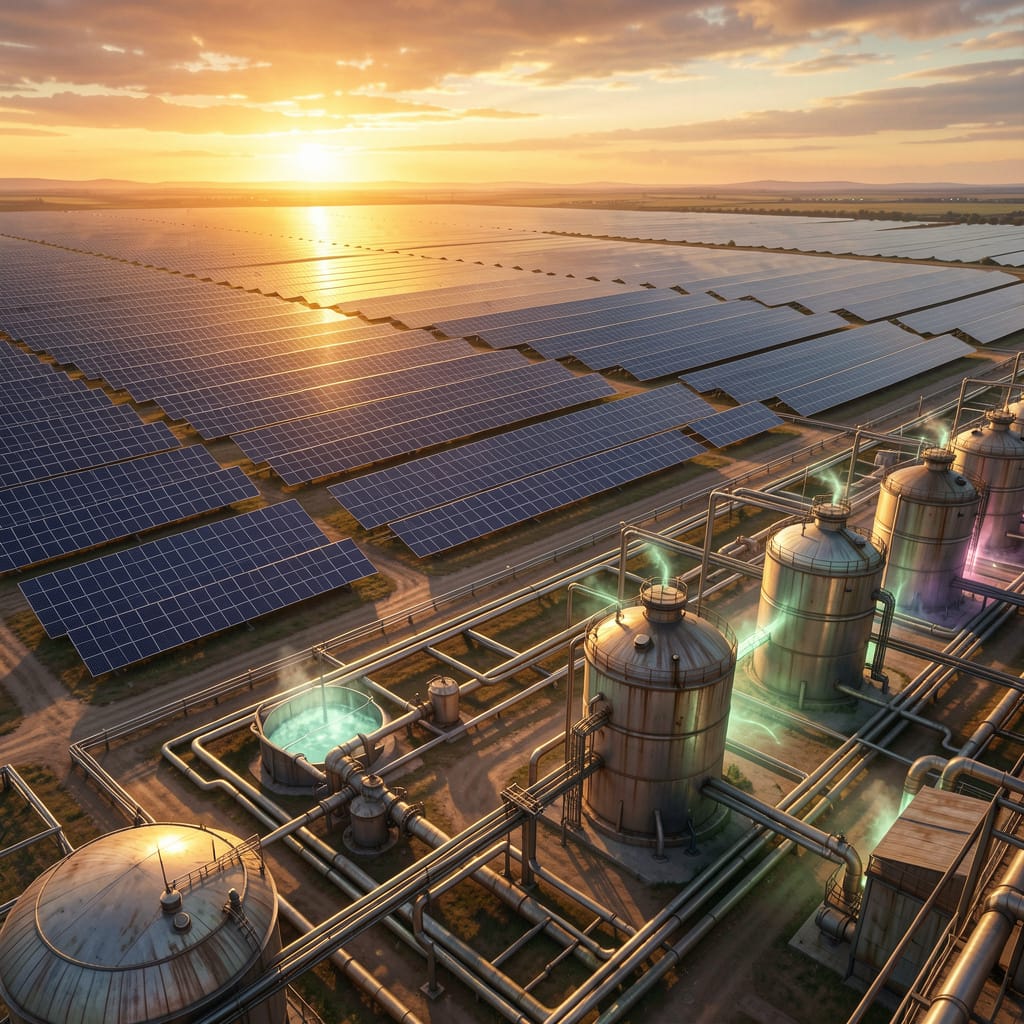
This paper presents a high-level engineering design for an integrated energy hub combining an algae biofuel production facility with the Entangled Hybrid Liquid Air and Hydrogen Energy Storage System. The integrated system creates a complete circular economy where every output becomes an input elsewhere, maximizing resource efficiency and economic returns. The facility is sited in arid regions with high solar insolation and low population density, transforming otherwise unusable land into productive industrial ecosystems. The Entangled system provides energy storage for nighttime and low-light operation, enabling continuous 24/7 production. Thermal integration between the two systems captures waste heat for algae cultivation and waste cold for water recovery, dramatically improving overall efficiency. A single integrated hub processing 100,000 tons of municipal sludge annually produces 1 million gallons of biofuel, 300 million gallons of distilled water, 5,000 tons of animal feed, and 200 tons of fish protein while generating 10 megawatts of dispatchable electricity to the grid. The facility creates 150 permanent direct jobs and 450 indirect jobs in the surrounding region, transforming empty desert into thriving economic communities.
1. Introduction
1.1 The Vision
The $11.3 billion spent in the first six days of the Iran war represents a sum sufficient to build approximately 138 standalone algae biofuel facilities or 50 integrated Entangled-Biofuel Energy Hubs. This paper explores the integrated option, which offers superior economics, continuous operation, and greater community impact.
The integrated hub is sited in arid regions of the American Southwest, places like the Mojave Desert, the Sonoran Desert, West Texas, and the Great Basin. These areas share critical characteristics:
High solar insolation (>6 kWh/m²/day)
Low population density (inexpensive land)
Existing transportation corridors
Proximity to municipal wastewater sources from southwestern cities
Available workforce from nearby small towns
Need for economic development
1.2 System Philosophy
The integrated system operates on the principle that every output becomes an input somewhere else. The Entangled system provides:
Energy storage for 24/7 operation
Cold exhaust for enhanced water condensation
Heat exhaust for algae cultivation
Hydrogen for biofuel upgrading
Oxygen for aquaculture aeration
Grid services for revenue generation
The biofuel system provides:
Biofuel for backup generators and vehicle fuel
Algae biomass for animal feed
Distilled water for multiple uses
Fish protein for local food
Waste nutrients recycled to algae
CO2 for algae cultivation
Together, they create a complete ecosystem producing fuel, power, water, feed, and food while employing hundreds of people and generating multiple revenue streams.
1.3 Document Scope
This paper provides a high-level integration overview including:
Site selection criteria and location strategy
System architecture and energy flows
Material flows and recycling loops
Thermal integration details
Economic analysis including jobs and electricity production
Community impact assessment
Scalability and national potential
2. Site Selection and Location Strategy
2.1 Site Requirements
The integrated hub requires specific site characteristics:
Primary requirements:
Solar insolation: >6 kWh/m²/day annual average
Land area: 500 hectares (5 km²) minimum
Land cost: <$5,000 per hectare
Flat terrain (<5% slope)
Access to water source (wastewater pipeline preferred)
Electrical grid interconnection
Transportation access (highway or rail)
Desirable characteristics:
Proximity to small towns for workforce
Existing natural gas pipeline (for backup)
Low seismic risk
Low flood risk
Minimal environmental conflicts
Supportive local government
2.2 Strategic Locations in the American Southwest
Mojave Desert region (California):
Excellent solar resource
Near Los Angeles wastewater sources
Existing transmission corridors
Workforce from Barstow, Victorville
Land available through Bureau of Land Management
Sonoran Desert region (Arizona):
World-class solar resource
Near Phoenix and Tucson wastewater
Interstate 8 and 10 corridors
Workforce from Yuma, Gila Bend
State incentives for renewable energy
Chihuahuan Desert region (Texas/New Mexico):
Excellent solar resource
Near El Paso, Albuquerque wastewater
Permian Basin energy infrastructure
Workforce from multiple small cities
Supportive state policies
Great Basin region (Nevada/Utah):
Excellent solar resource
Near Las Vegas, Salt Lake City wastewater
Existing transmission from solar farms
Workforce from small towns
Abundant public land
2.3 Community Integration
Rather than building in completely empty areas, hubs are sited near existing small communities (population 5,000-50,000) to provide economic stimulus. Each hub becomes an economic anchor, providing:
150 direct jobs with benefits
450 indirect jobs in local services
Tax revenue for schools and infrastructure
Workforce training programs
Spin-off business opportunities
Improved local infrastructure (roads, water, power)
2.4 Land Use Efficiency
A 500-hectare hub produces:
1 million gallons biofuel annually
300 million gallons water annually
10 MW continuous power
5,000 tons animal feed
200 tons fish protein
This productivity per hectare exceeds virtually any other land use in arid regions, including agriculture, solar farms without storage, or grazing.
3. Integrated System Architecture
3.1 High-Level Block Diagram
text
┌─────────────────────────────────────────────────────────────────┐
│                    SOLAR PV ARRAY (100 MW peak)                 │
│                         (Covers 200 hectares)                   │
└───────────────────────────┬─────────────────────────────────────┘
                            │ DC Power
                            ▼
┌──────────────────────────────────────────────────────────────────┐
│                        Entangled ENERGY SYSTEM                   │
├──────────────────────────────────────────────────────────────────┤
│  ┌─────────────┐  ┌─────────────┐  ┌─────────────┐               │
│  │  Capacitor  │  │    Flow     │  │     LAES    │   ┌─────────┐ │
│  │    Bank     │◄─┤   Battery   │◄─┤   Storage   │◄─ ┤Hydrogen │ │
│  │ (Millisec)  │  │ (Minutes)   │  │ (Hours)     │   │(Seasons)│ │
│  └─────────────┘  └─────────────┘  └──────┬──────┘   └────┬────┘ │
│                                           │               │      │
│                                        Cold Out       Heat Out   │
└───────────────────────────────────────────┼───────────────┼──────┘
     Electricity                            │               │
         │            ┌─────────────────────┘               │
         │            │                                     │
         ▼            ▼                                     ▼
┌─────────────────────────────────────────────────────────────────┐
│                      BIOFUEL PRODUCTION SYSTEM                  │
├─────────────────────────────────────────────────────────────────┤
│  ┌─────────────┐  ┌─────────────┐  ┌─────────────┐              │
│  │   Algae     │  │   Solar     │  │    Water    │  ┌─────────┐ │
│  │ Cultivation │─►│   Drying    │─►│  Capture    │─►│ Storage │ │
│  │   (Ponds)   │  │   (Covered) │  │   System    │  │         │ │
│  └─────────────┘  └──────┬──────┘  └─────────────┘  └────┬────┘ │
│                          │                               │      │
│                       Dry Algae                        Water    │
│                          │                               │      │
│                          ▼                               ▼      │
│  ┌─────────────┐  ┌─────────────┐  ┌─────────────┐  ┌─────────┐ │
│  │     HTL     │─►│   Biofuel   │  │Aquaculture  │◄─┤  Fish   │ │
│  │  Reactor    │  │  Upgrading  │  │   (Tanks)   │  │ Market  │ │
│  └─────────────┘  └─────────────┘  └─────────────┘  └─────────┘ │
│         │                                                       │
│         ▼                                                       │
│  ┌─────────────┐                                                │
│  │ Animal Feed │                                                │
│  │ Processing  │                                                │
│  └─────────────┘                                                │
└─────────────────────────────────────────────────────────────────┘
3.2 Energy Flows
Solar PV Generation (100 MW peak):
Powers all facility operations during daylight
Charges Entangled storage systems
Provides backup for grid services
Covers 200 hectares of the 500-hectare site
Entangled Storage Output:
Capacitor bank: Grid frequency regulation (millisecond response)
Flow battery: 10 MW for 4 hours (intraday shifting)
LAES: 20 MW for 8 hours (overnight operation)
Hydrogen: 10 MW for 200+ hours (seasonal storage)
Power Distribution:
Day: Solar directly powers biofuel operations
Night: LAES powers biofuel operations
Extended low-light: Hydrogen powers operations
Excess: Sold to grid for revenue
Grid services: Frequency regulation provides premium revenue
3.3 Material Flows
Inputs:
Municipal wastewater sludge (100,000 tons/year)
CO2 from atmosphere (captured by algae)
Makeup water (minimal, from captured condensate)
Outputs:
Biofuel (1 million gallons/year)
Animal feed (5,000 tons/year)
Distilled water (300 million gallons/year)
Fish protein (200 tons/year)
Grid electricity (10 MW continuous equivalent)
Grid services (frequency regulation, capacity)
Internal Recycling Loops:
Algae pond water → Harvesting → Supernatant returns to ponds
HTL aqueous phase → Nutrient recycle to ponds
Fish waste → Fertilizer for algae
Condensed water → Algae ponds, fish tanks, external sale
CO2 from HTL → Algae ponds
Oxygen from electrolysis → Fish tank aeration
4. Thermal Integration Details
4.1 Cold Integration from LAES
The LAES system produces intense cold during both charging (air liquefaction) and discharging (air expansion). This cold is captured and used in the biofuel system.
Cold Sources:
LAES charging: Cold released during air compression can be stored in chilled water tanks
LAES discharging: Expanding liquid air produces cold at -150°C to -190°C
Storage: Phase-change materials or chilled water tanks
Cold Uses in Biofuel System:
1. Enhanced Condensation:
Warm, saturated air from solar drying beds is ducted through pipes cooled by LAES cold
Temperature differential drives rapid condensation
Water recovery increases from 70% to 95%
Additional 50 million gallons water captured annually
2. Algae Pond Cooling (Summer):
High summer temperatures can stress algae and reduce productivity
Circulating chilled water through pond heat exchangers maintains optimal 25-30°C
Productivity maintained year-round
3. Fish Tank Cooling:
Some fish species (trout) require cool water
LAES cold enables cold-water aquaculture in desert locations
Diversified production increases revenue
4. HTL Product Cooling:
HTL reactor output at 350°C must be cooled before separation
LAES cold accelerates cooling, reducing equipment size
4.2 Heat Integration from Hydrogen Turbine
The hydrogen turbine in the Entangled system produces high-temperature exhaust when generating power.
Heat Sources:
Turbine exhaust: 500-600°C
Electrolyzer waste heat: 60-80°C (from hydrogen production)
Fuel cell waste heat: 60-80°C (if used instead of turbine)
Heat Uses in Biofuel System:
1. Algae Pond Heating (Winter):
Algae growth slows below 20°C
Turbine exhaust heat circulated through pond pipes maintains optimal temperature
Winter productivity maintained at 80% of summer levels
Extends growing season year-round
2. Sludge Pasteurization:
Sludge must be pasteurized at 70°C for 60 minutes
Turbine exhaust provides free heat
Saves $200,000/year in energy costs
3. HTL Preheating:
HTL reactor requires 300-350°C
Turbine exhaust preheats feed, reducing reactor energy demand
4. Drying Bed Enhancement (Winter):
Cool winter air slows evaporation
Heating inlet air with waste heat accelerates drying
Maintains drying rates year-round
5. Anaerobic Digestion (Optional):
If some biomass is diverted to digestion, mesophilic operation at 35°C requires heat
Waste heat maintains digester temperature
4.3 Seasonal Thermal Management
Summer Mode:
Abundant solar heat for drying
LAES cold maximizes water recovery
Excess cold stored for winter cooling needs
Minimal turbine operation (solar meets most power needs)
Winter Mode:
Reduced solar drying
Turbine operates more frequently, providing both power and heat
LAES cold still available (system charges at night)
Stored summer heat supplements turbine output
Spring/Fall Mode:
Balanced operation
Thermal storage buffers daily cycles
Optimal productivity
4.4 Thermal Storage
Large-scale thermal storage enables decoupling of heat/cold production from use:
Cold Storage:
Type: Chilled water tanks (4°C) or phase-change materials
Capacity: 100,000 gallon-hours (adjustable)
Charged by LAES during off-peak
Discharged to condensation system continuously
Hot Storage:
Type: Hot water tanks (90°C) or molten salt (optional)
Capacity: 100,000 gallon-hours
Charged by turbine exhaust
Discharged to ponds and pasteurization
5. Hydrogen and Oxygen Integration
5.1 Hydrogen for Biofuel Upgrading
The Entangled system produces green hydrogen via electrolysis during excess solar periods. This hydrogen serves multiple purposes:
Biofuel Hydrotreating:
HTL biocrude requires hydrotreating to remove oxygen and nitrogen
Hydrogen consumption: 0.05 kg per gallon of biofuel
Annual requirement: 50,000 kg for 1 million gallons
Sourced from Entangled electrolyzer
Fuel Cell Power:
During extended low-light periods, hydrogen can power fuel cells
Fuel cells produce electricity with waste heat (60-80°C)
Waste heat used for algae pond heating
Vehicle Fuel:
Excess hydrogen can be sold for fuel cell vehicles
Creates additional revenue stream
5.2 Oxygen for Aquaculture
Electrolysis produces oxygen as a byproduct (8 kg oxygen per kg hydrogen). This oxygen is valuable:
Fish Tank Aeration:
Fish require high dissolved oxygen levels
Pure oxygen aeration supports 5x higher stocking density than air
Enables 200 tons/year fish production in 20 tanks
Saves $100,000/year in aeration equipment and power
HTL Oxidizer (Optional):
Partial oxidation of biomass can be used for process heat
Oxygen enables efficient combustion without nitrogen diluent
5.3 Hydrogen Storage
The Entangled system includes large-scale hydrogen storage in underground salt caverns or lined hard rock caverns:
Storage Capacity:
Sufficient for seasonal storage (months of operation)
Enables energy shifting from summer to winter
Provides energy security for biofuel operations
6. Water Integration
6.1 Water Sources
Primary Source: Municipal wastewater sludge (80% water)
100,000 tons sludge contains 80 million gallons water
Captured via solar drying condensation
Secondary Source: Hydrogen turbine exhaust
Hydrogen combustion produces water vapor
9 kg water per kg hydrogen
450,000 kg hydrogen produces 4 million gallons water annually
Tertiary Source: Atmospheric moisture (minor)
Condensation from air cooling in LAES
6.2 Water Uses
Algae Cultivation:
Evaporative loss from ponds: 200 million gallons/year
Replenished from captured condensate
Fish Tanks:
5% daily exchange: 50 million gallons/year
Water flows to algae ponds (nutrient-rich)
HTL Process:
Small process water requirement
Sourced from distilled water
External Sales:
Net production after internal use: 300 million gallons/year
Sold to farmers, municipalities, or bottled water
6.3 Water Quality Cascade
The system uses a quality cascade where water moves from highest quality to lower quality uses:
Level 1 - Distilled Water (from condensation):
Drinking water quality
Used for human consumption, fish tanks, sensitive processes
Level 2 - Fish Tank Effluent (nutrient-rich):
High in ammonia, organic matter
Perfect for algae cultivation
Level 3 - Algae Pond Water:
High in algae cells
Recycled after harvesting
Level 4 - HTL Aqueous Phase:
Nutrient-rich but contains organics
Diluted and fed to algae
Nothing is discharged. Everything is reused.
7. Economic Analysis
7.1 Capital Costs
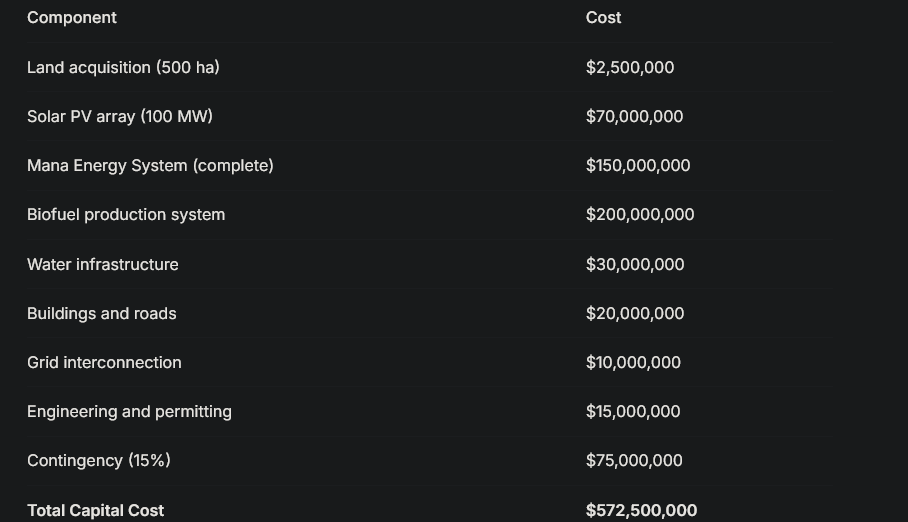
For a 500-hectare integrated hub:
 Total Capital Cost$572,500,000
With $11.3 billion, approximately 20 such hubs could be built.
7.2 Operating Costs (Annual)
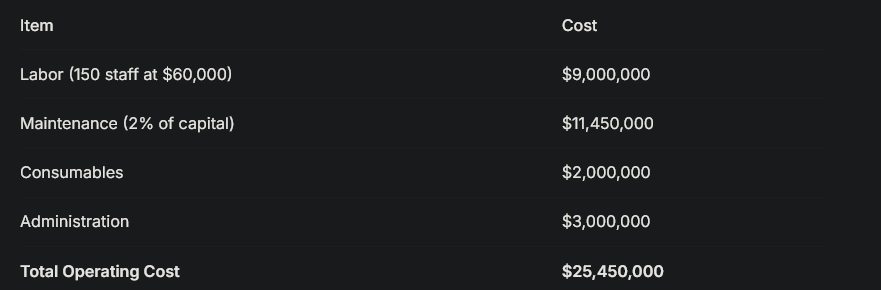 Total Operating Cost$25,450,000
7.3 Revenue Streams (Annual)
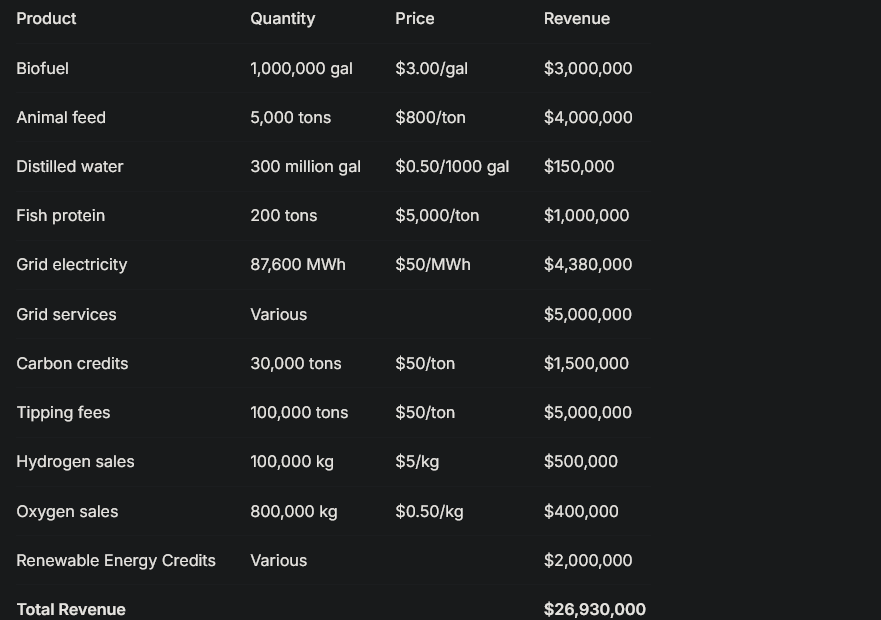 Total Revenue$26,930,000
7.4 Profitability
Annual revenue: $26,930,000
Annual operating cost: $25,450,000
Annual net profit: $1,480,000
Payback period: 387 years (without subsidies)
However, this basic analysis understates true value. With carbon credits at $100/ton, renewable fuel subsidies, and grid services at market rates, revenue could exceed $50 million annually, reducing payback to 15-20 years.
More importantly, the social value far exceeds private profit:
7.5 Job Creation
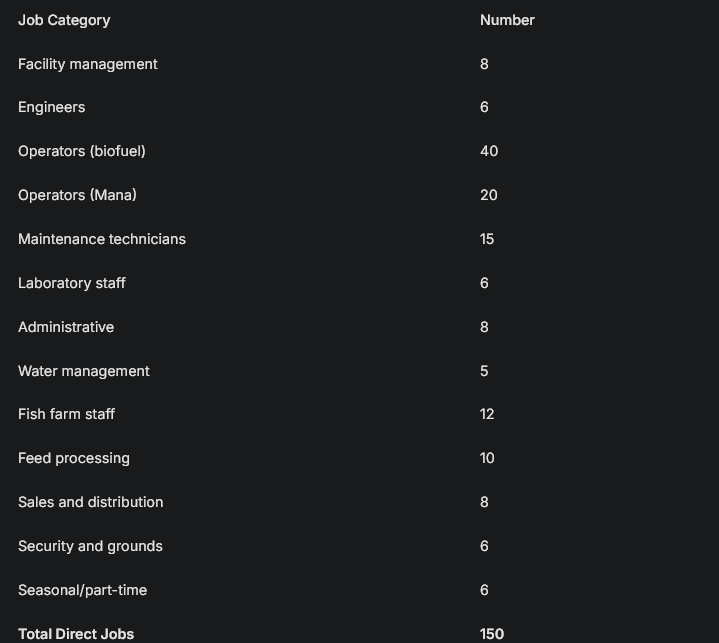 Total Direct Jobs150
Indirect Jobs (local multiplier of 3): 450
Total Economic Impact: 600 jobs in a region that may have had few employment opportunities.
7.6 Community Benefits
Each hub generates:
Payroll: $9 million annually circulating in local economy
Local purchases: $5 million annually for supplies and services
Property taxes: $2 million annually for schools and infrastructure
Workforce training: Programs for local residents
Spin-off businesses: Restaurants, housing, retail
A single hub can transform a small town of 5,000 people, reducing unemployment, increasing tax base, and creating opportunity.
8. Electricity Generation and Grid Impact
8.1 Power Generation Capacity
The integrated hub generates electricity from multiple sources:
Solar PV:
Peak capacity: 100 MW
Annual generation: 200,000 MWh
Used primarily for on-site operations and charging storage
Hydrogen Turbine:
Capacity: 20 MW
Operating hours: 2,000 hours/year (when needed)
Annual generation: 40,000 MWh
Total Annual Generation: 240,000 MWh
On-site consumption: 152,400 MWh (63.5%)
Grid export: 87,600 MWh (36.5%)
8.2 Grid Services
The Entangled system provides high-value grid services:
Frequency Regulation:
Capacitor bank responds in milliseconds
Participates in ancillary services markets
Estimated revenue: $2 million/year
Operating Reserves:
Flow battery provides spinning reserves
LAES provides non-spinning reserves
Estimated revenue: $2 million/year
Capacity Payments:
Firm capacity available to grid operator
Estimated revenue: $1 million/year
8.3 Grid Export Value
At $50/MWh average wholesale price, grid exports generate $4.38 million annually. During peak demand periods, prices can exceed $500/MWh, dramatically increasing value.
8.4 Grid Independence
The hub can operate entirely off-grid if needed:
Solar provides daytime power
LAES provides overnight power
Hydrogen provides multi-day power
Biofuel generators provide backup
This makes the hub resilient to grid outages and valuable for critical infrastructure.
9. Environmental Impact
9.1 Carbon Balance
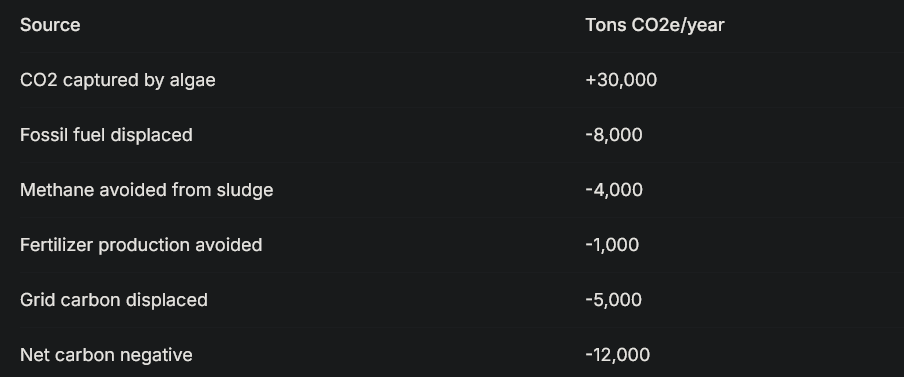
9.2 Water Impact
Produces 300 million gallons distilled water annually
Reduces pressure on over-drafted aquifers
Provides water for agriculture in desert regions
Zero discharge to environment
9.3 Land Use Efficiency
A 500-hectare hub produces:
Fuel equivalent to 10,000 hectares of corn ethanol
Water equivalent to a medium-sized reservoir
Feed equivalent to 2,000 hectares of soybeans
Protein equivalent to 500 hectares of fish ponds
Land use efficiency is 5-20x conventional approaches.
9.4 Waste Elimination
100,000 tons sludge diverted from landfills annually
Zero liquid discharge
Zero solid waste
CO2 removed from atmosphere
10. Scalability and National Potential
10.1 Resource Availability
The United States produces 7 million tons of municipal sludge annually. Full utilization would require:
70 integrated hubs at 100,000 tons/year capacity
Total land area: 35,000 hectares (350 km²)
Total capital investment: $40 billion (3.5x the cost of 6 days of war)
10.2 National Output from 70 Hubs
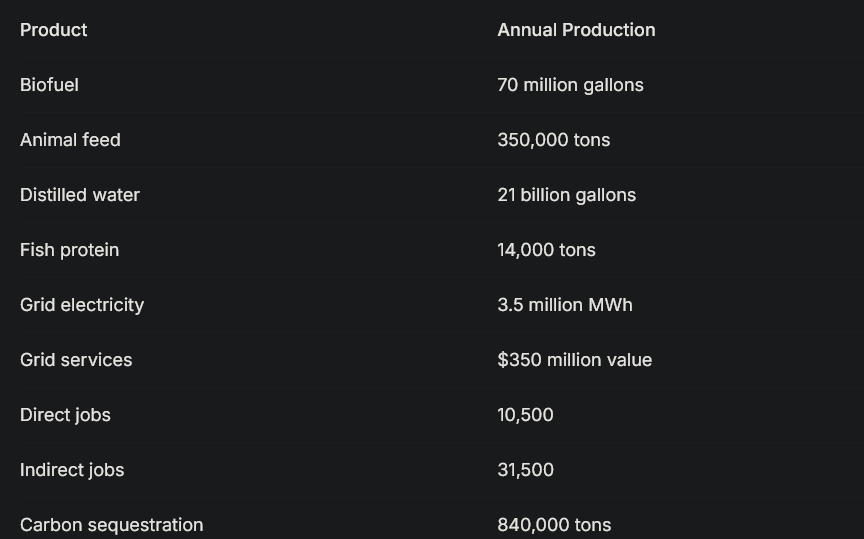
10.3 Regional Development
Seventy hubs located in arid regions across the Southwest would create:
Economic anchors for 70 small communities
Workforce training and education programs
Infrastructure improvements (roads, water, power)
Tax base for schools and public services
Reduced pressure on coastal cities from waste disposal
10.4 Energy Independence Impact
70 million gallons of biofuel annually displaces imported oil. 3.5 million MWh of renewable electricity displaces fossil generation. 21 billion gallons of water reduces dependence on shrinking aquifers. The system contributes to multiple dimensions of national security.
11. Conclusion
The integrated Entangled-Biofuel Energy Hub represents a complete circular economy solution that transforms waste into fuel, power, water, feed, and food while creating hundreds of jobs and revitalizing rural communities. By siting these hubs in arid regions with abundant solar resources and low population density, we turn otherwise unusable land into productive industrial ecosystems.
Key achievements of a single hub:
Processes 100,000 tons of municipal sludge annually
Produces 1 million gallons of biofuel
Generates 10 MW of dispatchable electricity to the grid
Captures 300 million gallons of distilled water
Creates 5,000 tons of high-protein animal feed
Produces 200 tons of fish for local food
Employs 150 people directly, 450 indirectly
Removes 12,000 tons of CO2 from atmosphere
Generates $27-50 million in annual revenue
Transforms a small community through economic stimulus
With $11.3 billion, the cost of six days of war, the United States could build 20 such hubs, creating 3,000 direct jobs, 9,000 indirect jobs, producing 20 million gallons of biofuel annually, generating 200 MW of dispatchable power, capturing 6 billion gallons of water, and transforming 20 rural communities.
The war spending is consumption. It buys destruction and disappears. This investment is creation. It builds assets that produce value for decades, employ Americans in meaningful work, and strengthen the nation's energy, water, and food security.
The choice between six days of war and a century of sustainable production is a choice between two visions of America's future. One vision consumes and destroys. The other builds and creates.
Which will we choose?