
Check out Part 2: Wild Arms, here.
One of the main reasons I picked up an SNES mini a few years ago was to play Secret of Mana after I left my SNES cartridge with a friend halfway around the world in 2008. As I fired up Secret of Mana for the first time in more than 20 years, memories came flooding back. The game quickly and easily checks the nostalgia box, but does it hold up today?
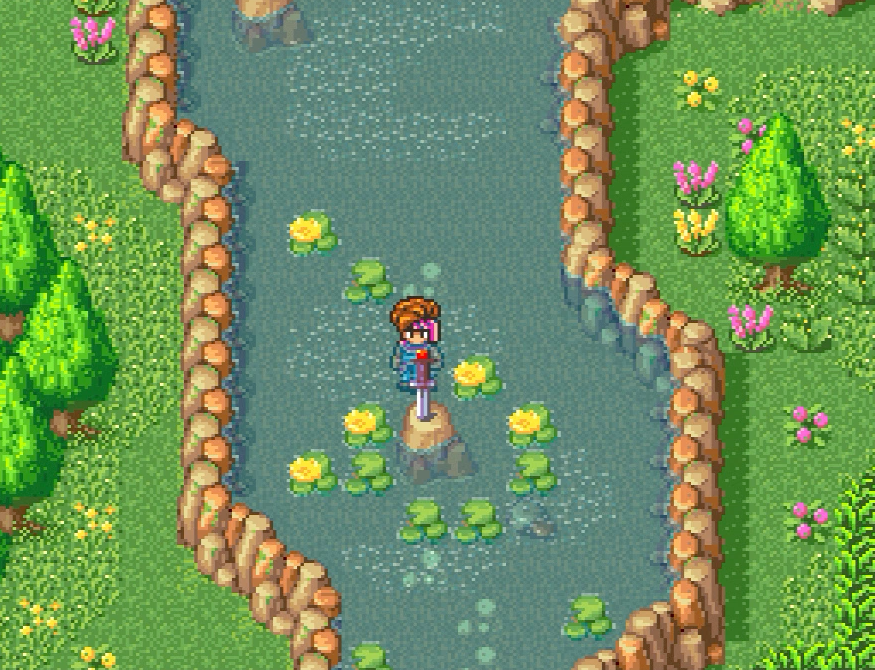 The game starts with the main protagonist, Randy, who disobeys the elder one too many times and gets kicked out of the only place he has ever known after an especially egregious error dooms the village. From here, it is a journey of self-discovery as Randy meets several people who will help him along the way, including a knight named Jema, a blacksmith named Watts, a girl from Pandora, and a sprite child. But also some very dangerous people from a powerful empire, such as Fahna and Gesthar, an evil mage named Thanatos, and even the Scorpion Army, which serves more as comedic relief rather than being truly evil, as their plots are always bound to fail.
Even by SNES standards, the story is thin but not without its touching moments. The dialogue is basic and does not help the story to grow and reach its potential. Don’t play this game expecting an epic tale on the level of Final Fantasy 6 or Chrono Trigger. You won’t always understand the motivations of every character, and talking to NPCs never really sheds any light on extra aspects of the world in which Secret of Mana takes place, at least, nothing too intriguing. The character development feels stunted and superficial compared to other RPGs of the era, even for many of the main characters.
Where the game shines, and what helps the bare-bones story out, at least a little, is the music. There are no bad tracks, and every single song creates a unique mood depending on where you are in the game. When you are up north in the snow, the music truly makes you feel as if you are in a mystical winter land with its calming, mysterious music. When one of the characters faces something sad, the music perfectly matches the moment with the somber, melancholy atmosphere. The music during boss battles is fast-paced and hectic, adding a subtle layer of stress and desperation to the fight.
During one of the final battles, it is creepy, filled with disaster, and the threat that one wrong move could lead to death. The track that plays during heroic moments, “Calm before the storm,” is likely to fill the player with confidence, courage, and make you feel like what you are experiencing is grand and important, the bells proudly ringing as you move around. When you meet Thanatos for the first time, the music that plays, entitled “Ceremony,” perfectly matches the ominous, sinister dungeon and perfectly fits the character of Thanatos, even if the dialogue leaves a little to be desired.
This part of the game, with Thanatos in the Pandora Ruins, is one of the more interesting aspects of the story. Still, other songs that play in faraway, exotic lands are festive and upbeat. The sound effects, on the other hand, are perfectly average and don’t detract from the game, but don’t add anything either.
The numerous locations are another strong point. They are diverse, with unique qualities and characteristics. Once you get your own mode of transportation, you will be able to travel from the searing heat of the desert to the bitter cold of a northern tundra in moments. You’ll travel to humble villages and opulent castles, gigantic mountain peaks and dense forests, and much more. Regardless of how different each location is, one thing remains the same: they are all exquisite with the utmost attention to detail, bursting with vibrant colors that pushed the SNES to its max in 1993. The dungeons are fairly big, although sometimes too straightforward. Once you get the ability to fly, you will see that the world is indeed gigantic, but much of it remains impossible to explore. Apparently, this game was supposed to be much larger, but I won’t get into that topic. Suffice it to say, there is a lot of empty land on the world map.
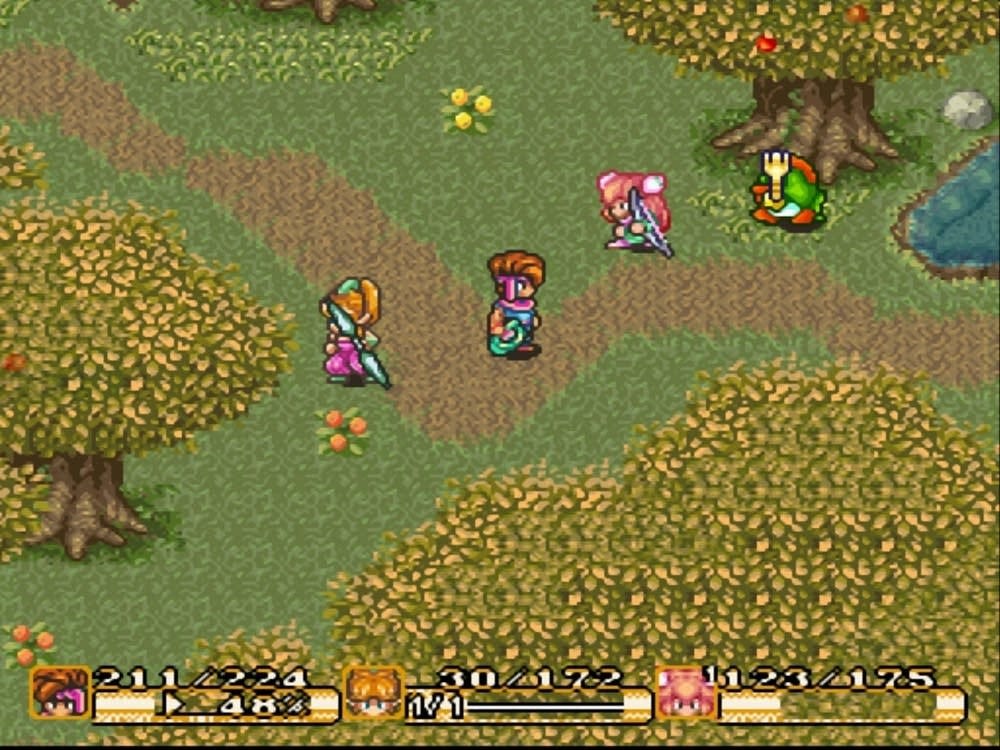 As far as gameplay, the view is top-down, and combat is real-time, and the action is quick; however, players are rewarded by being patient and charging their weapons for a few seconds to land stronger hits. The hit detection is not always great. Sometimes this is to your benefit, but other times it is to your detriment; the game is not so hard that a missed hit is likely to ruin you.
Later on, the girl and sprite gain magic. The girl largely focuses on healing and support magic, while the sprite gains attack magic. This is where you can find one of the game's major flaws. You can cast magic spells, one after another, effectively creating a chain of attack spells, so most bosses won’t even be able to touch you, aside from Mech Rider and the last two bosses. Although magic is likely to be a prominent focus of most people’s strategies, it can be a pain to level.
There are eight elements, seven per character (each character has one unique element), and each element has 8 levels. If you consistently cast magic as you progress through the game, your magic levels will be adequate by the end, but will still require some grinding to do massive amounts of damage. This can take time, trust me, I’ve grinded all of my magic to 8.99 after dedicating a few days to just casting magic, that is how slow magic levels are. Weapons also have levels that most players are unlikely to see the cool level 8 attacks as; again, later levels (6, 7, and 8) can take a very long time to obtain. Again, having leveled all weapons to 8, I know from experience that it is a timely process.
It is important to note that weapon levels depend on the orbs you currently have, and Watts will help strengthen your weapons as long as you have the money and the orbs, usually found in enemy-infested areas or after defeating a boss. For example, if you only have 3 orbs for the sword, you can only reach level 3. This ensures that players switch weapons so they are not wasting time with the same weapons, as the current number of orbs serves as a temporary barrier to higher weapon levels. The spell animations and charged weapon attacks are very cool and one of the game's strong points. It is worth leveling magic to 8 to see the special, extremely detailed spell animations!
In general, controls are very tight and responsive, and animations are very fluid. On the downside, some of the final weapon orbs in the last dungeon are exceedingly rare. In past playthroughs, I’ve reached level 99 before managing to collect them all. The game makes the drop rate of some items frustratingly arduous. A very organized ring menu system helps manage armor and items. This was very innovative for its time and is still functional to this day.
As for extras, there are no bonus dungeons and only a handful of very short side quests, all of which can be completed quickly. The game is largely linear, and aside from tackling a few dungeons in a different order, there’s little freedom in how you progress. It’s not particularly difficult, especially given the flaws mentioned earlier. The only way to increase the challenge is through self-imposed restrictions, such as a no-magic run or, if you’re disciplined, avoiding chain-casting altogether. Still, rating the difficulty of a game based on self-imposed restrictions gives it an unfair advantage, so that is only a recommendation and one that I did once I realized chain casting would make the game too easy, but one I realize other players might not be keen to do.
Probably the two hardest stretches of the game are from Spikey, which is before you have magic until Jabberwocky or Spring beak, when MP is still very low, and funds are likely too limited to buy more than 1 or 2 magic walnuts that replenish MP, making chain casting not only impractical but unable to last long enough to take out those bosses. The second stretch of the game that presents some challenges is simply moving through the Pureland. Had the game maintained that level of difficulty, it would have found even greater success.
So, with all that said, Secret of Mana still strikes me as a great game, even with all of its flaws that have only become more apparent over time. It effortlessly creates its own unique world and atmosphere, aided by a stunningly brilliant soundtrack and lush, storybook visuals. Another highlight is the option to play cooperatively with one or two friends. Anyway, if you can self-impose some limitations on magic casting, you will likely see the difficulty as the developers intended, which might make the game more enjoyable. So, to answer my question at the start of the review regarding whether the game still holds up, the response is yes!
Seiken Densetsu 3 featured here!
Wayback Wednesday Volume 1: Final Fantasy 7 and Chrono Trigger.
Wayback Wednesday Volume 2: Super Metroid and Castlevania: Symphony of the Night.
Wayback Wednesday Volume 3: The Legend of Zelda: A Link to the Past and Lunar: Silver Star Story Complete