
Subscribers get bonus perks: ask me unlimited gameplay questions about any review and get personal responses within 24 hours!
Check out Part 1, Illusion of Gaia, here.
Grandia was first released in Japan in 1997 for the Sega Saturn. I remember ogling over an extensive preview of Grandia in a gaming magazine in 1998 and immediately becoming excited for the potential this game seemed to hold. Grandia finally made its way to the USA nearly two years after its Japanese release in late 1999, towards the second half of the PlayStation life cycle. Does Grandia stand the test of time? Was it worth the hype it got in that gaming magazine nearly three decades ago? Read on!
Grandia starts in a humble seaside village, where the player will be thrust into a competition within seconds of starting a new game. Justin, the lead character, must find four "legendary" pieces of equipment before sundown, or he will have to hand over his best friend, Sue, to a neighborhood bully so he can marry her. Really, this sets the tone for the rest of the game as you will sail across an expansive sea, explore a haunted ship, climb mountains and other man-made objects that seem to reach into the heavens, navigate lush forests, meet locals from exotic faraway villages, and explore the deepest recesses of ancient ruins and more! If this sounds like a lot, it really is, and you will gain and lose party members several times throughout this epic adventure and make more friends than you can count.
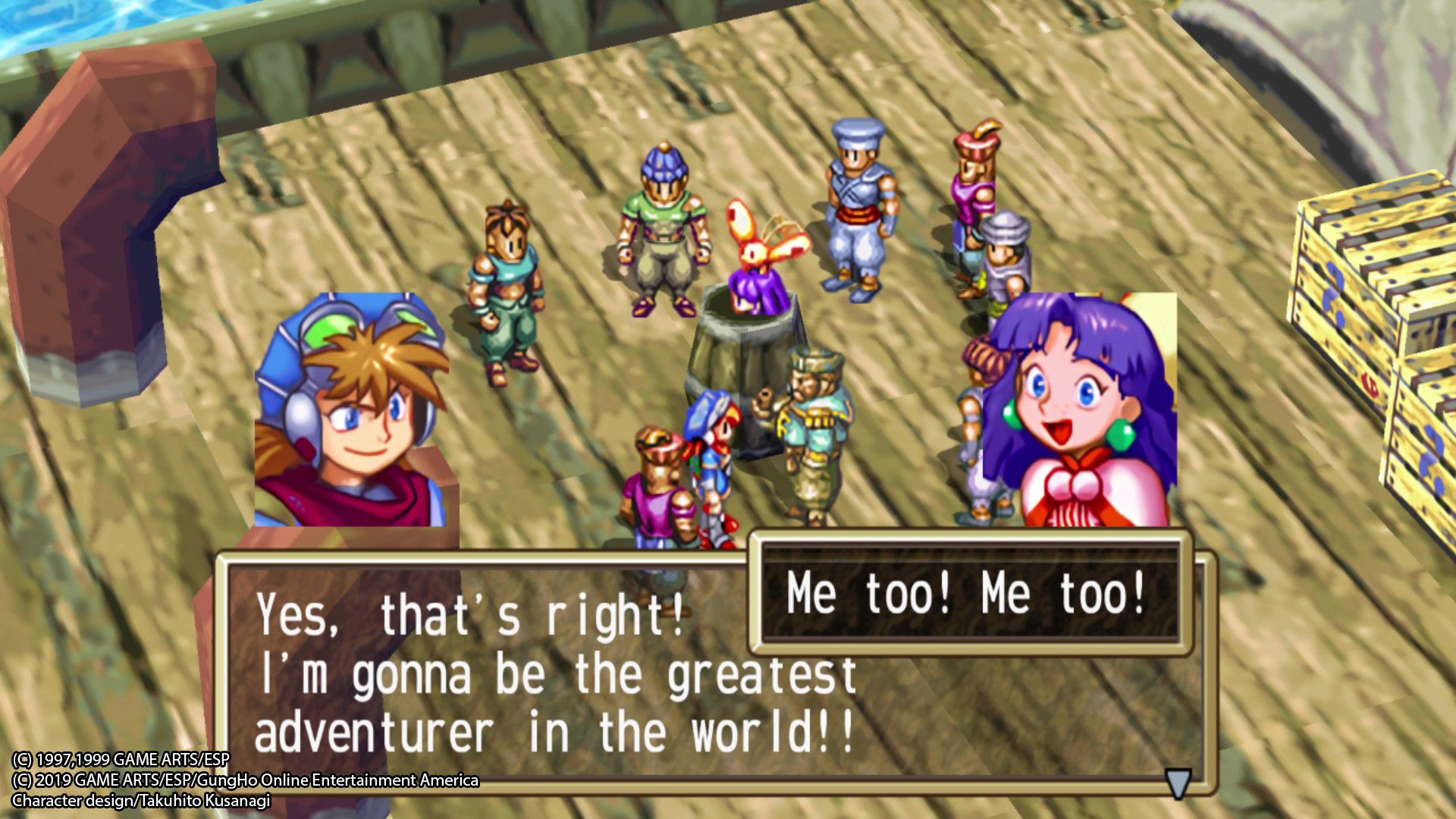 Justin is adventurous by nature; he really drives that point home ad nauseam throughout the game. He does not need many reasons to run off to the next destination, and his primary motivation at the start of the game is to follow in his father's footsteps. It's intriguing to see how, as the game progresses, Justin grows as a person and thus, so do his motivations. Justin maintains a positive attitude throughout the majority of the adventure and is charismatic, winning over nearly everyone he meets.
How is the supporting cast in this game? If Justin is barely a teen, maybe 14, his best friend Sue is the slightly younger preteen, maybe 11 or 12, who looks up to Justin. At first, the gamer might view her as an annoying child, but her maturation as the game continues is special to witness. It is rare to find a video game where so many characters change for the better in such natural ways. The developing friendship between Rapp and Milda is another example of this growth. Feena, to contrast Justin, seems wise and mature beyond her years and is patient with Justin's occasionally clumsy emotional displays. You will come across many other well-written characters, such as Gadwin and Leen. Leen is complex for a videogame character, and it is always fascinating to see her develop. On the other hand, Rapp was a misfire; 2-dimensional and boring, and Guido's kindness could not overcome his annoying speech patterns, which are for sure an obvious stereotype and cringeworthy.
If it seems like the story, plot, and characters take center stage in this review, it is because they are the focus in the game, but the gameplay is just as entertaining. Within battles, things might seem chaotic at first, but you will get the hang of it despite the awkward in-battle camera. The camera within battles is one of the minor issues I had with the game. It can never stay still, continuously zooming in and out and panning to the right or left. I am not sure if that was a stylistic choice, but it felt like a poor choice. Otherwise, the battles are fast-paced and unique.
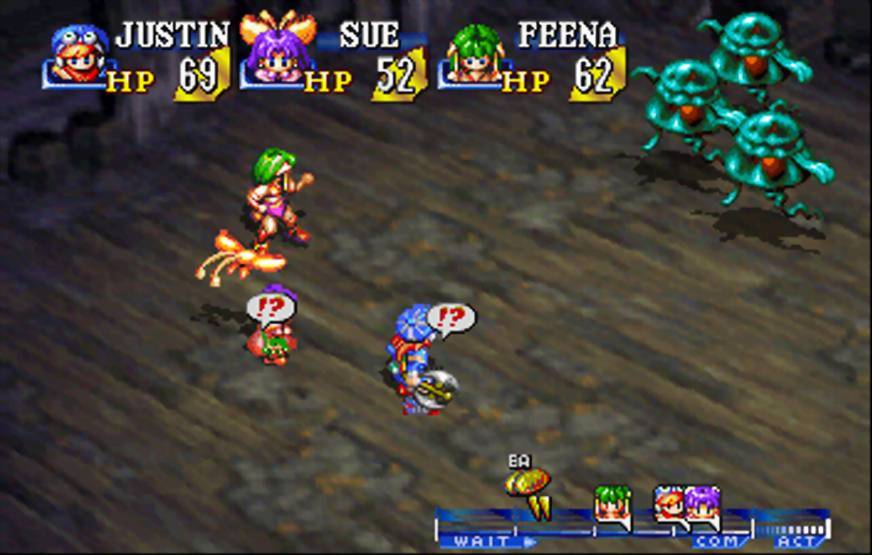 You will have to constantly use magic, as that's the only way to gain new magic. Like many RPGs before it, Grandia uses a basic element system of fire, water, earth, and wind. For example, the more you use that level 1 water spell, the more experience you get for your characters' water element. Eventually, that experience leads to levels for that element and stronger spells. If you level up your level 1 wind spell in tandem with water, you will eventually get mixed element spells such as crackling, which is a blizzard element, a mix between wind and water, and a spell you get once you get wind to level 10 and water to level 12. The four elements serve a second purpose. As you level up each element, you will improve your base stats too. Each element is tied to a stat, allowing for a decent level of character stat customization. Some of the mixed elements are not just interesting, but strong, with neat animations. Each character can equip between 1 and 3 different types of weapons. Weapons have levels, too, and the more levels you get, the better special attacks you can utilize. Weapon levels also improve base stats.
The graphics, for the most part, are vibrant and detailed for a late 1990s game, but when the camera zooms in during important story beats, it looks pixelated and blurry. Overall, towns, dungeons, enemies, and characters are detailed and colorful. The number of cutscenes is impressive for a two-disc PSX game and adds to the story, never detracting or feeling like a superficial addition.
However, the voice acting during important moments in the story, cutscenes, and battles was uninspired. My second minor issue. Some of the things characters say while casting spells are ridiculous, such as "Oh thunder crash in the darkness, come here" or "Oh cold that freezes all, come here" or "Suffer the punishment of heaven", whatever that means, which detracts from the intensity and importance of some battles. Mullen is the worst offender and lacks the intensity you would expect from a character of his type. The voice actor who voiced Mullen seemed bored or about to fall asleep most of the time, and his character is not nearly as effective as he could have otherwise been. Some of the non-spoken dialogue is when he is at his best, and where you witness the most growth from him.
Finally, some of the enemy sound effects were terrible. Some enemies sound like squealing pigs, others repeat the word "wow" every second, while others seem to make gross-sounding noises. Well, monsters are nasty, so I guess the sounds fit at least.
The music was hit or miss. While some of the town music was peaceful and some of the music for later boss battles was epic, I found other tracks jarring, such as the music from Typhoon Tower and the town music of Gumbo, where I think Game Arts tried a little too hard to innovate. Other tracks, especially played in the various ruins in the game, add a mysterious vibe to the atmosphere.
The dungeon designs are intuitive, and many of them are open to exploration and, in general, not linear, sometimes feeling slightly overwhelming, but always making sense in the design, with the occasional puzzle or hidden area thrown in for good measure. Only a few will likely leave you cursing at your TV, such as Typhoon Tower and Soldiers graveyard. Luckily, the second of which is optional. There are three optional dungeons where you can find a lot of the game's best equipment and fight the hardest opponents. Soldiers' graveyard is more annoying than tough. Castle of Dreams is short and sweet, but the toughest and longest dungeon is the 3rd optional one, Tower of Temptation. Depending on whether you do the optional stuff and how much you want to level up your spells and weapons, expect to spend around 40 to 60 hours on Grandia.
Overall, with a few tweaks, Grandia comes close to legendary status. But due to a few design choices, Grandia misses the mark for "outstanding," but is still a great game with an engaging tale, full of adventure and mystery.
Wayback Wednesday Volume 1: Final Fantasy 7 and Chrono Trigger.
Wayback Wednesday Volume 2: Super Metroid and Castlevania: Symphony of the Night.
Wayback Wednesday Volume 3: The Legend of Zelda: A Link to the Past and Lunar: Silver Star Story Complete
Wayback Wednesday Volume 4: Secret of Mana and Wild Arms