
Subscribers get bonus perks: ask me unlimited gameplay questions about any review and get personal responses within 24 hours!
Check out Part 1, Chrono Trigger, here
I don’t say this often, but I have to hand it to the marketing team responsible for Final Fantasy VII’s massive success in 1997. Their commercials are still stuck in my head 28 years later. In my neck of the woods, everyone from dedicated RPG fans to casual players was swept up in the pre-release excitement. My older sister’s boyfriend at the time, a rebel punk who usually stuck to games like Tony Hawk or Cool Boarders, was even talking to me about it, but I didn’t get the game right away.
But when I finally did, cracking open that jewel case was the single most anticipated moment of my gaming life. I’d been worried my RPG hobby wouldn’t be well-received at school, but suddenly everyone was talking about Final Fantasy VII for the rest of the year. Its popularity endured, with conversations still happening in 1998 and 1999. Remarkably, my school buzzed more about FFVII in the first half of 1999 than it did about the newly released Final Fantasy VIII! It’s rare for a product to live up to its massive hype, but FFVII met and even surpassed it for so many of us. It was a joy that had me sprinting home from the bus to dive back into the story. It delivered one of gaming’s most iconic scenes, brought the genre into the mainstream, and even turned a hulking bully four years older than me into a friend, forever changing what we believed RPGs could achieve.
The game itself is deeply focused on memory and the nature of the past. For me, the game is inseparable from my memories of that time: bike rides ending at the lake, quick trips for junk food, and friendly games of basketball. As phenomenal as Final Fantasy VII is, it was the powerful nostalgia for those innocent, carefree days of summer vacation that ultimately cemented its place as something more than just a game for me.
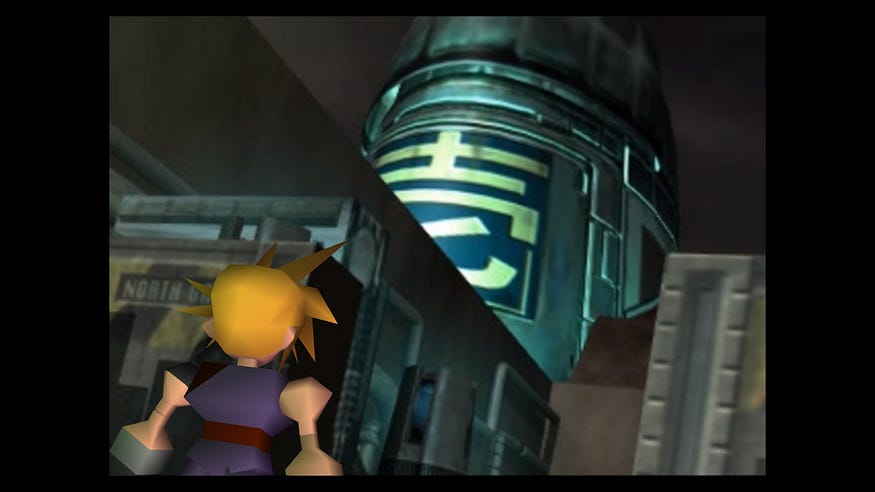 That fondness starts right at the title screen, with a wistful melody that welcomes us to the world of Final Fantasy VII. After a breathtaking opening, the scene quickly changes to our spiky-haired protagonist hopping off the train to start a new mission. As a teen, these sequences blew me away. Even as an adult replaying it more than 25 years later, it’s one of the best introductions to an RPG and the premise is just as relevant now: the imperative to protect our planet, the struggle against those who exploit it, the widening chasm between the privileged and the marginalized, and the unsettling visions of a dystopian future where science has run amok all weight heavy as themes.
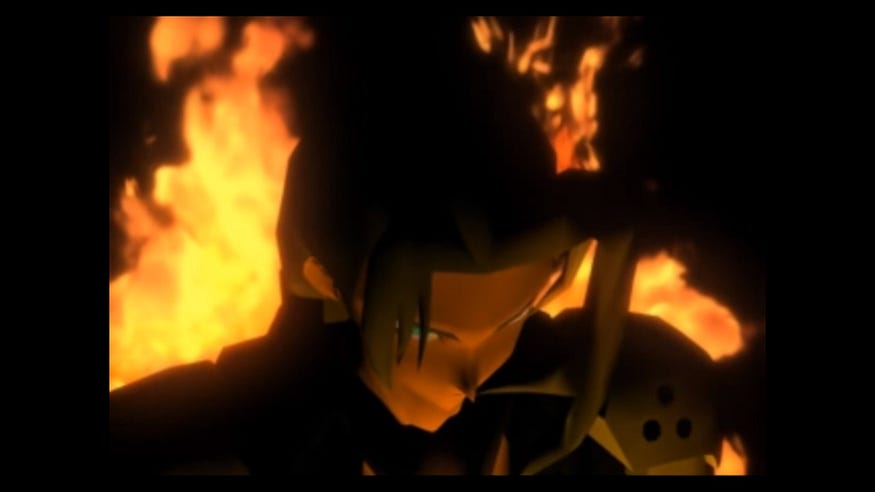 Cloud is the indifferent hero who slowly opens up and becomes more vulnerable as the game progresses. Barrett is the gun-wielding badass who will do anything to create a better world for the future, including for his daughter. They are joined by the sweet flower girl Aeris, Cloud’s childhood friend Tifa, the mysterious, brooding Vincent, the cunning, mischievous Materia hunter, Yuffie, the wise Red VIII, Cid, the gruff mid-aged pilot, and Cait Sith, who at first seems like just another annoying mascot character but with a hidden secret. The antagonists are certainly some of the best the 90s had to offer and even compete with many games from the next decade. Hojo is the psychopathic mad scientist who will stop at nothing to conduct whatever twisted experiment he has in mind, discarding any failed human experiments as if they were nothing. Additionally, the iconic Sephiroth and his slow descent into madness are well explored on the first disc, especially.
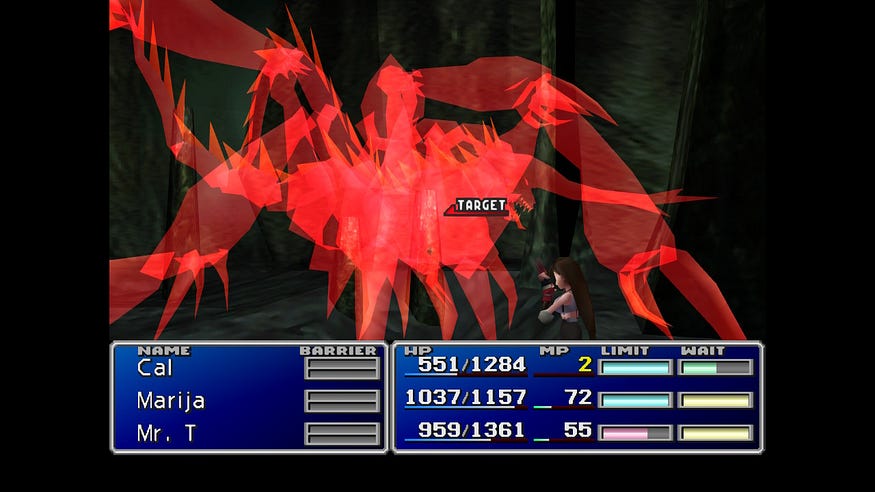 Beyond the personalities, the customization is almost limitless with 83 Materia and 3403 possible combos, although a more realistic number of the best, most viable combos would place it around 100. What this means is every character is pretty much a jack of all trades, while not specializing in much beyond unique limit breaks. Limit breaks, by the way, are special, powerful attacks that can be used once a gauge is filled, as damage is taken. At level 1, they’re impressive, but by the final level 4 limits, they are devastating game changers. The first three levels have two limit breaks, and you need to use the preceding one enough times before unlocking the next, except for the level 4 limit breaks that are usually locked behind finding a special quest, location, or key NPC. Combot uses the Active Time System (ATB) that stresses real-time decision-making but can be set to “wait” to give enough time to make choices. My only other gripe is that you’re limited to a three-person party, despite having a roster of 7–9 available characters depending on whether you recruit the optional ones.
 But I digress. As great as Materia can be, finding excellent combos is rewarding, but there are some issues I found. By the end of the game, when you have tons the game lacks an efficient way to organize them beyond a general “arrange” command. Plus, during certain story parts, like when your Materia is stolen, and you get them back, your setup is all jumbled, and it happens a few times, which takes a good while to reset. So a better Materia organization would have been awesome. Maybe allowing each character to save a few preferred setups.
Because of the exponentially increased options, starting with just a few Materia but ending with 100s by the end game, Final Fantasy is one of those games that, in my experience, gets progressively easier as it goes. By the end of disc 2, you are spoiled for choice. For those looking for a challenge, the two optional weapon fights, then, are necessary. Finding unique ways to optimize your chosen three heroes is fascinating. I remember going into an optional battle, only to realize, no, there are still a few tweaks to be made. Back to the drawing board, try again, realize another tweak, and so on, a few more times before finally coming out on top. It was a fun little loop, maybe lasting an hour for each, but noticing the little gains and improvements was highly worth it, considering how easy the final dungeon was.
As a teen, I grinded like crazy and spent 83 hours on the game. On my recent playthrough, I did it in a brisk 36 hours, but still grinded, not so much for experience, but for the large amounts of AP required to max some of the best Materia. Even with double growth weapons and the 2 or 3 triple growth, it’s a time-consuming process, but needed if you, for example, want more than 1 mime Materia. Beyond the AP grinding, plenty of other time sinks exist; In my younger days, I made up for not owning Cool Borders by spending a lot of time snowboarding at the Gold Saucer. (A year later, I got Cool Boarders anyway). The Gold Saucer, by the way, is a fun amusement park-like setting where some key story events take place, but where several hours can slip away, too. The battle arena is not for the faint of heart, but it offers some of the best rewards in the game. Plus, there is Chocobo breeding, which starts on a faraway farm, before leading to the Gold Saucer to bring your trained birds and raise them through the ranks, win prizes, and help them become more virile for raising the best offspring, to, after a few generations, eventually get the ultimate Chocobo.
Thank goodness there’s a lot to do at the Gold Saucer because the world, as a whole, is surprisingly small and kind of sparse, with a few optional areas to check out which I’d recommend adding to the lore and increase the location count, about a dozen required towns and 15 dungeons (not counting optional content) with less visual variety than other RPGs of the time but it can be said that every single location has strong narrative impact and many are quite dense. For example, you are likely to spend at least four hours in Midgar.
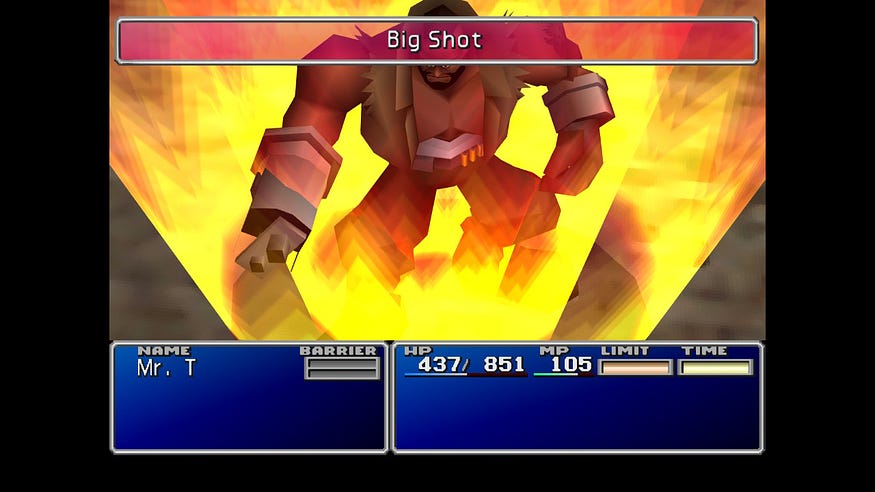
Where this game shows its age is in the blocky animations, especially within towns and on the world map, though some of the backdrops in towns and dungeons still look fairly impressive, and the cutscenes, as I expressed earlier, are something to behold. In battle, hero and enemy sprites have aged decently, and there is enough enemy variety to not get too bored, especially if you use steal to get useful items. Some of the bosses are gigantic and imposing, and they still dazzled me even in 2025, and I love the slow fade into red after striking the final blow.
The music also holds up well, from the opening theme until the last boss theme, one of the best in the series, and everything in between, from the laid-back vibes of Costa Del Sol to the jazzy Mideel, Cosmo Canyon, which invokes ancient wisdom and the poignant, bittersweet Aerith’s theme and “Flowers Blooming the Church”.
Many gamers return to this game every few years, or even every year, because of the sheer variety of builds that can be done, encouraging different party compositions and styles. Final Fantasy VII has its shortcomings and, in a few specific ways, namely the graphics, has aged like milk, but in many ways, especially musically and in its intriguing narratives, has aged like fine wine. For newcomers to the genre, it is an excellent introduction, and veterans should find plenty to love, too.
Check out my reviews of other Final Fantasy titles:
Lightning Returns: Final Fantasy XIII-3
You can buy Final Fantasy 7 for Switch here.
This post contains affiliate links. I may earn a small commission at no extra cost to you.
Wayback Wednesday Volume 2: Super Metroid and Castlevania: Symphony of the Night.
Wayback Wednesday Volume 3: The Legend of Zelda: A Link to the Past and Lunar: Silver Star Story Complete
Wayback Wednesday Volume 4: Secret of Mana and Wild Arms
Wayback Wednesday Volume 5: Illusion of Gaia and Grandia
Wayback Wednesday Volume 6: Breath of Fire 3 and X-Men Legends