

 Are you concerned about the next few days in the stock market?
Who isn't?
The developments in the Middle East are moving rapidly and the markets will likely be roiled on Monday.
But you don't have to sail these tumultuous times without a helping hand.
Here is some useful information to help you get grounded.
If you're an ETF investor and you're not a Member of the Sector Selector, this is a perfect opportunity for you to become one.
This week will be crucial for your portfolio. Not managing your assets in a measured way could lead to regrettable decisions and outcomes.
Tomorrow, I will have a fully detailed portfolio report that will offer practical guidance for all the holdings in our highly successful ETF portfolio. And all you have to do to grab it is to take a Free trial tonight.
To receive tomorrow's full report just take a FREE trial - click here.
Getting Ready for a Bumpy Week
Let's get ready for tomorrow. The financial markets enter the month of March embroiled in a perfect storm as military action in Iran coincides with tightening liquidity.
I’ve been uneasy about the status of liquidity and its potentially negative effect on the markets over the last few days, having posted the following:
February 26, 2026: Liquidity Tightens. Markets Get Sluggish. Is the Fed Falling Behind? Bitcoin Poised for Something Big. New ETF Trade Added.
February 27, 2026: Buckle Up! Liquidity Tightens. UK Mortgage Lender Crashes. Something’s Giving.
February 27, 2026 (in the last hour of trading with plenty of time to adjust portfolios): Flash Alert: Batten Down the Hatches - Just in Case. New ETF Added for Protection.
And this caution is likely to pay off. Indeed, over the last couple of weeks, we’ve been reducing risk by shifting to energy and consumer stocks and taking profits on existing positions while tightening Sell stops on positions which have delivered big profits. On 2/27/26 we added a protective ETF to the portfolio.
How good is this service? Considering that we've helped subscribers turn their $5/month membership into over $9000 over the last two years should help.
Moreover, one of our ETFs has delivered over $5000 in two combined trades.
You can get the full story here.
Important Events Preceded Iran Developments
The developments in Iran are rightly grabbing the headlines. But inside the financial markets, there are important details to understand. The most important one is that liquidity holds the key to the markets. And several events occurred just prior to the attack on Iran that are worth noting:
The Fed announced that financial conditions are tightening (2/25/26) – See NFCI below.
The major indexes failed to rise above important support levels (price charts below)
The U.S. Ten Year Note yield (TNX) broke below 4% in the face of a hot PPI report (2/27/26) and
Reports of yet another private credit crash in the makings surfaced (2/27/26).
Bond Market Foreshadowed Something was Up.
Inflation may be ticking up, as suggested by a rising PCE, and a hotter than expected PPI. Yet, the U.S. economy is a bit sluggish (GDP underperformed), all while the Supreme Court rejected the Trump tariffs.
But the U.S. Ten Year Note yield (TNX, see below for details) broke below 4% on 2/27/26, its lowest reading since October 2025, which is when the liquidity squeeze prompted by the Tricolor auto dealer crash in private credit land triggered the Fed into ending its starting its Reserve Management Purchases (RMP - $40 billion/month) cash infusion into the financial markets to keep things from unraveling.
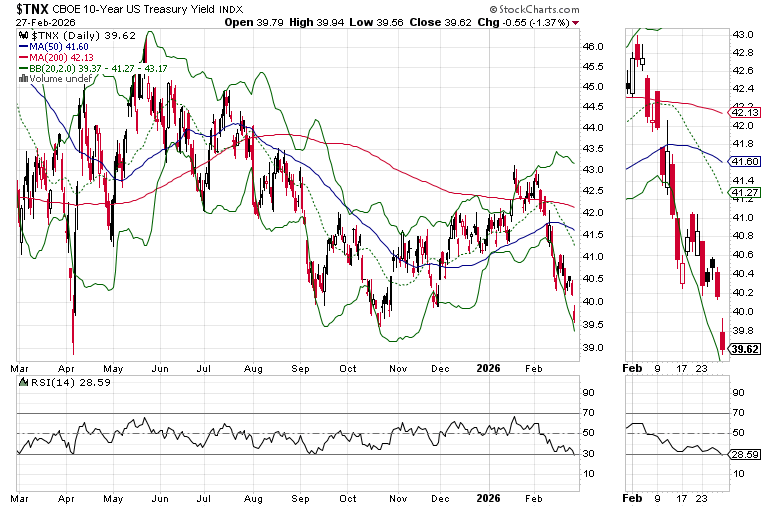 The decline in U.S. Treasury bond yields coincided with a Bloomberg report, which I detail here, noting UK Mortgage lender (MFS), now in the UK’s equivalent of bankruptcy court is insolvent.
In addition there are rumors/allegations of potential fraud and reports of some Wall Street banks (Wells Fargo, Jeffries, and Barclays along with some private equity houses) may lose hundreds of millions.
Liquidity: Sneeze or Pneumonia?
Is the financial system sneezing or catching pneumonia? Aside from the developments in Iran, there may be more going on, which will likely complicate matters.
On 2/25/26: the Fed’s National Financial Conditions Index (NFCI, see below for details) turned up, which means financial conditions tightened, implying liquidity in the system is being reduced.
That’s a big deal, because the Fed has, though routine REPO market operations and the RMP, injected over $100 billion (nearly $60 billion in February alone) in 2026.
Moreover, the tightening in liquidity coincides with the news of the MFS situation as well as negative comments about private credit from JP Morgan CEO Jamie Dimon.
So, is the financial system catching a cold? Or are we in for a full blown pneumonia episode. The answer matters because it will dictate how much money the Fed infuses into the system. The Iran situation complicates the situation further because of its potential to raise oil and shipping prices which will work through the supply chain.
History suggests the Federal Reserve may be forced to aggressively inject liquidity into the system. A combination of QE and a war induced inflationary spiral won’t turn out well.
Bottom Line
If you're not plugged into a service which will help you sort the confusing scenario that's unfolding, your portfolio may suffer.
Do yourself a favor and take the FREE Trial to the Sector Selector.