

Dear parents & caregivers,
If you've been following me for a while, you know that, apart from getting more funding for our schools, my next highest priority is overhauling curriculum in Ontario.
My partner and I relocated to Toronto from Los Angeles in 2021 so I could go to grad school. My kids started in the TDSB in grades 4 and 7, and in short, my impression was that my kids were 2 to 3 years ahead of their Toronto classmates in both writing and math. I was appalled a the lack of educational materials, especially physical books, but also paper and pencils. But perhaps most concerningly some of the teachers my kids had did not seem properly trained or equipped in curriculum delivery. In particular, my younger daughter experienced very little class time actually devoted to math, even though according to the principal, the teacher should have been blocking out significant portions of each morning for math lessons. I also noticed that group projects were extremely unstructured and went on for far too many weeks.
It was also hard not to notice that the collection of student writing assignments posted on the wall in my younger daughter's grade 5 and 6 Curriculum Nights would not have been deemed neat, thorough, or grammatically proper enough to make the wall in her grade 1 classroom in California. I recognize that kids come to class at vastly different levels, but part of the learning process for her older sibling in their elementary school experience in LA, was peer editing and revising again and again, until the assignment truly reflected a student's best work. Here in Toronto, I can't say I saw my kids being pushed to do their best work until high school here in Toronto, which I think is too late.
This year, my kids are starting their 5th school year in the TDSB. With some exceptions, we have noticed that the academic program available in the TDSB has been weak overall. But even where instruction has been truly excellent, as it was with their middle school science teacher, my kids' learning was materially disrupted by the fact that science class was only offered three days out of a ten day cycle. While some science topics were well covered, others, for example, plant biology, were not even mentioned.
Yesterday, the OECD released the results of the 2025 PISA (Programme for International Student Assessment) exam, which is given to 15 year-olds in 83 countries. The good news is that Canadian students still appears to be performing similarly to their peers in the USA and the UK, for example. The bad news is that scores globally have been tanking for the last 25 years and this includes Canada's scores. In fact, the drop in scores reflects a decrease of approximately two grade levels on average over that time. This corresponds anecdotally with statements from my professor colleagues at York who have shared with me that coursework they used to assign to first year undergrads now can't be given until third year.
Here are the bullet points directly from the OECD's 2025 PISA Canada report:
Average 2025 results in Canada were lower than in 2022 in mathematics and reading, and about the same as in 2022 in science.
In all three subjects, PISA 2025 results are the lowest ever observed in PISA in Canada, and are significantly below results from a decade earlier, in 2015.
Over the most recent period (2022 to 2025), the gap between the highest-scoring students (10% with the highest scores) and the weakest students (10% with the lowest scores) widened in mathematics, while it did not change significantly in reading and science. (NOTE: Elsewhere in the report it states that this discrepancy in math between highest and lowest performers is now about 4 grade levels.)
Compared to 2015 the proportion of low-performing students (scoring below proficiency Level 2) increased by 12 percentage points in mathematics; by 11 percentage points in reading; and by five percentage points in science. (NOTE: In other words, in 2015, only 12% of students taking the exam scored in the "lowest performers" range in math. Now they comprise 24% of test-takers).
In reviewing the OECD's Canada 2025 PISA report and the corresponding report issued by the Council of Ministers of Education in Canada (CMEC) (PISA_2025_Public_Report_EN.pdf), I note a dramatic improvement in the scope of the published results. For example, in prior years, results were not broken out by province at all (only in Alberta). (Side note: I do wonder if that has to do with the FOI I submitted several months ago for this info...hmm).
Some additional tidbits:
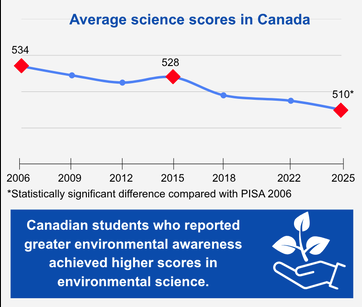
The test focused on science as the major portion of the exam. Since 2000, Canadian students tend to do best on science, but the scores have still dropped significantly over time.
Boys performed slightly better than girls in science (512 vs. 508) in Canada overall.
In Ontario, our average science score dropped from 524 in 2015 to 513 in 2025.
While our reading scores were on par with the UK, Australia and the US, Canadian students were outperformed by Singapore, Japan, Korea, Ireland, Estonia, and New Zealand students.
While our math scores were on par with the UK, Poland, Netherlands and Belgium, Canada was outperformed by Singapore, Japan, Korea, Estonia and Switzerland students.
The highest decile (90th percentile) scored 273 points higher in reading and 256 points higher in math than those in the lowest decile (10th percentile), which is greater than the OECD average differences, which are 265 points in reading and 244 points in math. This suggests a deeply unequal education landscape that is much worse than our peer countries.
Some important analysis is glaringly omitted. For example:
What is the difference in scores, especially math scores, between public school and private school students taking the 2025 exam? In 2022, the results published directly by the OECD indicated that the discrepancies in Canadian math scores between public and private school students was among the highest in the OECD - about 24 points, adjusted for socioeconomics!
How many principals surveyed reported that the school's capacity to provide instruction is hindered by a lack of teaching staff, or by inadequate or poorly qualified teaching staff? In 2022, 44% of principals reported a teacher shortage, and 24% indicated inadequate or poorly qualified teachers. In 2018, the corresponding percentages were 19% and 7%.
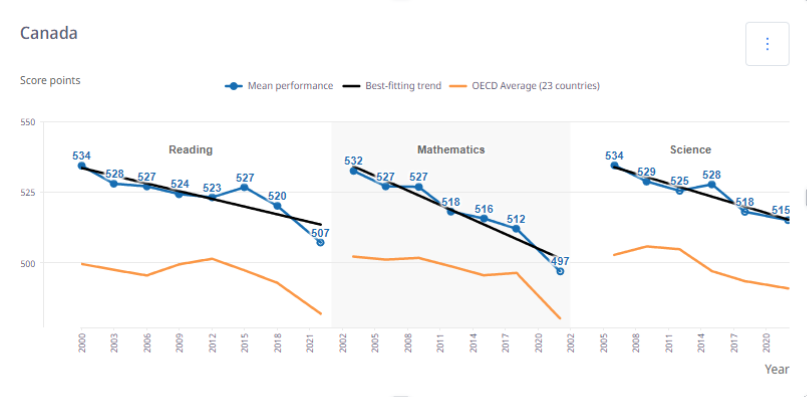
I'm struggling to find a chart in the report that shows how Canada's math and reading scores have tanked over the last 25 years. Here was the summary chart from 2022:
If you'd like to see the data and analysis I had previously pulled from the 2022 exams and prior, please look at this deck I previous put together (PISA discussion starts on slide 11): https://canva.link/6jvmktl3p43xv7r
As I mentioned, I already have an FOI for some of my outstanding questions, including why some schools were invited to participate over others, and I will keep you updated. I was quoted $240 for this additional FOI detail - if you'd like to contribute towards that please use by buymeacoffee page.
The last thing I want to point out is that, according to the CMEC 2025 report, the newcomer students in most countries do more poorly than non-immigrants on both math and reading, however this is not the case in most Canadian provinces! While newcomers (aka first generation immigrants) scored about 13 points lower in reading than non-immigrants, the second generation students scored 17 points higher! And in Manitoba, immigrant students actually scored higher in reading than non-immigrants.
In Ontario, Canadian-born students perform better in reading than non-immigrants, but score about 8 points lower than newcomers in math (adjusted for socio-economics). Additional, 12.4% of newcomers scored in the top quartile in math, as did 14.2% of second-generation students; whereas only 10.6% of non-immigrants did. In New Brunswick, immigrant students performed 30 points higher than non-immigrant students which, again represents about 2 grade levels.
All told, Canada's education system and our performance on the PISA is concerning, even as there are ways to spin it positively. If you are interested in advocating to your MP for a national discussion about curriculum and funding please message me. I realize that it is not currently part of the national political landscape due to provincial authority over education, but in order for Canada to compete (especially in an economy where the US is a political antagonist), we need federal funding to rescue our schools from provincial corruption, lack of care, and a damaging austerity approach.
And finally, the last thing I want to plug is a mini-documentary that was aired by CBC Radio yesterday, about math instruction in Canada. Although only 25 minutes long, it gives brings the same kind of investigation as the Sold a Story podcast series about the controversy over reading instruction. I hope you all listen here: Are your kids learning math the RIGHT way? | The Current | On Demand | CBC Listen
Thanks for caring,
Katrina