
3 April 2025
— a View Verdict Spotlight
When we say Robben Island, most minds go straight to one name.
Rightly so — his story echoes in the limestone walls.
But to stop there is to miss the deeper verdict.
This place was never just a prison.
It was a fortress. A quarantine station. A military outpost.
A spiritual checkpoint for centuries of passing ships —
and later, for a country adrift, searching for its moral compass.
The Dutch settlers named it Robbeneiland — Seal Island — in 1654, barely two years after establishing their Cape colony.
Within a decade, they had already begun using it as their first penal settlement.
The VOC (Dutch East India Company) saw in this isolated outcrop not just a convenient place to banish troublemakers from the Cape, but a strategic control point for anyone attempting to approach Table Bay.
It became their maritime panopticon — watching and warning in equal measure.
Political exiles arrived centuries before the modern era.
Autshumato (Harry the Strandloper), a Khoi interpreter who challenged Dutch authority, was banished here in 1658.
And from distant Indonesia came Sheikh Madura and later political prisoners from Java and the East Indies — creating a 300-year continuum of political confinement that bound the island's story to the complex dynamics of power, opposition, and colonial governance.
Long before the world learned of Rivonia, WWII cannons stood watch on these shores, anticipating German U-boats that never arrived.
The runway, still visible today, wasn't for dignitaries but defence — a relic of a time when danger came from sea and sky, not from within.
The lighthouse, established in 1864, stands as a weathered sentinel, having witnessed the passage of thousands of ships and the changing tide of nations.
Its beam, now automated, represents one of the few constants in the island's tumultuous history — a continuous thread from imperial maritime ambitions to modern heritage conservation.
Go back further, and you'll find tales of leprosy and exile, of patients and priests, of forced silences and spiritual resilience.
The church built by lepers still stands — hands that society rejected created beauty that endures.
The penguins, now celebrities of the ferry ride, are descendants of return — once wiped out by 19th-century egg collectors, then reintroduced as part of the island's environmental rehabilitation.
And still further:
The Khoisan knew this island as Penguin Island or Seal Island long before European ships appeared on the horizon.
In their oral traditions, it was a place where the sea gave life — abundant with birds, seals, and shellfish.
Their seasonal visits, leaving behind middens of shells, speak of a different relationship with this land — one of harvesting, not imprisonment.
Robben Island is not a monument to one man.
It is a mirror to many eras — some we honour, some we must never repeat, and some we've all but forgotten.
The layers of limestone quarried by generations of prisoners built not just Cape Town's infrastructure but, ironically, the very walls that would later confine subsequent generations of political prisoners.
It’s a lighthouse in the truest sense:
It doesn’t move,
But it helps others find their way.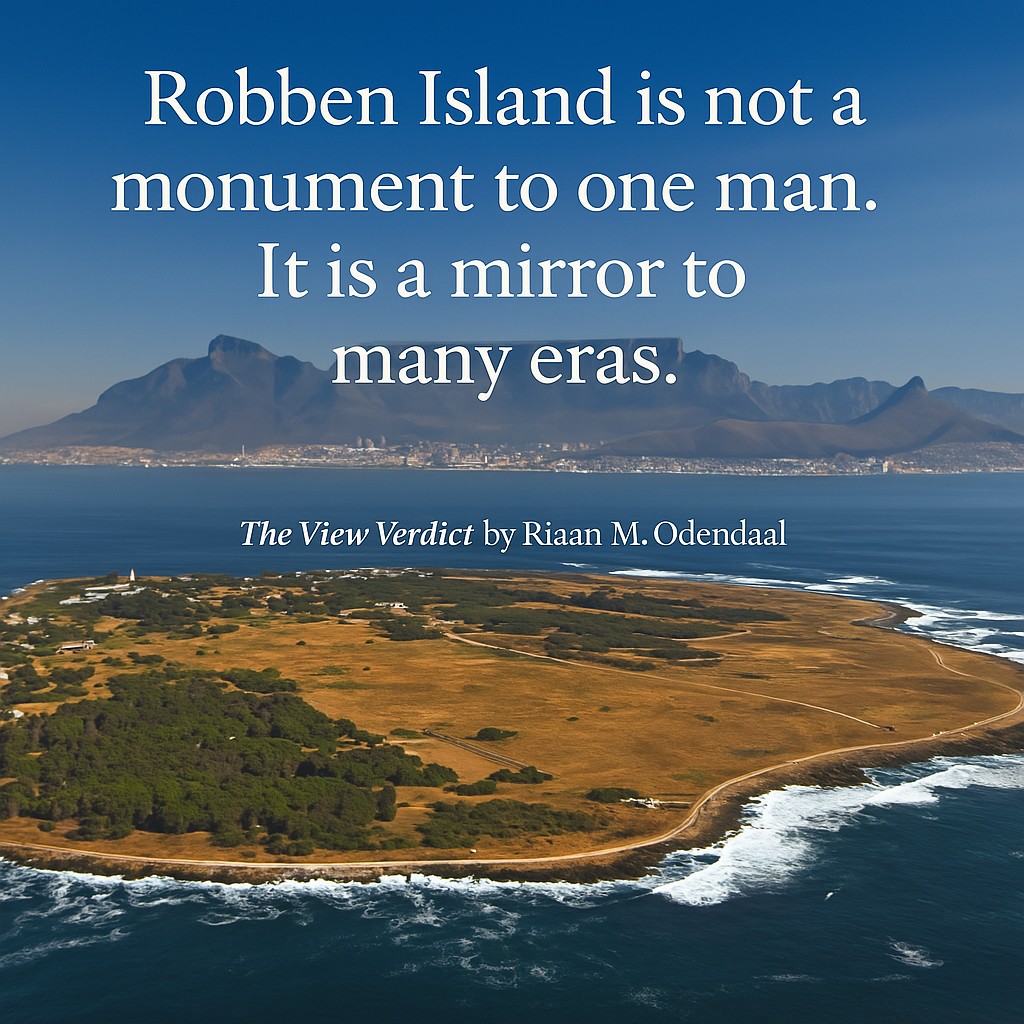
🔎 VVI Score: 90 – Exceptional Destination
✅ Cultural depth
✅ Historical complexity
✅ Ecological resilience
✅ Symbolic identity
📊 VVI Score Breakdown
Classification:
1️⃣ Exceptional Destination (80–100)
A location with strong cultural, historical, and economic identity, demonstrating resilience, sustainability, and a well-balanced mix of tradition and progress.
✅ Cultural Depth – 23/26
Continuous use from Khoisan, VOC, lepers, political prisoners to heritage conservation
Rich oral traditions, spiritual landmarks, and layered usage over centuries
Inclusive of indigenous, colonial, and resistance histories
✅ Historical Complexity – 25/27
A lens into South African and colonial history
From 1654 to 1990s: VOC, WWII, Apartheid, the push to the current democracy
Features underrepresented figures and narratives
✅ Ecological Resilience – 17/20
Reintroduction of penguins
Preserved marine ecosystems
Ongoing conservation vs tourism pressures
✅ Symbolic Identity – 25/27
Globally recognised symbol of transformation
National memory and spiritual metaphor
Enduring lighthouse as living symbol
🌍 Let us not visit Robben Island only to see the past —
but to understand the layers that built the present.
For in these layers, we find not just South Africa's story,
but a universal truth about how places of confinement can, paradoxically, become powerful symbols that shape national identity and historical memory.
—
☕ Support reflections like this on
👉 buymeacoffee.com/thedailyverdict
#VVIScoring #iftrue #TheViewVerdict #RobbenIsland
#HeritageUnveiled #MaritimeLegacy #SouthAfricanHistory
#VOCHistory #ColonialLegacy #IslandStories #LighthouseLegacy
#wisdombyriaan #signposts @wisdombyriaan