

15 April 2025
✍️ By Riaan M. Odendaal – The Daily Verdict
From airports to bank apps, a quiet shift has happened.
We’re not being forced — we’re being trained.
Not by tyrants, but by terms of service. Not with weapons, but with “welcome screens.”
As a U.S. citizen living in South Africa, I’ve experienced firsthand how biometric surveillance now disguises itself as convenience — and how the erosion of liberty happens not through violence, but through voluntary compliance.
This piece draws from U.S. and South African law, including United States v. Davis, Carpenter, and POPIA.
But more than that — it asks:
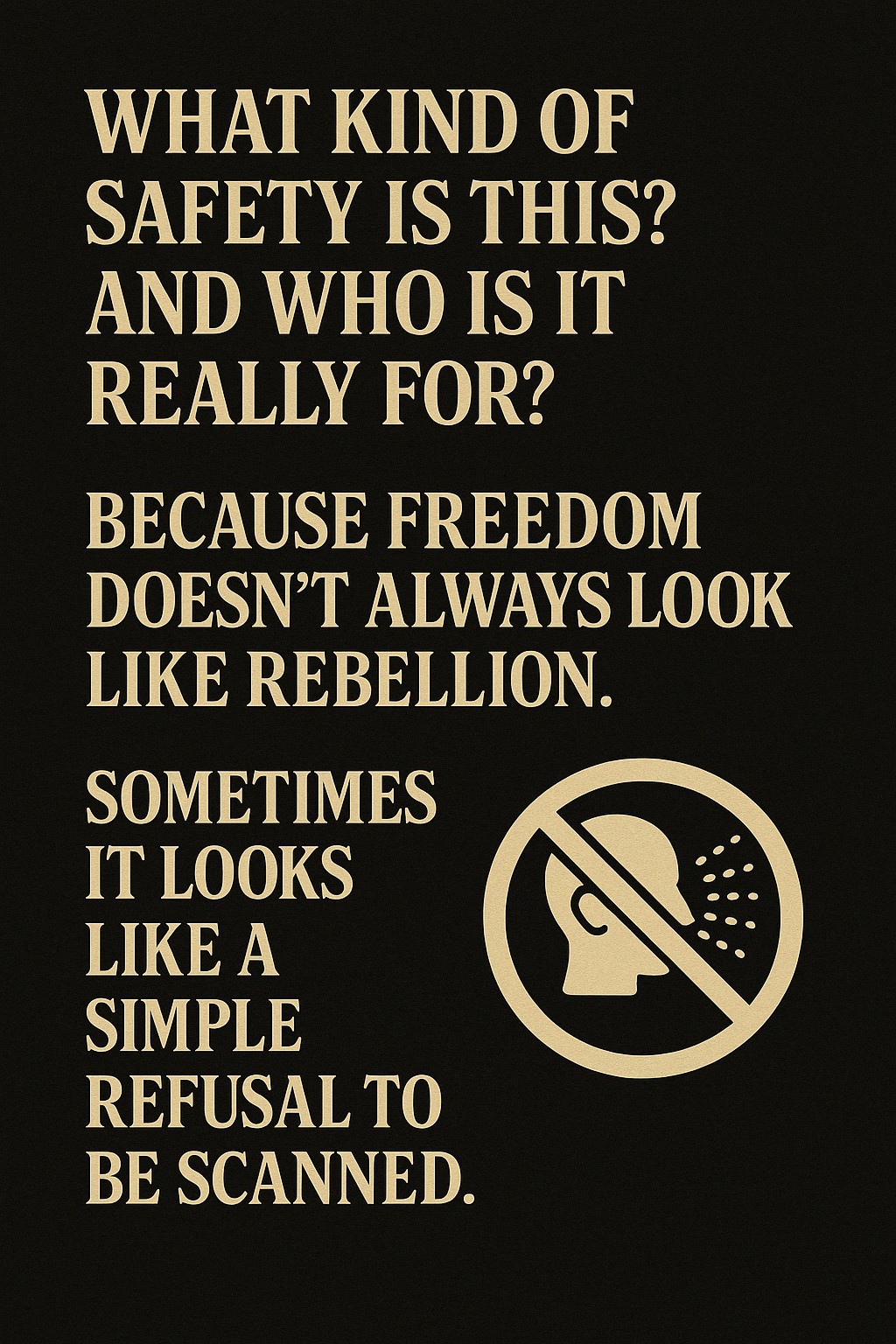
What kind of safety is this? And who is it really for?
Because freedom doesn’t always look like rebellion.
Sometimes it looks like a simple refusal to be scanned.
Read the full reflection below — and if it resonates, consider sharing or supporting.
This is the first of several Signposts challenging the architecture of modern control.
👇
I stood at the airport. A quiet command flashed on the screen:
“Look into the camera.”
No questions. No consent. Just compliance.
I did as instructed. Not because I agreed — but because resistance delays you. Delays everyone. And these days, delays feel dangerous.
But in that moment, I remembered:
My bank back home in South Africa now requires a selfie to log in.
Not a password. Not a question. A face.
And that face is verified through Home Affairs — the same department that took my photo, not for me, but for the system.
In the U.S., they now call it a REAL ID.
In South Africa, it's the Smart ID.
Either way, we are screwed.
⚖️ The Rights We Lose Without Knowing
In America, the Fourth Amendment is clear:
“The right of the people to be secure in their persons, houses, papers, and effects, against unreasonable searches and seizures, shall not be violated…”
But now we're scanned not because we're suspected — but simply because we're present.
What the TSA won’t tell you: The Supreme Court created the "administrative search exception" in cases like United States v. Davis (1973), where they decided that airport screenings aren’t really “searches” in the constitutional sense. They’re “administrative procedures.”
As if changing the name changes what happens to your rights.
In South Africa, Section 14 of the Constitution affirms our right to privacy — to be free from unlawful intrusion.
Yet the very ID issued to us is used to track us. Link us. Verify us. Quietly and constantly.
🧾 POPIA: The Illusion of Control
South Africa’s Protection of Personal Information Act (POPIA) was designed to protect our dignity and autonomy in the digital age. It tells us our biometric data is special. That it’s protected. That consent matters.
But POPIA only becomes active after your data is collected. It governs the use — not the capture.
So the system scans first, and explains later.
Your face becomes a "compliance point" in a system you didn’t opt into — and can't opt out of.
And while POPIA says consent must be voluntary, specific, and informed — try telling that to the ATM, the bank login screen, or the passport control gate. You either comply or you don’t proceed.
The law lags.
The scanners do not.
🔍 The Legal Fiction of “Special Needs”
When the Founding Fathers drafted the Fourth Amendment, they imagined specific searches of specific people for specific reasons.
They never contemplated what courts now call “suspicionless mass surveillance.”
In Carpenter v. United States (2018), Chief Justice Roberts warned that technology should not be allowed to “erode the privacy guaranteed by the Fourth Amendment.”
Yet the judiciary has carved out a labyrinth of exceptions:
The “border search exception” that treats airports as Constitution-free zones
The “third-party doctrine” that strips privacy from data you’ve “voluntarily” shared
The “special needs doctrine” that allows searches for non-law enforcement purposes
Each exception chips away at what the Constitution intended to protect.
🕳️ The Deep State Doesn’t Knock — It Integrates
This isn’t conspiracy. It’s configuration.
The Deep State is not a man in a trench coat.
It’s a digital latticework. Silent. Legal. Permanent.
It doesn’t need to threaten you. It just needs your pattern — your face, your voice, your compliance.
While courts debate, agencies build databases. The FBI’s Next Generation Identification system already houses over 150 million fingerprints and 30 million facial scans.
And in Byrd v. Aaron’s Inc. (2015), the court admitted:
“Certain invasions of privacy are actionable.”
But actionable doesn’t mean preventable — and technology has already outrun the law.
In return, we’re offered the illusion of safety.
Benjamin Franklin warned:
“Those who would give up essential liberty to purchase a little temporary safety deserve neither liberty nor safety.”
We didn’t hear him.
Or perhaps we did… and simply nodded anyway.
⚖️ The Constitutional Crisis of “Reasonable Expectation”
Since Katz v. United States (1967), your privacy rights hinge on whether you have a “reasonable expectation of privacy.”
But who defines reasonable in an era where invasive surveillance is now the default setting?
In Riley v. California (2014), the Court ruled unanimously that digital searches demand special consideration.
“Modern cell phones… hold for many Americans the privacies of life,” wrote Chief Justice Roberts.
And yet our faces — the most personal identifier we have — are scanned, stored, and cross-referenced with less protection than our phones.
🧠 Surveillance and the Mask of Empathy
The appearance of empathy versus the reality of empathy creates the perfect surveillance system.
When authority figures speak of protection and community welfare with practiced concern in their eyes, remember this:
The same technologies that scan your face without consent were implemented by those who claimed to safeguard your dignity.
True empathy doesn’t demand your biometric submission.
The greatest hypocrites are those who preach freedom while building systems of control —
who smile for the cameras while programming the cameras to track you.
Their moving lips speak of cooperation,
while their hands design the architecture of compliance.
The distance between their words and their actions is the exact measurement of their hypocrisy.
🔍 Ask This Before You Smile for the Camera
What kind of safety is this?
And who is it really for?
Because freedom doesn’t always look like rebellion.
Sometimes it looks like a simple refusal to be scanned.
Some will argue these measures are necessary.
That they are lawful. That they are fair.
But history reminds us:
“Legal” and “just” are not always the same.
“Secure” and “free” rarely coexist without tension.
Yes, airport screening has precedent.
Yes, POPIA outlines recourse.
Yes, surveillance may serve a function.
But when surveillance becomes the default, and freedom becomes the request,
we must ask not only what the law allows —
but what conscience permits.
Because once biometric compliance becomes the currency of access,
the burden of proof shifts silently — from the state to the citizen.
And that is not security.
That is submission.
So perhaps the most fundamental constitutional question isn’t whether these systems make us safer —
But whether safety without liberty is worth having at all.
 —
—
#TheDailyVerdict #Signposts #WisdomByRiaan
#REALID #SmartID #DigitalSurveillance #FourthAmendment #Section14
#POPIA #ConstitutionalRights #DeepState #FreedomMatters
#FaceNotRequired #HumanBeforeData #IfTrue #VVIScoring #ConsentIsNotCompliance @wisdombyriaan