

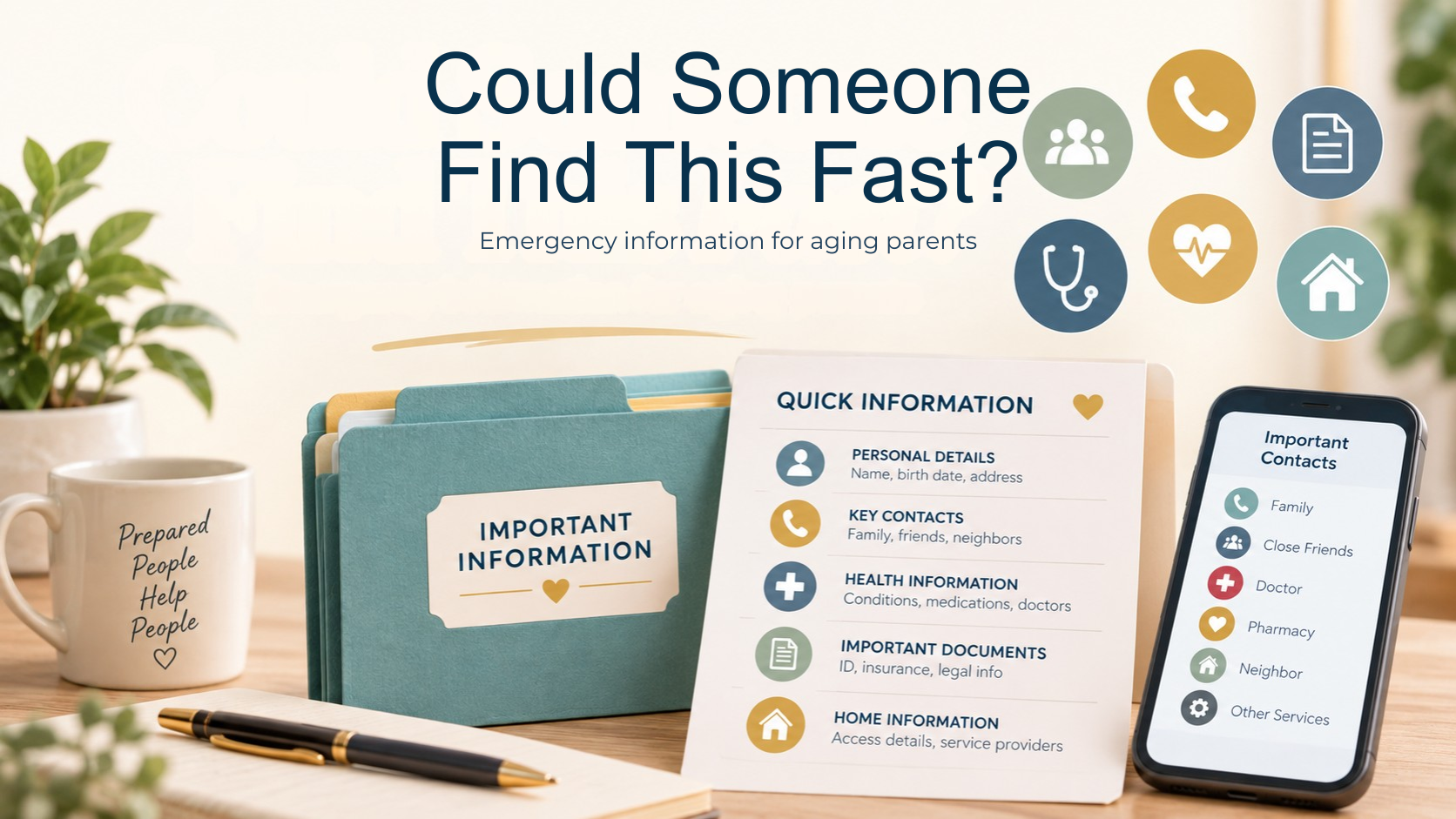
Emergency information for aging parents is most useful when another trusted person can find the essentials quickly — without calling you to reconstruct everything from memory.
 Hi dear friends, 💛
When one person becomes the family’s unofficial information center, something interesting happens.
Everyone may be helping.
But one person knows the doctor’s number.
One person knows where the medication list is.
One person remembers which pharmacy Mom uses, where Dad keeps the insurance papers and who normally handles transportation.
And if that person is suddenly unavailable?
The information may technically exist — but nobody else knows where to look.
That is why every family helping an aging parent can benefit from a small quick-information layer.
Not a giant emergency binder.
Not a medical-response manual.
Just one clear place that helps another trusted person answer:
Who do I call? What is current? What does this person need? Where is the rest of the information?
Start With Essential Contacts
The first thing another person may need is not a document.
It is a human being.
Your quick-information page should make the key contacts easy to identify.
That might include:
the older adult’s primary contact
primary care office
current specialists when relevant
pharmacy
nearby family or trusted support person
regular home or community service
one agreed backup family contact
CDC emergency-planning guidance recommends keeping a contact list of family, friends, neighbors and care providers, and making sure those people know they are part of the support plan.
One detail makes the list far more useful:
add the person’s role.
Instead of:
Michael — 555…
write:
Michael — son — local backup contact
The next person should not have to guess why a name is on the page.
 Keep One Current Medication List
Medication information deserves a prominent place — but not six competing versions.
The quick-information layer does not need to contain every medication history note.
It needs to point clearly to the current list.
The National Institute on Aging provides a medication worksheet specifically for keeping track of prescriptions, over-the-counter medicines and supplements and recommends keeping the list handy for caregivers and health professionals.
So your emergency-information page might simply say:
Current medication list: front section of care binder
Last checked: October 2026
If your family maintains a digital copy instead, record where the authorized current version lives.
My earlier guide Medication List for Aging Parents: Keep It Current goes deeper into how to separate current information from old versions.
Note Communication and Mobility Needs
This is information families often know so well that they forget somebody else might not know it at all.
Does your parent use hearing aids?
Glasses?
A walker or cane?
Do they communicate best in a particular language?
Do they need written instructions rather than verbal ones?
Is there an assistive device they rely on daily?
CDC preparedness guidance recommends planning for communication aids, assistive equipment, mobility devices and individual support needs rather than assuming one standard emergency plan works for everyone.
Keep these notes brief and factual.
For example:
Hearing: wears hearing aids; spare batteries stored in bedroom drawer
Mobility: uses walker outside the home
Communication: prefers written appointment information
You are not evaluating the person.
You are helping another trusted person understand how to support them.
Map Important Documents
A quick-information page should not become a vault full of sensitive identifiers.
Often the safer and more useful approach is to tell people where the official information is kept.
The National Institute on Aging recommends gathering important records, keeping them in an organized location and making sure someone trusted knows where to find them.
Instead of copying sensitive numbers everywhere, use a map:
Insurance information: blue folder in desk
Healthcare documents: labeled file in home office
Identification: secure document drawer
Advance care documents: official copy stored with ______
Later in this series we’ll have an entire article about important documents for aging parents, because this topic deserves more detail on its own.
For now, remember:
the quick page tells you where to look.
It does not need to duplicate everything that is there.
Include Immediate Support Needs
Medical details are only part of the picture.
If somebody else has to help for a day or two, they may need to understand very ordinary things.
Who normally provides transportation?
Is there a meal service arriving?
Does the dog need medication or feeding?
Is someone scheduled to visit tomorrow?
Does your parent expect a particular family member to call?
Is there a mobility or communication need that matters immediately?
This is where our caregiver schedule becomes useful.
If you have a recurring family support plan, link the quick-information page to it rather than rewriting the whole weekly schedule.
My guide Caregiver Schedule: A Weekly Plan People Can Follow explains how we use owner + backup without turning availability into an assumed commitment.
Add One Handoff Note
Now we come to the part that can save enormous confusion.
Imagine someone else has to step in tomorrow.
What would you want them to know first?
Not everything.
Just the current situation.
A short handoff note could answer:
What changed recently?
What is already scheduled?
What needs attention next?
Who is already involved?
For example:
Dad has an appointment Thursday at 10 AM. Maria normally drives. Current medication list is in the front folder. Pharmacy refill is already being processed. Call Anna if plans change.
That is a handoff.
It is not a clinical summary.
It is not a diagnosis.
It is simply enough context for another trusted person to find their footing.
Keep Emergency Prep Separate
There is one important distinction I want to make.
A family quick-information sheet is not the same thing as a disaster-preparedness plan.
CDC and NIA preparedness guidance for older adults includes broader planning such as emergency supplies, medications, communication methods, transportation, assistive devices, evacuation arrangements and copies of important documents.
Those are valuable preparations.
But trying to squeeze all of them onto one family handoff page defeats the purpose.
Think of the quick-information layer as the front door.
It helps someone locate the people, information and support systems that already exist.
A full disaster-preparedness kit or evacuation plan is a separate tool.
Make It Easy to Update
A quick-information page becomes dangerous only if everyone assumes it is current when it is not.
So give it one simple field:
Last reviewed: ______
Then update it after meaningful changes such as a new provider, changed pharmacy, new mobility support, different backup contact or new document location.
You do not need to rewrite the page every month if nothing changed.
But you do need to make stale information visible.
The principle is the same one we’ve been using throughout this series:
current first, history later.
One Page Is Enough
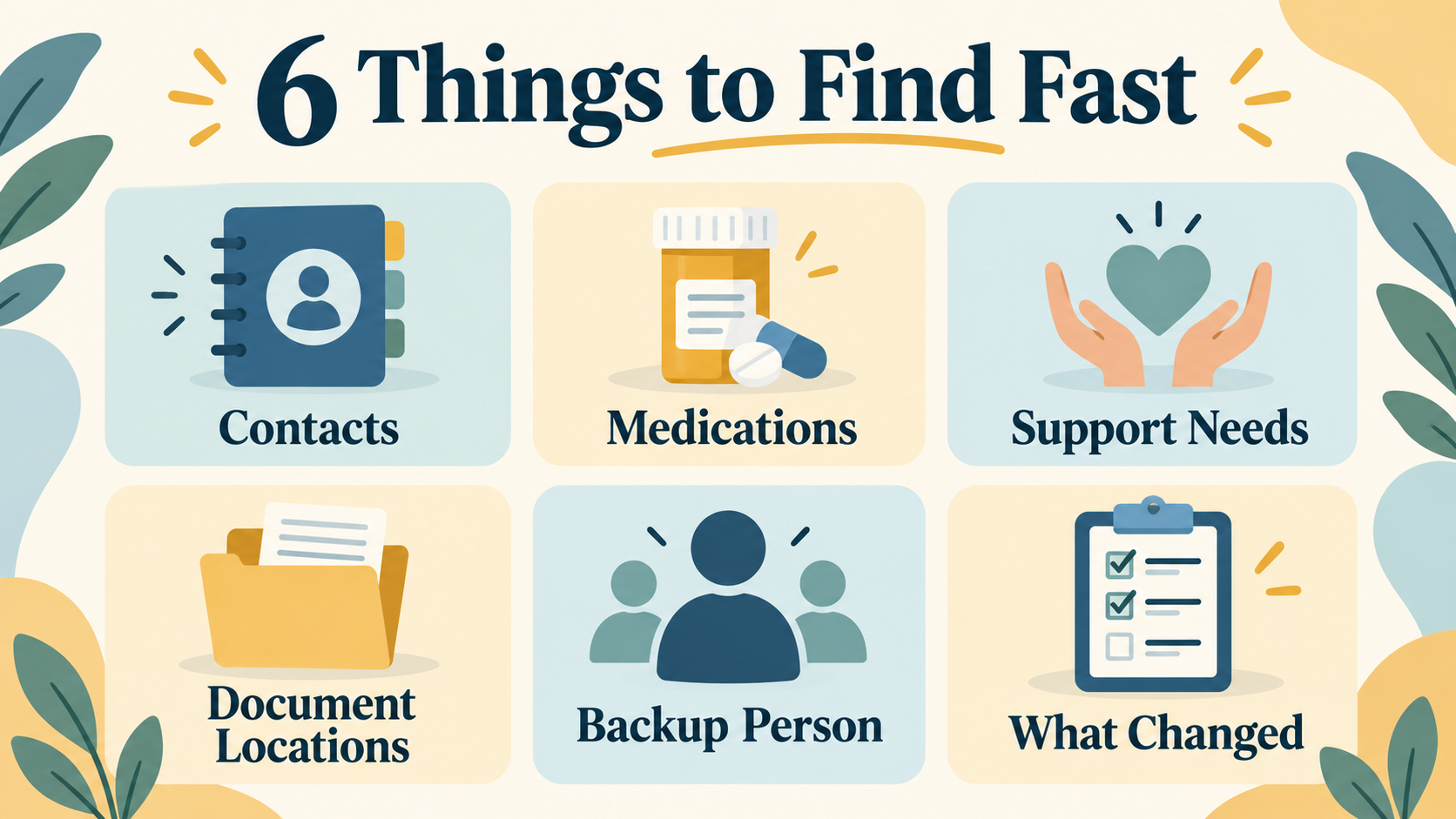
If you want the simplest possible version, your quick-information layer needs only six things:
CONTACTS → MEDICATIONS → SUPPORT NEEDS → DOCUMENT LOCATIONS → BACKUP → WHAT CHANGED
That is enough to orient another person.
Everything else can live deeper in the system.
This is also why The Aging Parent Care System includes a standalone Critical Snapshot and separate handoff pages rather than expecting someone to search through an entire organizer when they need the essentials.
The product is built around the same idea:
START → MAINTAIN → HAND OFF
The goal is not to collect more paperwork.
It is to make the right information easier to find when someone genuinely needs it.
Quick Information Should Create Clarity
The best emergency-information page does not make you feel frightened.
It makes you feel prepared.
Another trusted family member can find the current medication list.
They know who to call.
They understand important communication or mobility needs.
They know where the official documents live.
And they can see what needs attention next.
That is a much calmer kind of preparedness.
Not planning for every possible disaster.
Just making sure one person is no longer the only person who knows where everything is.
If one other person in your family might ever need to step in, share this article with them and compare what each of you currently knows where to find. 💛
With warmth,
Tamara
Makeup of the Soul ✨