

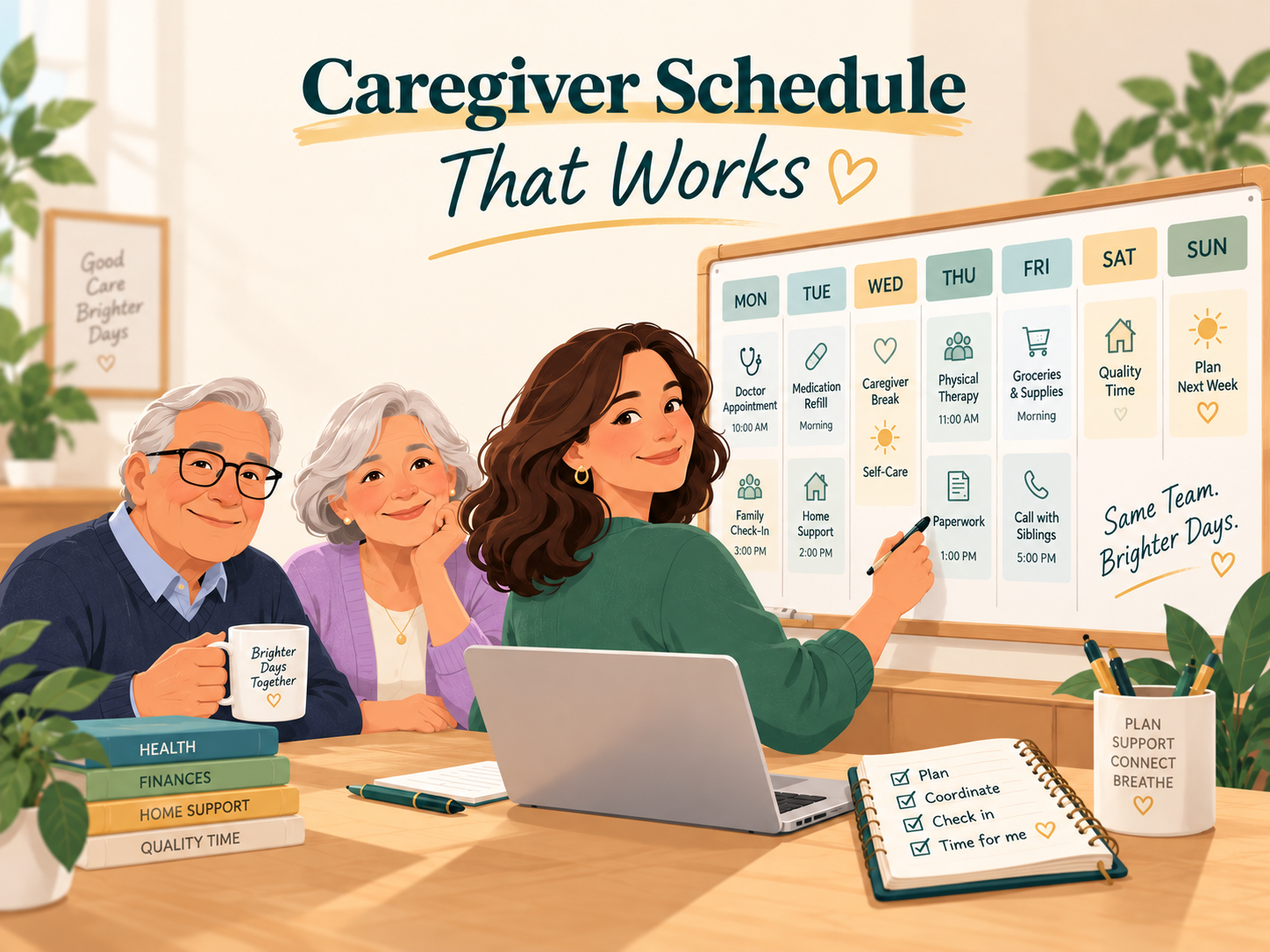
A caregiver schedule only works if the people on it have actually agreed to the tasks beside their names.
 Hi dear friends, 💛
Family caregiving often develops without anyone sitting down and officially deciding who does what.
One person starts driving to appointments.
Someone else picks up prescriptions.
A sibling calls every evening.
A neighbor occasionally helps with groceries.
And before long, there is a whole support system — but most of it lives in habits, text messages and assumptions.
That can work beautifully.
Until someone is sick, traveling, busy at work or simply thought another person was handling Tuesday.
A useful caregiver schedule does not need to control every hour.
It just needs to make recurring support visible:
what needs doing, who agreed to do it, when it happens, and who can help if the plan changes.
Start With Repeating Tasks
Do not begin with a giant calendar.
Begin with the things that happen again and again.
For example:
weekly grocery run
transportation to appointments
prescription pickup
meal support
household help
regular phone check-in
paperwork follow-up
pet care
a scheduled visit
community or paid services
The National Institute on Aging recommends identifying the care that is needed and then deciding who will be responsible for specific tasks. It also notes that caregiving arrangements may need to change as the older adult’s needs or family members’ availability change.
Your schedule should reflect real life now, not every task the family might possibly need one day.
Ask Before You Assign
This may be the most important rule in the whole schedule.
Availability is not commitment.
Your sister may work from home on Fridays.
That does not automatically mean she has agreed to drive Dad to every Friday appointment.
Your brother may live nearby.
That does not mean he has silently accepted every local errand.
Before a name goes beside a recurring task, ask.
A simple conversation is enough:
“Would you be able to handle the grocery run on Wednesdays for the next month?”
That creates something a calendar cannot create by itself:
an actual agreement.
NIA recommends discussing caregiving responsibilities with the older person and the people who will be involved, ideally during a calm period rather than in the middle of an emergency.
Give Each Task an Owner
Once someone agrees, make the responsibility visible.
A simple schedule could look like this:
MONDAY
Evening check-in — Anna
TUESDAY
Grocery order — Dad + Maria
WEDNESDAY
Prescription pickup — Alex
THURSDAY
No recurring task
FRIDAY
Household help — paid service
SUNDAY
Family update — Tamara
Notice that the schedule does not need to list every ordinary part of your parent’s day.
It focuses on support responsibilities.
That is the difference between a family coordination schedule and trying to manage another adult’s life minute by minute.
If you are still deciding which responsibilities deserve a place in your system, What to Track in a Caregiver Planner is a useful companion article.
Add a Backup Carefully
For important recurring tasks, add a backup when it makes sense.
For example:
Appointment transport
Primary: Maria
Backup: Alex
Weekly groceries
Primary: Dad orders online
Backup: Anna
Prescription pickup
Primary: Alex
Backup: pharmacy delivery, if already arranged
But the same rule applies:
a backup should know they are the backup.
Do not write someone’s name into the second column simply because you think they could probably help.
A backup is useful when there is a real understanding:
“If I cannot do this, are you okay being the person I contact first?”
NIA encourages families to consider who can occasionally step in and to divide responsibilities according to people’s abilities, location, interests and availability.
Keep Your Parent Involved
A caregiver schedule should not be created around an aging parent while everyone else decides what happens to their week.
Whenever possible, build it with them.
Ask:
Which tasks do you actually want help with?
Which things do you still prefer doing yourself?
Who are you comfortable asking for help?
Which days or routines work best for you?
Sometimes the best schedule has fewer family tasks because the older adult already has a system they prefer.
That is a success.
The goal is support, not maximum involvement.
NIA’s guidance on sharing responsibilities specifically recommends including the older person in conversations about what care is wanted and needed.

Don’t Confuse Coordination With Authority
One person may become the family coordinator simply because they are good with calendars.
That does not mean they automatically become the person who decides everything.
A schedule shows:
who agreed to handle a practical task.
It does not need to imply medical, legal or financial authority.
For example:
Call pharmacy about refill status — Maria
means Maria agreed to make the call.
It does not mean Maria decides whether the medication should change.
Keeping that distinction clear prevents a simple organizational tool from quietly taking on a role it was never meant to have.
Use One Weekly View
The easiest schedule is usually the one you can understand in ten seconds.
You might use:
a paper weekly grid
a shared digital calendar
a simple family spreadsheet
a caregiving app
a page in your family organizer
NIA notes that families may use a paper caregiving notebook, electronic tools or apps to divide duties, keep appointments and share updates, as long as the information is accessible to the people involved and kept current.
The technology matters much less than the habit.
Everyone should know:
where the schedule lives.
Add Tasks, Not Assumptions
Here is a small language trick that makes schedules clearer.
Instead of writing:
Maria — Mom
write:
Maria — Tuesday appointment transport
Instead of:
Alex — medications
write:
Alex — pick up prescriptions when notified
Instead of:
Susan — help
write:
Susan — Friday grocery delivery
Specific tasks reduce ambiguity.
They also make it easier for someone to say:
“I can do that.”
or:
“I can’t do that this week.”
without feeling as if they are accepting or rejecting the entire caregiving role.
Review the Schedule Weekly
A caregiver schedule should be easy to change.
At the end or beginning of the week, take five minutes.
Ask:
What is happening this week?
Did any appointment move?
Is anyone unavailable?
Does a backup need to step in?
Did a recurring task stop or change?
NIA recommends checking in regularly because both care needs and family availability can change over time.
You do not need a formal family meeting every Sunday.
A group text may be enough.
The important thing is that the calendar reflects reality.
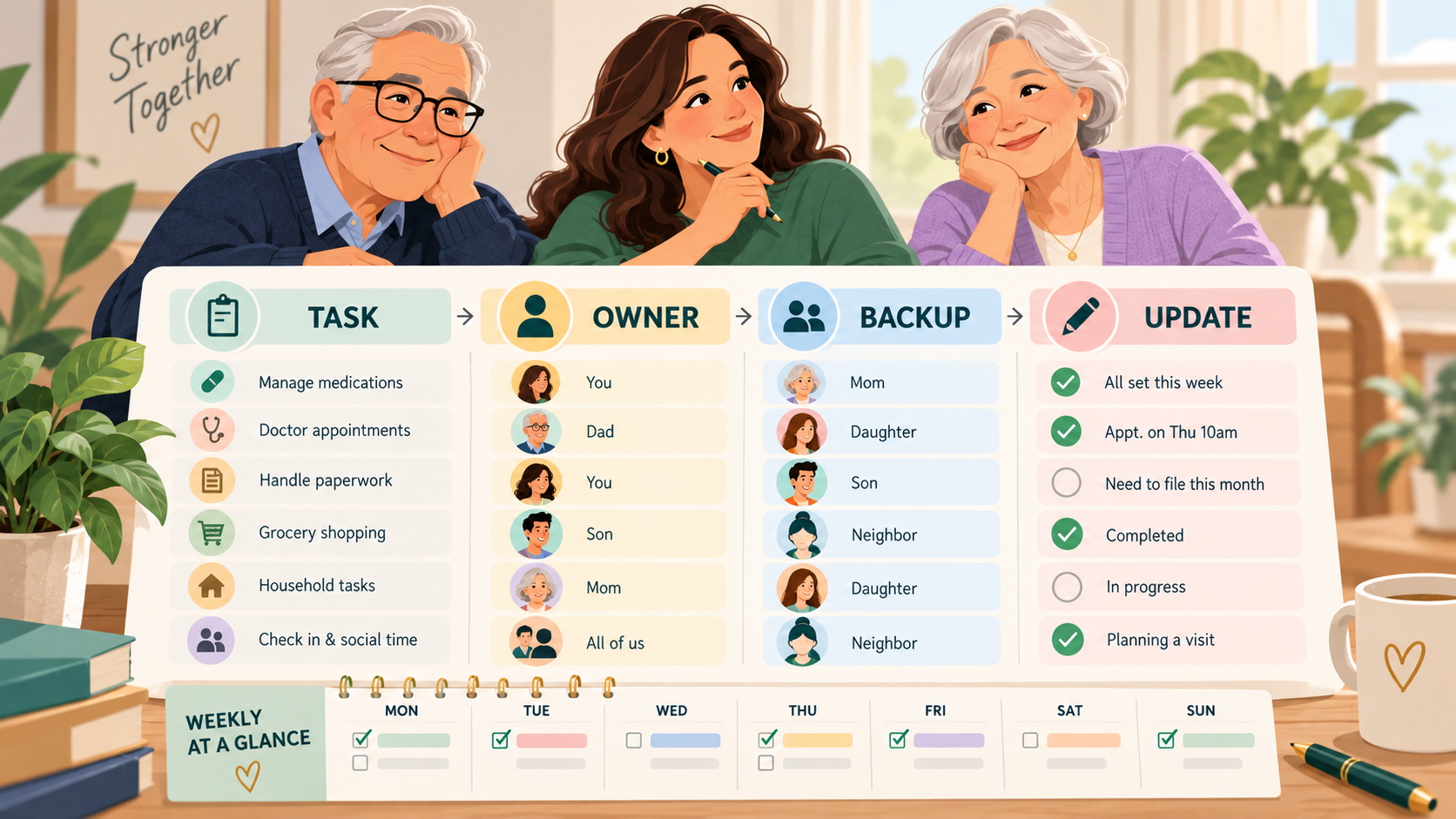
Use a Simple Four-Part Rule
If you want one easy framework, use this:
TASK → OWNER → BACKUP → UPDATE
TASK
What needs to happen?
OWNER
Who agreed to handle it?
BACKUP
Who agreed to be contacted if needed?
UPDATE
What changed this week?
That is enough for most recurring family support.
No elaborate project-management system required.
Connect Schedule and Follow-Up
A schedule tells you when something happens.
Your action list tells you what still needs finishing.
Those should work together.
For example:
Calendar:
Doctor visit — Tuesday, 10 AM — Maria driving
Action list afterward:
Schedule referral — Alex — by Friday
If appointments are one of the harder pieces to coordinate, my Doctor Appointment Checklist for Aging Parents explains the PREPARE → VISIT → ACT flow we use for turning the visit into clear next steps.
How I Organize This
Inside The Aging Parent Care System, the family-coordination section separates the weekly support schedule from the shared action list, role map and backup plan.
I did that deliberately.
A calendar answers:
Who is doing what this week?
An action list answers:
What still needs to get done?
A responsibility map answers:
Who usually handles this area?
A backup plan answers:
What happens when the usual person cannot do it?
Trying to squeeze all four jobs into one calendar usually creates more clutter, not more clarity.
A Schedule Should Reduce Guessing
The best caregiver schedule is not the busiest one.
It is the one that prevents questions like:
“Was I supposed to do that?”
“I thought you were taking her.”
“Who is calling the pharmacy?”
“What happens while you’re away?”
A clear schedule makes commitments visible without turning family care into a corporate operations meeting.
And it leaves room for something equally important:
people being daughters, sons, spouses, siblings and friends — not only task managers.
If your family already shares caregiving tasks, which recurring responsibility is the hardest one to keep covered when plans change? 💛
With warmth,
Tamara
Makeup of the Soul ✨