

Unlike other communist-bloc members, Belgrade successfully kept Moscow at bay.
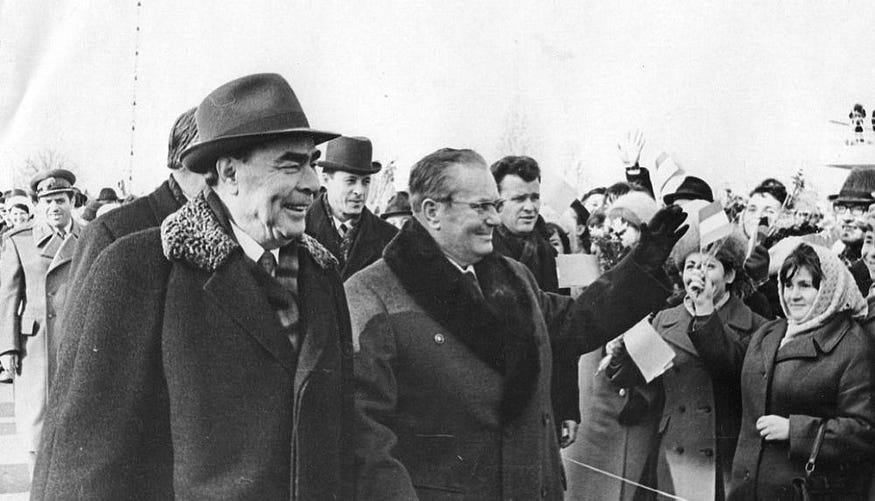 Brezhnev and Tito in Kyiv, 19 November 1973, Wikimedia Commons
The Soviet Union (full name: the Union of Soviet Socialist Republics) was known for its obsession with controlling its allies in the socialist/communist bloc. If a leftwing uprising happened somewhere, Moscow immediately offered assistance, if a communist coup was grabbing power, the Kremlin hurried to support the “revolution.”
Very often, uninvited.
Moscow’s involvement in communist movements and regimes was not confined to Eastern Europe. It also extended across Asia, Africa and Latin America, and took many forms. Financially, politically, economically, diplomatically, militarily, whatever needed to secure the spread of Marxist ideas and Moscow’s influence in new regions.
Just a few reminders in this regard: Greece during the 1946–49 civil war; China from the 1940s; Cuba after 1959; Vietnam from 1950; Angola from 1975; Ethiopia from 1974; Mozambique after independence in 1975; Afghanistan from 1978–79; Nicaragua after 1979; and Cambodia at some extent.
Moscow provided weapons, money, advisers and diplomatic support, sometimes directly and sometimes via its proxies.
 CLICK ON IMAGE TO OPEN THIS STORY
The same is valid when popular revolts attempted to relax the communist regime or demanded more rights and freedoms. When its influence was under threat or any events undermined Moscow’s leading role, or questioned the communist model, the Soviets stepped in brutally, with direct military intervention: Hungary in 1956; Czechoslovakia in 1968; Afghanistan in 1979.
Here I’d like to make an important remark. I used both “socialist” and “communist” terms. During the Cold War, these two words were often used interchangeably in political discourse, although they were not technically synonymous. Communist regimes generally described themselves as socialist states, with communism presented as the ultimate goal.
Since many capitalist countries today have extensive social-welfare systems, I want to avoid any confusion between that modern usage of “socialism” and the Soviet-style political system discussed here. Therefore, whenever I use “socialist” or “socialism” hereafter in the Cold War context, I am referring to the communist-era political system. Most European countries today have adopted social-democratic or welfare-state models to varying degrees. The Scandinavian countries are particularly well known for this — but they have never been communist states.
 CLICK ON IMAGE TO OPEN THIS STORY
So, this was the political setting after World War II — the world was split into two major blocs: the capitalist West and the Soviet-led communist coalition, while a number of countries in Africa, Asia and Latin America were struggling to find their own path. The choices they made attracted candy and praise from one camp, and thunder and lightning from the other camp.
And there was one particular country in Europe which embraced communist ideology after the war but refused to become part of the Warsaw Pact or Moscow’s circle of satellites.
Much to the displeasure of the Kremlin.
Yugoslavia.
When the Red Army advanced towards Germany in 1944, all countries in its way were forced to cede power to communist parties, forming pro-Soviet governments. In Yugoslavia, Moscow trusted Josip Broz “Tito”, commander of the Yugoslav People’s Army (also known as Yugoslav Partisans) and leader of the Yugoslav Communist Party, with governing the Serbia-dominated Balkan federation.
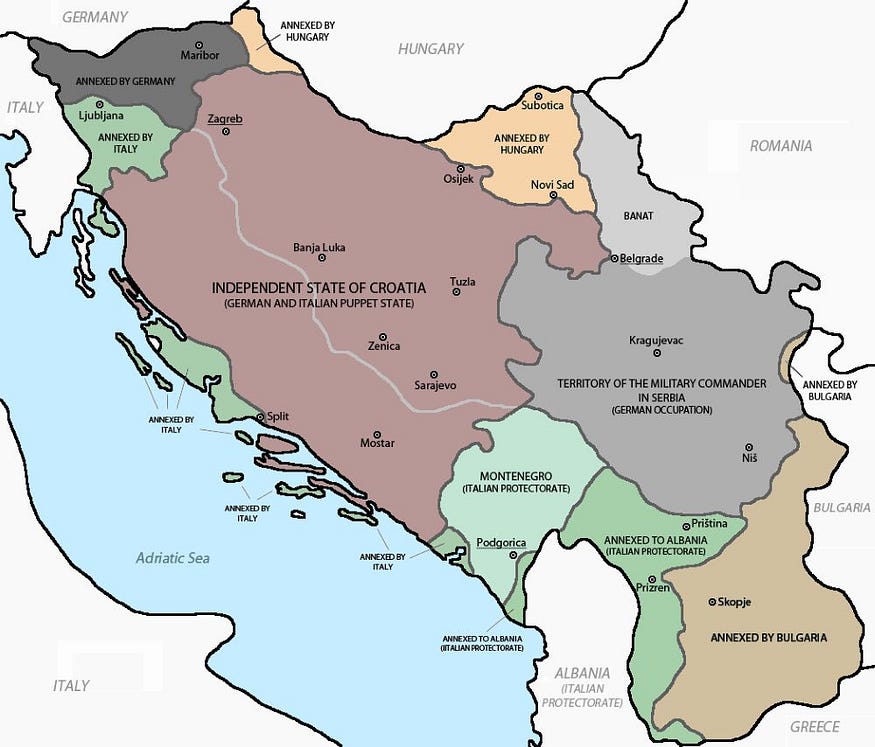
Yugoslavia in 1941.
Consistent with the agreement made with Tito, the Red Army did not maintain a long-term occupation. After the liberation of eastern Yugoslavia and the conclusion of their strategic objectives in the region, Soviet forces largely withdrew, leaving the Partisans to continue the fight for the rest of the country.
In 1948, however, Soviet dictator Joseph Stalin expelled Yugoslavia from the Cominform (short for Communist Information Bureau), a Soviet-led organization that coordinated the activities of European Communist parties from 1947 to 1956.
This was a response to Tito’s refusal to subordinate Yugoslavia to Moscow.
The Kremlin accused Tito and the Yugoslav Communist Party of “nationalist deviation” and betraying the Marxist-Leninist teachings. The dispute gradually evolved into a fundamental break: Yugoslavia remained communist, but pursued its own political and economic model and increasingly independent foreign policy.
After Yugoslavia’s expulsion, the Cominform’s headquarters was moved from Belgrade to Bucharest, Romania. Tito was elected prime minister (1945–1953) and president (1953–1980; being declared president for life in 1974). Yugoslavia became a federation of six republics:
Serbia (including two autonomous provinces: Vojvodina and Kosovo)
Croatia
Slovenia
Bosnia and Herzegovina
Macedonia (North Macedonia today)
Montenegro
Yugoslavia becomes a pariah
After Stalin’s death, relations between the two countries improved, but the underlying conflict over Yugoslav independence never completely disappeared.
By the mid-1960s, Marshall Tito moved Yugoslavia considerably away from the centralized Stalinist model of communism. Aleksandar Ranković, one of the most powerful centralizers in Yugoslavia and head of the security apparatus, was removed.
Afterward, Yugoslavia continued toward greater republican autonomy; economic decentralization; stronger self-management; weaker federal party control; greater political space within the communist system. It was slowly approaching democratic principles.
The system became more liberal and decentralized, but the Yugoslav federation also became increasingly dependent on Tito personally to arbitrate disputes among its republics.
A later U.S. assessment described the process as one in which the political and economic power had progressively shifted from the federal government toward the republics and regional institutions. That became crucial in Croatia later.
To be continued…
***
References and sources:
U.S. Department of State Office of the Historian, Intelligence Information Cable 229
https://history.state.gov/historicaldocuments/frus1969-76v29/d229
The U.S. Naval Institute, The Adriatic: Soviet Seaway Someday?
https://www.usni.org/magazines/proceedings/1972/august/adriatic-soviet-seaway-someday
Wilson Center, The Soviet intervention that never happened,
https://www.wilsoncenter.org/blog-post/the-soviet-intervention-never-happened
U.S. Department of State, The Kissinger Memorandum on Yugoslavia,
https://2001-2009.state.gov/documents/organization/97933.pdf?safe=1
Time Magazine, Crisis in Croatia,
https://time.com/archive/6839431/yugoslavia-crisis-in-croatia/
Courage archives, Information on student activities related to the 23rd plenary session of the Central Committee of the League of Croatia,
https://al.cultural-opposition.eu/registry/?lang=sq&type=masterpieces&uri=http%3A%2F%2Fcourage.btk.mta.hu%2Fcourage%2Findividual%2Fn45189
Britannica, The Brezhnev Doctrine,
https://www.britannica.com/event/Brezhnev-Doctrine#1
Seven Moments in Soviet History, Brezhnev Doctrine,
https://soviethistory.msu.edu/1968/crisis-in-czechoslovakia/crisis-in-czechoslovakia-texts/brezhnev-doctrine/#1