

Imagine.
In front of you lies a sea of greenery. Leaves of all different shapes and sizes surround you in a thick canopy. Above you, there’s a dense, translucent material coated in a reddish haze from the Martian dust outside.
You hear a faint buzzing.
Slowly, the sound grows louder, and you turn around to see a colony of robotic bees flying from flower to flower. One lands beside you, and you lean in to get a closer look. The robot is no bigger than your fingertip, with four powerful wings.
Its underside has several “legs” or stick-like structures covered in hair. You reach out and touch one to find it’s coated in a sticky material, almost like honey. The robobee turns to face you, and a small sensor extends from the top of its body so its internal AI can scan you. After a moment, it detects that you’re human and flies off, searching for its next flower.
At first, this scene was just a crazy idea in my head, but the more I learn about robobees, the easier it is to envision them being part of real life.
Over the past few months, I’ve obsessed over science articles, used new project-building tools, and built a website to share everything I discovered. It was all part of my Mastery Project at Inertia, where I was tasked with becoming smarter than ChatGPT in an industry I’m interested in (if you’re curious: I was declared smarter than ChatGPT after my final presentation and a Q&A session).
In this post, I’ll share my process—from choosing my topic to building a website and everything in between.
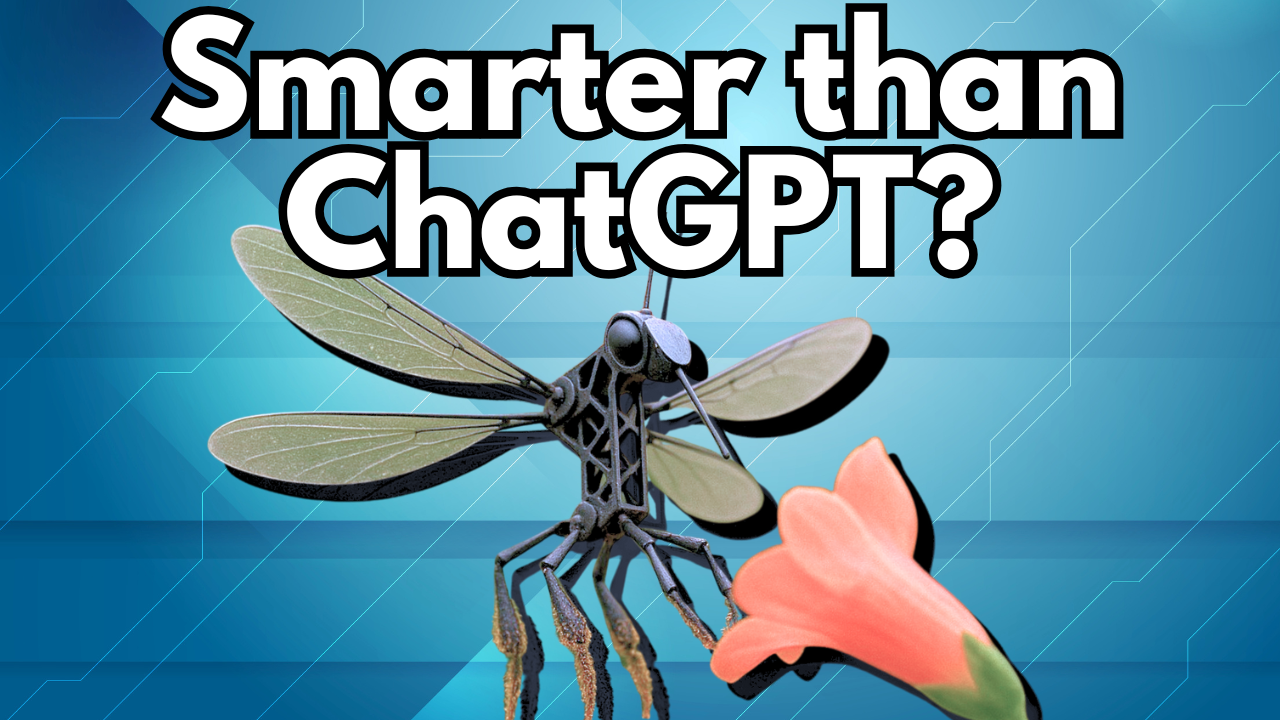
The Big Decision
In the beginning, there were three words haunting me: “choose a topic.” While this task might seem simple on the outside, with so many ideas to choose from, it quickly became overwhelming.
I started by looking at a list of broad industries (agriculture, biology, technology, engineering, etc.) and was able to narrow it down to my two favorites: biology and technology. However, I was unable to choose just one.
Then an idea struck me. I remembered how I’d recently emailed several people in the field of biorobotics requesting interviews (sadly, none replied), and I realized I didn’t have to choose just one industry—I could combine multiple!
After a few conversations with ChatGPT, I narrowed my focus to biotechnology. With each new prompt, my topic became more specific until I finally arrived at the question I wanted to answer in my presentation: “Are Robotic Bees the Gateway to Farming on Mars?” It stood out to me, and I was excited that it managed to combine so many of my interests into one question. I finally felt ready to get started!
Weird Experiments and Sticky Gels
My favorite step of this assignment was diving into the research. I played with ChatGPT’s “Deep Research” feature to help recommend articles for me to read on robobees. From there, I spent as much time as I could reading articles, crafting summaries, and compiling information.
My favorite article was from ScienceDirect, about a Japanese chemist named Dr. Eijiro Miyako, who invented a sticky gel that happened to be great for artificial pollination.
It was really entertaining watching Dr. Miyako’s toy drone attack lilies in an attempt to pollinate them. It was also amazing how thoroughly the researcher tested his hypothesis, from counting the individual pollen grains on ant legs to putting dots of sticky gel on fly heads. It was so precise and really hilarious!
Example of Dr. Miyako’s drone taking off and pollinating a lily (Credit: Dr. Eijiro Miyako and Science News)
It was also fun to read articles from different perspectives and compare opinions on the topic. For example, some articles focus on robotic bees' impacts on vertical farming on Earth, while others look at their potential for multiplanetary exploration. There are so many ways robobees could be used!
Fun Fact: According to the USDA, about 35% of the world’s crops depend on pollinators. With pollinator populations in decline, robobees not only have potential on other planets but could also play a key role as pollinators on Earth.
I dove deep, channeling my inner researcher toward questions like: “Why do we need robobees? What makes them important? How will they be developed? What research already exists, and where is there room for improvement?”
All this research and excitement reminded me of how I felt when I first learned about bubble-breathing lizards and the fascination that came from reading about them (I wrote about my findings on the lizards here).
I could’ve continued researching infinitely, but I had a deadline to meet, so I needed to begin constructing my website.
Fun Fact: Did you know robotic bees have already been tested on the International Space Station? In 2019, NASA sent up a group of free-flying robotic cubes called Astrobees that assist astronauts with routine tasks.
Building a Website Without Knowing Code
Building a website is easier than ever.
Years ago, when I started my business, Ringtailwear, and original blog site, a friend’s mom helped me get set up using Squarespace because I didn’t know how to code. Nowadays, you don’t have to know coding to build a website.
In class at Inertia, the students are introduced to a lot of AI website-building tools, such as v0.dev. This is what I used to craft a website for my robobee project (see my site here). It’s basically a compilation of the articles I’ve found and a place for people to go if they want to know more about robobees.
v0 is available for free, but you have a limited number of “credits” or prompts you’re able to use. I was really thankful that Inertia paid for a premium account for all the students so we didn’t have to worry about credits and could focus on the information.
For anyone who wants to craft their own site, here’s how to use v0:
Log in
Enter a prompt explaining what you want to build (an app, website, game, etc.)
The AI will code the site (typically takes 1–5 minutes)
Refine/problem-solve
Publish!
It’s so simple to use, and one of my favorite parts about v0 is that you can ask questions about how the code works or how to improve the site—and it does a great job of breaking it down into easily understandable information.
Smarter Than ChatGPT?
After reading about robobees and creating a website to share what I learned, the deadline for my presentation was approaching. I needed to write a script for a 5-minute presentation.
In between writing sessions, I had ChatGPT ask me questions to help bridge gaps in my knowledge.
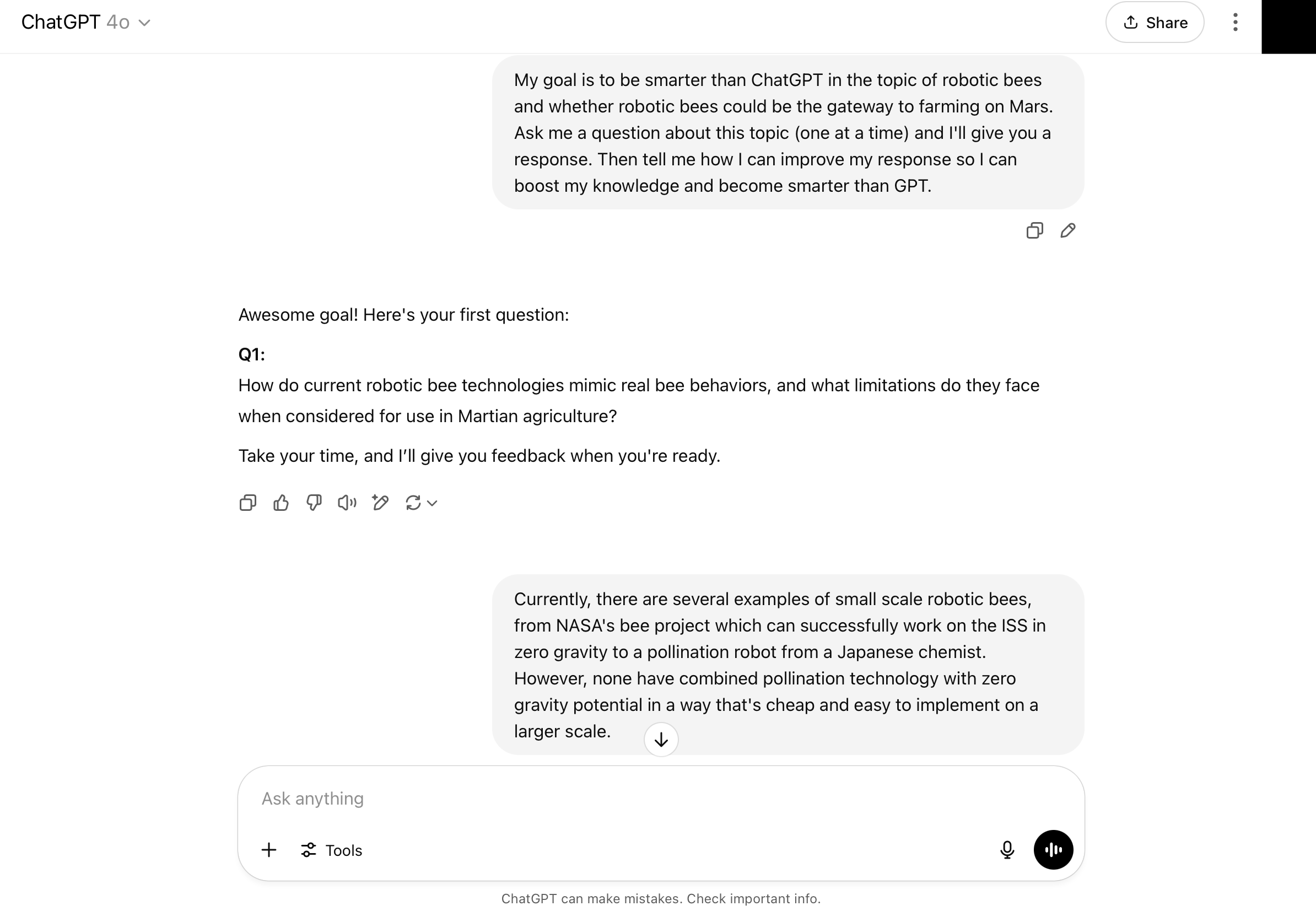
I spent a few days practicing my presentation, problem-solving technical difficulties with my slides, and prepping for the Q&A session with my class and a special guest who was invited to give feedback.
When it was finally my turn to present, I began to talk, slowly at first, then more confidently.
Once I finished speaking, I was asked a specific follow-up question to find out whether I knew my subject as well as or better than ChatGPT. I had no idea what the question would be, so my answer was entirely unscripted. As I gave my response, my teacher, Zain, put the same question into ChatGPT to compare answers. I answered correctly and even mentioned several of the same points as ChatGPT. Afterwards, it was decided that I passed the “Are you smarter than ChatGPT?” test!
It was so much fun presenting after working so hard to learn about robobees. I also enjoyed listening to my classmates’ presentations and seeing the topics they chose. It was a great learning experience.
My Takeaways
I didn’t just learn about robobees. I also learned how to find a topic I love, research it, present about it, and apply my knowledge to a project (in this case, a website).
It was exciting to explore the field of biotechnology, learn about robobees, and imagine ways they could impact the future. I want to learn more and interview people in this field. If you know anyone, send them my way.
Check out the website I built here to see the finished product.
If there’s a topic you’re interested in and want to learn more about, my advice is to follow your curiosity and see where it takes you! You never know what you might find.
Huge thanks to Zain and Inertia for the v0 subscription and for always making learning so fun! I’m excited to continue classes next semester!