

If you've ever slathered on SPF 50 and wondered whether you've just cancelled any chance of a tan — you're asking the right question. The short answer is yes, you can absolutely tan while wearing sunscreen. The longer answer is that SPF number, sunscreen type, and how you apply it all affect how quickly you build colour and whether you do it without burning.
This guide breaks down exactly how it works, which SPF levels let you tan, which sunscreens are worth buying for outdoor tanning, and what to use if you want colour without sun exposure at all.
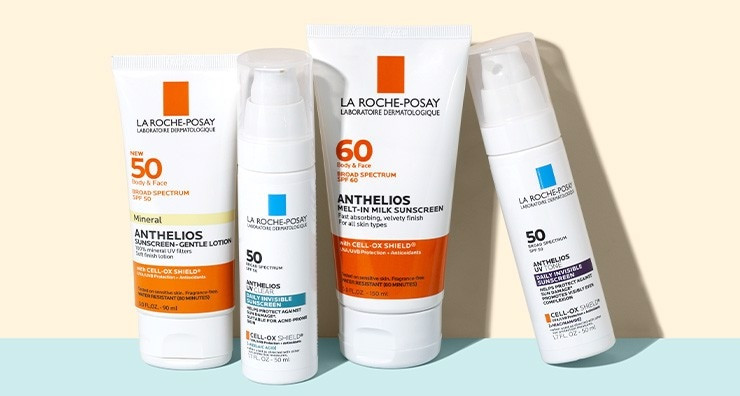
Does Sunscreen Stop You From Tanning?
No — but it does slow it down, which is the point.
Here's the science: tanning happens when ultraviolet radiation (UV) from the sun triggers melanin production in the skin. Melanin is the pigment that creates visible colour. UVB rays are the primary driver of both sunburn and the melanin production that causes a tan.
Sunscreen works by absorbing, reflecting, or scattering UV rays before they penetrate the skin. An SPF 30 sunscreen blocks approximately 97% of UVB rays. SPF 50 blocks around 98%. Neither blocks 100% — which means tanning is still possible under both, just slower and more controlled.
The difference between SPF 30 and no sunscreen isn't the absence of tanning — it's the difference between gradual colour and burning red before you can tan at all. Burning damages skin cells, triggers an inflammatory response, and actually interrupts the melanin production process. You're more likely to peel than to tan after a bad burn.
The practical upshot: wearing SPF 30 or above gives your melanin time to develop without the burn that short-circuits the process. For most people, a sunscreen tan is slower but more even and longer-lasting than a no-protection one.
What SPF Should You Use If You Want to Tan?
The dermatology consensus and the tanning community's preference don't fully agree here — so here's both positions honestly.
Dermatologist recommendation: SPF 30 minimum, reapplied every two hours. SPF 30 provides enough protection to prevent significant skin damage while still allowing gradual melanin development. This is the standard recommendation from the American Academy of Dermatology.
What actual tanners use: Many experienced tanners use SPF 8 to SPF 15 when they want faster colour, accepting higher burn risk. Products like Coppertone's SPF 8 tanning lotion exist specifically for this market. The risk calculus is higher — lower SPF means more UV penetrates, faster colour, but also more cumulative DNA damage and higher long-term skin cancer risk.
The honest middle ground: SPF 15 to SPF 30 is where most people land for tanning sessions. SPF 15 blocks about 93% of UVB rays, meaning 7% still reach your skin — enough to stimulate melanin production for a tan. Many dermatologists recommend SPF 15 to SPF 30 for safe tanning because it provides protection while allowing gradual colour development.
What SPF you choose is ultimately a personal risk decision. The information below helps you make it with accurate context rather than guesswork.
The 4 Best Sunscreens for Tanning on Amazon
These four products cover the range from protective-but-tan-friendly SPF 30 to accelerator-style lower SPF options — all with strong Amazon ratings and real-use track records.
1. Australian Gold Botanical SPF 30 Spray Gel — Best Overall
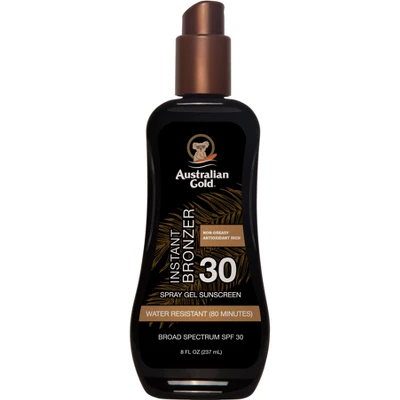
Best for: everyday outdoor tanning, broad protection, all skin types
Australian Gold has been the go-to brand for tanning-focused sun care for decades, and the Botanical SPF 30 Spray Gel is the product that earns its reputation. It's formulated specifically for people who want both protection and colour — SPF 30 broad-spectrum coverage with a lightweight gel formula that absorbs without leaving a greasy film.
What stands out is the instant bronzer component in some formulations — it gives a temporary colour hit immediately on application so you can see where you've applied while the real tan builds underneath over subsequent sessions. The botanical formula includes antioxidants from plant extracts rather than a purely chemical base, and it's water resistant for up to 80 minutes.
Australian Gold's Spray Gel scored highly for its perfect balance of instant gratification and serious protection — the instant bronzer gives a sun-kissed look immediately while SPF 30 ensures you can enjoy longer tanning sessions safely.
The verdict: The most balanced sunscreen-for-tanning option on the market — serious SPF protection that doesn't compromise on colour results.
👉 Australian Gold Botanical SPF 30 Tanning Spray Gel — Amazon
2. Coppertone Sunscreen Tanning Lotion SPF 8 — Best for Faster Colour
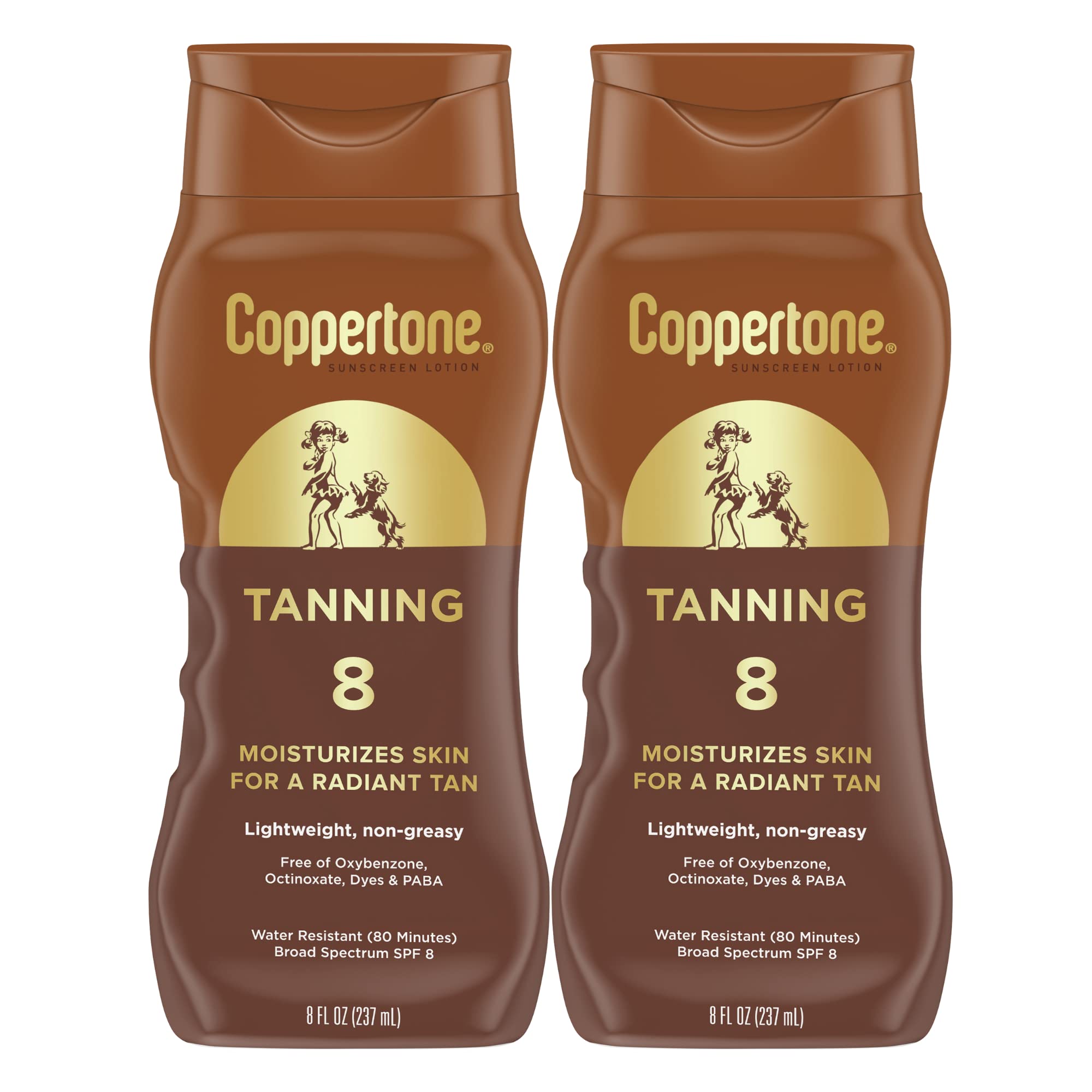
Best for: experienced tanners who want faster colour, lower-protection sessions, warm climates
Coppertone's SPF 8 tanning lotion is the classic choice for tanners who prioritise colour speed over maximum protection. Coppertone's SPF 8 Lotion is a lightweight, non-greasy sunscreen that is water resistant and oxybenzone free, and moisturizes skin for a radiant tan.
SPF 8 blocks roughly 87% of UVB rays — enough to extend your time in the sun before burning, but significantly lower protection than SPF 30. This is the right product for people who've built up some base colour and want to deepen it, not for fair-skinned first-session tanners.
The lotion formula applies evenly, absorbs without streaking, and the moisturising base means it works as a skin conditioner during and after exposure. For beach or pool sessions where you're also swimming, the water resistance matters.
Important note: this is a sun protection product, not a tanning accelerator. It does not speed up tanning compared to higher SPF — it simply removes less of the UV that reaches your skin. The faster colour versus SPF 30 comes from more UV exposure, not from an active ingredient.
The verdict: The budget-friendly tanning session lotion for experienced tanners who understand the SPF trade-off and want a reliable, widely-available option.
👉 Coppertone SPF 8 Sunscreen Tanning Lotion — Amazon
3. Banana Boat Deep Tanning Oil Spray SPF 4 — Best Tanning Oil with SPF
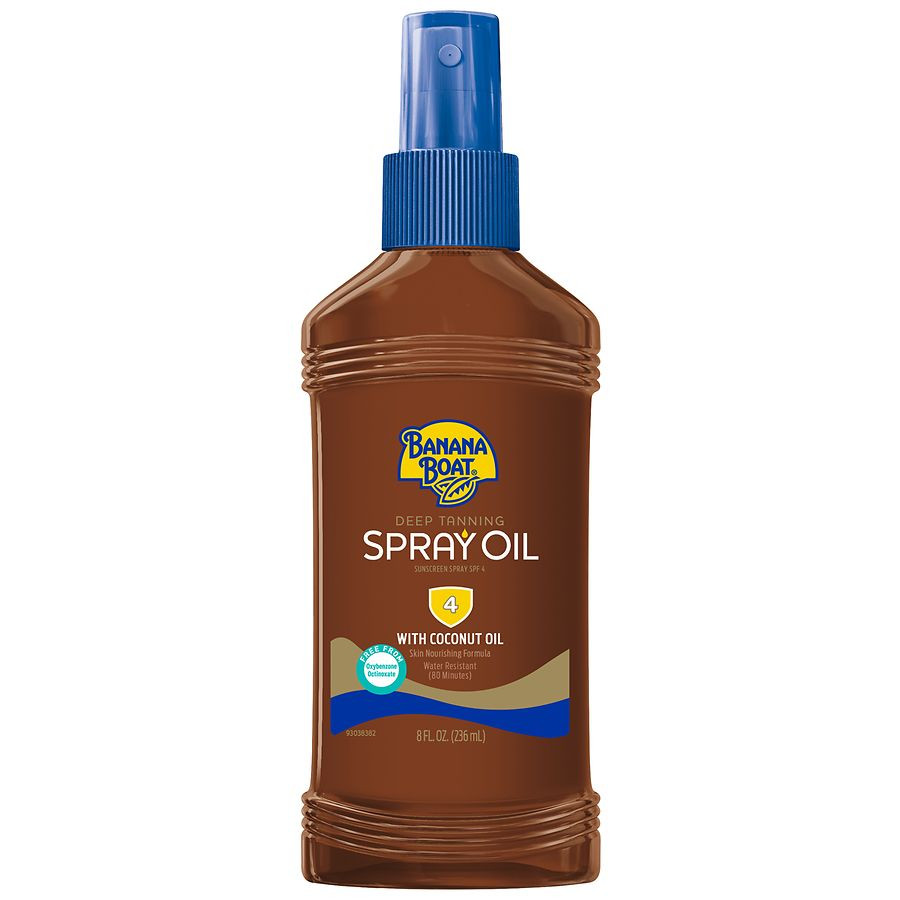
Best for: deep tan seekers, experienced tanners only, warm-weather outdoor use
Banana Boat's Deep Tanning Oil Spray is the tanning oil answer for anyone who wants the texture and application experience of an oil with at least some SPF coverage. Banana Boat Deep Tanning Oil Spray SPF 4 is a dark tanning oil that is water resistant, available as a twin pack.
SPF 4 is minimal protection — it blocks roughly 75% of UVB rays, which means 25% reaches your skin. This product is for people who know exactly what they're doing with sun exposure and have enough base colour to handle it. For pale or fair-skinned people, or anyone in very high UV environments, SPF 4 is not adequate protection.
What the oil formula does differently from a lotion: it spreads more evenly over the skin, penetrates faster without requiring rubbing in, and leaves a slight sheen that shows as a healthy glow both before and after tanning. The tropical scent is a genuine sensory experience.
Apply in the direction of the spray, use minimal pressure to avoid patchiness, and reapply every hour in direct sun rather than the standard two-hour interval given the low SPF.
The verdict: The classic tanning oil option for experienced outdoor tanners who want depth and speed — with the minimum protection that responsible labelling allows.
👉 Banana Boat Deep Tanning Oil Spray SPF 4 — Amazon
4. Coco & Eve Tan Boosting Anti-Aging Body Oil SPF 20 — Best Premium Option
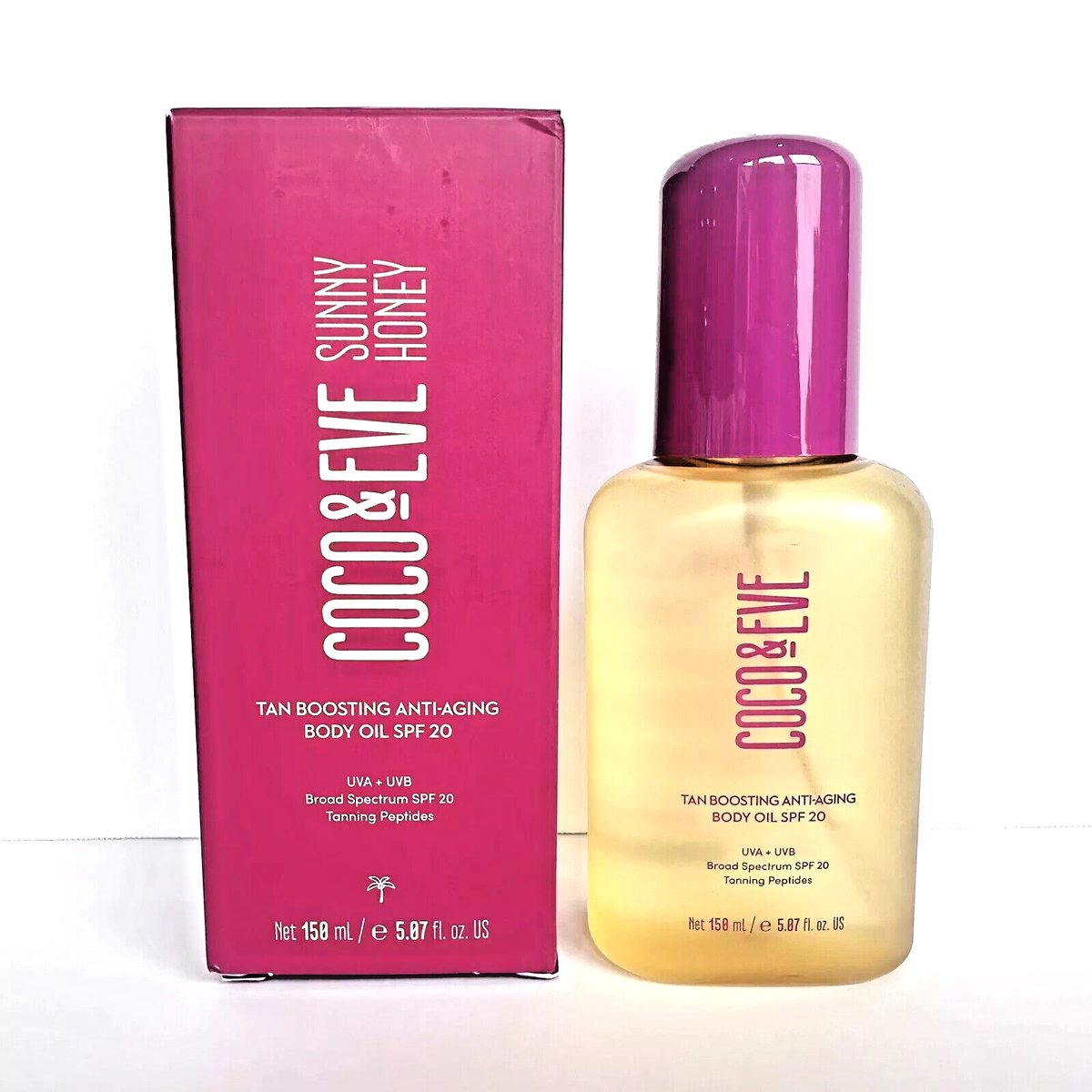
Best for: anti-aging conscious tanners, those wanting SPF with tanning acceleration, premium skincare approach
Coco & Eve's tanning body oil is the premium tier for people who want sun protection, tanning enhancement, and anti-aging skincare working simultaneously. Coco & Eve's Tan Boosting Anti-Aging Body Oil SPF 20 is a tanning accelerator spray with UVA/UVB sun protection and a moisturizing outdoor bronzing enhancer with natural ingredients and antioxidants.
SPF 20 sits in a practical middle ground — blocking about 95% of UVB rays, which is meaningfully more protection than SPF 8 or SPF 4 while still allowing enough UV through for real colour development. The tan-boosting formula is the differentiator here: it contains ingredients designed to support the skin's melanin production process, not just allow UV through.
The anti-aging positioning reflects the fact that this product is formulated with antioxidants that help counteract the oxidative stress that UV exposure causes. The oil texture is luxurious and the scent is notably better than most SPF products.
The verdict: The sunscreen for people who want to tan but also care about long-term skin quality — higher end than the Coppertone or Banana Boat but a more complete formula.
👉 Coco & Eve Tan Boosting Anti-Aging Body Oil SPF 20 — Amazon
SPF Quick-Reference: How Much UV Gets Through?
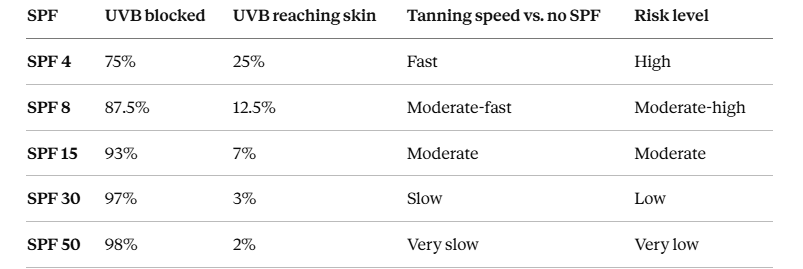
The gap between SPF 30 and SPF 50 in UV protection is only 1% — but the gap between SPF 8 and SPF 30 is 9.5% of UVB reaching skin versus 3%. That's a meaningful difference in both tanning speed and skin damage accumulation over time.
Does Sunscreen Type Affect Tanning?
Yes — the formula matters beyond just the SPF number.
Chemical vs. mineral sunscreen
Chemical sunscreens (common active ingredients: avobenzone, oxybenzone, octocrylene) absorb UV radiation and convert it to heat. Mineral sunscreens (zinc oxide, titanium dioxide) physically reflect UV away from the skin.
For tanning purposes: mineral sunscreens at the same SPF tend to block slightly more UV than chemical ones because of how physical reflection works. If tanning speed matters to you and you're choosing between an SPF 30 chemical and an SPF 30 mineral, the chemical formulation will typically allow marginally more UV through.
The practical difference is small. More relevant for most people is the white cast issue: mineral sunscreens, particularly at higher concentrations of zinc oxide, leave a white or grey tint on skin. For deeper skin tones this is visible and unflattering. Tinted mineral sunscreens (like CeraVe's Hydrating Mineral Sunscreen SPF 30 with Sheer Tint) solve this for the face, but body mineral sunscreens are harder to find without cast.
Water resistance
Tanning typically involves water — pools, beaches, sweating in the sun. All four products above are water resistant, but water resistance ratings (40 minutes vs. 80 minutes) tell you when to reapply, not whether to skip it. Reapplication after swimming or sweating is non-negotiable regardless of the original rating.
Tanning oils vs. tanning lotions
Tanning oils typically have lower SPF levels or none at all, focusing on intensifying UV penetration for faster tanning, while tanning lotions offer more balanced protection with moisturising benefits. Oil formulas spread more evenly and give a better sensory experience in sun; lotion formulas tend to be more stable on skin in heat and provide better moisturisation. Neither is superior for protection — SPF number determines that.
Can You Use Fake Tan Sunscreen? (Sunscreen on Top of Fake Tan)
This is a related question that gets a lot of confused answers.
If you're wearing a sunless self-tanner (DHA-based products like St. Tropez or Jergens Natural Glow) and then go outdoors, you still need real sunscreen on top. Self-tan products do not provide any SPF protection whatsoever — the colour they create comes from a chemical reaction with dead skin cells, not from melanin. Your skin under a self-tan is just as vulnerable to UV as uncoloured skin.
Apply your self-tanner the night before or the morning of. Apply a full SPF product on top before going outside. The two products do not interfere with each other meaningfully — SPF sits on top of the skin surface and self-tan reacts at the dead skin layer. Some users find that very high SPF chemical sunscreens applied on top of fresh self-tan can slightly affect the colour development if applied immediately after, but waiting 8+ hours between self-tanner application and sunscreen resolves this.
For people wearing self-tan who are also in the sun: SPF 30 minimum. The self-tan colour provides no protection and can create a false sense of security.
How to Get the Best Tan While Wearing Sunscreen
The methodology matters as much as the product.
Apply correctly. Most people apply too little sunscreen, which means the actual SPF delivered is a fraction of what's on the label. The standard is 1 ounce (roughly a shot glass) for full body coverage. Apply 15 to 30 minutes before sun exposure — this gives chemical sunscreen time to absorb and activate.
Reapply every two hours. The key is consistency — apply regularly and give your skin time to build colour without burning. Reapplication is crucial for maintaining protection and even tanning. Apply every two hours, and immediately after swimming, sweating, or towel drying. Even water-resistant formulas lose effectiveness over time, and missing spots can lead to uneven colour or burns.
Build gradually. A 20-minute first session is more effective than a two-hour first session. Melanin production is a cumulative process — repeated shorter exposures over multiple days build a more even, lasting tan than single marathon sessions that risk burning.
Exfoliate before tanning. Dead skin cells scatter UV unevenly and cause patchy colour. Exfoliating the day before your first sun session removes the uneven surface layer and gives melanin a uniform canvas to develop in.
Moisturise after. Post-sun moisturisation extends the life of a tan by slowing the turnover of the upper skin layer. Aloe-based after-sun products are particularly effective because aloe calms UV-induced inflammation while hydrating.
Frequently Asked Questions About Tanning with Sunscreen
Can you tan through SPF 50? Yes, but very slowly. SPF 50 allows approximately 2% of UVB rays through — enough for melanin production over extended sun sessions, but not enough for fast colour development. Most people who use SPF 50 for sunburn protection won't build noticeable tan colour in a single session.
Does higher SPF mean no tan? No. Any SPF below 100 allows some UV through, and no commercial sunscreen is rated above SPF 100 (which still only blocks 99%). The higher the SPF, the more gradual the colour development — but blocking tanning entirely would require blocking all UV, which no topical product does.
Is it better to tan with chemical or mineral sunscreen? For tanning specifically, chemical sunscreen at the same SPF will allow slightly more UV through because reflection (mineral) is more complete than conversion to heat (chemical). In practice the difference is minor. More important is choosing an SPF appropriate to your skin type and the UV index of your location.
Can I put sunscreen on over a fake tan? Yes, and you should. Self-tan products provide zero SPF protection. Any outdoor activity while wearing a fake tan requires separate SPF applied on top.
What SPF is best for fair skin? SPF 30 minimum, reapplied every two hours. Fair skin types (Fitzpatrick I and II) burn quickly and produce melanin slowly — higher SPF and shorter initial sessions are both advisable. SPF 30 allows gradual colour development safely; lower SPF on fair skin is a burn risk within 20-30 minutes in peak summer UV conditions.
Does SPF 30 or SPF 50 affect tanning speed that much? The difference in UV-blocking between SPF 30 (97%) and SPF 50 (98%) is only 1% — so practically, no. If you're choosing between SPF 30 and SPF 50, the tanning speed difference is negligible. Where SPF matters meaningfully for tanning speed is in the jump from SPF 8 to SPF 30.
The Bottom Line
SPF does not stop you from tanning — it makes you tan more slowly and safely. The right SPF for tanning depends on your skin type, your tolerance for burn risk, and how quickly you want colour to develop.
For most people, SPF 15 to SPF 30 is the practical range for outdoor tanning sessions: enough protection to prevent burning, low enough SPF to allow gradual colour over multiple sessions.
The four products above cover the range:
Australian Gold SPF 30 for the safest broad-protection option that still produces real colour
Coppertone SPF 8 for faster colour in people with established base tans
Banana Boat Tanning Oil SPF 4 for the traditional oil experience with minimal protection
Coco & Eve SPF 20 for the premium tanning-with-skincare approach
Whatever you choose, the SPF number is secondary to actually wearing it, applying enough of it, and reapplying consistently. The best tanning sunscreen is the one you use correctly.
More Sun Care Guides
👉 Best Vegan & Reef-Safe Suntan Lotions — Ranked
👉 Best Self Tanner for Every Skin Tone — Tested & Ranked
👉 Best Indoor Tanning Lotion for Tanning Beds — 2026 Guide
Affiliate disclaimer: Some links in this article are Amazon affiliate links using the tag ziilaa-20. If you make a purchase through them, I may earn a small commission at no additional cost to you.