


Series Introduction In the first two articles of this series, we explored how Goal Trees and TameFlow Kanban help improve decision-making and manage knowledge work in New Product Introduction (NPI). In this third installment, we explore a vital but often overlooked aspect of NPI: logistics, specifically the management of lab space and critical stock like RF components. We will demonstrate how TOC principles, particularly risk mitigation, can streamline operations, reduce costs, and optimize time to market.
This article is part of a series that applies TOC to different facets of NPI, including:
Strategic Alignment and Decision-Making using Goal Trees (previous article)
Managing Knowledge Work with TameFlow Kanban (previous article)
Optimizing Time to Market with TOC Centralized Logistics (this article)
Project Management using Critical Chain Project Management (CCPM)

Disclaimer
The views, opinions, and insights expressed in this article series are my own and do not reflect the official policies or strategies of my employer, Marvell Technology Italia, srl. This content is provided for educational purposes based on personal experience and research. Any references to companies, products, or individuals are not endorsements.

The Logistics Challenge in NPI: Space, Stock, and Time-to-Market
Logistics is often an underappreciated but critical component in semiconductor labs. Efficiently managing lab space and stock for expensive and scarce components like wideband RF couplers, attenuators, cables, baluns, or instruments often with greater than 50GHz bandwidth can make or break project timelines. Labs are not only spaces for testing and measurement but also house inventories of high-cost, low-availability equipment. The challenge lies in balancing the need for immediate availability of components with the cost and space constraints of storing them.
At the heart of this issue is a conflict between two essential but opposing objectives:
Maximizing availability – to avoid delays by having all necessary components on hand.
Minimizing cost – by reducing excess stock and optimizing the use of lab space.
This conflict creates a classic TOC dilemma, which is addressed through TOC’s conflict cloud tool. By centralizing logistics, we can reduce the need for local stockpiles while maintaining or improving availability.
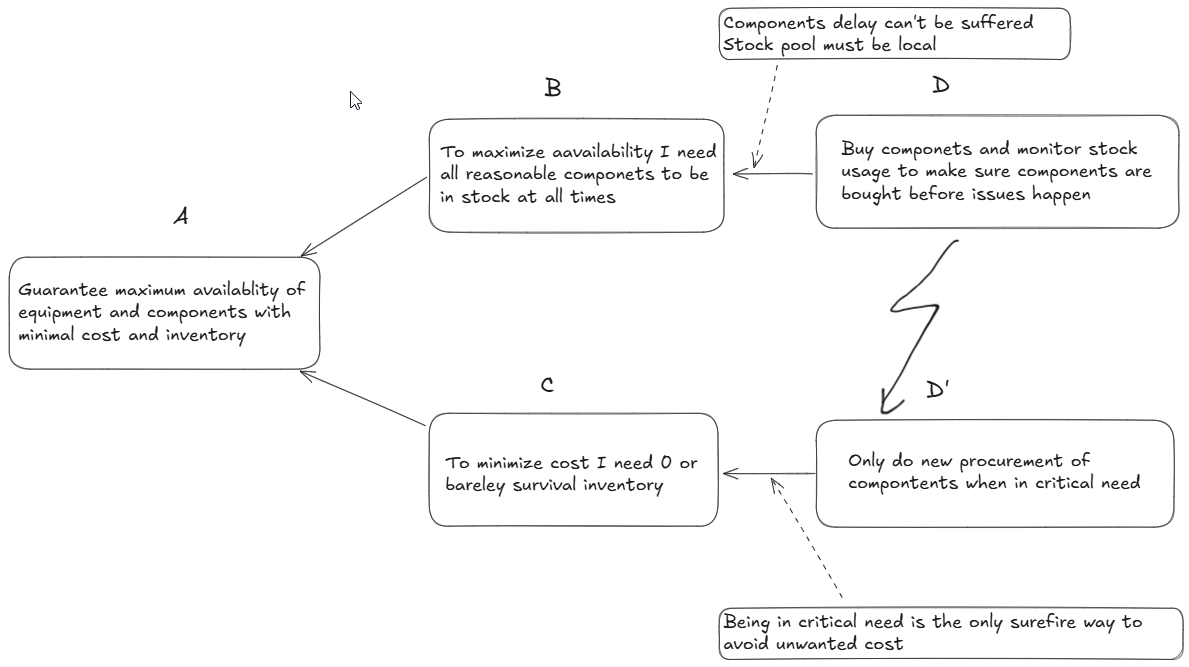
In the above exemplifed clould, all 3 assumptions can be challenged.
Component delay can be tolerated if it does not jeopardize the final project date. A project buffer can measure the schedule risk added, allowing informed decisions.
Stock pool does not need to be strictly “local” if logistics are fast and reliable. With today’s shipping capabilities, delivering worldwide in less than 48 hours is achievable, minimizing the need for strict local pools.
Being cost-sensitive doesn’t mean avoiding stock. Without considering the “cost of delay,” we can’t assess whether delayed project delivery is truly “cost-free.” In my experience, delay costs often exceed the cost of a reasonably sized protection pool.
This scenario parallels Goldratt’s "Isn’t It Obvious?" where a retail shop faces the dilemma of dedicating floor space to “stocks” or “display,” with the breakthrough solution achieved through centralized logistics. Amazon applies a similar model on a massive scale, centralizing stock in warehouses instead of spreading inventory across multiple retail locations.
Applying TOC to Centralized Logistics
TOC teaches us that improving overall system performance requires identifying and addressing constraints. In the case of semiconductor labs, the logistical constraint is often the availability of crucial components. A delayed project due to the lack of a single RF coupler can result in cascading delays, increasing project risk and pushing back time-to-market.
Risk Mitigation through Centralized Stock Management
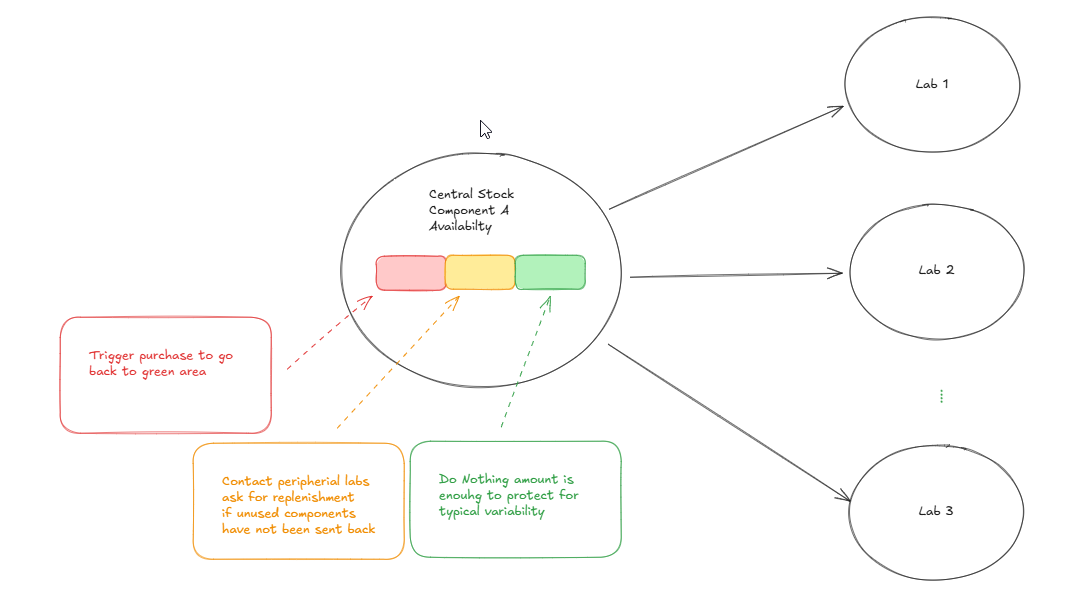
Centralized logistics provides a breakthrough solution to the availability versus cost conflict. By pooling inventory across multiple labs, the total stock required is reduced while still ensuring critical components are always available. This system operates on replenishment principles, with centralized stock maintaining optimal levels. When a component falls below a threshold, parts from peripheral labs may be collected first, followed by a single purchase if the safety stock level remains unmet.
How big each component stock need to be is governed by the serving time of each component. A typical lead time in the industry is 8 - 12 weeks, so the central stock must be capable of serving the typical needs of the peripheral labs in this timeframe and monitor the average and peak consumption in the last 24 to 52 weeks to keep the stock aligned with the varying trends.
Key TOC principles applied here include:
Buffer Management: Rather than overstocking each lab, a central stock serves as a buffer for all labs. The buffer size is dynamically adjusted based on demand and usage trends, mitigating the risk of stockouts without requiring overinvestment in inventory.
Throughput Optimization: The goal is to ensure uninterrupted project flow. Stockouts of RF components disrupt not just one project but often several, delaying throughput and increasing overall costs.
Focused Inventory Management: By identifying the critical components that are bottlenecks (constraints) in lab work, the central stock focuses only on what truly matters, ensuring lean but effective inventory.
For high-end equipment with costs exceeding hundreds of thousands of dollars, instrument rental can extend this approach further. In this case, rental companies like ElectroRent or TRSRenTelco act as central stock managers, ensuring availability without the financial strain of purchasing equipment that may sit unused for months.
The Thales Case Study: A Centralized Approach to Logistics
Thales Group in France offers a practical example of how centralized logistics can transform operations. Faced with managing logistics for aerospace, defense, and space sectors, Thales partnered with logistics providers like GEODIS and Bolloré Logistics to implement a centralized supply chain model.
By consolidating logistics into central hubs, Thales streamlined storage, ordering, quality control, and delivery processes. High-cost, high-demand components became available without each site needing large inventories.
Key Results from Thales’ Centralized Logistics Approach:
Cost Reductions: Thales achieved significant savings by eliminating redundant stock. By centralizing inventory, they reduced last-minute purchases and optimized stock levels.
Increased Availability: Centralized stock enabled timely access to critical components. Automatic replenishment reduced downtime due to stockouts.
Faster Time to Market: A more efficient logistics flow minimized production and testing delays, a key advantage in industries with tight project timelines.
This case underscores how centralized logistics can resolve the availability-cost conflict, providing a scalable solution that balances these goals.
Conclusion and Final Thoughts
By adopting TOC and centralized logistics, organizations can reduce logistical bottlenecks, creating systems that enhance both project speed and cost-efficiency. TOC principles such as buffer management and risk mitigation offer solutions for the conflicting goals of availability and cost.
Key Takeaways:
Focus on Mitigating Delays: Reducing wait times achieves significant throughput gains.
Centralized Stock Management: Replenishment and buffer management provide stock stability, minimizing disruption.
Full Kitting and Cost Analysis: Assessing delay costs can reveal the true value of maintaining essential stocks.
Data-Driven Replenishment: Monitoring trends ensures stock aligns with demand fluctuations.
Visual Management: Transparency across teams reveals bottlenecks, enabling proactive collaboration to resolve logistics issue before impacting projects timelines.
Enjoyed the content?
If you found this article useful, consider supporting my work with a coffee or exploring the downloadable examples available on my Buy Me a Coffee page. Your support helps keep the motivation high and fuels more hands-on content!

Bibliography
Goldratt, Eliyahu M. Isn’t It Obvious? North River Press, 2009.
This TOC-focused novel explores inventory management and logistics challenges through the lens of a retail business, illustrating the principles of centralized logistics and buffer management.
Link to book on Amazon
Goldratt, Eliyahu M. The Goal: A Process of Ongoing Improvement. North River Press, 1984.
The foundational TOC work that introduces the Theory of Constraints, focusing on bottleneck identification and throughput. Although manufacturing-centric, its core principles apply broadly to knowledge work and logistics.
Link to book on Amazon
Goldratt, Eliyahu M. The Haystack Syndrome: Sifting Information Out of the Data Ocean. North River Press, 1990.
This book addresses TOC’s application to information management and decision-making in complex systems, highlighting the importance of information flow in logistics.
Link to book on Amazon
Schragenheim, Eli, and Henry Fitzhugh Camp. Manufacturing at Warp Speed: Optimizing Supply Chain Financial Performance. CRC Press, 2000.
A detailed look at how TOC applies to supply chain and logistics, with focus on buffer management, financial metrics, and practical applications in inventory management.
Link to book on Amazon
Dettmer, H. William. The Logical Thinking Process: A Systems Approach to Complex Problem Solving. ASQ Quality Press, 2007.
This comprehensive guide to TOC’s logical thinking tools aids in problem-solving, valuable for understanding the foundational principles of constraint management in logistics.
Link to book on Amazon
Thales Group Logistics Overview. Thales Group.
An overview of Thales Group's approach to centralized logistics, particularly in their aerospace and defense sectors, where they apply TOC principles to streamline inventory and reduce project delays.
Link to Thales Group websiteMethod to Improve Project Logistics: “The case of Thales Italia”
.